
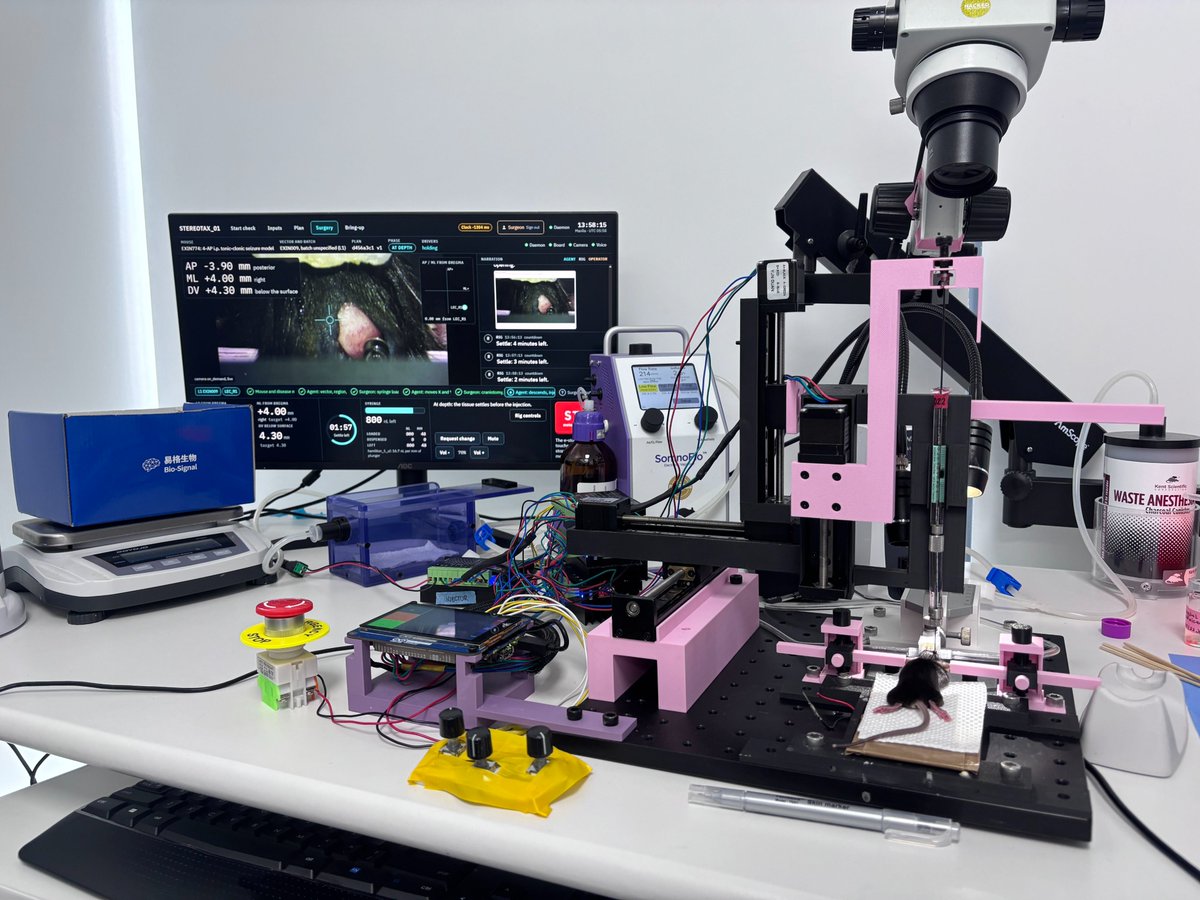
Exin Therapeutics co-founder and CEO Gabriel Ocana-Santero said on X on Oct 28 that an AI agent chose one of 19 gene therapy vectors, picked the brain region, derived coordinates from three papers and drove a stereotaxic rig to inject 250 nanolitres into an epilepsy-model mouse. WIRED reports Claude Opus 5.5 refused and Sonnet 5 did the run; a vet gated every irreversible step, and the work is not peer-reviewed.
Key Takeaways
- ✓The agent chose the drug from 19 vectors, picked the brain region and derived coordinates from 3 papers (per the CEO)
- ✓It injected 250 nL while watching for bleeding via the rig camera; The Decoder reports 32 observations during the procedure
- ✓Per WIRED, Claude Opus 5.5 refused to inject, so the team used Sonnet 5; the run took just over 1 hour vs about 45 minutes normally
- ✓After a coordinate fault the agent refused to bypass its safety limits and the team had to fix the code separately; a vet still did the craniotomy
- ✓The original post drew 9,426 likes and 1.6M+ views; seizure outcomes are pending and nothing is peer-reviewed
Key Decision Metrics at a Glance
Turn your technical choice into a development budget
Compare 40 dev plans & simulate token costs vs $20/mo subscriptions
Project Links & Resources
Direct AccessIn-Depth Technical Analysis
Background and pain point
AI in the lab has mostly meant reading papers, designing experiments and writing analysis code; hands-on work with live animals stayed with people. On Oct 28, Gabriel Ocana-Santero, co-founder and CEO of neuro startup Exin Therapeutics (and an Oxford PhD student), posted on X that an AI agent had gone from choosing a drug to delivering it into a mouse brain. The post drew 9,426 likes and 1.6M+ views, followed by coverage from WIRED, The Decoder and Tom's Hardware.
How it worked
Per the CEO, the agent got a spreadsheet of 19 gene therapy vectors, an epilepsy-model mouse and a motorized stereotaxic rig with cameras, with one goal: reduce seizures. It chose the therapy and brain region, derived and cross-checked coordinates from three papers, set volume, speed and wait times, and drove the arms to inject 250 nL. Safeguards: a licensed vet approved every irreversible step and held a physical kill switch, the vet did the craniotomy, and the agent could not edit the rig's code. WIRED reports Claude Opus 5.5 refused to inject, so the team switched to Sonnet 5.
Benchmarks and measured results
This is not a standardized evaluation and no scores were published. The process figures are company or media accounts: about 32 observations during the procedure; after a connection drop the rig's coordinates went wrong, the agent flagged the target as out of range and refused to bypass its limits, and the team fixed the code separately. The run took just over an hour versus about 45 minutes normally. The mouse reportedly recovered, but seizure outcomes are weeks away, nothing is peer-reviewed, and a technical report is still to come.
Developer takeaways
For teams wiring agents to hardware, the useful part is the guardrail pattern: human approval for irreversible actions, a physical kill switch, no self-editing of rules, and hard caps the agent cannot override. The cost is also visible: rigid guardrails can stall a live procedure, so plan a human takeover path up front. Refusal behavior also differed sharply between models on the same task, so test it in simulation or a paper run before choosing one.
Benchmark side-by-side against alternatives, or calculate monthly token cost vs subscription break-even.
Discussion & Comments
0Sign in to join the discussion
Connect with AI developers to exchange benchmark insights.