

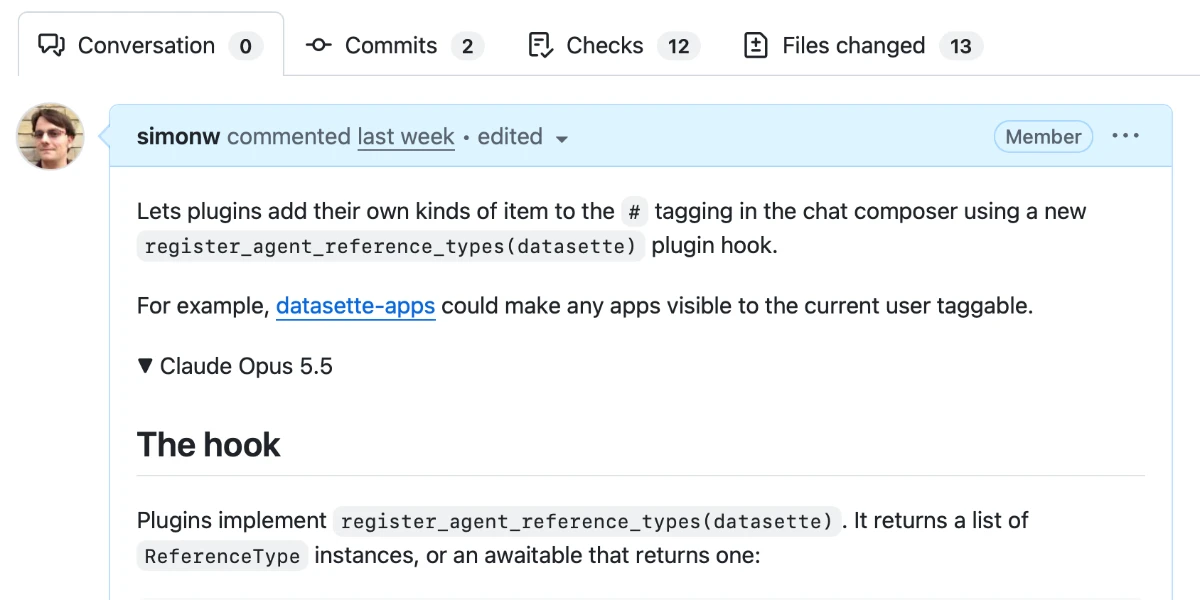
On November 9, Simon Willison, creator of Datasette and co-creator of Django, posted on X that he has started hiding the bulk of the PR descriptions written by Claude Code and Codex behind a collapsed <details><summary> tag, which GitHub Markdown supports, to make "PR slop" a little less exhausting. Within about four hours the post drew 650+ likes, 400+ bookmarks and nearly 150 replies. In a same-day blog post he explains that agent-written descriptions are accurate and comprehensive, but so long they read like slop. His fix: open each PR with one short, human-vetted explanation (sometimes with a screenshot), fold the full agent essay underneath, and label the fold with the model name and effort level, such as "Claude Opus 5.5 Medium". This is a personal workflow tip, not a product launch.
Key Takeaways
- ✓Reach: @simonw posted at 04:36 UTC on November 9 and within about 3.5 hours had 656 likes, 409 bookmarks, 149 replies and 38K views
- ✓Method: the first paragraph of each PR is the shortest human-vetted explanation of what it does and whether it deserves attention, often with a screenshot; the full agent-written description goes inside
<details> - ✓Labeling: the fold title names the model and effort level (for example Claude Opus 5.5 Medium), so readers see at once that the text below is AI-written
- ✓Examples: he lists 5 recent PRs across datasette (#3052, #3043, #3042), datasette-agent (#51) and llm (#1838)
- ✓From the replies: leave a blank line after
</summary>or Markdown inside the fold will not render; others warn the folded description can drift from the final diff after several review rounds
Key Decision Metrics at a Glance
Heavy Claude Code use: compare subscription limits and API bills
Compare 40 dev plans & simulate token costs vs $20/mo subscriptions
Project Links & Resources
Direct AccessIn-Depth Technical Analysis
Core Background & Industry Pain Points
Simon Willison says most changes to his projects now arrive as PRs opened for him by Claude Code or Codex, and the PR is his unit of work. He thinks today's coding agents are great at writing PR descriptions; the problem is that they are too good. The problem, the solution and the verification steps are all there, accurate but long. An AI-written PR is easy to spot, and the reader's first reaction is often "I'm not reading all of that", even when the author is Willison himself.
Architecture Highlights & Internals
The fix is simple: the HTML collapsible tags <details><summary>, which GitHub Markdown supports. The first paragraph of the PR is a human-vetted, high-level explanation, sometimes with a screenshot. The full agent essay goes inside the fold, and the <summary> names the model and effort level, such as "Claude Opus 5.5 Medium". He doesn't always write the opener himself, since sometimes the agent has already produced the right sentence, but his promise is that the opener reflects his own judgement.
Authoritative Benchmarks & Measured Scores
This is a workflow tip with no evaluation data, and Willison gives no measured numbers such as review time saved. What can be verified is engagement: about 3.5 hours after posting, the original post had 656 likes, 409 bookmarks and 149 replies. His blog post lists five real examples, all viewable on GitHub.
Developer Hands-on Guide
GitHub's documentation confirms that collapsed sections work in issues, PRs and comments. Practical tips from the replies: leave a blank line after </summary> or lists and code blocks inside will not render, and use <details open> to expand a section by default. Some replies push back: folding eases reading fatigue but does not make the content better, and an agent-written description reflects the first version of the branch, so after several review rounds it may no longer match the diff. One suggestion is to note which commit the folded text was written against.
Benchmark side-by-side against alternatives, or calculate monthly token cost vs subscription break-even.
Discussion & Comments
0Sign in to join the discussion
Connect with AI developers to exchange benchmark insights.