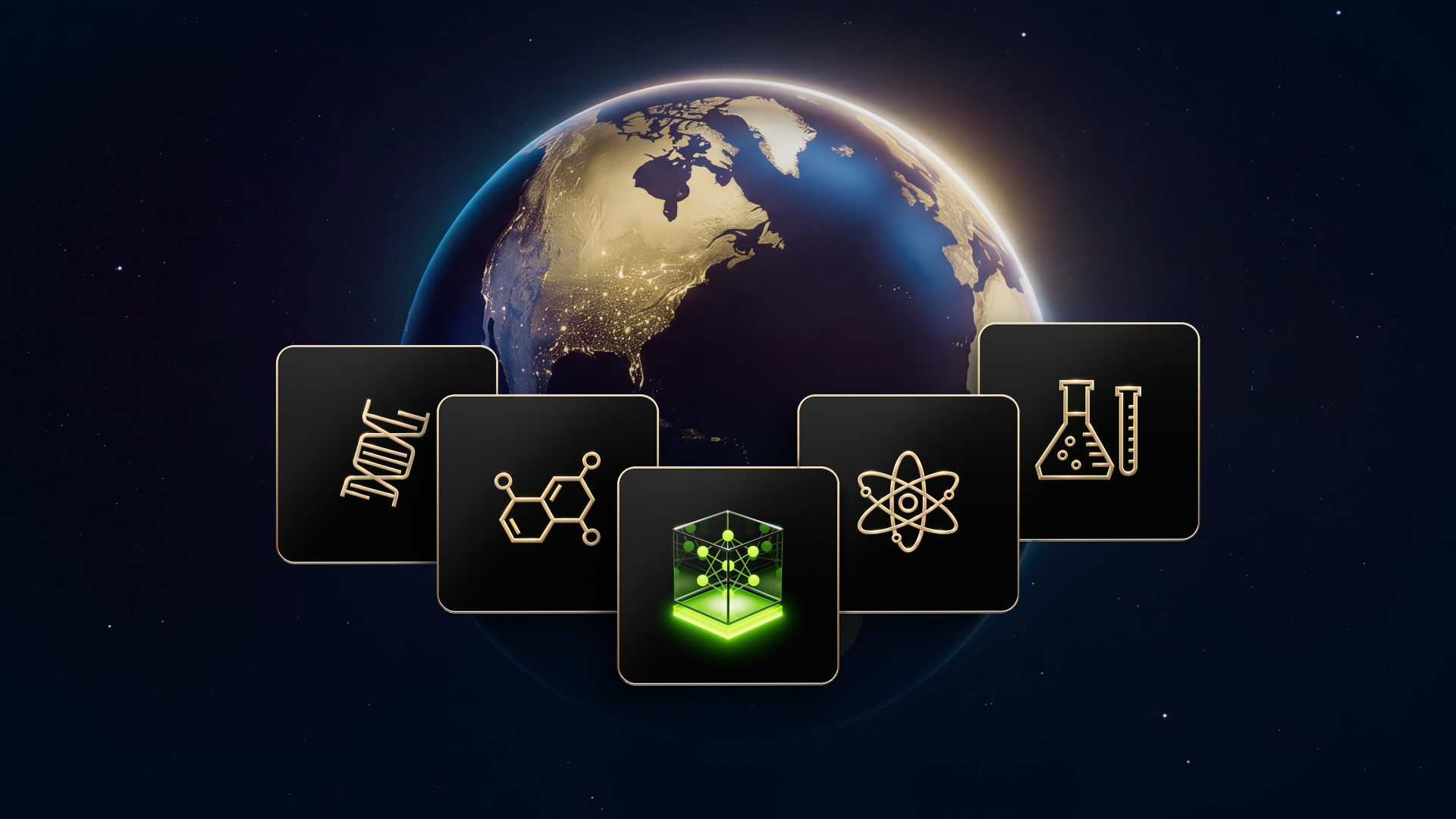
At SC26 in Chicago, NVIDIA launched Nemotron for Science, bundling the open Nemotron 3.5 Super VL model, scientific evaluations, the new open LitmusBench v0.2 chemistry dataset (nearly 50,000 questions) and post-training recipes so researchers can build agents that plan tasks, run simulations and check results. NVIDIA says Lila Sciences reached 61% accuracy on quantum-dot synthesis after post-training, above GPT-6 Astra at 54%, at 10-20x lower inference cost; the model and dataset are on Hugging Face.
Key Takeaways
- ✓Nemotron for Science combines the open Nemotron 3.5 Super VL model, scientific evaluations, the LitmusBench v0.2 dataset and post-training recipes
- ✓LitmusBench v0.2 is an open chemistry-reasoning dataset of nearly 50,000 questions drawn from molecular-property and drug-discovery data, usable for evaluation and post-training
- ✓Official case studies: Lila Sciences reached 61% quantum-dot synthesis accuracy after post-training (GPT-6 Astra: 54%) at 10-20x lower inference cost; Terray recovered about 76% of annotated reactions on RxnScribe
- ✓KTH fixed 81% of GROMACS test cases overnight with a Nemotron agent on a single DGX Spark; Argonne, Julich and RIKEN are integrating it
- ✓The model and dataset are available on Hugging Face, and Nemotron 3.5 Super VL is optimized to run locally on a 128GB DGX Spark
Key Decision Metrics at a Glance
Turn your technical choice into a development budget
Compare 40 dev plans & simulate token costs vs $20/mo subscriptions
Project Links & Resources
Direct AccessIn-Depth Technical Analysis
Background
General-purpose models still fall short on specialized tasks like chemistry and protein design, and research institutions often need to run them on infrastructure they control. NVIDIA VP Ian Buck announced Nemotron for Science at SC26, and the official @NVIDIAAI account posted it on X.
How it works
The kit is built on the open multimodal Nemotron 3.5 Super VL model, with scientific evaluations, post-training recipes and the new LitmusBench v0.2 dataset. Researchers post-train the model on domain data and plug it into agent workflows that interpret scientific information, write code and call CUDA-X accelerated tools, scaling from a DGX Spark desktop to supercomputing centers.
Numbers that matter
All figures are partner results published by NVIDIA: Lila Sciences nearly doubled quantum-dot synthesis accuracy to 61% after post-training with lab feedback, above GPT-6 Astra at 54%, at 10-20x lower inference cost; Terray recovered about 76% of annotated reactions on RxnScribe; Therna nearly doubled accuracy in predicting mRNA protein-expression ranges; KTH's agent fixed 81% of GROMACS test cases overnight on one DGX Spark.
What it means for developers
Nemotron 3.5 Super VL and LitmusBench v0.2 are available on Hugging Face, and the model is optimized to run locally on a 128GB DGX Spark. NVIDIA's technical blog walks through post-training for a scientific domain, a useful starting point for teams building chemistry, materials or biology agents.
Benchmark side-by-side against alternatives, or calculate monthly token cost vs subscription break-even.
Discussion & Comments
0Sign in to join the discussion
Connect with AI developers to exchange benchmark insights.