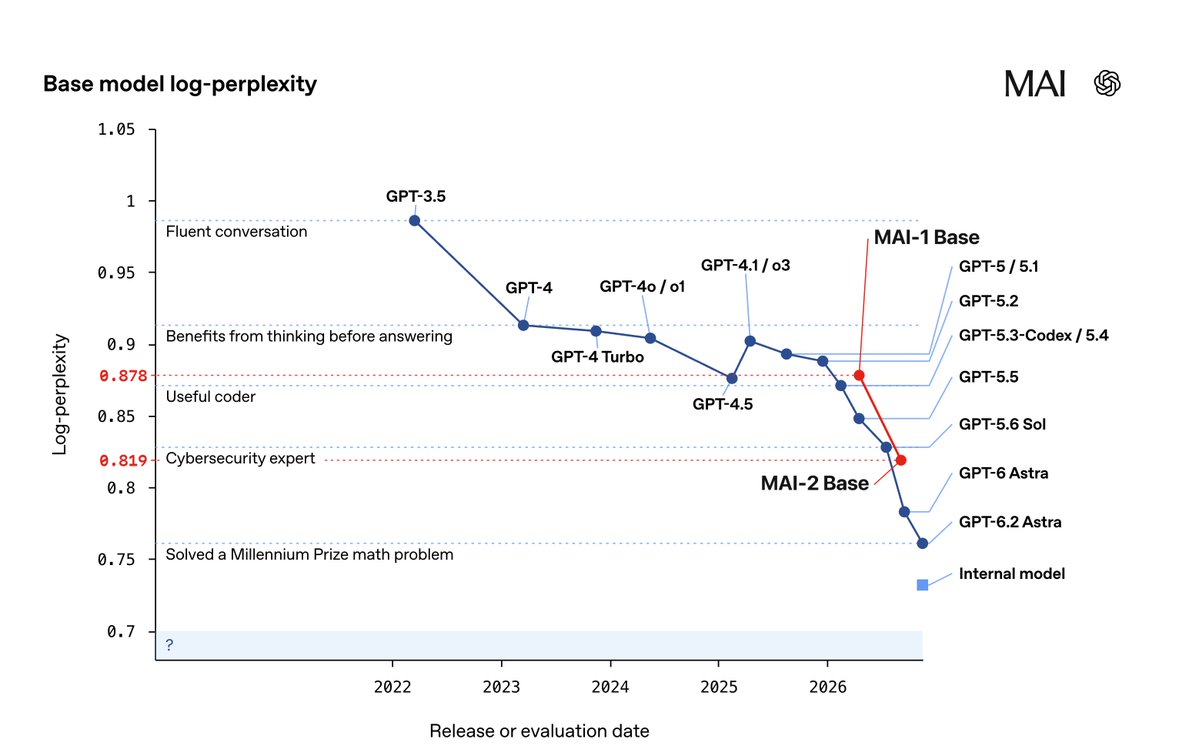
On November 23, Microsoft AI CEO Mustafa Suleyman said on X that Microsoft AI fully supports the pretraining transparency initiative proposed by OpenAI Chief Scientist Jakub Pachocki. With OpenAI's permission, he reported that MAI-2 Base scores a log-perplexity of 0.819 on OpenAI's held-out evaluation set, in the same ballpark as the GPT-5.6 Sol base model. He said MAI uses the same tokenizer as OpenAI, so the numbers are directly comparable, and committed to sharing pretraining progress on a common held-out set. It is the first lab to publicly answer the call with a number.
Key Takeaways
- ✓Source: an original X post by Microsoft AI CEO Mustafa Suleyman quoting Jakub Pachocki's post introducing "Perplexity and Intelligence", thanking Pachocki, Mark Chen, Greg Brockman and Sam Altman
- ✓Data: with OpenAI's permission, MAI-2 Base scores a log-perplexity of 0.819 on OpenAI's held-out eval set, in the same ballpark as the GPT-5.6 Sol base model; for reference, OpenAI disclosed about 0.91 for GPT-4 and about 0.99 for GPT-3.5
- ✓Comparability: MAI uses the same tokenizer as OpenAI, so the numbers are directly comparable; Suleyman notes access to OpenAI's eval set is a special case, and cross-lab comparison may need bits-per-byte (BPB) and shared eval datasets
- ✓Commitment: Microsoft AI will share pretraining progress on a common held-out eval set, calling safety and alignment the number one focus for the industry, starting with small steps on coordinating pace
- ✓Engagement: about 1,665 likes, 144 reposts and 4.29M views; whether other labs will follow has not been announced
Key Decision Metrics at a Glance
Turn your technical choice into a development budget
Compare 40 dev plans & simulate token costs vs $20/mo subscriptions
Project Links & Resources
Direct AccessIn-Depth Technical Analysis
Background
On November 22, OpenAI Chief Scientist Jakub Pachocki posted on X to introduce his article "Perplexity and Intelligence", disclosing OpenAI's internal pretraining perplexity curve and proposing that labs set shared safety limits based on perplexity. At 00:37 UTC on November 23, Microsoft AI CEO Mustafa Suleyman posted that Microsoft AI fully supports the initiative, becoming the first lab to answer with a number.
How it works
Suleyman says that, with OpenAI's permission, Microsoft AI evaluated MAI-2 Base on OpenAI's held-out evaluation set. MAI uses the same tokenizer as OpenAI, so the numbers are directly comparable. He notes that access to OpenAI's eval set is a special case, and that future cross-lab comparison may need bits-per-byte (BPB) and shared evaluation datasets.
Numbers that matter
MAI-2 Base scores a log-perplexity of 0.819, in the same ballpark as the GPT-5.6 Sol base model. For reference, OpenAI disclosed about 0.91 for GPT-4 and about 0.99 for GPT-3.5, with transformative capabilities appearing below 0.8. Lower is better, and this is a base-model metric, not a measure of reasoning or product quality.
What it means for developers
This is not a product launch and does not change any API. What matters is that frontier labs are starting to disclose pretraining progress on a shared eval set, which gives a new reference for generational gaps between models. Whether other labs will follow has not been announced.
Benchmark side-by-side against alternatives, or calculate monthly token cost vs subscription break-even.
Discussion & Comments
0Sign in to join the discussion
Connect with AI developers to exchange benchmark insights.