Vercel has launched Audited ZDR on AI Gateway: an inference provider earns the Audited ZDR label only after an independent security firm tests its zero data retention claims against its source code, infrastructure and live traffic, then publishes the report. Teams can enable a team-wide toggle in policy settings so requests route and fail over only across audited providers. Launch partners Baseten, Modal and Wafer have begun audits, with reports expected by December 8, 2026. Between audits, Vercel also runs canary prompts containing unique URLs to detect retention.
Key Takeaways
- ✓Source: the official Vercel blog post (November 23, by Harpreet Arora and Talha Tariq) and the @vercel announcement post
- ✓Audit scope: prompts, completions, system prompts, files, tool-call payloads and derived data are never written to durable storage, covering logs, traces, crash dumps, prompt caches, backups, support tools and training or evaluation datasets; KV caches may live only in volatile storage for the request
- ✓The audit also checks that a ZDR request never fails over to a non-ZDR endpoint, that no human or automated process touches customer data outside the request, that sub-processors comply, and that no training on customer data occurs
- ✓Ongoing checks: between audits Vercel sends canary prompts with unique, unindexed URLs, and any hit on those URLs triggers an investigation; Vercel notes canaries cannot catch data written to disk and never read
- ✓Timeline: Baseten, Modal and Wafer have started audits with reports expected by December 8, 2026, and each provider joins the tier only once its report is published; audit costs and auditor names have not been announced
Key Decision Metrics at a Glance
Turn your technical choice into a development budget
Compare 40 dev plans & simulate token costs vs $20/mo subscriptions
Project Links & Resources
Direct AccessIn-Depth Technical Analysis
Background
Companies now send source code, customer records and regulated data through inference providers, yet zero data retention (ZDR) still rests on contracts and self-attestation. On November 23, the Vercel blog and @vercel announced Audited ZDR on AI Gateway, asking providers to prove their claims through independent audits.
How it works
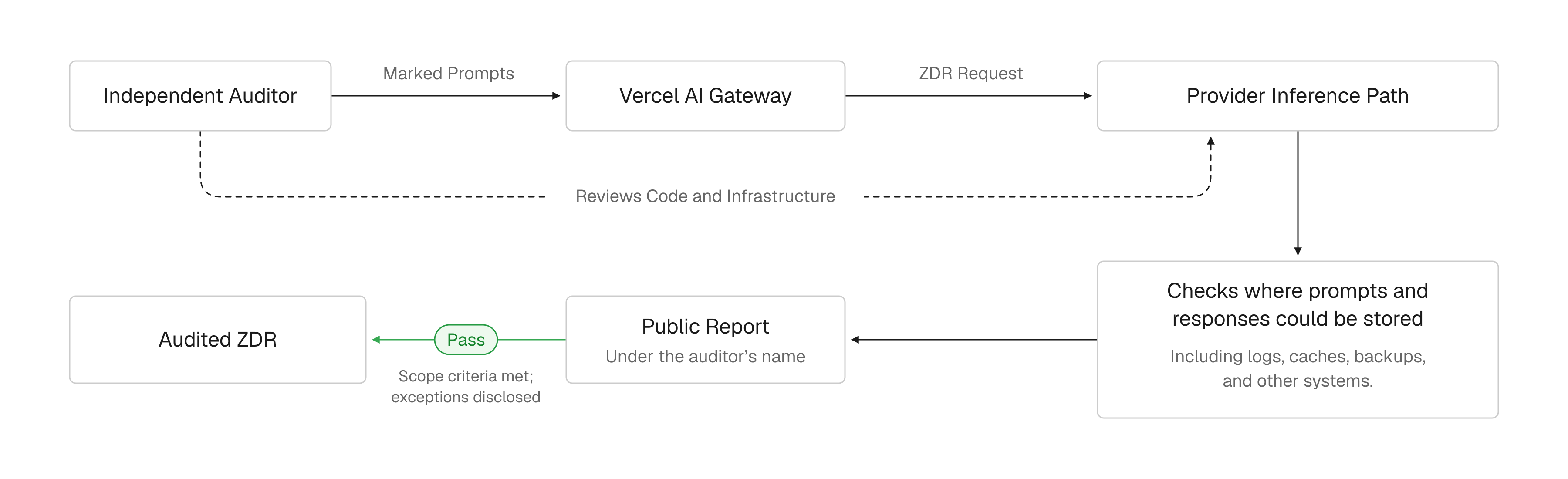
An independent security firm reviews the provider's serving-path source code and infrastructure configuration, then sends marked prompts through AI Gateway and searches the provider's logging, caching and storage systems for any trace. It also checks that ZDR requests never fail over to non-ZDR endpoints and that customer data is never used for training. Between audits, Vercel runs canary prompts with unique URLs to catch retention.
Numbers that matter
This is a compliance feature, so there are no benchmarks. Launch partners Baseten, Modal and Wafer have begun audits, with reports expected by December 8, 2026, covering scope, methodology, dates, findings and fix status. The auditing firms have not been named.
What it means for developers
Turning on the team-wide Audited ZDR toggle in AI Gateway policy settings restricts routing and failover to providers with published audits. It works alongside regional inference, provider-headquarters filtering and private inference; see the AI Gateway docs.
Benchmark side-by-side against alternatives, or calculate monthly token cost vs subscription break-even.
Discussion & Comments
Sign in to join the discussion
Connect with AI developers to exchange benchmark insights.