
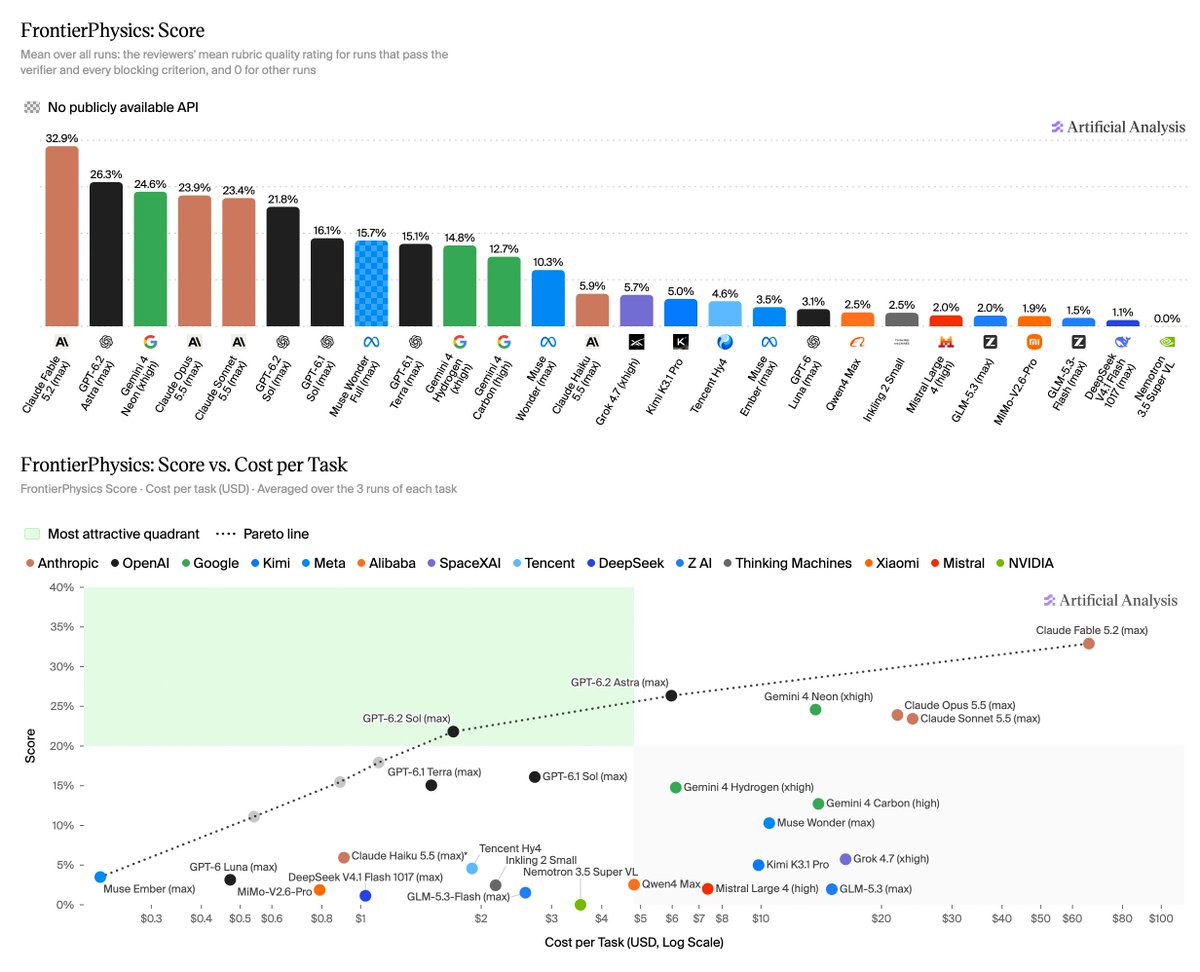
On November 25, independent evaluator Artificial Analysis (@ArtificialAnlys) launched a FrontierPhysics leaderboard. Built by BenchFlow, the benchmark asks agents to review the literature, run simulations and analyses, and submit results with a manuscript; AA runs 54 of its tasks (excluding two GPU tasks) across 9 physics domains. Claude Fable 5.2 (max) scored 32%, GPT-6.2 Astra (max) 26%, Gemini 4 Neon (xhigh) 25%, Claude Opus 5.5 24%, Claude Sonnet 5.5 23% and GPT-6.2 Sol 22%. Neon passed numeric checks 54% of the time, the most of any model, but passed review only 28% of the time.
Key Takeaways
- ✓Leader: Claude Fable 5.2 (max) at 32%, 6 points ahead of GPT-6.2 Astra (max), with the next five models between 22% and 26%
- ✓Strict grading: results must pass the task's numeric checks and LLM reviewers must find no flaw that would block publication; failed runs score 0
- ✓Gemini 4 Neon passed numeric checks 54% of the time, the most of any model, but only 28% passed review, often due to invalid simulation setups, missing derivations or unsupported conclusions
- ✓Cost: GPT-6.2 Sol scored 22% at $1.70 per task and GPT-6.2 Astra 26% at $5.97, both on the score-cost Pareto frontier; Neon and Opus 5.5 cost $13.69 and $21.93
- ✓Tasks are private to avoid contamination; on BenchFlow's own audited leaderboard Fable 5.2 with Claude Code scores 33.3%
Key Decision Metrics at a Glance
Turn your technical choice into a development budget
Compare 40 dev plans & simulate token costs vs $20/mo subscriptions
Project Links & Resources
Direct AccessIn-Depth Technical Analysis
Background
Whether AI can do real research has lacked a hard, reproducible metric. FrontierPhysics, built by BenchFlow with physicist-written tasks, asks agents to go end to end from literature review through simulation and analysis to a submitted manuscript. Artificial Analysis announced its leaderboard on X on November 25.
How it works
According to the AA evaluation page, AA runs 54 tasks across 9 domains from condensed matter to astrophysics, and the tasks are private to avoid contamination. A deterministic verifier checks the results first, then LLM reviewers grade the submission and trajectory against an expert rubric. A run passes only if it passes the verifier and meets every blocking criterion; it then scores the reviewers' mean quality rating, otherwise 0.
Numbers that matter
Claude Fable 5.2 scored 32%, GPT-6.2 Astra 26%, Gemini 4 Neon 25%, Claude Opus 5.5 24%, Sonnet 5.5 23% and GPT-6.2 Sol 22%. Neon passed numeric checks 54% of the time but review only 28%. On BenchFlow's own leaderboard, Fable 5.2 with Claude Code scores 33.3%.
What it means for developers
Research agents need their derivations and conclusions checked, not just their numbers. Cost-sensitive teams can start with GPT-6.2 Sol ($1.70 per task), while Fable 5.2 has the highest ceiling; either way, keep human review in the loop.
Benchmark side-by-side against alternatives, or calculate monthly token cost vs subscription break-even.
Discussion & Comments
Sign in to join the discussion
Connect with AI developers to exchange benchmark insights.