AI Coding Live News

World Labs Ships Frameboy: Optimized Atlas Streams at up to ~15 fps for Real-Time Browser World Exploration

On 2026-11-05 World Labs released research preview Frameboy: a highly optimized Atlas variant streamed from cloud GPUs to the browser at up to ~15 fps (vendor claim) with live camera control. A public demo and a Viewfinder closed-beta overlay shipped together; CEO Fei-Fei Li amplified “Real time Atlas” on X.

World Labs Ships Frameboy: Optimized Atlas Streams at up to ~15 fps for Real-Time Browser World Exploration

Key Takeaways

  • Official: World Labs shipped Frameboy research preview on 2026-11-05 (blog + X)
  • Vendor claim: optimized Atlas streams from cloud GPUs at up to ~15 fps with live camera control
  • Public demo: frameboy.worldlabs.ai; Viewfinder closed beta builds scenes then overlays live explore
  • Capabilities: single-image/text scene seeding + multiview novel-view synthesis; RTFM form factor at Atlas scale
  • Vendor notes powerful cloud GPUs required and cost vs local rendering; no independent quality/latency board
Read full story
Linked Models & Agents:
⚡ Atlas⚡ RTFM🌐 World Labs

Meituan ships LongCat-2.5, a 1.6T-parameter (about 48B active) native multimodal agentic model, with API pricing of $0.30/$1.20 per 1M tokens

On Nov 2 Meituan's LongCat team listed LongCat-2.5 in its API platform change log as the full release of September 25's LongCat-2.5-Preview. The official technical blog says it has 1.6 trillion total parameters with about 48 billion activated per token, builds on LongCat-2.0 with stronger native visual understanding and agentic coding, and was trained and served with W4A4 inference on domestic AI accelerators. Vendor-reported scores include 88.4 on Terminal Bench v2.1, 38.5 on Terminal Bench v4.0, 91.9 on BrowseComp and 83.1 on MCP Atlas. The API speaks both OpenAI and Anthropic formats with a 1M-token context and up to 128K output tokens, at a limited-time price of $0.30 per 1M uncached input tokens, $0.006 cached input and $1.20 output.

Meituan ships LongCat-2.5, a 1.6T-parameter (about 48B active) native multimodal agentic model, with API pricing of $0.30/$1.20 per 1M tokens

Key Takeaways

  • Scale: a 1.6-trillion-parameter MoE with about 48B active per token, a 1M-token context and up to 128K output tokens (official blog, API docs)
  • Code agents (vendor-reported): Terminal Bench v2.1 88.4 (Claude Opus 5 89.1, GPT-5.6-Sol 88.8), Terminal Bench v4.0 38.5 (GPT-5.6-Sol 37.3, Claude Opus 5 53.9), DeepSWE v1.1 64.6
  • General agents (vendor-reported): BrowseComp 91.9, MCP Atlas 83.1, AutomationBench v1.0.6 51.8, HLE with tools 63.1; AutomationBench jumps from 15.8 on LongCat-2.0
  • Pricing: limited-time $0.30 per 1M uncached input tokens, $0.006 cached input and $1.20 output (pricing page)
  • Engineering: W4A4 inference raises prefill throughput 43.3% and decode throughput 42.77% over a W8A8 baseline; FSDP gives 86% higher per-device throughput than DDP in long-sequence SFT
Read full story

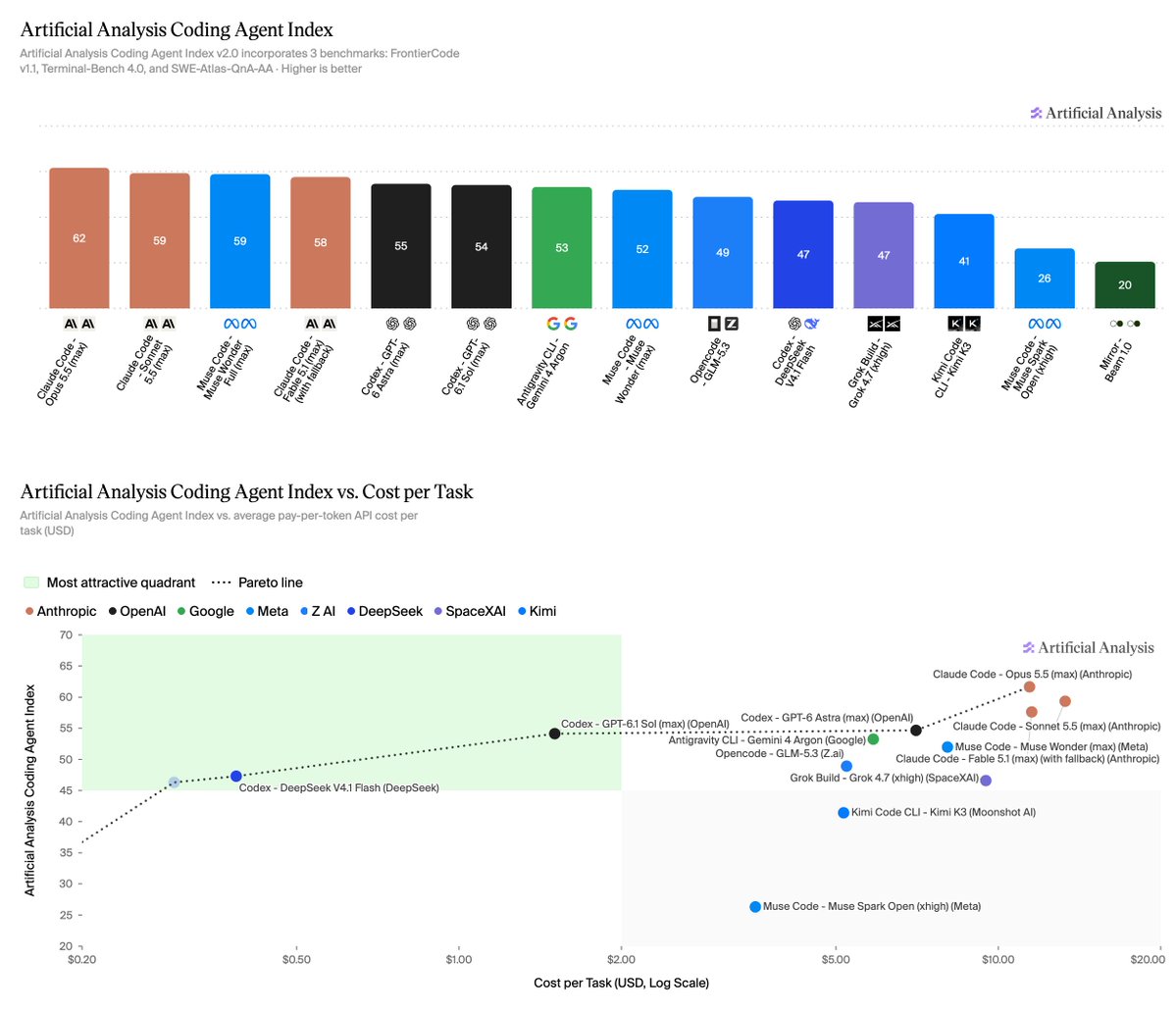
Artificial Analysis launches Coding Agent Index v2.0: FrontierCode from Cognition replaces DeepSWE, and Claude Code with Opus 5.5 leads at 61.7

On 2026-10-23 Artificial Analysis launched Coding Agent Index v2.0, which scores model-plus-harness combinations across 290 tasks with three equally weighted benchmarks: FrontierCode v1.1 from Cognition (100 tasks on real open-source repos, graded on whether a maintainer would merge the change) replaces DeepSWE v1.1, SWE-Atlas-QnA becomes the stricter SWE-Atlas-QnA-AA, and Terminal-Bench 4.0 is unchanged. Claude Code with Claude Opus 5.5 (max) leads at 61.7, ahead of Sonnet 5.5 at 59.3 and Muse Wonder Full at 58.9. Scores fall across the board: the 21 configurations measured on both versions drop from a mean of 54.8 to 47.4.

Artificial Analysis launches Coding Agent Index v2.0: FrontierCode from Cognition replaces DeepSWE, and Claude Code with Opus 5.5 leads at 61.7

Key Takeaways

  • Top of the index: Claude Code with Claude Opus 5.5 (max) 61.7, Claude Sonnet 5.5 (max) 59.3, Muse Code with Muse Wonder Full (max) 58.9, Claude Fable 5.1 (max with fallback) 57.6 (Artificial Analysis figures)
  • On FrontierCode v1.1, Opus 5.5 scores 56.0%, ahead of Codex with DeepSeek V4.1 Flash at 52.6%; 15 of 24 configurations sit between 43% and 49%
  • Version shift: 21 configurations average 54.8 on v1.5 and 47.4 on v2.0, with 20 of 21 moving down; the same set averages 45.1% on FrontierCode versus 65.6% on DeepSWE
  • Four points on the cost frontier: DeepSeek V4.1 Flash 47.3 at $0.39 per task, GPT-6.1 Sol 54.1 at $1.50, GPT-6 Astra 54.7 at $7.04, Opus 5.5 61.7 at $11.42 (pay-per-token API costs, not subscriptions)
  • SWE-Atlas-QnA-AA rewords 127 of 1,306 rubric criteria and uses GPT-6 Luna (xhigh) as judge with five votes per criterion; dataset and judge config are on Hugging Face
Read full story

Ornith-1.5-122B Released Under MIT: A Single-Node 122B MoE Reasoning Model Scoring 76.9 on SWE-bench Pro

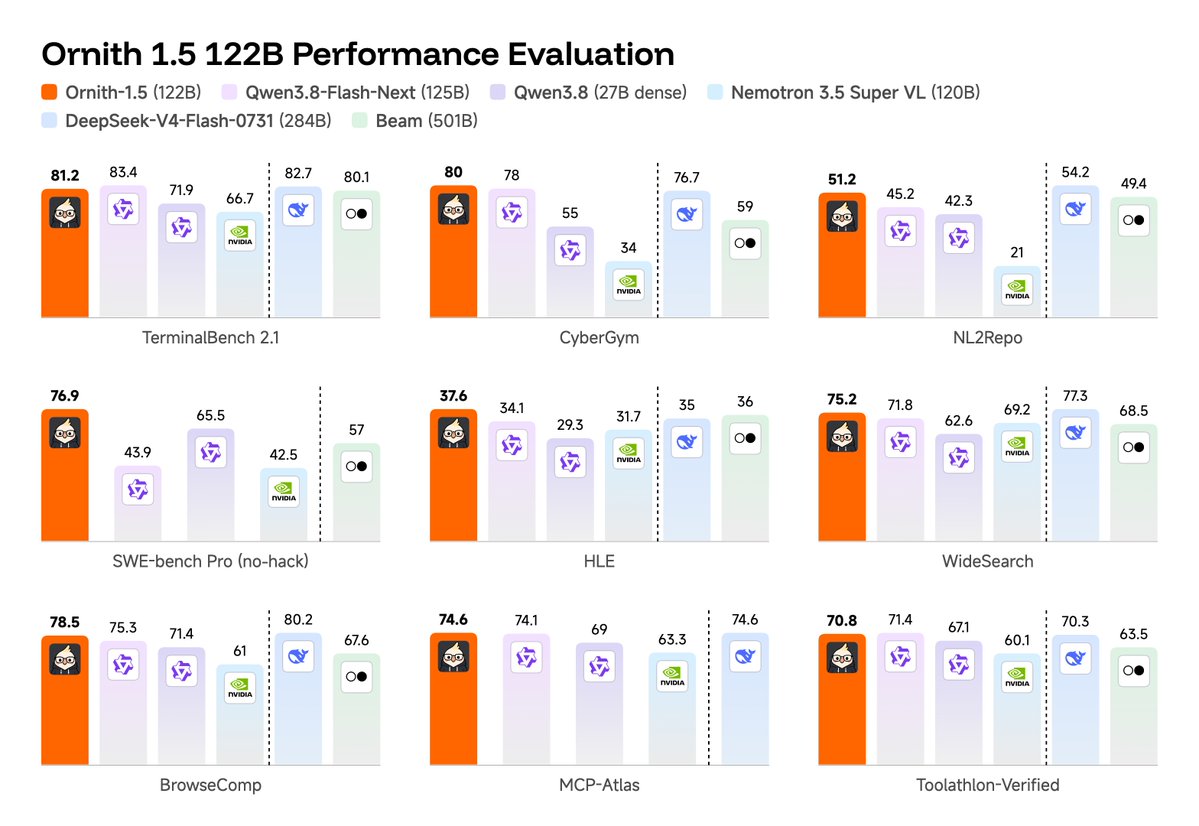
The Ornith AI team officially released Ornith-1.5-122B under the permissive MIT license, a 122-billion parameter mixture-of-experts (MoE) reasoning model optimized to execute on a single GPU node (such as a single DGX). The model is immediately available across vLLM (0.19.1+), SGLang (0.5.9+), Hugging Face, and Ollama (ornith-1.5:122b) with native FP8, GGUF, and MLX quantization. Across independent agentic evaluations in the OpenHands harness, Ornith-1.5-122B registered 84.5 on SWE-bench Verified, 76.9 on SWE-bench Pro (surpassing Qwen3.8-Flash-Next's 43.9 by 33 points), 81.2 on TerminalBench 2.1, and 74.6 on MCP-Atlas.

Ornith-1.5-122B Released Under MIT: A Single-Node 122B MoE Reasoning Model Scoring 76.9 on SWE-bench Pro

Key Takeaways

  • Ornith-1.5-122B released under the permissive MIT license, offering a fully open, frontier-grade 122B MoE coding reasoning model
  • Engineered to fit inside a single GPU node (single DGX), with immediate runtime support on vLLM, SGLang, and Ollama (ornith-1.5:122b)
  • Achieves 76.9 on SWE-bench Pro, drastically outperforming the comparable open-weight baseline Qwen3.8-Flash-Next (43.9)
  • Delivers balanced agentic performance with 81.2 on TerminalBench 2.1, 80.0 on CyberGym, and 74.6 on MCP-Atlas
Read full story
Linked Models & Agents:
⚡ Ornith-1.5-122B⚡ Qwen3.8-Flash-Next🤖 OpenHands🌐 Ornith
ADSponsored

Meta Releases Muse Glimmer 30B: An Apache 2.0 On-Device Agentic Model Running on a Single Consumer GPU

Meta AI published the technical report for Muse Glimmer 30B (arXiv:2610.24628), an open-source 30-billion parameter causal language model with an integrated perception encoder designed for on-device autonomous agents. Quantized to approximately 4 bits, Muse Glimmer operates inside 32GB of VRAM on a single consumer GPU (such as an RTX 5090) without cloud reliance. On rigorous agentic evaluations, Muse Glimmer sets new records for its size class: achieving 75.5 on MCPAtlas (surpassing Gemma4-31B at 54.2 and Qwen3.6-27B at 62.5) and 51.2 on SWE-Bench Pro, released fully under the Apache 2.0 license.

Meta Releases Muse Glimmer 30B: An Apache 2.0 On-Device Agentic Model Running on a Single Consumer GPU

Key Takeaways

  • Meta released the technical report for Muse Glimmer 30B (arXiv:2610.24628), open-sourcing the agentic foundation model under Apache 2.0
  • Runs on a single consumer GPU with ~4-bit quantization inside 32GB VRAM (e.g. RTX 5090), enabling 100% offline edge autonomy
  • Scores 75.5 on MCPAtlas tool use benchmark, outperforming Gemma4-31B (54.2) and Qwen3.6-27B (62.5) by wide margins
  • Achieves 51.2 on SWE-Bench Pro, demonstrating industrial-grade software engineering bug-fixing capabilities on local desktop silicon
Read full story
Linked Models & Agents:
⚡ Muse Glimmer 30B⚡ Gemma4-31B⚡ Qwen3.6-27B🌐 Meta

Inception Unveils Mercury 3: Diffusion-Based LLM Breaks 1,000+ Tok/s with 1M Context Window

Inception co-founder Stefano Ermon officially unveiled Mercury 3, the company's next-generation diffusion-based large language model. Delivering an astonishing 1,068 tokens per second inference speed on NVIDIA GPUs, Mercury 3 scales to 40x the size of Mercury 1 with a native 1M context window. Benchmarked on IFBench, GPQA Diamond, and SWE-Bench Atlas, it matches frontier closed baselines with standard API pricing of $0.20 / $0.70 per 1M input/output tokens (with 50% promotional pricing of $0.10 / $0.35).

Inception Unveils Mercury 3: Diffusion-Based LLM Breaks 1,000+ Tok/s with 1M Context Window

Key Takeaways

  • Inception co-founder Stefano Ermon officially launched Mercury 3, a diffusion LLM generating 1,068 tokens per second on NVIDIA GPUs
  • Scales model size by 40x over Mercury 1 with a native 1M context window; priced at $0.20 / $0.70 per 1M tokens ($0.10/$0.35 promotional)
  • Triples baseline intelligence on IFBench, GPQA Diamond, and SWE-Bench Atlas, with live availability via OpenRouter
  • Bypasses autoregressive sequential bottlenecks via parallel diffusion denoising, accelerating multi-step agent workflows
Read full story
Linked Models & Agents:

Inception launches Mercury 3 diffusion LLM: 1,068 tokens/s and 1M context, beating GPT-6 Luna and Haiku 5.5 on several benchmarks per the vendor

On October 19 Inception released Mercury 3, which it calls the most capable diffusion LLM (dLLM) to date. Per the vendor, it is more than 40x the size of Mercury 1, outputs 1,068 tokens/s, expands context from 260K (Mercury 2.5) to 1M tokens, and beats GPT-6 Luna and Claude Haiku 5.5 (both medium) on GPQA Diamond, IFBench, SWE-Bench Atlas and more. List price is $0.20/M input and $0.70/M output, 50% off at launch. It is live on the Inception API, OpenRouter, Baseten and Vercel AI Gateway with an OpenAI-compatible API. All scores are vendor-reported and not yet independently reproduced.

Inception launches Mercury 3 diffusion LLM: 1,068 tokens/s and 1M context, beating GPT-6 Luna and Haiku 5.5 on several benchmarks per the vendor

Key Takeaways

  • Speed: 1,068 tokens/s output; the vendor table lists GPT-6 Luna at ~130 and Haiku 5.5 at ~240 (vendor figures).
  • Scores: GPQA Diamond 89.23, IFBench 76.84, SWE-Bench Atlas 51.08, all above Luna and Haiku 5.5; but DeepSWE v1 at 46.31 trails Haiku 5.5 (51.62), and MRCR v2 also trails Haiku.
  • Scale and context: more than 40x the parameters of Mercury 1, with a 1M-token window (260K on Mercury 2.5).
  • Price: $0.20/M in and $0.70/M out list, 50% off at launch ($0.10/$0.35), cached input 90% off; new API keys get 100M free tokens.
  • Access: Inception API, OpenRouter, Baseten and Vercel AI Gateway, OpenAI-compatible as a drop-in replacement.
Read full story

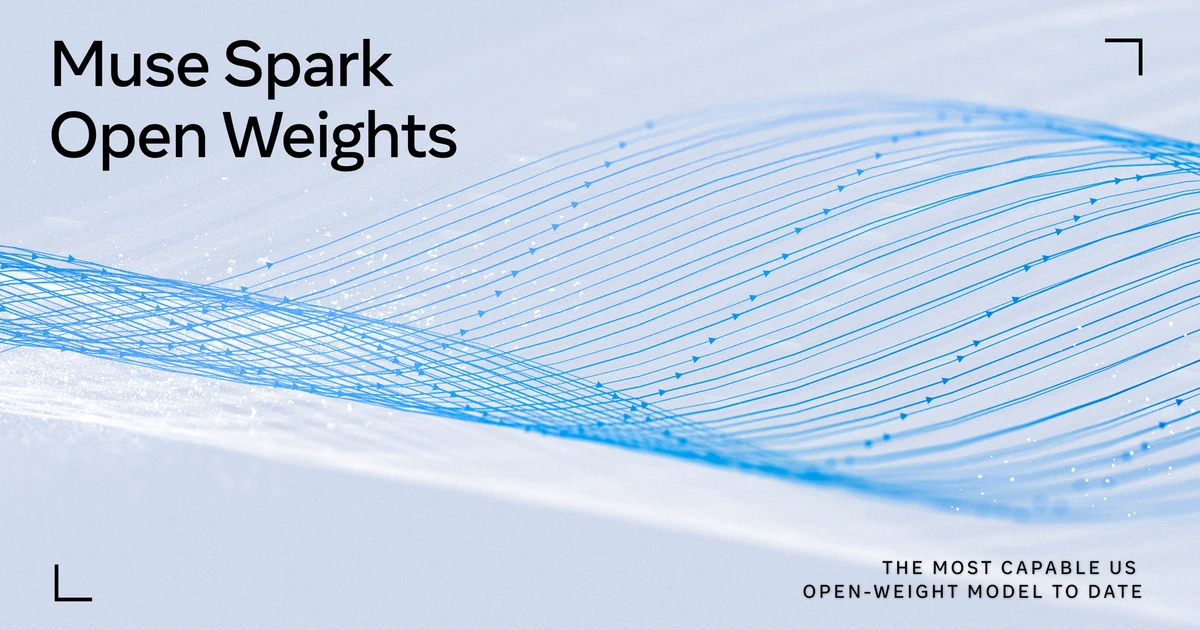
Meta open-sources Muse Spark Open: 816B-total / 42B-active MoE with 1M context, billed as the most capable US open-weight model to date

On 2026-10-15 Meta released weights for Muse Spark Open, a natively multimodal MoE (~816B total / ~42B active per token, 1M context) aimed at long-horizon coding and agents. Weights are on Hugging Face and peers; hosted APIs include Together, Fireworks, Groq and OpenRouter. Reported figures include DeepSWE 60%, MCP-Atlas 89.2% and JobBench 61.8% (see Meta’s evaluation methodology).

Meta open-sources Muse Spark Open: 816B-total / 42B-active MoE with 1M context, billed as the most capable US open-weight model to date

Key Takeaways

  • Scale: ~816B total / ~42B active per token; 256 experts/layer with top-8 routing; 62 layers, hidden 8192; context up to 1,048,576 (HF blog)
  • Coding/agents (Meta scorecard / AA, xhigh): DeepSWE 60.0%; SWE-Atlas Codebase QnA 58.0%; MCP-Atlas 89.2%; JobBench 61.8%; Toolathlon-Verified 72.8% (eval methodology)
  • Throughput (NVIDIA tech blog, agentic on GB300 NVL72): up to ~50K tok/s/GPU and ~600 tok/s/user; NVFP4 checkpoints published (NVIDIA blog)
  • Deploy: Muse Model License with limited commercial terms; SGLang / vLLM / TensorRT-LLM / MLX / llama.cpp; Meta demos two Apple M5 Ultra Mac Studios for on-desk local run
  • Third-party index: Artificial Analysis Intelligence Index ~38.9–39 (xhigh, as of 2026-10-07)—behind closed frontier, but a key open-weight reference (AA)
Read full story
Linked Models & Agents:
⚡ Muse Spark Open⚡ Muse Spark Open 816B-A42B🤖 Muse Code🌐 Meta🌐 NVIDIA🌐 Hugging Face🌐 Apple

Atlassian launches Agentic Multiplayer Protocol (AMP) and a rebuilt Atlassian MCP with 220+ tools, 15M+ daily calls and up to 25% fewer tokens

At Team '26 Europe, Atlassian introduced AMP, a framework giving agents an assigned identity, scoped authority, shared Teamwork Graph context and reviewable output, and made a rebuilt Atlassian MCP generally available with 220+ tools, OAuth 2.1/PKCE and tiered read/write/destructive scopes.

Atlassian launches Agentic Multiplayer Protocol (AMP) and a rebuilt Atlassian MCP with 220+ tools, 15M+ daily calls and up to 25% fewer tokens

Key Takeaways

  • Atlassian MCP handles 15M+ calls/day; rebuilt from dozens of tools to 220+, with up to 25% token savings on the same Jira/Confluence work in internal Claude benchmarks
  • Teamwork Graph (250B+ connections) now indexes Bitbucket/GitHub source down to functions, symbols and classes via Rovo Code Search, no clone needed
  • Internal benchmark: agents grounded in Teamwork Graph were 44% more accurate with 48% fewer tokens
  • Humans and agents already collaborate 10M+ times a month on Atlassian; Jira agent sessions link local and cloud agent runs back to work items
  • MCP secured with OAuth 2.1 + PKCE by default, read/write/destructive scopes separated; EU-local AI inference added, non-human identity inventory coming soon
Read full story
H
Hugging Face / Reflectionhuggingface.co·
👀314
🔥98

Reflection Beam weights are live: 501B/23B MoE under Apache 2.0, BF16/FP8/NVFP4 on Hugging Face, 80.1% Terminal-Bench 2.1

On 2026-10-16 Hugging Face and Reflection confirmed Beam weights are downloadable: ~501B-total / ~23B-active sparse MoE, 1M context, Apache 2.0. BF16/FP8/NVFP4 checkpoints ship with day-0 transformers≥5.20.1, vLLM and SGLang. Model-card figures (vendor): SWE-bench Verified 81.6% (BF16), Terminal-Bench 2.1 80.1%, MCP Atlas 80.8%. This closes the Oct 5 promise to release weights later that month.

Reflection Beam weights are live: 501B/23B MoE under Apache 2.0, BF16/FP8/NVFP4 on Hugging Face, 80.1% Terminal-Bench 2.1

Key Takeaways

  • Weights live: reflection/Beam-1.0-501B-A23B plus FP8/NVFP4; Apache 2.0 (HF blog)
  • Scale: ~501B total / 23B active; 52 layers (3 dense + 49 MoE), 256 experts, top-8; hybrid sliding-window + global attention; 1M context
  • Coding/terminal (model card BF16, temp=0.7): SWE-bench Verified 81.6%; Terminal-Bench 2.1 80.1%; DeepSWE v1.1 43.3%; MCP Atlas 80.8% (vendor-reported)
  • Efficiency: Reflection claims ~3× fewer inference reasoning tokens vs leading open peers; effort low–max with preserve_thinking
  • Deploy: vLLM/SGLang recipes with DFlash2; BF16 ~1TB, NVFP4 ~280GB; plan ≥4×B200; try HF Inference Providers (Baseten/Fireworks/Together)
Read full story
Linked Models & Agents:
ADSponsored

OpenRouter ships Model Router Benchmarks: 7 routers vs 6 suites on quality, speed, and cost

On 2 Oct 2026 OpenRouter shipped Model Router Benchmarks: seven model routers (Auto, Jev, NVIDIA Switchyard, Unbiased Pareto, Sakana Fugu, and variants) compared on GPQA Diamond, Tau3 Banking, MMMU Pro Vision, SWE Atlas QA, Deep SWE, and Terminal Bench 2.1. The Router Index defaults to quality 60% / time 20% / cost 20%. openrouter/pareto-code and Fusion are not on this board.

OpenRouter ships Model Router Benchmarks: 7 routers vs 6 suites on quality, speed, and cost

Key Takeaways

  • Announced 2026-10-02 22:08 UTC; blog by Brian Thomas dated 10/2/2026; live page openrouter.ai/benchmarks/routers
  • Seven router slugs in the public stats feed: openrouter/auto, typesafe/jev-router, nvidia/switchyard, unbiased/pareto, sakana/fugu-max, sakana/fugu-ultra, sakana/fugu-ultra-v2. pareto-code and Fusion were not benchmarked
  • Router Index default is quality 60% / time 20% / cost 20% on a 0-10 scale; it is not raw accuracy
  • Stats API 2026-10-04 SGT, Deep SWE n=113: Switchyard Flash+Opus 5.5 and Opus-only both 83/113 (~$279 / $285); Flash+GPT-6 Sol 74/113 at ~$55
  • Terminal Bench 2.1 n=89: GPT-6 Astra 77/89 ($66.50), Opus 5.5 74/89 ($24.00); one Pareto run 71/89 ($27.20)
Read full story
Linked Models & Agents:
⚡ openrouter/auto⚡ typesafe/jev-router⚡ nvidia/switchyard⚡ unbiased/pareto⚡ sakana/fugu-ultra-v2⚡ openrouter/pareto-code🌐 OpenRouter🌐 NVIDIA🌐 Sakana🌐 TypeSafe🌐 Unbiased

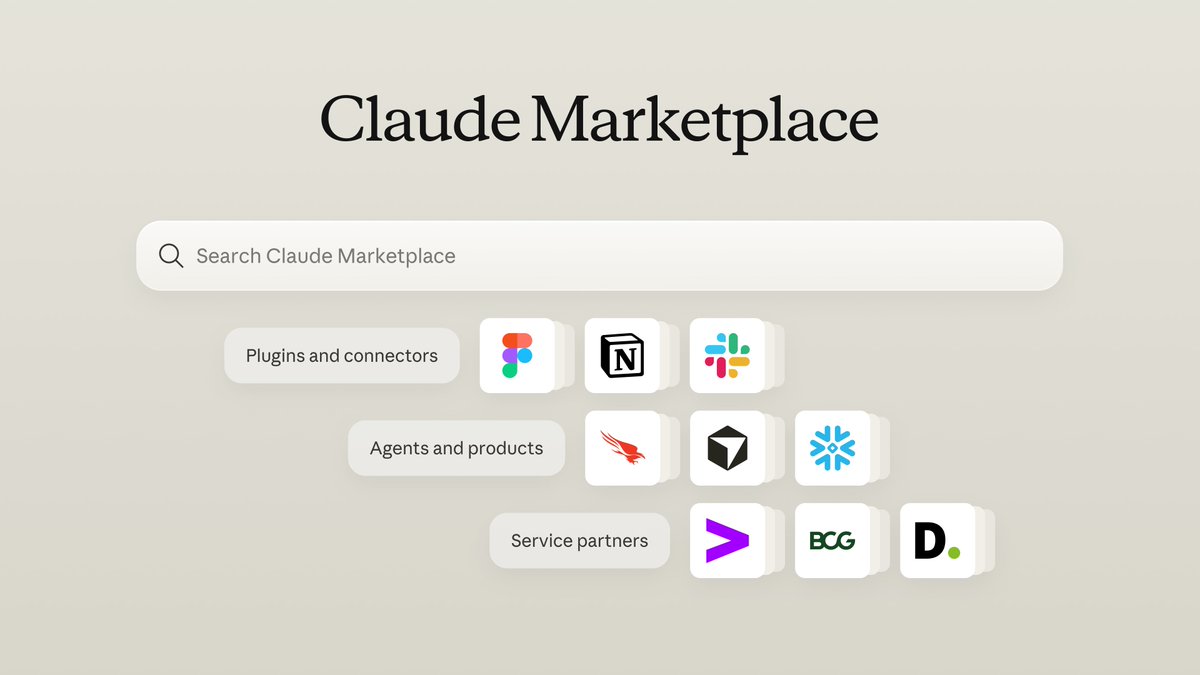
Anthropic launches Claude Marketplace: 2,000+ connectors; spend commit on Cursor and partner agents

Claude (@claudeai) launched Claude Marketplace—one place for connectors/plugins, agents/products, and service partners. Customers get 2,000+ connectors (Atlassian, Google, Microsoft, Notion, Salesforce, …), can apply Anthropic committed spend to Claude-powered software from CrowdStrike, Cursor, Harvey, Legora, Lovable, Snowflake, and engage Accenture/BCG/Deloitte-style partners. Builders can list to reach Claude teams.

Anthropic launches Claude Marketplace: 2,000+ connectors; spend commit on Cursor and partner agents

Key Takeaways

  • Announcement: three shelves—connectors/plugins, agents/products, service partners.
  • Over 2,000 connectors/plugins (Google Drive, Gmail, Microsoft 365, Notion, Figma, Slack, …).
  • Apply Anthropic committed spend to partner software like CrowdStrike, Cursor, Harvey, Legora, Lovable, Snowflake.
  • Service partners via Claude Partner Network (Accenture, BCG, Deloitte); builders can apply to list.
Read full story

Google DeepMind Releases AlphaGenome Atlas: AI Database Covering 9 Billion DNA Mutations

Google DeepMind unveiled the AlphaGenome Atlas, a 1-petabyte open AI resource predicting the molecular and functional consequences of all ~9 billion possible single-letter DNA mutations across the human genome to accelerate genetic medicine.

Key Takeaways

  • 1-petabyte dataset predicting molecular consequences for all 9 billion human single-base DNA changes
  • Predicts non-coding and regulatory mutations, filling historical blind spots beyond coding exomes
  • Globally available via open web interface and programmatic API for biomedical researchers
Read full story
Linked Models & Agents:
⚡ AlphaGenome🌐 Google DeepMind

DeepMind launches AlphaGenome Atlas covering 9 billion DNA variants

Google DeepMind launched AlphaGenome Atlas, an AI-powered searchable database mapping the predicted impact of all 9 billion possible single-letter DNA changes. Resources are available via the Atlas website, the AlphaGenome API, as a skill in Google Antigravity, and coming to Google Cloud.

Key Takeaways

  • Google DeepMind launched AlphaGenome Atlas, an AI-powered searchable database mapping the predicted impact of all 9 billion possible single-letter DNA changes. Resources are available via the Atlas website, the AlphaGenome API, as a skill in Google Antigravity, and coming to Google Cloud.
Read full story
Linked Models & Agents:

CopilotKit: useFrontendTool can opt into WebMCP so browser agents call frontend tools

Marwan Atef (@Marwan_3atef) reported a CopilotKit product change: every useFrontendTool can opt into WebMCP so browser agents such as ChatGPT Atlas discover and call frontend tools instead of only screenshotting the page. Same React API, plus readOnlyHint annotations. The official blog post Introducing WebMCP for CopilotKit is live.

Key Takeaways

  • useFrontendTool can opt into WebMCP so browser agents call frontend tools.
  • Same React API with readOnlyHint annotations.
  • Official blog: Introducing WebMCP for CopilotKit.
Read full story
Linked Models & Agents: