AI Coding Live News

RoboColosseum Opens Real-Robot Evaluation: 100+ Robots at 124 Sites, Claude Opus 5.5 and GPT-6 Astra Rival Specialized VLA Policies Zero-Shot

Hugging Face, BitRobot, the Singapore Embodied AI Centre, NUS and others launched RoboColosseum on November 4, a distributed real-robot evaluation framework covering four embodiments: SO-101, Franka, Bimanual-YAM and the Unitree G1 humanoid. The first study ran 5,699 blinded pairwise comparisons at 124 sites across 5 VLA policies and 3 frontier models. Claude Opus 5.5 and GPT-6 Astra beat their VLA counterparts on average task progress by 12.1 and 11.0 points, while Grok 4.7 trailed by 7.5. All rollouts are open on Hugging Face, and the project pledges 10,000 free evaluation hours to academic labs.

RoboColosseum Opens Real-Robot Evaluation: 100+ Robots at 124 Sites, Claude Opus 5.5 and GPT-6 Astra Rival Specialized VLA Policies Zero-Shot

Key Takeaways

  • Two tracks: the Open Track runs blinded zero-shot pairwise comparisons, and the Fine-tune Track gives each VLA the same 100 demonstrations per task across 20 tasks.
  • The VLAs tested are GR00T N1.7, pi0.5, MolmoAct2, G0.5 and LingBot-VLA v2; the frontier models are GPT-6 Astra, Claude Opus 5.5 and Grok 4.7.
  • After fine-tuning, GR00T N1.7 leads on SO-101 and pi0.5 leads on Franka and Bimanual-YAM; on the G1 humanoid no policy completes any task, with average progress of 13.3% to 23.2%.
  • Rankings agree only weakly across robots (Kendall W = 0.24), and zero-shot rankings poorly predict rankings after fine-tuning.
Read full story

Kling 4.0 Flash Is Fully Available With an API: 3-20 Second 720P Videos via Text, Image and Omni Reference Generation

Kling AI announced on November 4 that Kling 4.0 Flash is open to all users on the website and via API, and is also reachable through MCP, CLI and AI plugins, including Photoshop, Premiere Pro and After Effects. The official API changelog says the Flash API generates 3 to 20 second videos at 720P, supports text-to-video, image-to-video and Omni reference-to-video, accepts up to 15 inputs per task and bills by total duration.

Kling 4.0 Flash Is Fully Available With an API: 3-20 Second 720P Videos via Text, Image and Omni Reference Generation

Key Takeaways

  • Flash had been in early access for Ultra yearly subscribers since September 28; it is now open to all users and the API.
  • The API paths are kling-4.0-flash under /text-to-video, /image-to-video and /omni-video; image-to-video takes a single first-frame image.
  • Prompts can be up to 26,000 English characters, with up to 10 reference images and 5 reference videos, plus 21:9 and adaptive aspect ratios.
  • Billing is by the total duration of input and output video; unit prices are on the official pricing page and were not stated in the announcement.
Read full story
Linked Models & Agents:
⚡ Kling 4.0 Flash⚡ Kling 4.0🌐 Kling AI🌐 Kuaishou🌐 Adobe

Moonshot Releases Kimi K3.1 Pro Open Weights on Hugging Face: 2.8T-Parameter, 104B-Active MoE in MXFP4 at About 1.56TB, Custom License Limits Large Model-as-a-Service Use

The official Kimi account @Kimi_Moonshot announced the Kimi K3.1 Pro model weights at 16:00 UTC on November 4; the moonshotai/Kimi-K3.1-Pro repository is public and not gated. The model card describes a natively multimodal MoE with 2.8T total and 104B active parameters and a 1M-token context, shipped as MXFP4 weights from quantization-aware training, about 1.56TB in total; vLLM, SGLang and TokenSpeed are the recommended engines. The license allows free use and modification, but Model-as-a-Service businesses with over $20M in annual revenue need a separate agreement.

Moonshot Releases Kimi K3.1 Pro Open Weights on Hugging Face: 2.8T-Parameter, 104B-Active MoE in MXFP4 at About 1.56TB, Custom License Limits Large Model-as-a-Service Use

Key Takeaways

  • Architecture: 93 layers (1 dense), 69 KDA plus 24 Gated DSA attention layers, 896 experts with 16 selected per token plus 2 shared experts, and a 401M MoonViT-V2 vision encoder.
  • Compared with K3, the full-attention Gated MLA layers are replaced with Gated DeepSeek Sparse Attention for more efficient long-context modeling.
  • Vendor-reported scores on the model card: Terminal-Bench 4.0 65.7 (Opus 5.5 66.4), SWE Marathon v1.1 51.7 (Opus 5.5 46.3), HLE-Full with tools 70.0 and BrowseComp 92.1; ProgramBench 31.5 trails Opus 5.5 at 65.0.
  • License: a Model-as-a-Service business with over $20M revenue in any 12 months needs a separate agreement with Moonshot, and products above 100M monthly users or $20M monthly revenue must prominently display "Kimi K3.1-Pro"; internal use is exempt from both.
Read full story

Anthropic Amended S-1: $17.0B Q3 Revenue, Compute at 58% of Revenue, and About $895.4B in Committed Compute and Infrastructure Spend

Amendment No. 1 to the S-1 that Anthropic filed with the SEC on November 2 adds its first Q3 2026 numbers. Quarterly revenue was $16.956B, up 1,127% year over year and about 47% above Q2 revenue of $11.555B. Compute and infrastructure expense was $9.863B, or 58% of revenue versus 48% in Q2, including $5.0B of pricier short-term compute. Q3 swung to a $567M operating loss from $974M of operating income in Q2; a $21.9B fair-value charge on convertible notes and similar instruments drove a $23.29B net loss. Anthropic also discloses about $895.4B of purchase commitments and leases, substantially all for compute and infrastructure.

Key Takeaways

  • Q3 revenue was $16.956B, up 1,127% year over year and about 47% over Q2 revenue of $11.555B; nine-month revenue reached $33.2B
  • Compute and infrastructure expense hit $9.863B, rising to 58% of revenue from 48% in Q2, including $5.0B of short-term compute that costs far more than multi-year capacity
  • Q3 operating loss was $567M versus $974M of operating income in Q2; the $23.29B net loss is driven mainly by a $21.9B fair-value change on convertible notes and similar instruments
  • Committed compute and infrastructure spend is about $895.4B: roughly $447.5B expected before the end of 2030 and about $69.8B due in the next 12 months
  • Anthropic says it does not expect revenue to keep growing at comparable rates; headcount is about 5,300 and more than 1,900 customers pay $1M or more on a TTM basis
Read full story
Linked Models & Agents:
ADSponsored

SenseTime Ships SenseNova 6.8 Flash: An Office Agent Model With Long-Term Memory and Proactive Interaction That Builds Animated Slides, Motion Posters and Editable Blender 3D Projects

On the evening of November 2, SenseTime released the official version of SenseNova 6.8 Flash, a multimodal agent model with two main upgrades. First, long-term memory and proactive interaction: it keeps user goals and constraints across tasks and sessions and flags affected items when information changes. Second, design generation across Web, SVG, Three.js, Blender, animated PPT and motion posters, with Figma integration. It is live in SenseNova Studio, the Raccoon assistant and the SenseNova Token Plan; the official X account says the Token Plan offers a free trial of 1,500 API requests every 5 hours. SenseTime says it beats some international frontier models on agent collaboration, data analysis and presentation generation, but the announcement lists no specific scores.

SenseTime Ships SenseNova 6.8 Flash: An Office Agent Model With Long-Term Memory and Proactive Interaction That Builds Animated Slides, Motion Posters and Editable Blender 3D Projects

Key Takeaways

  • The official release landed on the evening of November 2, positioned as a multimodal agent model for office collaboration and design delivery
  • Long-term memory plus proactive interaction: it remembers goals, constraints and preferences across sessions and suggests changes when related information shifts (demos ran on an internal Raccoon build)
  • Design output spans Web, SVG, Three.js, Blender, animated PPT and motion posters, producing editable PPTX files and Blender projects, with Figma integration
  • Available in SenseNova Studio, the Raccoon assistant and the SenseNova Token Plan; the official X post cites 1,500 free API requests every 5 hours
  • SenseTime only says it beats some international frontier models on agent collaboration, data analysis and presentation generation; no scores were published and there is no independent evaluation yet
Read full story
Linked Models & Agents:
⚡ SenseNova 6.8 Flash⚡ SenseNova Loop-9B-Preview🤖 Raccoon🌐 SenseTime

Google Turns Gemini and Search Off by Default for K-12 Student Accounts Until Admins Opt In, Launches Guided Learning in Classroom Globally

On November 3, Google VP and GM of Education Chris Phillips announced on the official Google blog that Gemini, Gemini Notebook, Gemini in Classroom and Google Search will be entirely off for K-12 student accounts until school administrators explicitly turn them on. Guided Learning is globally available in Google Classroom starting that day and is coming to Search for student accounts, with a pilot in select U.S. schools later this month. Because Search now includes AI Mode and AI Overviews, schools that want AI fully off also lose Search, which drew sharp backlash; Google later clarified on X that Search can be enabled on its own. EdWeek and AP report the change starts early next year; Google has given no exact date.

Google Turns Gemini and Search Off by Default for K-12 Student Accounts Until Admins Opt In, Launches Guided Learning in Classroom Globally

Key Takeaways

  • Off by default: Gemini, Gemini Notebook, Gemini in Classroom and Google Search are entirely off for K-12 student accounts until admins explicitly enable them (Google blog)
  • The controversy: Search now includes AI Mode and AI Overviews with no AI-free option, so student groups with AI fully off lose Search too (per EdWeek and NBC News)
  • Google clarified on X that schools can turn on Search without Gemini products, and that AI Mode and AI Overviews for students will guide them step by step instead of giving answers
  • Guided Learning is globally available in Google Classroom starting November 3; the Search version pilots in select U.S. schools later this month before wider expansion
  • Timeline: EdWeek and AP report the change starts early next year; Google only says it will share specifics in the coming months, with no exact date
Read full story
Linked Models & Agents:
⚡ Gemini🌐 Google

LiberAI Unveils Liber-0 World Action Model: Pretrained on 2.2M Hours of Human Experience, 36% Zero-Shot Success Across 60 Manipulation Tasks

Robotics company LiberAI announced Liber-0 on its official X account and technical blog. It is a World Action Model that jointly predicts future frames and actions, pretrained on more than 2.2 million hours of human experience and anchored by precise hand-motion data from its own LiberSense Glove. On 60 tasks proposed by GPT-6 across 600 trials, Liber-0 reached 36.0% overall success without robot demonstrations collected for those tasks, but only 10.5% on challenging multi-step tasks. No open weights or API have been announced.

LiberAI Unveils Liber-0 World Action Model: Pretrained on 2.2M Hours of Human Experience, 36% Zero-Shot Success Across 60 Manipulation Tasks

Key Takeaways

  • Zero-shot results: 63.5% on pick-and-place, 34.0% on short non-pick-and-place tasks and 10.5% on challenging multi-step tasks, 36.0% overall (60 tasks x 10 trials)
  • For comparison, GPT-6 Astra used alone as a robot policy scored 8.3%, 5.0% and 1.7% on the same three task groups, with 87.3 s of reasoning per decision
  • 10K hours of glove data beat 200 times more web human video (2,000K hours), suggesting precise action labels matter more than raw video volume
  • Glove data plus 25% of the robot demonstrations reached a progress score of 75.6, above the 72.8 from robot-only training with the full pool, using 75% fewer robot demos
  • All figures are LiberAI self-reported internal evaluations; no open weights, API or commercial timeline has been announced
Read full story
Linked Models & Agents:

Axion 1.0 Open Agent Foundation Model: Two SFT Stages Plus RL, 35B-A3B Reproduction Checkpoint Under Apache 2.0, Full Recipe Released

arXiv paper 2611.03233 by Yuqi Jia, Yunjie Tian and five co-authors introduces Axion 1.0, an agent foundation model that is open beyond its weights. It uses just two lightweight SFT stages plus reinforcement learning, with no dedicated mid-training, DPO or on-policy distillation, and about 18K SFT trajectories in total. Training code is hosted under the bytedance GitHub organization, and the training data and an Axion 1.0-35B reproduction checkpoint (Qwen3.6-35B-A3B base, 35B total / 3B active, Apache 2.0) are on Hugging Face; weights for the paper's 122B model are listed as coming soon.

Axion 1.0 Open Agent Foundation Model: Two SFT Stages Plus RL, 35B-A3B Reproduction Checkpoint Under Apache 2.0, Full Recipe Released

Key Takeaways

  • A minimal recipe: SFT stage one for self-contained scientific reasoning, stage two for tool use and information seeking, then RL for long-horizon interaction, with 18,363 SFT trajectories and 484 RL tasks
  • The release covers data construction, generation, filtering, verification, prompts and training code (GitHub), not just weights
  • The 35B reproduction checkpoint scores 52.8 on HLE, 60.4 on SEAL-0, 85.0 on FrontierScience Olympiad and 55.0 on FrontierScience Research (HF model card)
  • The paper's 122B model reports 59.0 on HLE with restricted website access and 66.7 on FrontierScience Research; 122B weights are not out yet
  • All scores are self-reported; the HF card lists Claude Opus 5 at 63.6 on HLE, so Axion still trails the strongest closed models
Read full story
Linked Models & Agents:
⚡ Axion 1.0-35B⚡ Axion 1.0-122B⚡ Qwen3.6-35B-A3B🌐 ByteDance🌐 Hugging Face

Tencent Releases Hy4: First Hy Model With Vision and Computer Use, Live on Tencent Cloud and OpenRouter, Open Weights Planned

On November 4, Tencent Hy published Hy4 on its official site. Versus Augusts Hy4 preview, Tencent says it scaled up pre-training and post-training, added vision for the first time, added computer use across CLI and GUI, and trained specifically on Blender, CAD and engines like Unreal, Unity and Godot. Hy4 is live on Tencent Cloud and OpenRouter (tencent/hy4, 1M context) at the same API price as the preview. Weights and a system card are promised soon, and a cheaper Hy4 flash is coming.

Key Takeaways

  • Official blog: Introducing Hy4, dated 2026-11-04; the Tencent Hy transparency center also lists V1.0 Hy4
  • Two firsts: vision (fine-grained image detail, complex charts, math visual reasoning) and computer use (CLI plus GUI, with targeted training on Blender, CAD and long cross-app workflows)
  • Tencent's own evals: on 579 real finance tasks rated by 213 finance professionals Hy4 scores 3.04, first among open-weight models (DeepSeek-V4.1-Flash-1017 2.97, Kimi K3.1 Pro 2.68, GLM-5.3 2.68); GameDev +19.1%, GameLogic +9.8%; internal search hallucination rate 15.76% to 5.45%
  • Same API price as the preview: $0.042 cached input, $0.834 input, $2.501 output per million tokens; the OpenRouter page currently shows 50% off ($0.417/$1.251), 1,048,576 context and up to 65,536 output tokens
  • Weights are not out yet: Tencent says it will open-source them with a full system card, working with vLLM and SGLang; Hy4 flash is due soon
Read full story
Linked Models & Agents:
⚡ Hy4⚡ Hy4 preview⚡ Hy4 flash🤖 CodeBuddy🤖 WorkBuddy🌐 Tencent

fal Announces $1.65B Across Series E and F for Generative Media Inference, Led by Sequoia and Bessemer with NVIDIA

fal, which hosts inference for image, video and audio models, announced on its official X account and blog on November 3 that it raised a combined $1.65B across Series E and Series F. Sequoia Capital led the Series E, closed earlier this year, and Bessemer Venture Partners led the Series F with continued investment from NVIDIA. fal did not disclose valuation or per-round amounts; Bloomberg reported the Series F at $1.3B at a $16B valuation, double the $8B from April. fal says the money funds inference capacity, hiring, and research and platform work in 2027.

fal Announces $1.65B Across Series E and F for Generative Media Inference, Led by Sequoia and Bessemer with NVIDIA

Key Takeaways

  • Confirmed by fal: $1.65B combined across Series E and F, Sequoia led E, Bessemer led F, NVIDIA continued investing (fal blog)
  • fal did not disclose valuation; Bloomberg reported the Series F at $1.3B at a $16B valuation and the Series E at $350M at $8B
  • Per Bloomberg, CEO Burkay Gur said demand spiked so much over the summer that fal had to rate limit customers, driving the large raise
  • Funds go to inference capacity, team growth and new research in 2027; fal hosts many third-party media models such as Seedance, Kling, Veo and FLUX
Read full story
ADSponsored

Artificial Analysis Upgrades Its Six Capability Indexes to v2.0, Weighting Non-Hallucination and Agentic Tool Use; Claude Opus 5.5 Leads All Six

Independent evaluator Artificial Analysis announced on X on November 4 that its six Capability Indexes (Finance & Accounting, Strategy & Ops, Legal, Healthcare & Medical, Engineering, Economics) are now v2.0, aligned with Intelligence Index v5.0 evaluations and weighting Non-Hallucination and Agentic Tool Use more heavily. Across the indexes, HLE becomes HLE-Diamond, AA-Omniscience moves to v1.1 and GDPval-AA is removed; Engineering gains a new Science capability. Per Artificial Analysis, Claude Opus 5.5 (max) leads all six, with GPT-6 Astra (max) second in Finance & Accounting, Legal and Engineering. Among open-weights models, Kimi K3.1 Pro (weights not yet released) leads all six at #5 to #8.

Artificial Analysis Upgrades Its Six Capability Indexes to v2.0, Weighting Non-Hallucination and Agentic Tool Use; Claude Opus 5.5 Leads All Six

Key Takeaways

  • The six indexes map O*NET occupation tasks to representative benchmarks, weighted by how often each capability appears in that occupation (methodology page)
  • Common changes: HLE becomes HLE-Diamond, AA-Omniscience moves to v1.1, and GDPval-AA is dropped from Agentic Knowledge Work (now AA-Briefcase v1.1)
  • Non-Hallucination weight rises to 15% in Finance & Accounting and Legal; Agentic Tool Use (AutomationBench-AA) is 35% of Strategy & Ops, its largest component
  • Engineering adds Science (20%, CritPt v2 Hard Subset plus Terminal-Bench-Science 0.1) and FrontierCode 2.0 under Agentic Coding; Economics swaps AA-LCR for GDP.pdf
  • Results per Artificial Analysis: Claude Opus 5.5 (max) is #1 in all six; among open weights, Kimi K3.1 Pro leads all six, MiniMax-M3.1-Flash leads Strategy & Ops (#10) and DeepSeek V4.1 Flash 1017 (max) leads Healthcare & Medical (#12)
Read full story

Vercel Security Review Enters Public Beta: Vulnerability Review on Every GitHub Push, One-Click Fixes with Vercel Agent

On November 3 (US Pacific time), Vercel launched Security Review in public beta. It is a new Vercel Agent capability alongside Code Review and Investigation: once enabled, every push to connected GitHub repositories triggers a diff-only vulnerability review that finishes in seconds. Findings land in the Security dashboard, PR comments and the CLI, and can be fixed with one click by Vercel Agent or pulled into your own coding agent via vercel security vulnerabilities. It is available to Pro and Enterprise teams, and reviews are free until November 10.

Vercel Security Review Enters Public Beta: Vulnerability Review on Every GitHub Push, One-Click Fixes with Vercel Agent

Key Takeaways

  • Trigger: every GitHub push (including direct pushes to production) is reviewed automatically; only the diff is scanned, which Vercel says finishes in seconds, so it can run on every preview and production deployment
  • Beyond pattern matching: the agent traces how changed code is reached, checks existing protections and rechecks each finding, which Vercel says catches logic flaws such as missing authorization checks
  • Teams can write security policies in plain language, scoped to projects or the whole team, and manage them with vercel security policy
  • Pricing: Vercel Agent rate, model tokens at provider cost with no markup, plus $0.25 per million tokens; reviews are free until November 10, 2026, while Agent fixes are billed
  • Availability: public beta for Pro and Enterprise teams; Vercel has not published detection-rate or false-positive benchmarks
Read full story

Grok Bot Rolls Out a New Shopping Experience: Find the Best Deal, Compare Product Cards, and Track Orders After You Approve the Buy

On November 3, the official Grok Bot account @bot posted a video promoting a new shopping experience: have the Bot find the best deal, compare items, and track all your orders. The features come from the official changelog for version 0.78.1 (which includes 0.78.0), dated October 27: products appear as cards with photo, rating, price and store plus up to two badges, and three or four results scroll in a carousel. Product pages list in-stock options first, and Buy now starts an order you approve. After purchase the Bot tracks shipping and delivery, with shipment cards showing carrier and stage. Shop Pay can be connected in the Vault Payments tab and set as the preferred method.

Grok Bot Rolls Out a New Shopping Experience: Find the Best Deal, Compare Product Cards, and Track Orders After You Approve the Buy

Key Takeaways

  • The official post went out at 21:50 UTC on November 3 with a 17-second demo video; about 1,687 likes, 122 reposts, 292 replies and 112K views at fetch time
  • Source of the features: the official 0.78.1 changelog entry (October 27, includes 0.78.0), titled Shopping cards and subscription templates
  • Product cards: photo, rating, price and store, up to 2 badges such as Top rated, 3 or 4 results in a carousel; product pages list in-stock options first and disable options no store has
  • Ordering and tracking: orders started with Buy now need your approval; afterward the Bot reports shipping and arrival, and shipment cards show carrier and stage
  • Payments: the Vault has had a Payments tab since 0.77.0 (October 26); 0.78.1 lets you connect Shop Pay and make it the method Bots use first
Read full story
Linked Models & Agents:

Epic Confirms Unreal Engine 5.9: Preview Next Week With Improved AI Workflows and Web Back as a Target Platform

On November 3, the official Unreal Engine account said UE 5.9 is happening, with a Preview build next week that includes improved AI workflows, web as a target platform, and rendering and animation updates; changes are already landing in the 5.9 branch on GitHub, with more details to come. This reverses Epic's June State of Unreal stance that 5.8 was the last planned major UE5 release, with 5.9 kept only as an option. UE 5.8 shipped the Experimental Unreal MCP plugin, which lets MCP clients such as Claude Code and Cursor drive the editor; the 5.9 AI workflow changes likely build on it, but Epic has not published a feature list yet.

Key Takeaways

  • Timing: the official post went out at 13:05 UTC on November 3 and says the 5.9 Preview arrives next week; the exact date and the final release date are not announced
  • Scope (per Epic): improved AI workflows, web as a target platform, and rendering and animation updates; changes are already landing in the 5.9 branch on GitHub
  • Context: in June, State of Unreal called 5.8 the last planned major UE5 release; UE6 targets Early Access at the end of 2027, with the full release 12 to 18 months later
  • AI groundwork: the Experimental Unreal MCP plugin in 5.8 embeds an MCP server in the editor at http://127.0.0.1:8000/mcp by default, loopback only and with no authentication
  • Reach: about 2,552 likes, 251 reposts, 114 quotes and 215K views at fetch time
Read full story

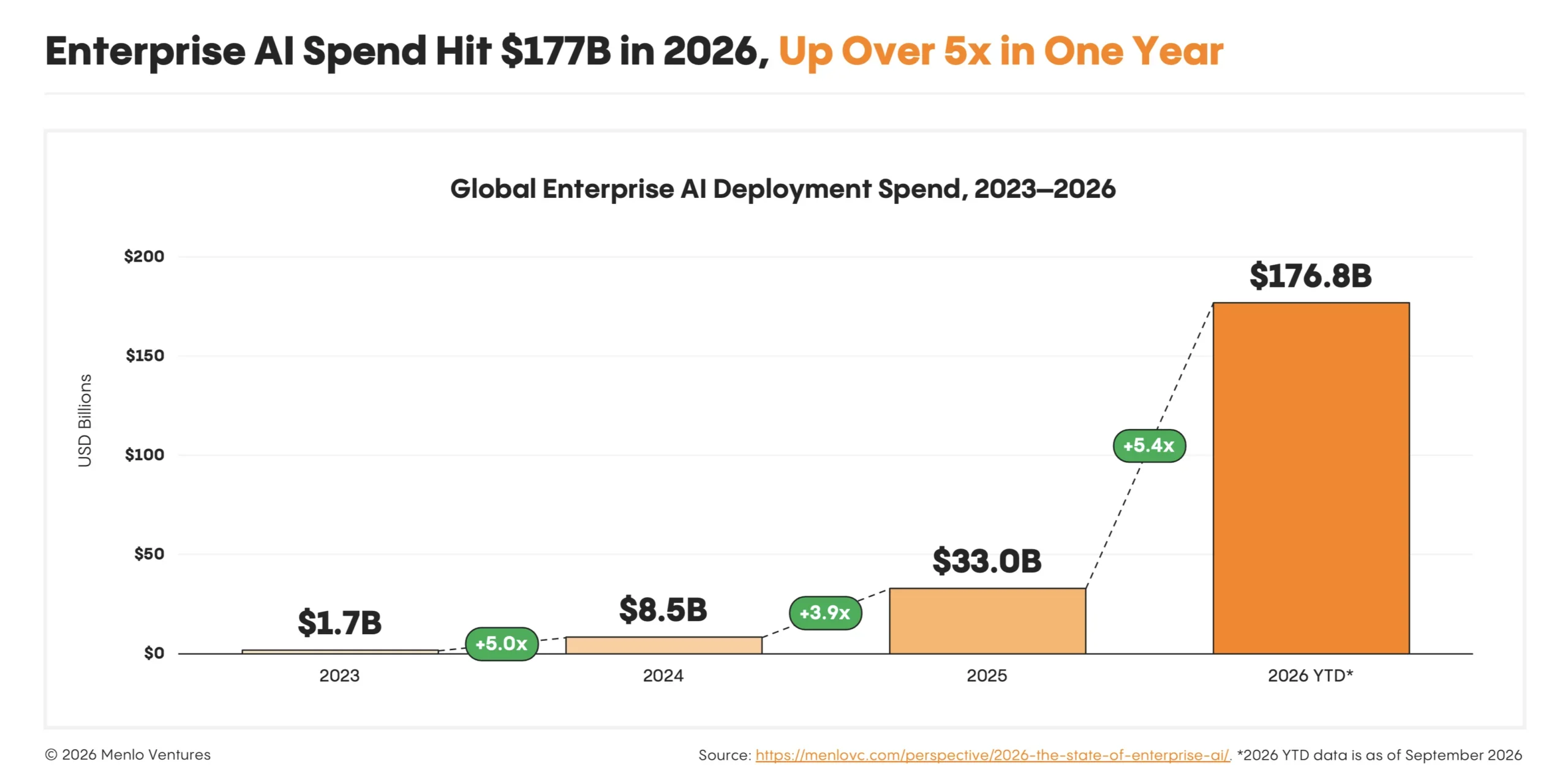
Menlo Ventures 2026 State of Enterprise AI: Enterprise AI Spend Hits $176.8B, Up 5.4x, as Anthropic Takes 55% of Enterprise API Spend

On November 3, Menlo Ventures released its fourth annual enterprise AI report. It estimates enterprise spending on using AI reached $176.8B by September 2026, up 5.4x from $33B in 2025. In enterprise LLM API spend, Anthropic rose from 40% to 55%, OpenAI from 27% to 31%, and Google fell from 21% to 9%. Coding is the largest app category at $34.0B. Figures come from a survey of about 400 US enterprise AI decision-makers plus third-party data, so they are estimates; Menlo is an Anthropic investor.

Menlo Ventures 2026 State of Enterprise AI: Enterprise AI Spend Hits $176.8B, Up 5.4x, as Anthropic Takes 55% of Enterprise API Spend

Key Takeaways

  • Enterprise AI deployment spend: $1.7B (2023) to $8.5B (2024) to $33B (2025) to $176.8B by Sep 2026, up 5.4x vs 3.9x last year (Menlo estimate)
  • Enterprise LLM API spend share: Anthropic 55% (from 40%), OpenAI 31% (from 27%), Google 9% (from 21%); open-source models are about 19% of usage but only 4% of spend
  • App-layer spend is about $77.3B: coding $34.0B and chatbots/productivity $25.0B make up 76%; Claude Code and Codex account for $24.0B (70%) of coding spend
  • On OpenRouter, agents generate 80% of tokens (about 130.9T per week), roughly 7x human usage, and have grown 37x since overtaking human traffic in February
  • 55% of incremental AI spend comes from net-new budgets and 22% from existing software budgets; the share of enterprises paying for AI rose only from 55% to 65%
Read full story