AI Coding Live News

SemiAnalysis releases GDPx, an agentic benchmark of 206 tasks across 11 high-value domains where the top model, Claude Opus 5.5, scores just 12%

On Nov 2, semiconductor and AI research firm SemiAnalysis released GDPx, a benchmark of agentic capability across 11 domains: chip design, cybersecurity, biology, finance, legal, quant trading, recursive self-improvement (RSI), hardware design, materials science, alignment and software engineering. Its 206 tasks were built by 14 specialist data partners, with SemiAnalysis doing final QA. On the official leaderboard Claude Opus 5.5 leads at 12.0%, followed by Gemini 4 Carbon at 10.9% and GPT-6 Astra at 9.6%; nearly every model scores 0 on finance and legal. SemiAnalysis says safety classifiers drag down Opus 5.5 and GPT-6 Astra, and plans a new version every 3–6 months. All scores are as reported by SemiAnalysis.

SemiAnalysis releases GDPx, an agentic benchmark of 206 tasks across 11 high-value domains where the top model, Claude Opus 5.5, scores just 12%

Key Takeaways

  • Scale: 11 domains, 14 data partners and 206 tasks, with a default time limit of 8 hours per task (GDPx site)
  • Leaderboard (as reported by SemiAnalysis): Claude Opus 5.5 12.0%, Gemini 4 Carbon 10.9%, GPT-6 Astra 9.6%, Muse Wonder Full 9.0%, Claude Fable 5.1 8.5%, GPT 6.1 Sol 8.4%, Claude Sonnet 5.5 8.2%
  • Lower tier and open weights: DeepSeek 4.1 Flash 1017 5.4%, GPT-6 Luna 5.1%, Grok 4.7 3.9%, GLM 5.3 2.7%; almost every model scores 0 on finance and legal
  • Method: each model runs in its native harness where one exists (Claude Code for Opus, Codex for Astra, Antigravity for Carbon), otherwise OpenCode; the headline is pass@1 over three attempts with all domains weighted equally (SemiAnalysis blog)
  • By domain: Opus 5.5 wins quant trading, hardware and chip design; Gemini 4 Carbon wins biology and software engineering; GPT-6 Astra wins RSI and materials science; Muse Wonder Full is the strongest cyber model
Read full story

Artificial Analysis releases AA-Omniscience v1.1: 3,000 refreshed questions and a calibrated 300-question public set, with Gemini 4 Carbon leading at a Net Score of 54

On October 31, independent evaluator Artificial Analysis released AA-Omniscience v1.1, its knowledge and hallucination benchmark and part of Intelligence Index v5. The question set shrinks from 6,000 to 3,000, dropping previously public and saturated questions, fixing errors and ambiguities, and adding new ones, and a new 300-question public set on Hugging Face is calibrated to the private set's difficulty, with 0.99 Pearson and Spearman correlation on Net Score. Gemini 4 Carbon (high) leads with a Net Score of 54, ahead of Claude Opus 5.5 at 48 and Claude Fable 5.1 at 46; Fable 5.1 has the highest accuracy (68%) and Gemini 4 Argon the lowest hallucination rate (4%). Models score about 1.9 points lower than on v1 on average, and MiniMax M3.1 Flash drops 22 points. All figures are as reported by Artificial Analysis.

Artificial Analysis releases AA-Omniscience v1.1: 3,000 refreshed questions and a calibrated 300-question public set, with Gemini 4 Carbon leading at a Net Score of 54

Key Takeaways

  • The question set shrinks from 6,000 to 3,000 across 6 domains and 42 topics: 600 each for science/engineering/math and software engineering, 450 each for finance, health, humanities/social sciences and law
  • A new 300-question public set is on Hugging Face, with 0.99 correlation to private-set Net Score and a median difference of 0.0 points
  • Net Score ranking: Gemini 4 Carbon (high) 54, Claude Opus 5.5 48, Claude Fable 5.1 46; the best open-weights model, Muse Spark Open, trails Gemini 4 Carbon by 28 points
  • Claude Fable 5.1 has the highest accuracy (68%), followed by Claude Opus 5.5 (66%); Gemini 4 Argon has the lowest hallucination rate (4%)
  • Rank order keeps a 0.98 Spearman correlation with v1, but scores are 1.9 points lower on average; MiniMax M3.1 Flash falls from 16 to -6 and MiMo V2.6 Pro from 8 to -5 (vendor-reported)
Read full story

Exin Therapeutics: Claude Sonnet 5 agent picks a gene therapy and drives a live mouse brain injection; Opus 5.5 declined

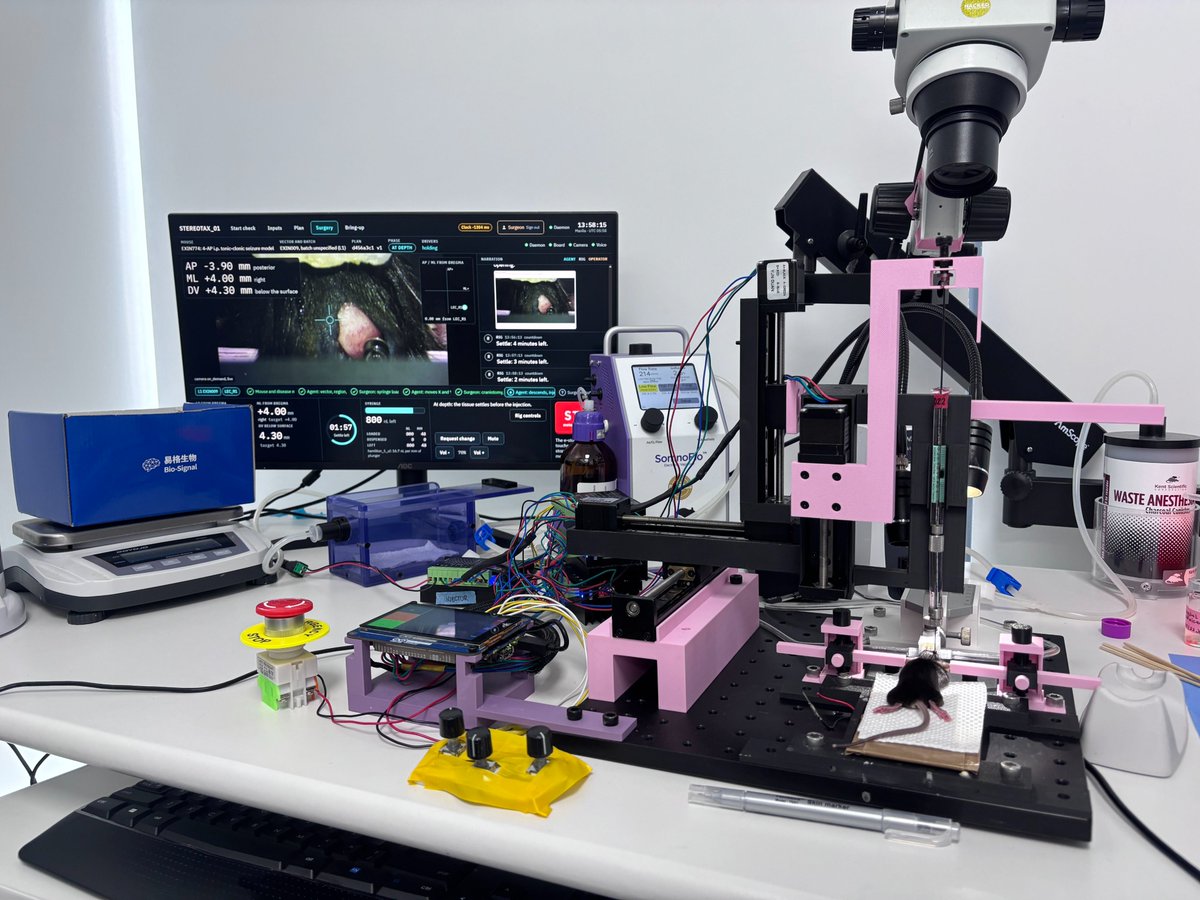
Exin Therapeutics co-founder and CEO Gabriel Ocana-Santero said on X on Oct 28 that an AI agent chose one of 19 gene therapy vectors, picked the brain region, derived coordinates from three papers and drove a stereotaxic rig to inject 250 nanolitres into an epilepsy-model mouse. WIRED reports Claude Opus 5.5 refused and Sonnet 5 did the run; a vet gated every irreversible step, and the work is not peer-reviewed.

Exin Therapeutics: Claude Sonnet 5 agent picks a gene therapy and drives a live mouse brain injection; Opus 5.5 declined

Key Takeaways

  • The agent chose the drug from 19 vectors, picked the brain region and derived coordinates from 3 papers (per the CEO)
  • It injected 250 nL while watching for bleeding via the rig camera; The Decoder reports 32 observations during the procedure
  • Per WIRED, Claude Opus 5.5 refused to inject, so the team used Sonnet 5; the run took just over 1 hour vs about 45 minutes normally
  • After a coordinate fault the agent refused to bypass its safety limits and the team had to fix the code separately; a vet still did the craniotomy
  • The original post drew 9,426 likes and 1.6M+ views; seizure outcomes are pending and nothing is peer-reviewed
Read full story

YC Labs pits AI agent swarms in Minecraft and Mindustry: GPT swarms win 12 of 16 head-to-head games against Claude, while a 50-agent colony slides into bureaucracy

YC Labs, a research project at Y Combinator, and multi-agent environment startup Olam Labs published "Agents in Games" on Oct 29. Fifty GPT-6.1 Sol agents told to "build a thriving civilization" in survival Minecraft spent three hours huddled in shelters rationing food, sending about 5,900 messages and inventing ration ledgers, permits and job titles. In nine Bed Wars games, 10 GPT-6.1 Sol agents beat 10 Claude Opus 5.5 agents 6–3; in seven 50-vs-50 Mindustry matches lasting about 9.5 hours, GPT won 6–1. The leader was almost always whichever agent was listed first in the directory, and stuck GPT agents fetched the game's public source code on their own. The Minecraft harness is open source. These are one lab's experimental observations, not a standardized benchmark.

YC Labs pits AI agent swarms in Minecraft and Mindustry: GPT swarms win 12 of 16 head-to-head games against Claude, while a 50-agent colony slides into bureaucracy

Key Takeaways

  • Head-to-head: GPT-6.1 Sol won Bed Wars 6–3 over nine games and Mindustry 6–1 over seven, 12 of 16 overall (see the YC Labs report)
  • Civ50: 50 GPT agents sent about 5,900 messages in three hours; 22 of 34 deaths came on the first night, after which the colony turned cautious
  • No election: 46 of the other 49 agents first messaged Ada, first on the roster, who received 616 DMs and became leader
  • Communication: in one Bed Wars game GPT players sent 1,147 DMs versus Claude's 82; GPT drifted into compressed shorthand while Claude voted with "+1"
  • Open source: the long-running Minecraft agent harness is public at yc-software/minecraft-agent-harness
Read full story
ADSponsored

Kaggle and IBM Research launch the ScarfBench Java migration leaderboard: Gemini 4 Argon with Antigravity leads at 75.2%, and about 72% of failures happen at runtime

Kaggle announced ScarfBench with IBM Research, a 204-task benchmark that tests whether coding agents can migrate enterprise Java apps between Jakarta EE, Quarkus and Spring without changing behavior. IBM's October 27 technical note shows Gemini 4 Argon with Antigravity first on the smoke score at 75.2%, Claude Opus 5.5 with Claude Code highest on all-tests-pass at 72.1%, and GPT-6.1 Sol with Codex cheapest at $1.25 per solved task.

Kaggle and IBM Research launch the ScarfBench Java migration leaderboard: Gemini 4 Argon with Antigravity leads at 75.2%, and about 72% of failures happen at runtime

Key Takeaways

  • 204 migration tasks and 10 model-plus-harness configurations; top smoke scores are Gemini 4 Argon + Antigravity 75.2%, Claude Opus 5.5 + Claude Code 70.5% and Claude Opus 5 + Claude Code 69.8% (IBM figures)
  • Claude Opus 5.5 + Claude Code has the highest all-tests-pass rate at 72.1%, just ahead of Gemini 4 Argon at 71.1%
  • Compiling is mostly solved: 8 of 10 configurations compiled at least 97% of solvable tasks, yet smoke scores spanned more than 50 points
  • 535 of 745 classified failing runs (about 72%) were runtime behavioral failures, including 210 lost-route/404 failures
  • Cost per solved task: $1.25 for GPT-6.1 Sol + Codex, $1.59 for Gemini 3.8 Flash + mini-swe and $10.10 for Claude Opus 5.5 + Claude Code; public submissions are not open yet
Read full story

Cognition scores Gemini 4 Carbon at 40% on FrontierCode 2.0 for $4.04 a task, near the top, while Gemini 4 Argon gets 26.3% at $6.41

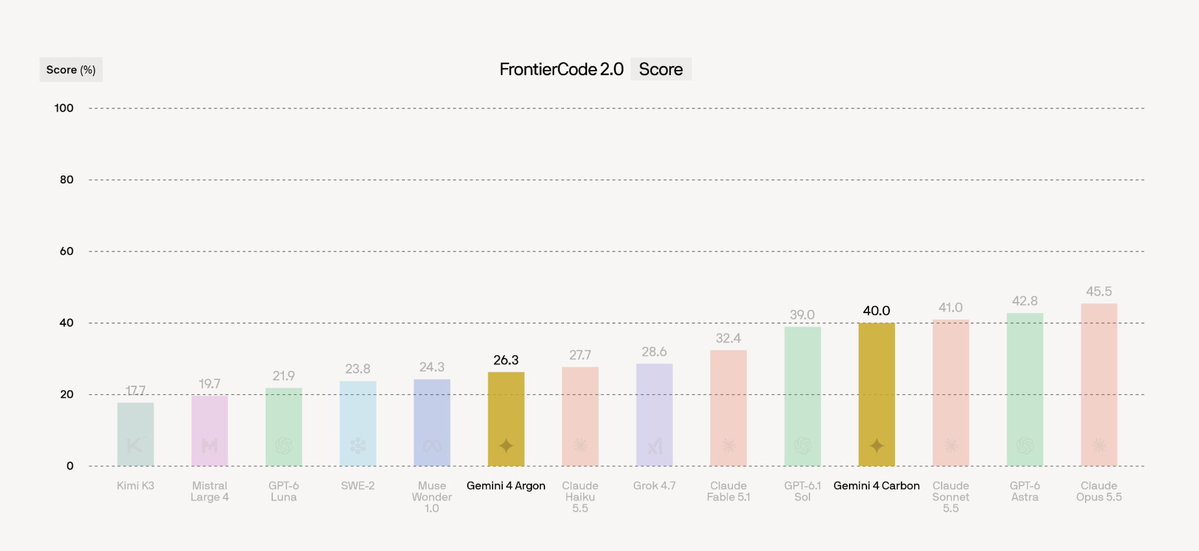
Cognition, the company behind Devin, posted on X at 01:45 UTC on Oct 30 that Google's new Gemini 4 Carbon scores 40% on its FrontierCode 2.0 coding benchmark at $4.04 per task, near the top and behind only Claude Opus 5.5, GPT-6 Astra and Claude Sonnet 5.5. The earlier Gemini 4 Argon scores 26.3% at a higher $6.41 per task. The results are Cognition's own runs, and the leaderboard on its site has been updated.

Cognition scores Gemini 4 Carbon at 40% on FrontierCode 2.0 for $4.04 a task, near the top, while Gemini 4 Argon gets 26.3% at $6.41

Key Takeaways

  • Gemini 4 Carbon scores 40% on FrontierCode 2.0 at $4.04 per task, behind Claude Opus 5.5 (45.5%), GPT-6 Astra (42.8%) and Claude Sonnet 5.5 (post)
  • Gemini 4 Argon scores 26.3% at $6.41 per task, ahead of Muse Wonder 1.0 but behind Claude Haiku 5.5 and Grok 4.7
  • From Argon to Carbon the score rises about 13.7 points while cost per task drops about $2.37
  • The changelog shows Gemini 4 Carbon was added on Oct 28; FrontierCode 2.0 has 132 tasks scored on whether a maintainer would merge the PR (leaderboard)
  • All figures are Cognition's own runs; Google has not published FrontierCode results itself
Read full story

Factory launches Droid 1.0: programmatic tool calling by default, hundreds of tool calls per model request, leads native harnesses on its own Terminal-Bench 4 runs

AI coding agent company Factory announced Droid 1.0 on X and its blog at 22:31 UTC on Oct 29, calling it the largest update yet to its agent harness. The key change makes programmatic tool calling (PTC) the default: the model writes a JavaScript program that runs up to hundreds of tool calls in a sandbox in one model request. In Factorys own Terminal-Bench 4 runs, Droid scored 57.6% with GPT-6.1 Sol ($0.79 per passed task) and 65.2% with Claude Opus 5.5 ($4.73), ahead of Codex, Claude Code, Cursor, OpenCode and Devin on the same models.

Factory launches Droid 1.0: programmatic tool calling by default, hundreds of tool calls per model request, leads native harnesses on its own Terminal-Bench 4 runs

Key Takeaways

  • Programmatic tool calling is now the default: the model writes JavaScript that runs in a sandbox with no file, network or system access of its own, making up to hundreds of tool calls per request, with independent calls run concurrently
  • Factory example: moving and verifying 151 Linear issues took 312 tool calls; direct calls needed about 36 requests and 3.1M input tokens, a Script needed 2 requests and 61K tokens
  • Terminal-Bench 4 (Factory runs, Oct 23-28, three trials per task): with GPT-6.1 Sol, Droid 57.6% vs Codex 54.0%, OpenCode 51.0%, Devin 45.0%; with Opus 5.5, Droid 65.2% vs Cursor and OpenCode 62.1%, Devin 59.6%, Claude Code 57.6%
  • The first request shrank from 20,887 to 13,055 tokens (-37%) and up-front tool definitions went from 11 to 2; newly loaded MCP tools are appended to keep the prompt cache intact, and a typical production request reads 98% of input from cache
  • Available now as a macOS and Windows desktop app, a terminal UI and the Droid SDK (@factory/droid-sdk); the benchmarks are vendor-run with no third-party reproduction yet
Read full story

Artificial Analysis launches Intelligence Index v5: 60% private test sets, Claude Opus 5.5 leads at 58 and the open-weights gap widens to 12 points

On Oct 28 independent evaluator Artificial Analysis released Intelligence Index v5, its biggest revision since v4 in January: it adds Cognition's FrontierCode 2.0 and Terminal-Bench-Science, swaps Humanity's Last Exam for HLE-Diamond, and now draws 60% of its weight from private or held-out test sets. Claude Opus 5.5 (max) leads at 58, ahead of GPT-6 Astra at 57 and GPT-6.1 Sol at 55; the top open-weights model, Kimi K3.1 Pro (weights not yet released), scores 46, widening the gap from 3 points in v4.3 to 12. It also launched Progress Index v1 for comparing models across years.

Artificial Analysis launches Intelligence Index v5: 60% private test sets, Claude Opus 5.5 leads at 58 and the open-weights gap widens to 12 points

Key Takeaways

  • Overall (vendor-reported by Artificial Analysis): Claude Opus 5.5 (max) 58, GPT-6 Astra (max) 57, GPT-6.1 Sol (max) 55; Anthropic and OpenAI hold the top five, with Gemini 4 Argon (high) next at 50
  • The open-weights gap grows from 3 to 12 points: Kimi K3.1 Pro scores 46, while released-weight leaders DeepSeek V4.1 Flash 1017 and GLM-5.3 (max) score 32, below Claude Haiku 5.5 (max) at 36
  • Cost per task varies more than 13x: among the top 10, GPT-6.1 Terra (max) is cheapest at $0.96 and Claude Fable 5.1 (max) priciest at $13.04; GPT-6.1 Sol trails Opus 5.5 by 4 points at about one eighth the cost ($1.27 vs $10.04)
  • Four categories at 25% each: Knowledge Work, Coding (FrontierCode 2.0 15%, Terminal-Bench 4.0 10%), Science and General; GDPval-AA v2.1, SciCode and AA-LCR were removed
  • Tasks are heavier: median output tokens per task rose from 35k to 59k, and effort matters more, with Opus 5.5 scoring 35 at low effort vs 58 at max for 10x the cost
Read full story

Cognition launches FrontierCode 2.0 coding benchmark: it asks whether a PR should be merged, and top model Claude Opus 5.5 scores just 45.5%

Cognition, the maker of Devin, released FrontierCode 2.0 on Oct 27. It keeps the method of maintainer-written tasks graded on whether the code is actually mergeable, but draws tasks from more repositories, adds security patches and performance work, uses deliberately underspecified prompts and adds many thoroughness criteria. In Cognition's results Claude Opus 5.5 leads at 45.5%, GPT-6 Astra follows at 42.8%, and Grok 4.7 and Gemini 4 Argon drop into the 20s, leaving the benchmark far from saturated.

Cognition launches FrontierCode 2.0 coding benchmark: it asks whether a PR should be merged, and top model Claude Opus 5.5 scores just 45.5%

Key Takeaways

  • Claude Opus 5.5 leads at 45.5% (54.6% on v1.1) and GPT-6 Astra scores 42.8% (53.3% on v1.1), per Cognition (vendor-reported)
  • Grok 4.7 scores 28.6%, Gemini 4 Argon 26.3%, Muse Wonder 1.0 24.3%, SWE-2 23.9%, DeepSeek V4.1 Flash 19.3% and Kimi K3 17.7%, showing a wide gap for open models
  • Versus v1.1, reference solutions touch 67% more files and 89% more lines in codebases 25% larger; tasks come from 55% more repositories with 43% more blocking criteria
  • Thoroughness blockers grew from 168 to 501, about 3x; in 80% of tasks the reference solution improves on the upstream PR, and an audit agent found and reported an upstream security vulnerability
  • On the cost-score Pareto frontier, Opus 5.5 sits at the high end and Luna, Haiku and Sol at the low-cost end, with GPT-6.1 Sol called out for strong value (official blog)
Read full story

Shanghai AI Lab ships Atria Dawn full release: 744B MoE GLM-5.2 agentic model, context doubled to 512K, MIT weights

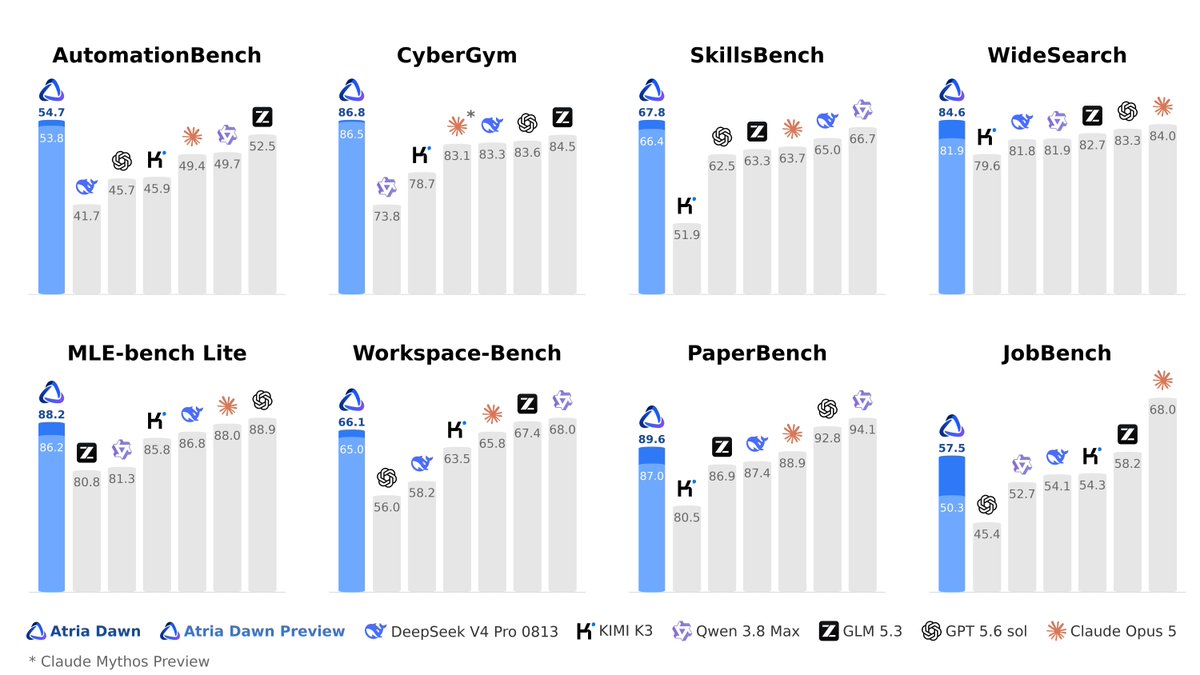
Shanghai AI Laboratory has moved Atria Dawn from Preview to a full release, with open weights (plus an FP8 build) on Hugging Face under internlm/Atria-Dawn and on ModelScope, MIT licensed. Built on the 744B-parameter MoE GLM-5.2, it targets long-horizon research and engineering agent work; context doubles from the Preview's 256K to 512K and input is text only. The vendor table shows it leading the listed models on AutomationBench, CyberGym and SkillsBench, while still trailing Claude Opus 5 on coding tests such as SWE-bench Pro and Terminal-Bench 2.1 (all vendor-reported).

Shanghai AI Lab ships Atria Dawn full release: 744B MoE GLM-5.2 agentic model, context doubled to 512K, MIT weights

Key Takeaways

  • 512K context, double the Preview's 256K; built on the 744B-parameter MoE GLM-5.2, text input only
  • BF16 and FP8 weights on Hugging Face and ModelScope, MIT license
  • Vendor-reported: AutomationBench 54.7, CyberGym 86.8, SkillsBench 67.8, BFCL V4 78.4, each the top score in its table
  • Weak spots from the same table: SWE-bench Pro 61.7 vs 76.5 for Claude Opus 5, Terminal-Bench 2.1 81.0 vs 90.2
  • Local serving needs SGLang v0.5.13.post1+ or vLLM v0.23.0+; an OpenAI-compatible API also plugs into Codex
Read full story
Linked Models & Agents:
ADSponsored

FrontierCS 2 benchmark: agents must rebuild a paper's deleted contribution in its own repo and beat the authors' code; Claude Opus 5.5 leads at 58%, 16 tasks unsolved

Teams from UC Berkeley, Princeton and others released FrontierCS 2 (arXiv 2610.29932): 48 tasks across 13 CS domains, each built by deleting a paper's contribution from the authors' released code. An agent has 5 hours to write it back and passes only if it beats the original on every metric and every hidden workload. Of 12 agents, Claude Opus 5.5 in Claude Code leads with a 58% pass rate, every other agent passes fewer than half, and 16 tasks have no passing run. On Oct 26 maintainer Wenhao Chai said a trace audit showed the Pi harness ends runs on refusals; rerun in Antigravity, Gemini 4 Argon now beats GPT-6 Astra and sits right behind Opus 5.5.

Key Takeaways

  • 48 tasks, 13 domains, 12 agents, one run per agent per task (paper)
  • Strict pass rule: the final submission must beat the authors' code on every metric and every hidden workload; a higher total score can still fail
  • Claude Opus 5.5 in Claude Code leads with a 58% pass rate; 16 tasks have no passing run
  • Under the Pi harness, 10 of Gemini 4 Argon's 48 runs ended on provider refusals; rerun in Antigravity it beats GPT-6 Astra (Wenhao Chai's post)
  • Tasks and evaluators are open source on GitHub; the authors estimate a full 48-task run with Opus 5.5 at about $1,000 in API fees, $300 GPU and $100 CPU
Read full story

Moonshot launches Kimi K3.1 Pro: 2.8T-total / 104B-active open-weight MoE with 1M context, 65.7% on Terminal-Bench 4.0, API at $2/$10, weights by Nov 4

On 2026-10-23 (17:15 UTC) the official @Kimi_Moonshot account launched Kimi K3.1 Pro, alongside K3.1 Pro Highspeed (2-3x faster). Both are live on Kimi.ai, Kimi Work, Kimi Code and the Kimi API, and full weights are promised by 2026-11-04. The official tech blog describes it as a post-trained version of K3 with much larger multi-domain joint RL: a 2.8T-total / 104B-active MoE, 1M-token context, multimodal. Vendor-reported scores: 65.7% on Terminal-Bench 4.0 (GPT-6 Astra 58.2%, Claude Opus 5.5 66.4%) and 92.7% on BenchCAD with tools. The Kimi API pricing page lists kimi-k3.1-pro at $2 input, $10 output and $0.20 cached input per million tokens, down from K3 at $3/$15.

Moonshot launches Kimi K3.1 Pro: 2.8T-total / 104B-active open-weight MoE with 1M context, 65.7% on Terminal-Bench 4.0, API at $2/$10, weights by Nov 4

Key Takeaways

  • 2.8T-total / 104B-active MoE, 1M-token context, multimodal; full weights promised by 2026-11-04 (official blog)
  • Vendor-reported: 65.7% on Terminal-Bench 4.0, ahead of GPT-6 Astra (58.2%) and just behind Claude Opus 5.5 (66.4%); 61.2% on the internal Kimi Code Bench 3.0 Long-horizon (K3: 55.95%)
  • API pricing: kimi-k3.1-pro at $2 input / $10 output / $0.20 cached input per million tokens; Highspeed at $4 / $20 (pricing page)
  • On the internal Kimi Hallu Bench Hard stress test, claim-level hallucination fell from 23.4% (K3) to 8.3%; Moonshot notes this is not a daily-use error rate
  • Cyber-related data was removed from mid-training and RL for the open-weight release: xdev-bench-hard pass@3 drops from 90.5% (unmitigated checkpoint) to 81.0%
Read full story
Linked Models & Agents:

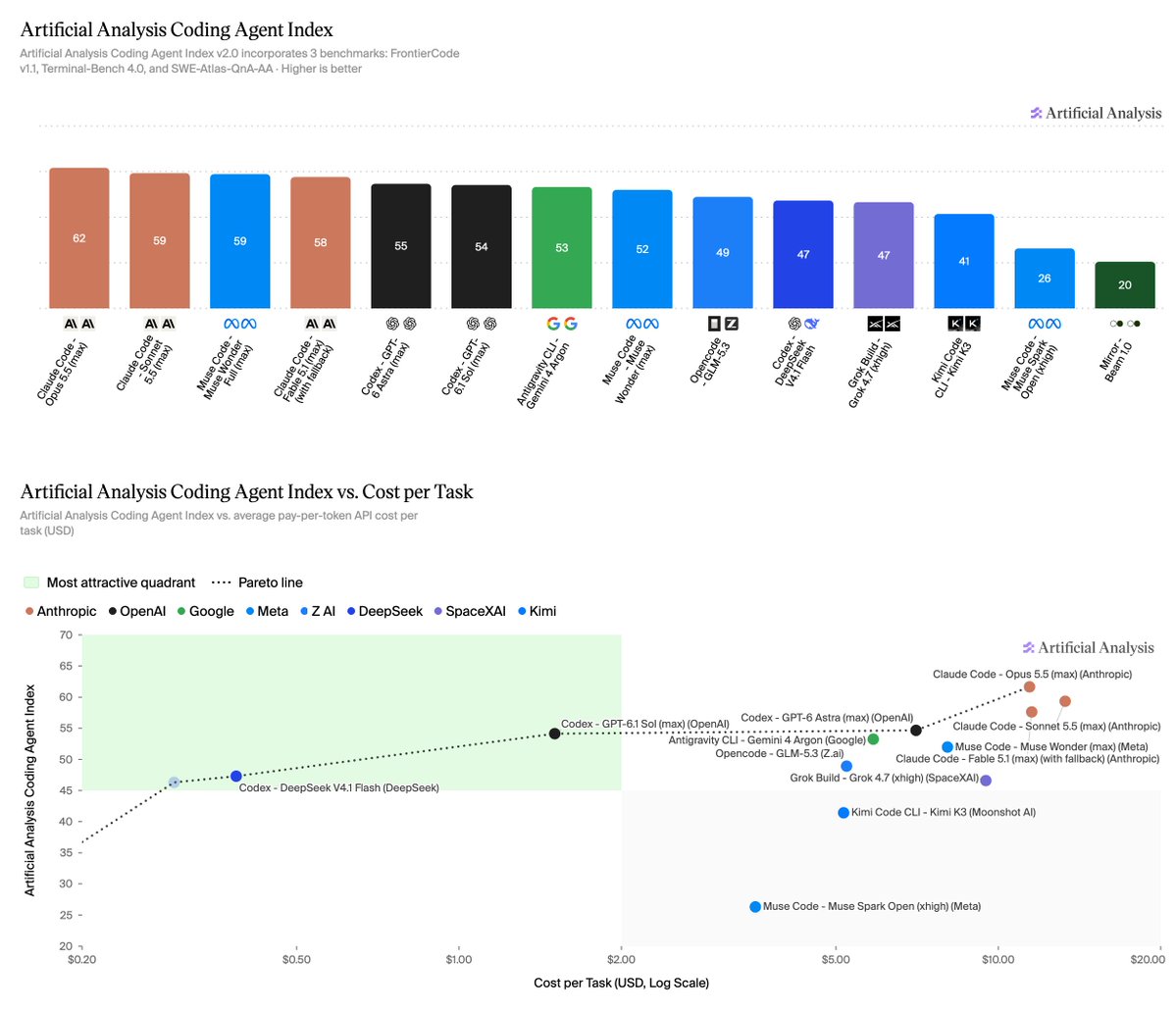
Artificial Analysis launches Coding Agent Index v2.0: FrontierCode from Cognition replaces DeepSWE, and Claude Code with Opus 5.5 leads at 61.7

On 2026-10-23 Artificial Analysis launched Coding Agent Index v2.0, which scores model-plus-harness combinations across 290 tasks with three equally weighted benchmarks: FrontierCode v1.1 from Cognition (100 tasks on real open-source repos, graded on whether a maintainer would merge the change) replaces DeepSWE v1.1, SWE-Atlas-QnA becomes the stricter SWE-Atlas-QnA-AA, and Terminal-Bench 4.0 is unchanged. Claude Code with Claude Opus 5.5 (max) leads at 61.7, ahead of Sonnet 5.5 at 59.3 and Muse Wonder Full at 58.9. Scores fall across the board: the 21 configurations measured on both versions drop from a mean of 54.8 to 47.4.

Artificial Analysis launches Coding Agent Index v2.0: FrontierCode from Cognition replaces DeepSWE, and Claude Code with Opus 5.5 leads at 61.7

Key Takeaways

  • Top of the index: Claude Code with Claude Opus 5.5 (max) 61.7, Claude Sonnet 5.5 (max) 59.3, Muse Code with Muse Wonder Full (max) 58.9, Claude Fable 5.1 (max with fallback) 57.6 (Artificial Analysis figures)
  • On FrontierCode v1.1, Opus 5.5 scores 56.0%, ahead of Codex with DeepSeek V4.1 Flash at 52.6%; 15 of 24 configurations sit between 43% and 49%
  • Version shift: 21 configurations average 54.8 on v1.5 and 47.4 on v2.0, with 20 of 21 moving down; the same set averages 45.1% on FrontierCode versus 65.6% on DeepSWE
  • Four points on the cost frontier: DeepSeek V4.1 Flash 47.3 at $0.39 per task, GPT-6.1 Sol 54.1 at $1.50, GPT-6 Astra 54.7 at $7.04, Opus 5.5 61.7 at $11.42 (pay-per-token API costs, not subscriptions)
  • SWE-Atlas-QnA-AA rewords 127 of 1,306 rubric criteria and uses GPT-6 Luna (xhigh) as judge with five votes per criterion; dataset and judge config are on Hugging Face
Read full story

Artificial Analysis Releases HealthBench & MLCR-AA: Exposing Severe Verbosity Bias in Medical AI Rankings

Independent AI evaluation platform Artificial Analysis officially released HealthBench Professional alongside the length-normalized MLCR-AA index (@ArtificialAnlys). The benchmark revealed a pervasive industry blindspot: LLM-as-a-Judge evaluations suffer from acute 'verbosity bias', disproportionately rewarding longer generations regardless of medical conciseness. In raw HealthBench scoring where Anthropic outputs were 4–6x longer, Claude Opus 5.5 led at 71.4%. However, once length bias was scientifically normalized via MLCR-AA, GPT-6 Astra (max) tied Claude Sonnet 5.5 for #1, while Claude Opus 5.5 plummeted from #1 down to #6, setting a new rigorous standard for medical model evaluation.

Artificial Analysis Releases HealthBench & MLCR-AA: Exposing Severe Verbosity Bias in Medical AI Rankings

Key Takeaways

  • Artificial Analysis unveils HealthBench Professional and the length-calibrated MLCR-AA benchmark
  • Exposes pervasive verbosity bias where evaluation judges disproportionately favor verbose outputs (Anthropic outputs averaged 4–6x longer)
  • Raw HealthBench placed Claude Opus 5.5 at #1 (71.4%) ahead of Sonnet 5.5 (70.8%) and GPT-6 Astra (69.7%)
  • Length-adjusted MLCR-AA shows GPT-6 Astra (max) tying Sonnet 5.5 for #1, while Opus 5.5 plummets from #1 to #6
Read full story

Anthropic opens Claude Duet research preview: a proactive personal agent app built on Opus 5.5, waitlist for US Pro and Max

On Oct 21, Anthropic opened a research preview of Claude Duet, a standalone app (iOS, Android and claude.ai) built around Claude Opus 5.5 that proactively surfaces what needs your attention, keeps working when you step away, and checks with you before acting on your behalf. It starts with a waitlist for US Pro and Max subscribers and shares the same usage limits as the rest of Claude.

Anthropic opens Claude Duet research preview: a proactive personal agent app built on Opus 5.5, waitlist for US Pro and Max

Key Takeaways

  • Positioning: a proactive agent that sends a morning brief and then messages you only when something needs you; it checks connected accounts every few hours
  • Model: designed around Claude Opus 5.5; carries over memory, skills and connected apps from your Claude account, with 6,000+ connectors and plugins per the product page
  • Execution: runs in its own virtual machine with a browser, so tasks continue with your laptop or phone off
  • Safety: credential handling follows the Managed Agents design so it never sees passwords; a new classifier blocks sharing card numbers and government IDs
  • Access: waitlist, US Pro and Max first, counted against existing plan limits
Read full story