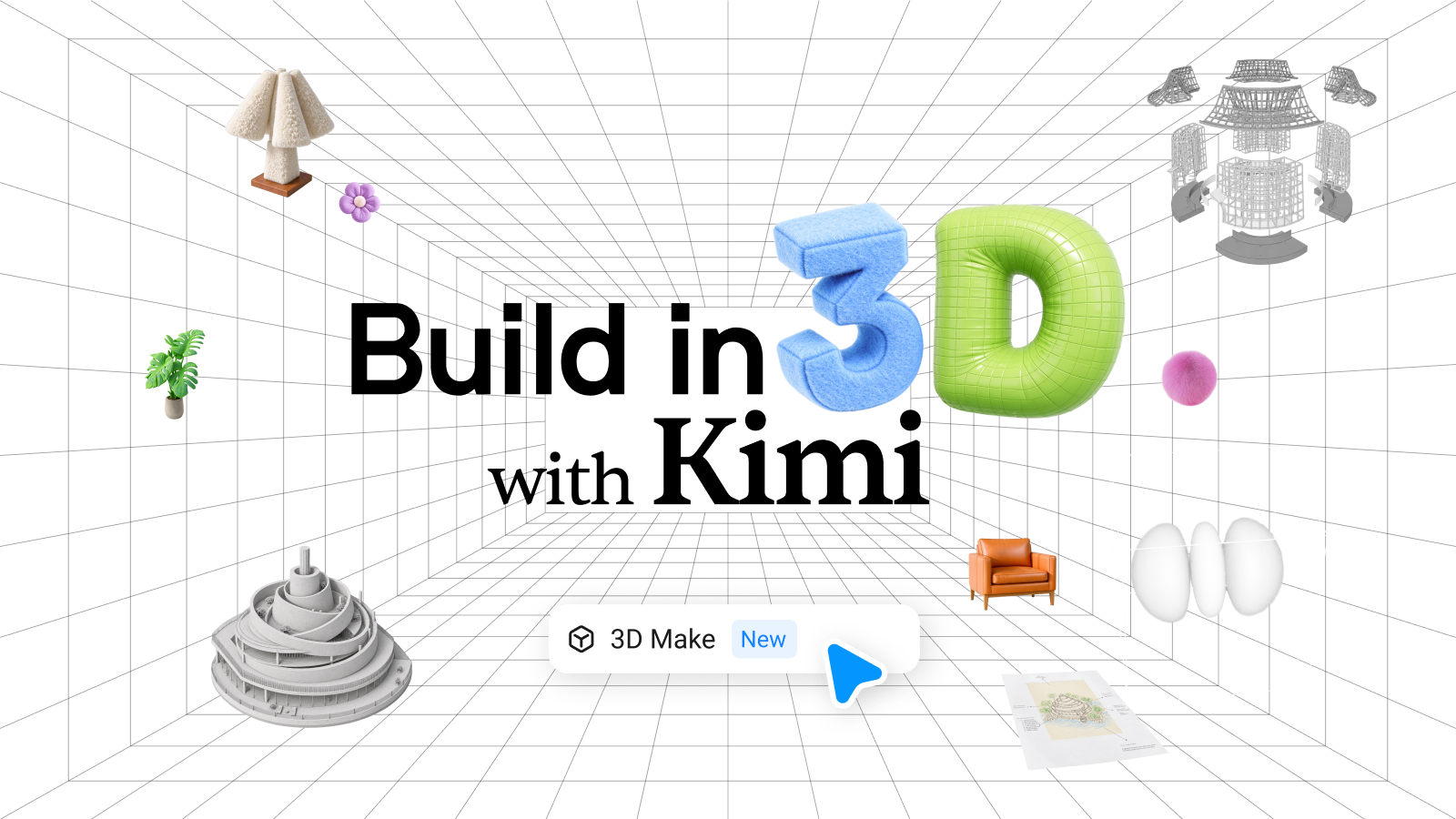
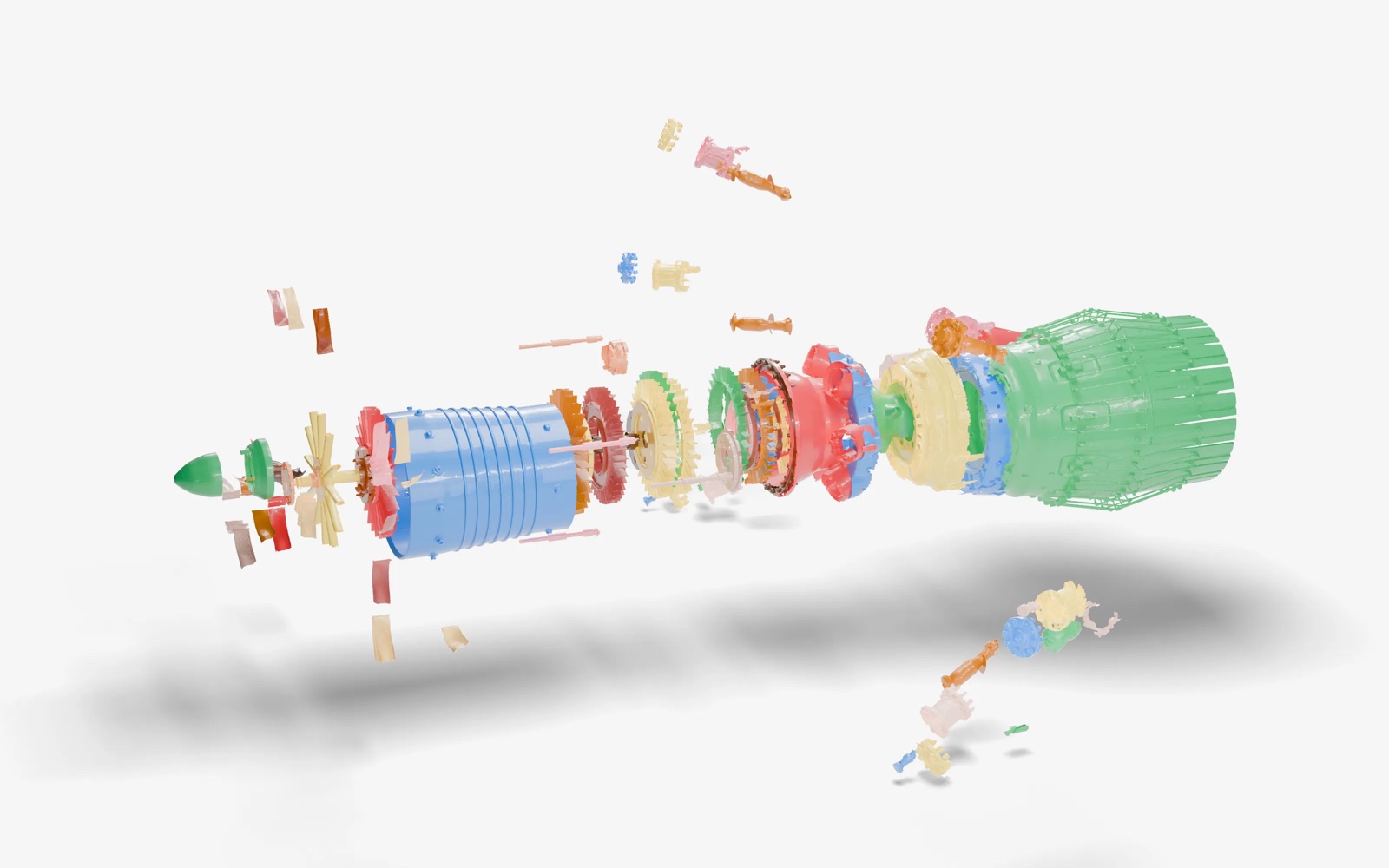
Moonshot AI's official Kimi account announced 3D Make at 03:14 UTC on Oct 30, saying Kimi connects to tools such as Blender and CAD software to create models, assemble scenes and develop games, available now on kimi.ai and Kimi Work. The companion 3D guide says K3.1 Pro was specifically trained to drive 3D software through Python scripts, so specialized tools without MCP support can join the workflow, while meshes such as people and animals are handed to diffusion services like Tripo. Plugins that need locally installed software work only in Kimi Work.
Zoom
Key Takeaways
Availability: 3D Make is live on kimi.ai and Kimi Work; plugins that need locally installed software are Kimi Work only
Two modeling routes: parametric models (furniture, mechanical parts, buildings) via Python scripts written by K3.1 Pro, and meshes via services such as Tripo, Meshy and Hyper3D
Engines: Kimi says it is adapted to Unreal Engine, Unity and Godot to import models, assemble scenes and build gameplay step by step
Showcase: the celestial palace in the K3.1 Pro launch video was built in Unreal Engine 5.8 from source models totaling 36 million triangles, rendered with Nanite and Lumen
Benchmarks: no 3D benchmarks were published; the guide admits some tasks need several rounds, and rigging and complex materials remain weak spots
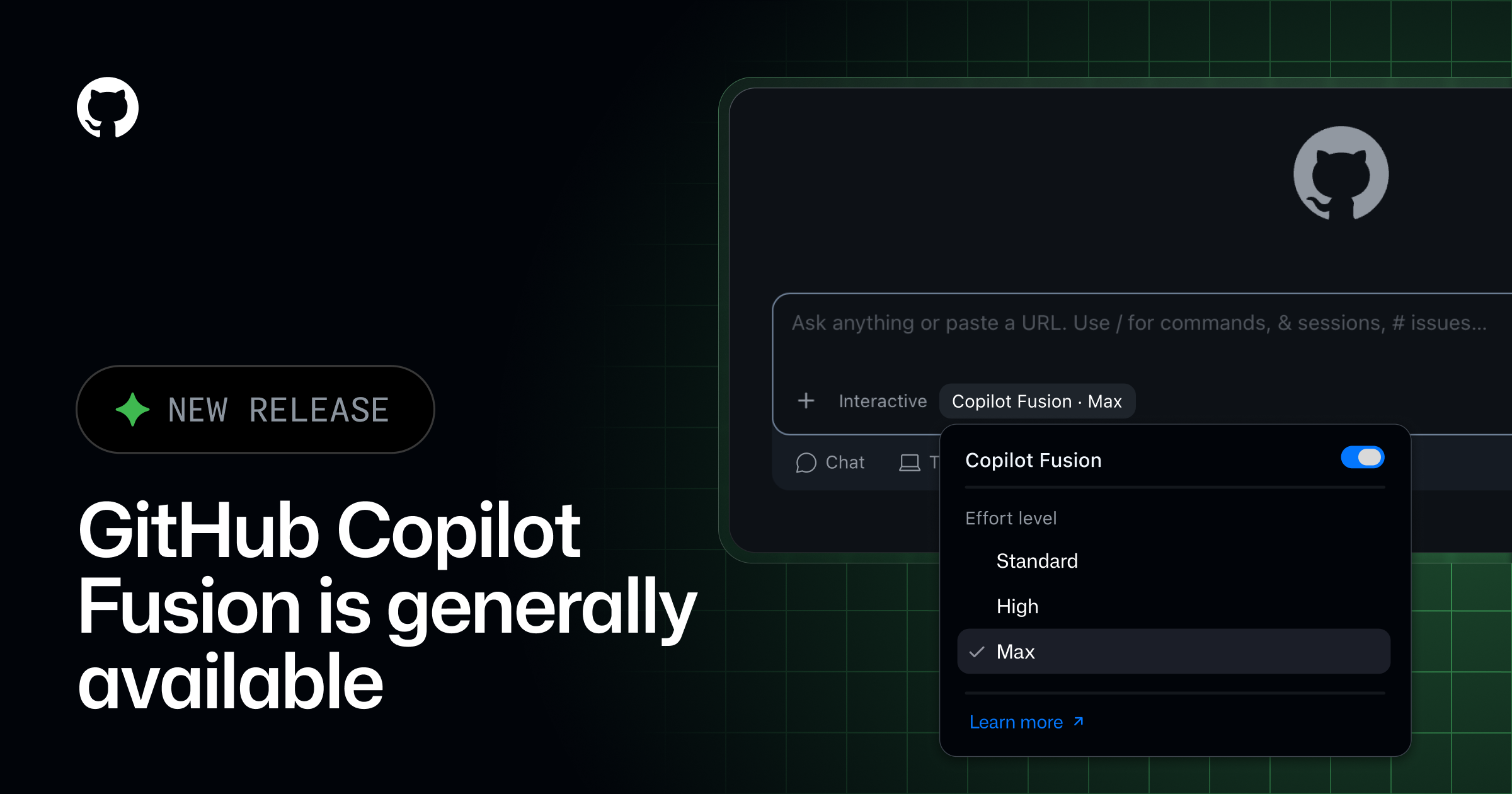
At GitHub Universe 2026 on Oct 28, GitHub made Copilot Fusion generally available. It merges the multi-model orchestration of the Project HydraFusion research preview with Copilot auto model selection: users pick Copilot Fusion and an effort level (Standard, High or Max) in the model picker, and the system decides which models to use and whether to run a Single, Cascade or Critique workflow. GitHub says Fusion Max scored 60 on the Artificial Analysis Coding Agent Index, two points below Claude Code with Opus 5.5 Max, at about half the API cost per task, about half the tokens and about 40% less time. Each underlying model is billed at its standard rate, and paid plans get 30% off through Nov 30.
Zoom
Key Takeaways
Scores (Artificial Analysis Coding Agent Index v2.0): Fusion Max 60 versus 62 for Claude Code with Opus 5.5 Max; $5.59 per task versus $11.42, while the Devin Fusion pairing scores 62 at $8.00
Breakdown: a slight lead on Terminal-Bench 4.0 at 71, third on FrontierCode at 51 (Claude Code 56, Devin Fusion 54), and a weaker 57 on SWE-Atlas-QnA-AA
Efficiency: about 7.2M tokens per task, roughly half of Claude Code with Opus 5.5 and 30% fewer than Devin Fusion; GitHub reports about 40% less time per task
The pool includes Claude Opus 5.5, Claude Sonnet 5.5, GPT-6 Astra and GPT-6 Sol; admins can disable individual models for Fusion only and set Fusion as the default
Availability: all Copilot plans in VS Code, the Copilot app, Copilot CLI and JetBrains IDEs; existing auto, HydraFusion and HydraFusion Max selections migrate to matching effort levels
On Oct 28 DiffuSpace, whose members come from the HKU NLP group behind Dream 7B, released its first model, Clover-35B-A3B-Preview: a mixture-of-experts diffusion language model initialized from Qwen3.6-35B-A3B, with 35B total and about 3B active parameters, a 128K context window and block-parallel denoising. Vendor-reported results include 73.6 on SWE-bench Verified, 51.7 on Terminal-Bench 2.1 and 83.8 on GPQA Diamond, with 680 tokens/s on a single GB300 in agent workloads. Weights are Apache 2.0 on Hugging Face, ModelScope and GitHub, with SGLang and llama.cpp support.
Zoom
Key Takeaways
A 35B-total, roughly 3B-active MoE diffusion model initialized from Qwen3.6-35B-A3B, with 128K context and a thinking mode
DiffuSpace says it tops all six agent benchmarks it compared: SWE-bench Verified 73.6, Terminal-Bench 2.1 51.7 and tau3 Overall 65.3, ahead of LLaDA2.2 flash, Mercury 2.5 and Qwen3.6-35B-A3B
Speed (vendor-reported): 680 tokens/s on one GB300 at BF16 and batch size 1 in agent workloads, and 515 tokens/s on one H200 versus 365 tokens/s for Qwen with DFlash2
An INT4 build runs on a 16GB RTX 5070 Ti at 101.8 tokens/s on MATH-500
Weights on Hugging Face are Apache 2.0, about 69GB in BF16, and SGLang is the recommended serving path
At Oracle AI World in Las Vegas on Oct 26, Oracle announced Oracle Fusion Claw, a new execution runtime for agents, and 25 Claw-powered Agentic Applications now available across ERP, HCM, supply chain (SCM) and customer experience (CX). It also introduced Fusion Companion and Fusion Agentic Home: employees describe a goal in natural language in supported AI tools such as ChatGPT or in the native Fusion interface, and the system picks and coordinates the transactions, workflows, approvals and AI agents needed, within existing identity, permission and approval controls. Oracle has not published pricing, benchmarks or a detailed rollout schedule.
Zoom
Key Takeaways
Runtime: Fusion Claw is a new agent execution runtime that Oracle says supports larger-scale and longer-running work, continuous replanning, deterministic execution and governed autonomy (press release)
Scale: 25 Claw-powered Agentic Applications are available now across the ERP, HCM, SCM and CX suites, including Ledger, Workforce Orchestration, Payroll Activity Workspace and Procurement Spend
Access: Fusion Companion works through supported AI tools such as ChatGPT and customer- or partner-built interfaces, with Fusion Agentic Home as the native entry point (Fusion Companion release)
Governance: all execution stays within existing identity, permissions, policies and approval controls, and decisions needing human judgment are escalated
Not disclosed: Oracle has not published pricing, benchmarks or a per-app rollout schedule
Researchers from NUS and CUHKSZ have introduced SolarRenderer (arXiv:2610.28630), a structure-conditioned generative reference rendering framework. Converting game engine grey-boxes, pose skeletons, semantic maps, and depth passes into photorealistic video, SolarRenderer adapts a frozen MiniMax-H3 33B backbone via lightweight control and 4-step generation LoRAs. Using structure-guided distribution matching, it renders stylized video in just 4 denoising steps (~12.3x faster than 50-step diffusion) and introduces a block-causal variant for real-time 768p streaming synthesis in generative game engines.
Zoom
Key Takeaways
SolarRenderer (arXiv:2610.28630) enables high-fidelity video rendering directly from coarse 3D geometry (grey-boxes, skeletons, depth, meshes)
Adapts a frozen MiniMax-H3 33B backbone with lightweight Control and 4-step LoRA modules, preserving visual priors
Requires only 4 denoising steps via structure-guided distribution matching, achieving a 12.3x acceleration over 50-step baselines
Block-causal streaming variant achieves real-time continuous 768p video generation for next-generation generative gaming engines
During the GTC Berlin keynote, NVIDIA unleashed a sweeping array of open-weights domain-specific foundation models. The release highlights include the multimodal Nemotron 3.5 Super VL, the lightweight Nemotron 3.5 Bolt series, and the end-to-end Nemotron Retriever suite for embedding, reranking, and document OCR. For physical AI, NVIDIA debuted the Cosmos world models and Alpamayo 2 Edge autonomous driving models. In life sciences, NVIDIA and the Baker Lab released BioNeMo RFD4-Proteina, which establishes state-of-the-art accuracy across more than 10 protein design benchmarks while synthesizing 200-amino-acid binders roughly 13x faster than RFdiffusion3.
Zoom
Key Takeaways
NVIDIA released an extensive open-weights portfolio at GTC Berlin: Nemotron 3.5 Super VL, Bolt 4GB edge variants, and Cosmos world models
Unveils the full Nemotron Retriever suite for embedding, reranking, and multimodal document parsing, boosting enterprise RAG fidelity
Co-developed BioNeMo RFD4-Proteina with the Baker Lab, leading on over 10 structural protein design benchmarks
Synthesizes 200-amino-acid de novo proteins 13x faster than RFdiffusion3, dramatically shortening computational drug discovery timelines
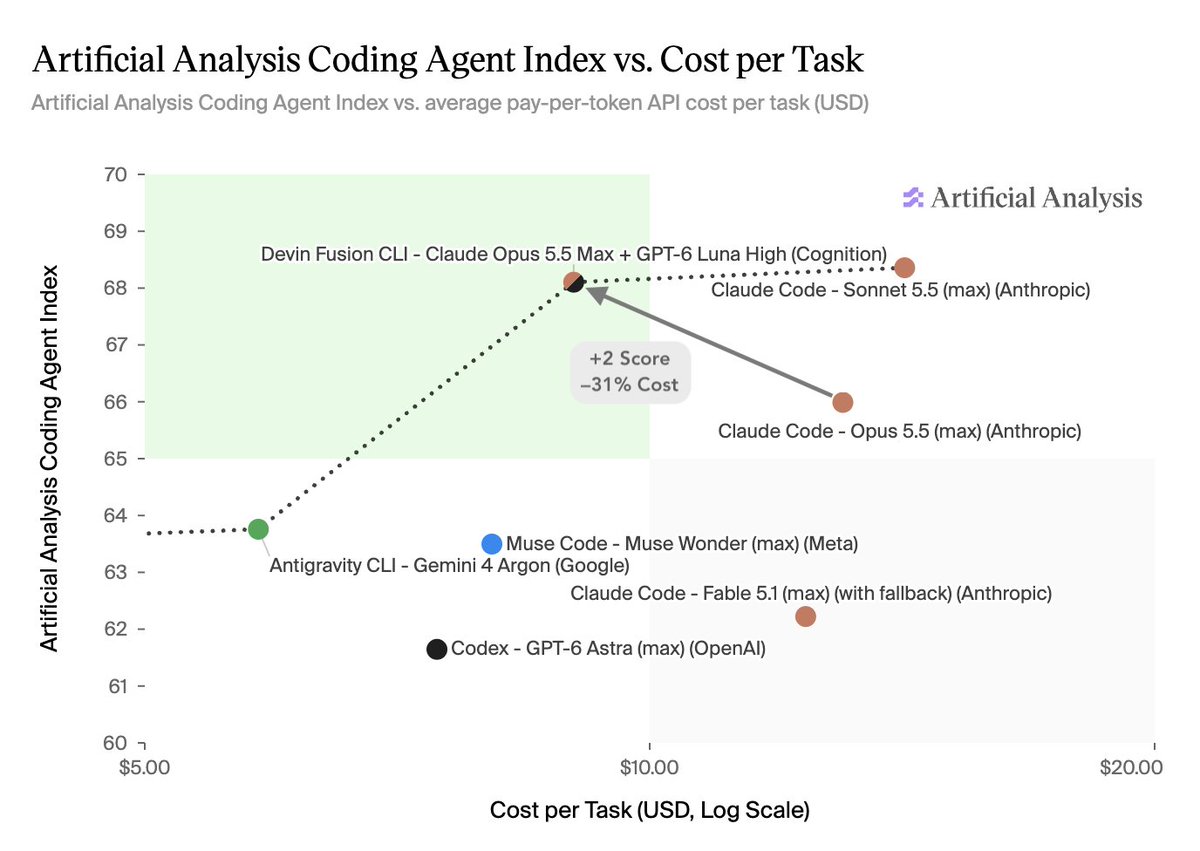
Artificial Analysis released an independent evaluation of Cognition's new coding agent, Devin Fusion. Moving beyond single-model execution, Devin Fusion employs an asymmetric multi-agent architecture pairing Claude Opus 5.5 (max) as the lead reasoning orchestrator alongside GPT-6 Luna (high) as a high-speed parallel worker. In the standardized Coding Agent Index, Devin Fusion achieved an elite score of 68.1 (matching Muse Code at 68.0 and rivaling Claude Code Sonnet 5.5 at 68.4). Crucially, the hybrid architecture slashes average task expense from $13.04 down to $9.01 (a 31% cost reduction) while shortening execution runtime from 65 to 55 minutes.
Zoom
Key Takeaways
Artificial Analysis independently benchmarked Devin Fusion, scoring 68.1 on the standardized Coding Agent Index
Pioneers asymmetric model collaboration: Claude Opus 5.5 orchestrates architecture while GPT-6 Luna executes parallel sub-tasks
Cuts per-task execution costs from $13.04 to $9.01 (a 31% savings) and trims average completion time from 65 to 55 minutes
Outperforms Claude Code with Opus 5.5 on DeepSWE v1.1 (72.6% vs 68.4%) and SWE-Atlas-QnA (69.6% vs 66.4%)
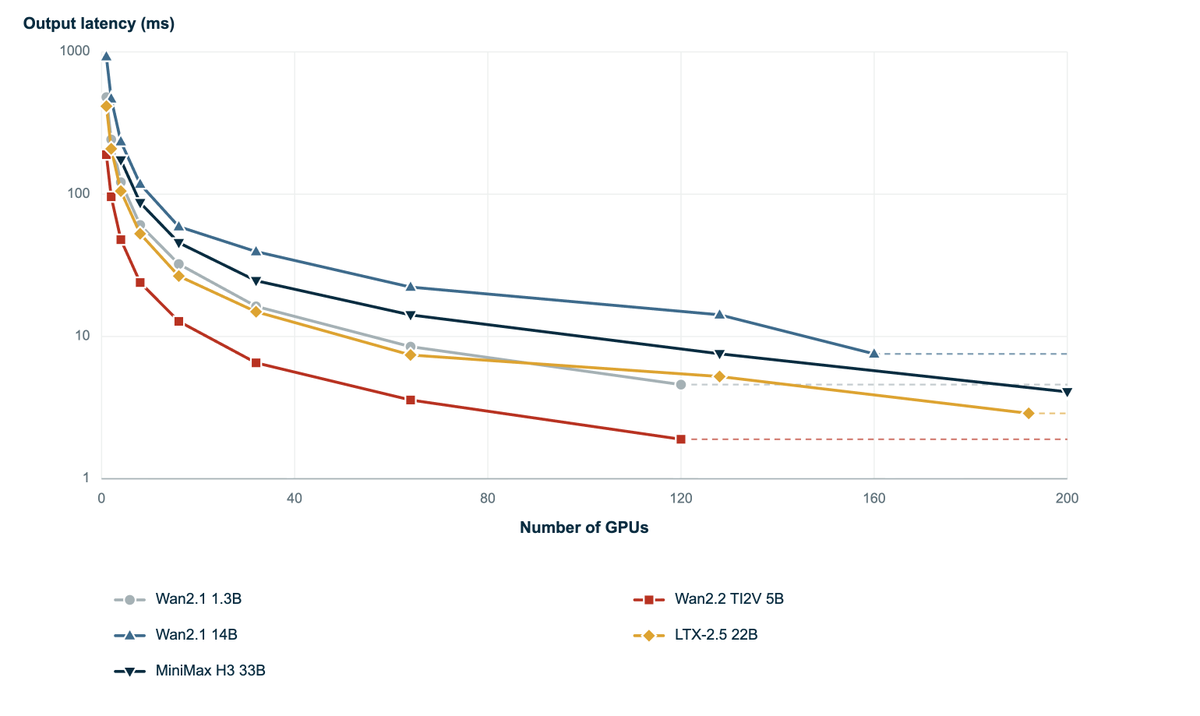
The vLLM Project officially announced that PhysisServe's core physical-world serving techniques are being integrated into vLLM-Omni. Addressing the severe memory bottlenecks and latency spikes of multi-step video diffusion and physical AI generation, PhysisServe introduces cross-denoising-step pipeline parallelism across Transformer blocks, time-shared batching, and virtual-rank joint scheduling. Benchmarked on MiniMax H3 33B across 200 GPUs, it generates a chunk every 4.1 ms (~1,000 FPS without VAE decoding), while cutting single-GPU latency for Wan2.2 5B from 173 ms down to 98 ms.
Zoom
Key Takeaways
The vLLM project announced the upstream integration of PhysisServe's serving architecture into vLLM-Omni for physical AI and video models
Introduces cross-timestep block pipelining and time-shared batching to eliminate GPU communication bubbles in multi-step diffusion
Generates a video chunk every 4.1 ms on MiniMax H3 33B across 200 GPUs (~1,000 FPS), cutting Wan2.2 5B single-card latency to 98 ms
Expands 24-GPU serving concurrency by 1.7x to 3.3x, with full open-source code merging into the vLLM-Omni mainline
Adobe Research and Brown University released OmniXRef (arXiv:2610.22744), a unified framework for multimodal multi-reference video editing. Overcoming the limitations of prior systems constrained to text prompts or single visual exemplars, OmniXRef utilizes a single-stream Diffusion Transformer with Mix-Patchify and Reference-Relative RoPE (R2-RoPE) to jointly control camera motion, subject content, dynamic motion, style, and visual effects (VFX). In camera trajectory evaluations, OmniXRef cuts rotation and translation errors by more than 5x compared to leading commercial engines.
Zoom
Key Takeaways
Adobe Research and Brown University released OmniXRef (arXiv:2610.22744), a unified framework for multi-reference video editing across text, images, and videos
Features a single-stream Diffusion Transformer with Mix-Patchify and R2-RoPE for multimodal cross-attention
Cuts camera trajectory error by more than 5x over commercial flagship Seedance 2.5, recording 0.874 RotErr and 3.961 TransErr
Achieves modular control across Camera, Motion, Content, Style, and VFX with an interactive project page now live
Cognition said on October 19 that Devin Fusion, pairing Claude Opus 5.5 as the lead with GPT-6 Luna as the sidekick, scored 68.1 on the Artificial Analysis Coding Agent Index v1.5. Artificial Analysis's current data puts it first, but only 0.1 ahead of Muse Code with Muse Wonder Full at 68.0, effectively a tie; Antigravity CLI with Gemini 4 Argon is third at 63.8. Cognition says the pairing costs 31% less per task than Claude Code with Opus 5.5 (vendor-reported). Fusion ships in Devin CLI and Desktop.
Skyfall AI, founded by the team behind Maluuba (acquired by Microsoft), released a research preview of SKY-001 on October 19, billing it as the first engineering world model. Instead of next-token prediction, it starts from text or a 2D image, generates several rough 3D options in parallel, recursively decomposes the chosen design into a parts tree, sketches and extrudes each part, then assembles them hierarchically for viewing in CAD tools such as Autodesk Fusion. On its own 3D CAD test it reports 79.7% IoU versus 79.1% for GPT-6 Astra, at 3.9 s and $0.005 per case versus 199 s and $0.75. Access is waitlist-only, with commercial deployment targeted for early 2027; all benchmarks are self-reported.
Zoom
Key Takeaways
3D CAD (self-reported): SKY-001 79.7% IoU, 3.9 s, $0.005 per case; GPT-6 Astra 79.1%, 199 s, $0.75; Opus 5.5 69.4%; Grok 4.7 completed none.
BIM (self-reported): SKY-001 43.6% IoU, 1.22 s, about $0.0024 per case; best LLM Gemini 3.8 Flash at 42.3%; 118x faster and 188x cheaper than GPT-6 Astra.
Four stages: parallel design exploration, recursive diffusion-based 3D decomposition, 2D-to-3D latent modeling, hierarchical assembly; the Jaguar E-Type demo yields 103 leaf parts and 139 nodes.
Availability: research preview behind a waitlist; the press release targets commercial deployment in early 2027; parameter count, training data and API pricing are not disclosed.
Team: Maluuba founders Sam Pasupalak, Kaheer Suleman and Sumit Pasupalak; backers include Fidelity, Touring Capital, M13 and iNovia Capital.
Inception co-founder Stefano Ermon officially unveiled Mercury 3, the company's next-generation diffusion-based large language model. Delivering an astonishing 1,068 tokens per second inference speed on NVIDIA GPUs, Mercury 3 scales to 40x the size of Mercury 1 with a native 1M context window. Benchmarked on IFBench, GPQA Diamond, and SWE-Bench Atlas, it matches frontier closed baselines with standard API pricing of $0.20 / $0.70 per 1M input/output tokens (with 50% promotional pricing of $0.10 / $0.35).
Zoom
Key Takeaways
Inception co-founder Stefano Ermon officially launched Mercury 3, a diffusion LLM generating 1,068 tokens per second on NVIDIA GPUs
Scales model size by 40x over Mercury 1 with a native 1M context window; priced at $0.20 / $0.70 per 1M tokens ($0.10/$0.35 promotional)
Triples baseline intelligence on IFBench, GPQA Diamond, and SWE-Bench Atlas, with live availability via OpenRouter
On October 19 Inception released Mercury 3, which it calls the most capable diffusion LLM (dLLM) to date. Per the vendor, it is more than 40x the size of Mercury 1, outputs 1,068 tokens/s, expands context from 260K (Mercury 2.5) to 1M tokens, and beats GPT-6 Luna and Claude Haiku 5.5 (both medium) on GPQA Diamond, IFBench, SWE-Bench Atlas and more. List price is $0.20/M input and $0.70/M output, 50% off at launch. It is live on the Inception API, OpenRouter, Baseten and Vercel AI Gateway with an OpenAI-compatible API. All scores are vendor-reported and not yet independently reproduced.
Zoom
Key Takeaways
Speed: 1,068 tokens/s output; the vendor table lists GPT-6 Luna at ~130 and Haiku 5.5 at ~240 (vendor figures).
Scores: GPQA Diamond 89.23, IFBench 76.84, SWE-Bench Atlas 51.08, all above Luna and Haiku 5.5; but DeepSWE v1 at 46.31 trails Haiku 5.5 (51.62), and MRCR v2 also trails Haiku.
Scale and context: more than 40x the parameters of Mercury 1, with a 1M-token window (260K on Mercury 2.5).
Price: $0.20/M in and $0.70/M out list, 50% off at launch ($0.10/$0.35), cached input 90% off; new API keys get 100M free tokens.
Access: Inception API, OpenRouter, Baseten and Vercel AI Gateway, OpenAI-compatible as a drop-in replacement.
Continuous diffusion language models (CDLMs) currently transplant architectures from causal LLMs or vision DiTs that are not optimized for parallel diffusion. Researchers from Xiaohongshu (Dots Studio), Peking University, CUHK Shenzhen, and UCLA introduced LangDiT (arXiv:2610.22330). By separating feature normalization from noise modulation, detaching shortcut gradients, and introducing confidence-gated self-conditioning, LangDiT reduces generation perplexity (GenPPL) to 21.72 on LangFlow and 11.33 on Plaid across 1024-token OpenWebText rollouts.
Zoom
Key Takeaways
Xiaohongshu, PKU, and CUHK Shenzhen introduced LangDiT (arXiv:2610.22330), the first transformer backbone customized for continuous diffusion language models
Decouples representation scaling from noise modulation via Q/K RMSNorm and stabilizes training through vocabulary shortcut detachment
Drives 1024-token generation perplexity on OpenWebText down to 21.72 on LangFlow and a record 11.33 on Plaid formulations
Maintains strong quality (27.51 GenPPL) even under 128 denoising steps, isolating transformer design as the core lever for diffusion text generation
Three new architectures advance 4D perception, 3D PBR texturing, and real-time autoregressive video diffusion: Gen4P (arXiv:2610.22371) repurposes a video generator into a single-pass feed-forward 4D perceiver without iterative denoising; HUST and Huawei's SUPRA-TEX (arXiv:2610.22352) reaches 32.08 dB Shaded PBR PSNR on DTC-Tex; and HKUST's ForcingBooster (arXiv:2610.12625) cuts patch denoising NFE by 50.19% for a 1.30x end-to-end speedup across Wan2.1 14B and LongLive.
Zoom
Key Takeaways
Gen4P (arXiv:2610.22371) converts a pretrained video generator into a single-pass feed-forward 4D perceiver without iterative denoising, hitting 91.93 APD / 0.112 EPE on WorldTrack ADT
HUST and Huawei's SUPRA-TEX (arXiv:2610.22352) reaches 32.08 dB Shaded PBR PSNR on DTC-Tex, beating Pixal3D (29.19 dB), TRELLIS.2 (28.60 dB), and Hunyuan3D 2.1 (26.80 dB)
HKUST's ForcingBooster (arXiv:2610.12625) reduces patch denoising NFE by 50.19% in autoregressive video diffusion for a 1.30x end-to-end speedup (11.15s to 8.56s) with lossless VBench semantics (72.20 vs 72.21)
ForcingBooster generalizes across Causal Forcing, Wan2.1 14B, LingBot-World-V2, and LongLive interactive world models