AI Coding Live News

Menlo Ventures 2026 State of Enterprise AI: Enterprise AI Spend Hits $176.8B, Up 5.4x, as Anthropic Takes 55% of Enterprise API Spend

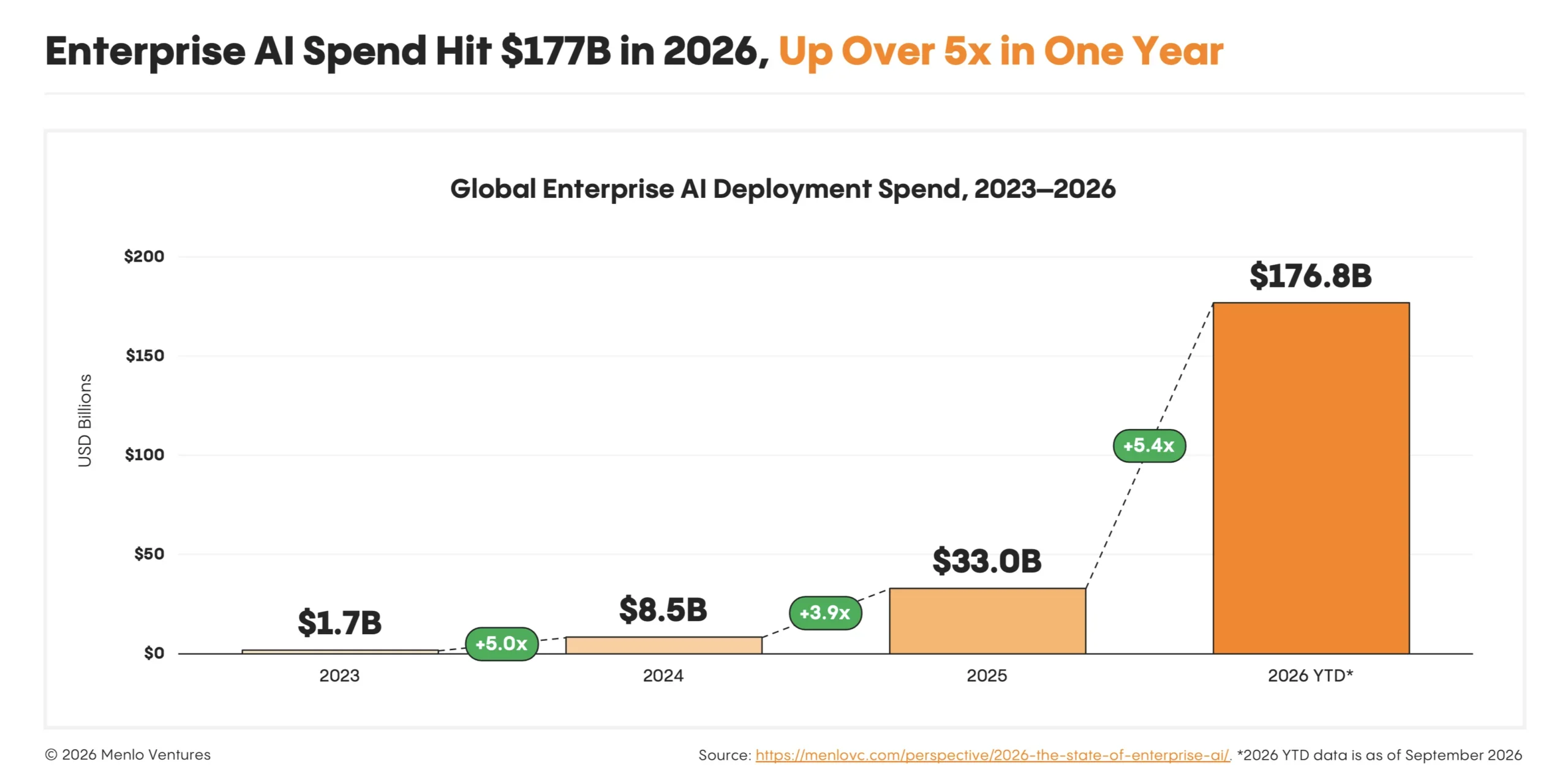
On November 3, Menlo Ventures released its fourth annual enterprise AI report. It estimates enterprise spending on using AI reached $176.8B by September 2026, up 5.4x from $33B in 2025. In enterprise LLM API spend, Anthropic rose from 40% to 55%, OpenAI from 27% to 31%, and Google fell from 21% to 9%. Coding is the largest app category at $34.0B. Figures come from a survey of about 400 US enterprise AI decision-makers plus third-party data, so they are estimates; Menlo is an Anthropic investor.
Menlo Ventures 2026 State of Enterprise AI: Enterprise AI Spend Hits $176.8B, Up 5.4x, as Anthropic Takes 55% of Enterprise API Spend

Key Takeaways

  • Enterprise AI deployment spend: $1.7B (2023) to $8.5B (2024) to $33B (2025) to $176.8B by Sep 2026, up 5.4x vs 3.9x last year (Menlo estimate)
  • Enterprise LLM API spend share: Anthropic 55% (from 40%), OpenAI 31% (from 27%), Google 9% (from 21%); open-source models are about 19% of usage but only 4% of spend
  • App-layer spend is about $77.3B: coding $34.0B and chatbots/productivity $25.0B make up 76%; Claude Code and Codex account for $24.0B (70%) of coding spend
  • On OpenRouter, agents generate 80% of tokens (about 130.9T per week), roughly 7x human usage, and have grown 37x since overtaking human traffic in February
  • 55% of incremental AI spend comes from net-new budgets and 22% from existing software budgets; the share of enterprises paying for AI rose only from 55% to 65%
Read full story

Stanford Retests 50 Well-Known LLM Findings on 20 Models: 44% Have Expired, Median Shelf Life About 15 Months

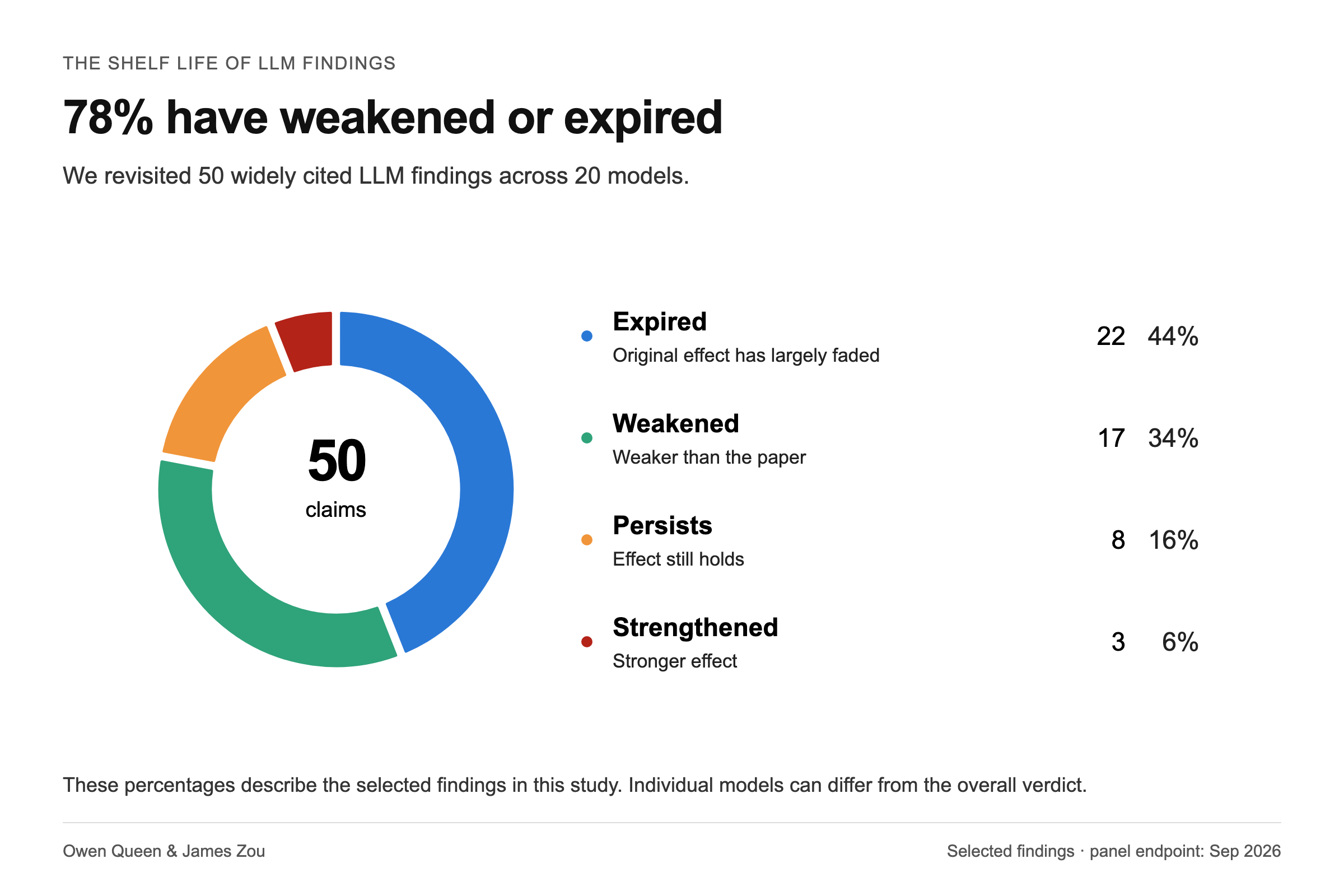
On November 2, Stanford researchers Owen Queen and James Zou published an interactive report, "The shelf life of LLM findings", retesting 50 widely cited claims about LLM behavior on 20 models released from July 2024 to September 2026 by eight developers. Verdict: 22 claims (44%) expired, 17 (34%) weakened, 8 (16%) persist and 3 (6%) strengthened; the median time from publication to expiration for expired claims was 14.7 months. Capability failures such as letter counting, lost-in-the-middle and fabricated citations have largely faded, while preference issues such as sycophancy and judges favoring their own answers persist.

Stanford Retests 50 Well-Known LLM Findings on 20 Models: 44% Have Expired, Median Shelf Life About 15 Months

Key Takeaways

  • 50 claims, 20 models, eight developers; verdicts reflect fitted effects as of September 30, 2026.
  • 44% expired, 34% weakened, 16% persist, 6% strengthened; expired claims had a median lifetime of 14.7 months (mean 15.7).
  • Kaplan-Meier estimates put the expired share at about 4%, 16% and 39% six months, one year and two years after publication.
  • Citation fabrication is expired overall, yet Qwen3.7-Flash still fabricated 69% of references in the same test (about 1% for Sonnet 5.5, 0% for GPT-6.1 Sol).
  • The pipelines were built with Claude Code and Codex; 43 of 48 reproduction checks matched the original papers within tolerance.
Read full story

Anthropic Open-Sources FlashProve: zkSNARK Proofs That a Reply Came From the Committed Model, About 110 Tokens/s for 400B Llama 4 Maverick on One H100

Anthropic's Frontier Red Team published a research post on November 2 and open-sourced FlashProve under Apache 2.0. A model provider commits to hidden weights once, then attaches a zero-knowledge proof to each reply, so a user without the weights can check on an ordinary CPU that the reply really came from that model. That targets routing services that quietly swap in cheaper models and tampered token streams. Anthropic reports about 110 tokens/s on one H100 for Llama 4 Maverick (400B MoE, 4-bit), proofs of about 19 MB per 1,024-token request, and roughly 70-95x the GPU time of vLLM inference. It is an unmaintained research prototype limited to 1,024-token contexts and greedy decoding of an integer version of the model. Anthropic engineer Steve Weis shared the release on X.

Anthropic Open-Sources FlashProve: zkSNARK Proofs That a Reply Came From the Committed Model, About 110 Tokens/s for 400B Llama 4 Maverick on One H100

Key Takeaways

  • Anthropic-reported: on Llama 4 Maverick (400B MoE, 4-bit) one H100 proves about 110 tokens/s (prefill, 24 requests per batch), with proofs of about 19 MB per 1,024-token request.
  • It is costly: roughly 70-95x the GPU time of vLLM inference; the performance page lists about 270 GB of host memory for serving and about 39 minutes to commit to a set of weights.
  • Verification needs no GPU: the C++ verifier checks a proof in about 21 seconds on one thread, and a slower Lean verifier plus Lean 4 proofs of the security theorem are included.
  • Against prior work: VerInf proved the same model at about 0.02 tokens/s; the commercial Attestable reached 53-77 tokens/s on Gemma 4 31B but has no open-source release.
  • Limits: v0.16.0 is an unmaintained research prototype with 1,024-token contexts, greedy decoding of an integer model only, and no architecture hiding.
Read full story
Linked Models & Agents:

LeCun and Balestriero turn the Platonic Representation Hypothesis into a theorem: a 109M text JEPA aligns with vision models better than 72B LLMs

On October 29, Randall Balestriero and Yann LeCun posted "Proving and Improving the Platonic Representation Hypothesis with JEPAs" (arXiv 2610.39302), affiliated with Brown University, NYU and AMI Labs. The paper proves that JEPAs trained separately on different modalities learn the same representation up to one rotation whenever their positive pairs are two observations of one scene ("good views"), and argues that next-token prediction is a JEPA with "bad views", which is why language models only align with vision through scale. The authors report that good views need 42x fewer training samples than next-token prediction to reach the same alignment, and that a 109M text JEPA scores 0.184 alignment with DINOv2 versus 0.154 for Qwen2.5-72B (author-reported). Code and a live demo are public; Balestriero's announcement post has about 1,054 likes and 72K views.

LeCun and Balestriero turn the Platonic Representation Hypothesis into a theorem: a 109M text JEPA aligns with vision models better than 72B LLMs

Key Takeaways

  • Paper: arXiv 2610.39302, submitted 2026-10-29 by Randall Balestriero and Yann LeCun (Brown University / NYU / AMI Labs)
  • On the PRH benchmark, the 109M text JEPA scores 0.184 alignment with DINOv2, versus 0.154 for Qwen2.5-72B and 0.151 for Llama-3-70B; with the CLIP image encoder it reaches 0.23 against a previous best of 0.21 (author-reported)
  • Good views reach the same alignment with 42x fewer training samples than next-token prediction; the authors pre-registered predictions from their alignment scaling law, trained 85 new runs, and the law was as accurate as rerunning with another seed
  • A single rotation turns separately trained encoders into an image captioner with CIDEr 0.838 on COCO; on a pair-free benchmark it hits 64% top-5 on ImageNet-100 versus at most 56% for language models up to 8B
  • Code (galilai-group/prh-proof) and a live demo are public; Balestriero's announcement post has about 1,054 likes and 180 reposts
Read full story
Linked Models & Agents:
ADSponsored

X discussion: an indie developer compiles an NPU into Qwen3.5-4B weights and runs Karpathy's stories260K, an LLM inside an LLM

A widely discussed experiment on X: on Oct 31 indie developer div (@divagr1925) showed QwenPU, which compiles a 32-bit RISC-V CPU plus a vector unit directly into the weights of Qwen3.5-4B and runs Andrej Karpathy's 260K-parameter stories260K inside the model's own forward passes, matching a reference implementation token for token. None of the added weights are trained; a compiler computes them all. The post drew about 1,540 likes, 163 reposts and 85K views and became an X trending story. It is a personal, self-described work-in-progress project: the checkpoint is 26.7 GB and one story token takes about 16 seconds on an L4. This is a write-up of the discussion, not an official announcement from any company.

X discussion: an indie developer compiles an NPU into Qwen3.5-4B weights and runs Karpathy's stories260K, an LLM inside an LLM

Key Takeaways

  • Buzz: the @divagr1925 post has about 1,540 likes, 163 reposts, 71 quotes and 85K views (public X metrics as of Nov 1); the earlier Qwenputer post (Oct 28) has about 5,880 likes and was quote-posted by Shopify CEO Tobi Lutke
  • Method: 13 compiled computer layers (RV32IM + Zba + a bignum unit + the vector unit) sit in front of Qwen's 32 layers, widening the hidden size from 2560 to 5120 while Qwen's own weights stay unchanged (GitHub README)
  • Efficiency: trace tokens per story token drop from 2.43M for plain C to 53K; at about 3,300 trace tokens per second on an L4, one story token takes about 16 seconds (author-reported)
  • Verification: the story program runs free on a GPU executor for all 3,184,920 steps, checked against a reference CPU model at every step, which the author says is exact; no independent reproduction has been published yet
  • Open source: code is MIT and weights are Apache-2.0 as a modified Qwen3.5-4B, on Hugging Face and ModelScope; the 26.7 GB checkpoint needs a 40 GB or larger GPU
Read full story
Linked Models & Agents:
⚡ Qwen3.5-4B⚡ stories260K🌐 Alibaba Qwen
T
Tsinghua University & Z.AI (HarnessPro, arXiv 2610.26770)arxiv.org·
👀11
🔥80

Tsinghua and Z.AI open-source HarnessPro: agents rewrite their own harness, reaching 80.8% on Terminal-Bench 2 at 34% lower cost per task

HarnessPro (arXiv 2610.26770, submitted Oct 19 and revised Oct 20), from Tsinghua University, Z.AI (Zhipu) and collaborators, is a label-free way to improve an agent harness: specialized agents diagnose execution traces, rewrite instructions and runtime policies, score candidates with LLM-generated tests, and keep Lite, Medium and Heavy harnesses along the performance-cost frontier. Per the paper, with GPT-5.5 and Codex the Heavy mode reaches 80.8% on Terminal-Bench 2, 4.5 points above the prior RHO method, while cost per task drops from $1.09 to $0.72. The code is MIT-licensed and drew wider media coverage this week, including from Pandaily.

Tsinghua and Z.AI open-source HarnessPro: agents rewrite their own harness, reaching 80.8% on Terminal-Bench 2 at 34% lower cost per task

Key Takeaways

  • Terminal-Bench 2 (GPT-5.5 with Codex, mean of 3 runs): Heavy reaches 80.8% at $0.72 per task, versus RHO at 76.3% and $1.09, a 33.9% cost cut (paper figures, arXiv)
  • Averaged over three benchmarks: +2.0 points pass rate and -26.1% cost per task versus RHO, across Terminal-Bench 2, SWE-Bench Pro and ProgramBench
  • Holds across models: with GLM-5.2 and Claude Code on Terminal-Bench 2, Heavy hits 81.4% at $0.62, versus vanilla at 74.6% and $0.92 and RHO at 78.0% and $1.00
  • Budget modes: Medium matches RHO at 76.3% on Terminal-Bench 2 for only $0.56 per task; Lite gets 72.9% at $0.43
  • Cheap to train: only 10 training tasks per benchmark and 3 to 4 evolution epochs, tested on 59, 100 and 100 held-out tasks; the three harness tiers are MIT-licensed on GitHub
Read full story

Wiz "Black October" report: at least nine AI developer platforms breached in October, with stolen API keys feeding an LLMjacking resale market

Cloud security firm Wiz published research on October 30 saying at least nine AI developer platforms disclosed incidents this month: Fireworks AI, Andromeda, Zeabur, Lightning AI, OpenCode, Railway, Warp, CommandCode and Northflank. Attackers hunted stored environment variables, especially keys for paid AI models; Wiz traced two stolen enterprise keys to roughly 800,000 and 1.7 million Amazon Bedrock calls, which it estimates likely ran over $100k at list price in those two cases alone.

Wiz "Black October" report: at least nine AI developer platforms breached in October, with stolen API keys feeding an LLMjacking resale market

Key Takeaways

  • Scale: between October 6 and 30, at least nine AI developer platforms disclosed incidents, and Zeabur is shutting down as a result (Wiz blog)
  • Methods: Fireworks, OpenCode and Warp reported signs of an "agent swarm" attack, and OpenCode and CommandCode attributed theirs to "distillation" attempts; the common thread is hunting stored environment variables that grant AI access
  • Case A: one stolen key drove about 800k Bedrock calls over 30 hours, about 90% successful, with Opus models making up three quarters (Wiz figures)
  • Case B: a single address made about 1.7 million calls in 13 hours, over a million successful; the two cases together likely exceeded $100k at list price
  • Resale chain: Wiz identified two sites selling discounted frontier-model access and saw both test the stolen keys
Read full story

CrowdStrike: China-nexus VAPOR PANDA used the ARTEX multi-agent framework, mainly on DeepSeek, against 200+ organizations in 11 days

CrowdStrike reported on Oct 29 that the China-nexus espionage group VAPOR PANDA, starting Oct 17, ran the open-source agentic intrusion framework ARTEX with DeepSeek plus a second, unconfirmed commercial LLM, hitting more than 200 organizations in at least 14 countries from a single controller over 11 days. Post-exploitation was confirmed at nine organizations, where the BLOODALCHEMY backdoor was deployed. Planning agents used about 1.4 billion input tokens in a single intrusion, and recovered transcripts show a human operator steering the agents in Chinese at key decision points.

Key Takeaways

  • Over 11 days from Oct 17, one ARTEX controller targeted 200+ organizations in at least 14 countries, including several foreign ministries, 19 US pharma, semiconductor, defense, nuclear and finance organizations, and telecoms in the US, Belgium and the Philippines (CrowdStrike report)
  • Post-exploitation was confirmed at 9 organizations, which received the BLOODALCHEMY backdoor; at least 12 more saw password spraying and credential scanning
  • DeepSeek was the main model, plus a subscription commercial LLM CrowdStrike could not confirm; planning agents used about 1.4 billion input tokens in one intrusion
  • Recovered transcripts show an operator issuing Chinese instructions tagged as human instructions, including an order to find Windows hosts without the Falcon sensor
  • CrowdStrike says this is separate from the Storm-0940 ARTEX activity reported by Microsoft, and judges China-nexus groups will highly likely keep adopting such agent frameworks over the next 12 months
Read full story
Linked Models & Agents:

Cartesia’s new H-Nets learn from raw bytes without a tokenizer, matching SmolLM3’s 11T-token result after about 1T tokens

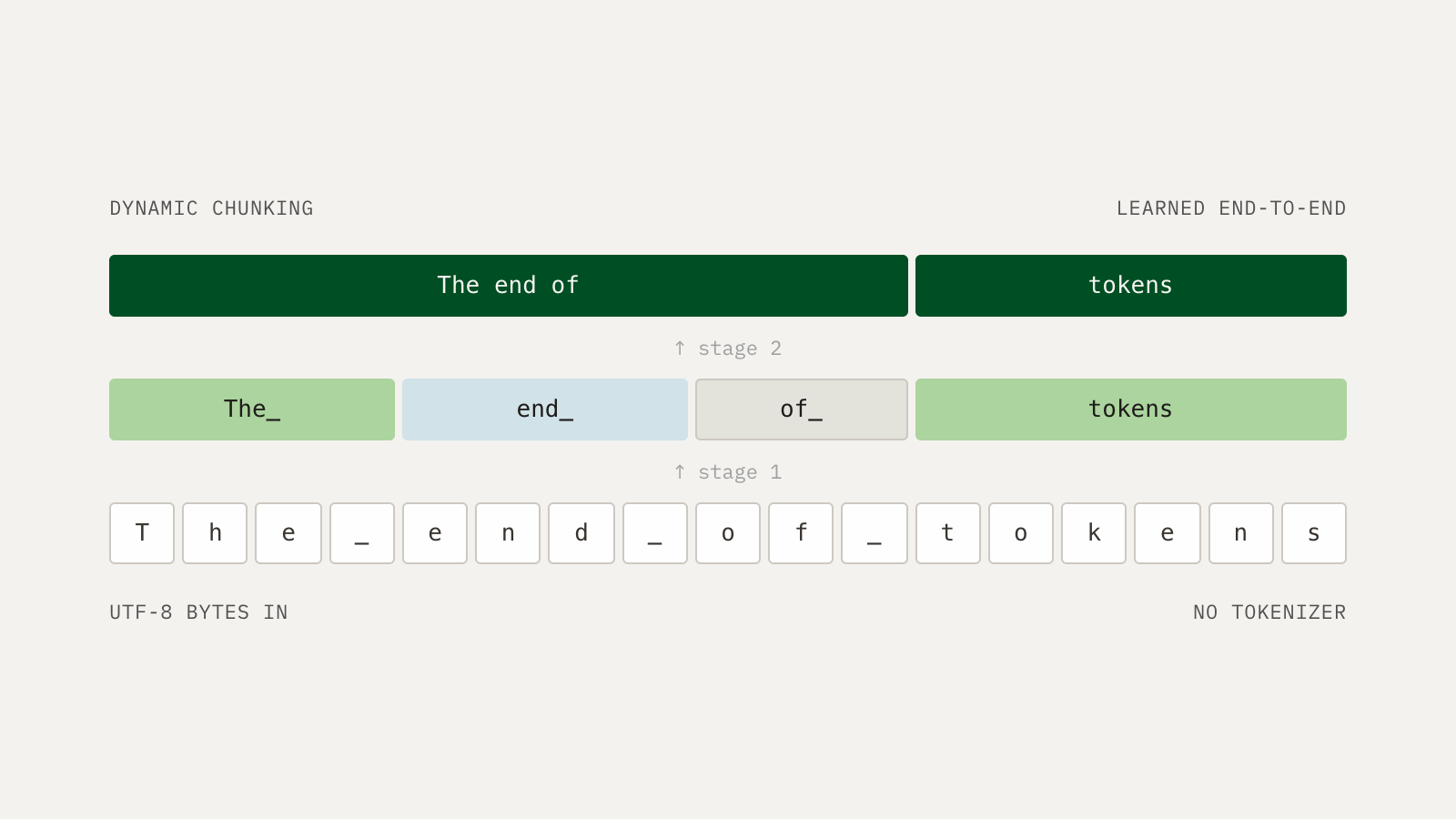
On Oct 28 Cartesia chief scientist Albert Gu (co-author of Mamba) and team published two research posts on a new generation of hierarchical networks (H-Nets). In a controlled scaling ladder, swapping BPE tokenization for learned dynamic chunking alone gave up to 3-5x compute efficiency. A larger two-stage byte-level H-Net (3.67B parameters), compute-matched per byte against SmolLM3-3B, reached SmolLM3’s final average downstream score after about 1T tokens versus 11T (vendor-reported). The new architecture is not released yet; Cartesia says it plans to release it over time.

Cartesia’s new H-Nets learn from raw bytes without a tokenizer, matching SmolLM3’s 11T-token result after about 1T tokens

Key Takeaways

  • Controlled ladder (vendor-reported): a 1-stage H-Net as a drop-in replacement for BPE gave about 1.3x compute efficiency on validation loss, about 2x on code, and up to 3-5x overall
  • Larger run: a 3.67B two-stage byte H-Net vs 3.08B SmolLM3, compute-matched within 2% FLOPs per byte, matched SmolLM3’s six-task average after about 1T tokens instead of 11T
  • Code gains are larger: 1.49x-2.40x (median 2.04x) on 15 in-distribution languages, median 3.10x on 10 out-of-distribution languages, up to 5.37x on Prolog
  • Training mix is 70% English, 20% code, 5% math and 5% multilingual; the main network sees about one position per 7.6 bytes, and the outer encoder and decoder take about 43% of FLOPs
  • No weights or code yet; Cartesia says it will release some of these architectures over time; the original H-Net paper is arXiv 2507.07955
Read full story
Linked Models & Agents:
⚡ H-Net⚡ SmolLM3-3B⚡ Mamba-2🌐 Cartesia🌐 Hugging Face

OpenBMB open-sources the MiniCPM-OCR suite: a 1.3B parser scoring 93.68 on Real5-OmniDocBench, plus a 2B judge model that flags OCR errors

On Oct 27 OpenBMB (ModelBest) open-sourced the MiniCPM-OCR suite with two models: MiniCPM-OCR 1.0, a 1.3B-parameter document parser that scores 93.68 on Real5-OmniDocBench and 54.7 on OCRBench v2 (vendor-reported), and MiniCPM-OCR Jev, a 2B OCR quality judge that scores any parser's output region by region from 0 to 1 and flags content that needs human review. Code and weights are Apache 2.0, with day-one support for vLLM, SGLang, llama.cpp, Ollama and multiple chip platforms.

OpenBMB open-sources the MiniCPM-OCR suite: a 1.3B parser scoring 93.68 on Real5-OmniDocBench, plus a 2B judge model that flags OCR errors

Key Takeaways

  • MiniCPM-OCR 1.0 has just 1.3B parameters and scores 93.68 on Real5-OmniDocBench and 54.7 on OCRBench v2 (vendor-reported, both claimed SOTA)
  • The 2B MiniCPM-OCR Jev judge reaches 93.6 AUROC on JevOCRBench, above JEV-35B-A3B at 90.1 and close to Qwen3.5-397B-A17B at 93.8 (vendor-reported)
  • Jev is parser-agnostic: AUROC stays between 91.9 and 93.4 on outputs from MiniCPM-OCR, GLM-OCR, PaddleOCR-VL-1.6 and Xiaomi-OCR-0
  • Throughput is about 1.49x PaddleOCR-VL-1.6 and 3.62x MinerU2.5 Pro, reaching up to about 128 pages per minute with SDK concurrency (vendor-reported)
  • Code and weights on GitHub are all Apache 2.0, with GGUF/AWQ/GPTQ quantized builds and a SKILL.md for coding agents
Read full story
Linked Models & Agents:
⚡ MiniCPM-OCR 1.0⚡ MiniCPM-OCR Jev⚡ PaddleOCR-VL-1.6⚡ MinerU2.5 Pro⚡ Qwen3.5-397B-A17B🌐 OpenBMB🌐 ModelBest🌐 Intel🌐 NVIDIA🌐 Arm
ADSponsored

DiffuSpace, founded by the HKU Dream team, open-sources Clover-35B-A3B, a diffusion LLM hitting 680 tokens/s on one GPU and 73.6 on SWE-bench Verified

On Oct 28 DiffuSpace, whose members come from the HKU NLP group behind Dream 7B, released its first model, Clover-35B-A3B-Preview: a mixture-of-experts diffusion language model initialized from Qwen3.6-35B-A3B, with 35B total and about 3B active parameters, a 128K context window and block-parallel denoising. Vendor-reported results include 73.6 on SWE-bench Verified, 51.7 on Terminal-Bench 2.1 and 83.8 on GPQA Diamond, with 680 tokens/s on a single GB300 in agent workloads. Weights are Apache 2.0 on Hugging Face, ModelScope and GitHub, with SGLang and llama.cpp support.

DiffuSpace, founded by the HKU Dream team, open-sources Clover-35B-A3B, a diffusion LLM hitting 680 tokens/s on one GPU and 73.6 on SWE-bench Verified

Key Takeaways

  • A 35B-total, roughly 3B-active MoE diffusion model initialized from Qwen3.6-35B-A3B, with 128K context and a thinking mode
  • DiffuSpace says it tops all six agent benchmarks it compared: SWE-bench Verified 73.6, Terminal-Bench 2.1 51.7 and tau3 Overall 65.3, ahead of LLaDA2.2 flash, Mercury 2.5 and Qwen3.6-35B-A3B
  • Speed (vendor-reported): 680 tokens/s on one GB300 at BF16 and batch size 1 in agent workloads, and 515 tokens/s on one H200 versus 365 tokens/s for Qwen with DFlash2
  • An INT4 build runs on a 16GB RTX 5070 Ti at 101.8 tokens/s on MATH-500
  • Weights on Hugging Face are Apache 2.0, about 69GB in BF16, and SGLang is the recommended serving path
Read full story
Linked Models & Agents:
⚡ Clover-35B-A3B-Preview⚡ Qwen3.6-35B-A3B⚡ Dream 7B⚡ LLaDA2.2 flash⚡ Mercury 2.5🌐 DiffuSpace🌐 HKU NLP🌐 Alibaba Qwen🌐 NVIDIA

Cadence launches Maestro, a domain-specialized AI model portfolio for agentic chip and system design built in part on NVIDIA Nemotron, claiming up to 30% better results and 5x token efficiency

EDA leader Cadence announced the Maestro AI Model Portfolio on October 26: domain post-trained LLMs, trained decision models and self-improving agent skills that power its AuraStack, ChipStack, InnoStack and ViraStack AI Super Agents as they drive Cadence EDA and SDA tools. Cadence solvers score outputs against engineering constraints to close a reinforcement learning loop. Initial results per Cadence show up to 30% higher quality and up to 5x token efficiency versus a general-purpose foundation model. NVIDIA contributes Nemotron and OpenShell, and the stack runs on Cadence cloud, public cloud or on-premises. The first models reach select early access customers in Q4 2026.

Key Takeaways

  • Maestro is a portfolio, not one model: domain post-trained LLMs, decision models and self-improving agent skills, mixed with frontier and open-weight models per task
  • Deterministic solvers and EDA tools score outputs against engineering objectives and constraints, feeding a verified reinforcement learning loop
  • Per Cadence: up to 30% higher quality of results and up to 5x token efficiency versus a general-purpose foundation model; no third-party evaluation yet
  • NVIDIA supplies Nemotron models and the OpenShell sandbox reference architecture; customers can post-train on their own designs and run on-premises
  • First models go only to select early access customers in Q4 2026; Socionext expects up to 5x productivity from deploying InnoStack
Read full story

Google's Gemma team says Gemini 4 Argon wrote vLLM optimizations that speed up gemma-4-E2B-it 2.85x on an A100

On Oct 26, Google's official @googlegemma account said a set of vLLM optimizations built with Gemini 4 Argon lifted gemma-4-E2B-it throughput on a single A100 from about 37,900 to 108,000+ tokens/sec, roughly 2.85x, with 100% token parity. The PRs were filed by Luciano Martins of Google DeepMind, and most are still under review.

Google's Gemma team says Gemini 4 Argon wrote vLLM optimizations that speed up gemma-4-E2B-it 2.85x on an A100

Key Takeaways

  • Google says gemma-4-E2B-it throughput on an A100 rose about 2.85x (about 37.9K to 108K+ tokens/sec) with 100% token parity
  • The PRs come from Luciano Martins of Google DeepMind and cover fused Triton kernels, MTP speculative decoding and KV-sharing fast prefill
  • The 2.85x figure is Google's claim for the full set; PR #60674 alone self-reports up to 1.90x prefill and about 1.06x decode
  • As of Oct 27, only 3 of the 10 PRs in the linked list are merged; the rest are still in review
  • It is a public example of using a frontier coding model for inference-kernel performance work, still awaiting reproduction by the vLLM community
Read full story
Linked Models & Agents:

X discussion: engineer Arpit Bhayani says "no human will ever write code better than LLMs", drawing 7K+ likes, 240+ replies and a debate over AI coding ability

At 13:37 UTC on 2026-10-25, engineer Arpit Bhayani (@arpit_bhayani) posted: "No human will ever write code better than LLMs. Accept this fact, stop pretending, and move on." (post). When we pulled it, the post had about 7,193 likes, 496 reposts, 104 quotes, 241 replies, 529 bookmarks and 174K views, and it reached X's trending stories. Replies are split: some agree LLMs already write code faster and better, while others push back that LLMs often produce more code than a task needs and that production edge cases, architecture and final verification still depend on people. This is an X discussion presented as opinions, not a proven conclusion.

Key Takeaways

  • Main post: Arpit Bhayani's post, published 13:37 UTC on 10-25, with about 7,193 likes, 496 reposts, 104 quotes, 241 replies, 529 bookmarks and 174K views when we pulled it
  • The wording is "No human will ever write code better than LLMs. Accept this fact, stop pretending, and move on"; it is a personal opinion with no data or experiment attached
  • For: one reply says the author coded for years and LLMs now code better and faster than they do
  • Against: other replies say LLMs tend to generate far more code than a simple use case needs, and that browser quirks, accessibility and production edge cases still need human judgment
  • Common ground: many replies place human value in design, supervision and verification; layoff and hiring-ratio figures circulating online were not verified here, so we do not use them
Read full story
Linked Models & Agents:

BOSS Zhipin's Nanbeige lab open-sources Nanbeige4.3-33B, a 33B dense agent model with 512K context under Apache 2.0, reporting 80.9 on Terminal-Bench 2.1 vs 73.0 for Qwen3.8-27B

At 12:11 UTC on 2026-10-25, the Nanbeige LLM Lab of BOSS Zhipin (Kanzhun Limited) announced Nanbeige4.3-33B from its account @nanbeige (post), with the model and its Base version released as open weights on Hugging Face under Apache 2.0 (model card). It is a 33B dense model on a Llama-style architecture with a 512K context window, positioned as the teacher model of the Nanbeige4.3 series that will be distilled into smaller models such as Nanbeige4.3-3B. The official model card compares it with Qwen3.8-27B, Muse-Glimmer-30B and Gemma4-31B using the same harness at highest thinking effort: 80.9 on Terminal-Bench 2.1 (Qwen3.8-27B 73.0) and 65.5 on DeepSWE (42.5), but 60.3 on SWE-Bench Pro, slightly below Qwen's 61.7, and 84.8 on GDPval vs 86.4. All figures are self-reported and not yet independently reproduced.

Key Takeaways

  • Official sources: @nanbeige post on X and the Hugging Face model card; the post had about 616 likes, 79 reposts and 38K views when we pulled it
  • Specs: 33B dense, Llama-style architecture, 512K context, Apache 2.0, with a Base checkpoint released too
  • Self-reported coding scores: Terminal-Bench 2.1 80.9, Terminal-Bench 4.0 23.8, DeepSWE 65.5, SWE-Bench Pro 60.3 (Qwen3.8-27B: 73.0, 6.3, 42.5, 61.7)
  • Self-reported cowork scores: Automation Bench 54.2, JobBench 44.8, GDPval 84.8 (Qwen3.8-27B: 38.3, 34.5, 86.4)
  • Deployment: Transformers, SGLang and vLLM, with official examples using 4-way tensor parallelism; Nanbeige4.3-3B distillation is next
Read full story
Linked Models & Agents:
⚡ Nanbeige4.3-33B⚡ Qwen3.8-27B⚡ Gemma4-31B⚡ Muse-Glimmer-30B🌐 Nanbeige🌐 BOSS Zhipin🌐 Kanzhun