
HarnessPro (arXiv 2610.26770, submitted Oct 19 and revised Oct 20), from Tsinghua University, Z.AI (Zhipu) and collaborators, is a label-free way to improve an agent harness: specialized agents diagnose execution traces, rewrite instructions and runtime policies, score candidates with LLM-generated tests, and keep Lite, Medium and Heavy harnesses along the performance-cost frontier. Per the paper, with GPT-5.5 and Codex the Heavy mode reaches 80.8% on Terminal-Bench 2, 4.5 points above the prior RHO method, while cost per task drops from $1.09 to $0.72. The code is MIT-licensed and drew wider media coverage this week, including from Pandaily.
Key Takeaways
- ✓Terminal-Bench 2 (GPT-5.5 with Codex, mean of 3 runs): Heavy reaches 80.8% at $0.72 per task, versus RHO at 76.3% and $1.09, a 33.9% cost cut (paper figures, arXiv)
- ✓Averaged over three benchmarks: +2.0 points pass rate and -26.1% cost per task versus RHO, across Terminal-Bench 2, SWE-Bench Pro and ProgramBench
- ✓Holds across models: with GLM-5.2 and Claude Code on Terminal-Bench 2, Heavy hits 81.4% at $0.62, versus vanilla at 74.6% and $0.92 and RHO at 78.0% and $1.00
- ✓Budget modes: Medium matches RHO at 76.3% on Terminal-Bench 2 for only $0.56 per task; Lite gets 72.9% at $0.43
- ✓Cheap to train: only 10 training tasks per benchmark and 3 to 4 evolution epochs, tested on 59, 100 and 100 held-out tasks; the three harness tiers are MIT-licensed on GitHub
Key Decision Metrics at a Glance
Turn your technical choice into a development budget
Compare 40 dev plans & simulate token costs vs $20/mo subscriptions
Project Links & Resources
Direct AccessIn-Depth Technical Analysis
Background and pain point
A coding agent's results depend not only on the model but on its harness: the instructions, tools and runtime policies wrapped around it. Recent recursive self-improvement methods let agents rewrite their harness from past runs, but the paper notes they usually buy higher pass rates with higher cost. With GPT-5.5 and Codex on SWE-Bench Pro, RHO raised mean cost per task from $1.88 to $2.68, up 42.6%. HarnessPro, from researchers at Tsinghua University, Z.AI (Zhipu) and collaborators, aims to raise scores and cut cost at the same time.
How it works
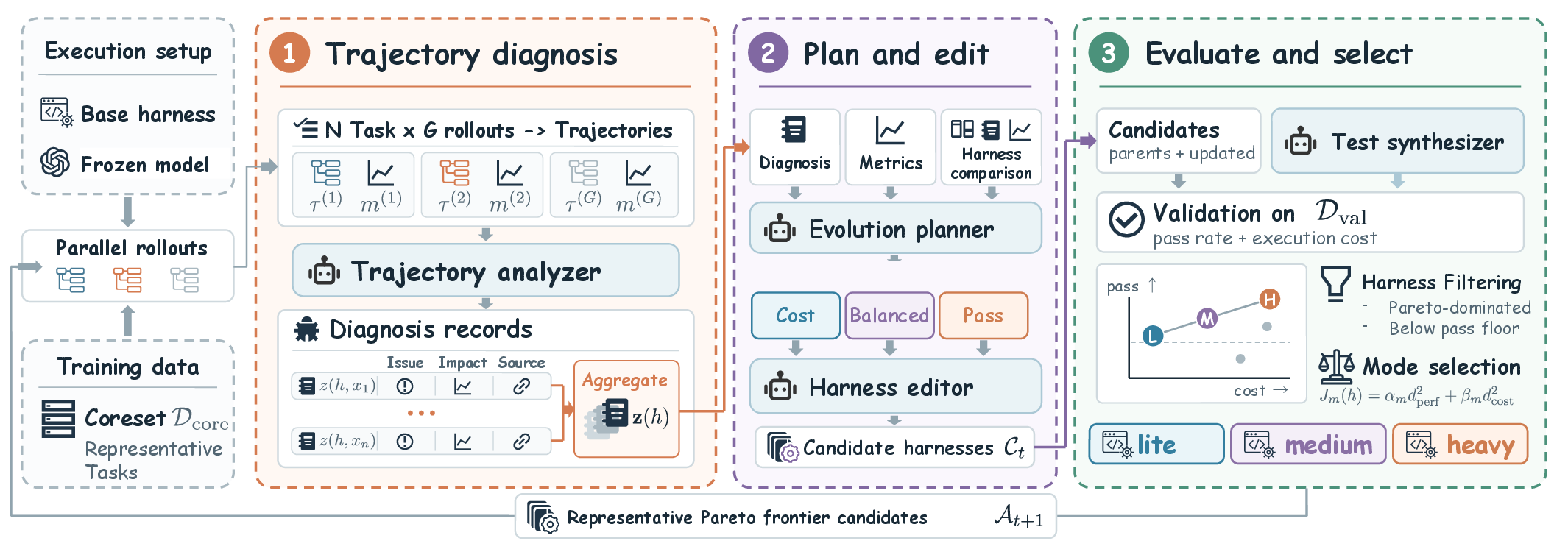
There are three steps. Specialized agents diagnose execution traces to find failure patterns, redundant tool calls and wasted computation. They then plan changes under different performance-cost priorities and implement candidate harnesses, touching instructions, execution profiles, tool-use policies and verification helpers. Candidates are scored with LLM-synthesized tests, without ground-truth answers or official tests, and a normalized weighted squared-distance rule keeps Lite (cost), Medium (balanced) and Heavy (performance) harnesses for the next iteration.
Benchmarks
All figures are the authors' own and have not been independently reproduced. With GPT-5.5 and Codex on Terminal-Bench 2, Heavy scores 80.8% at $0.72 per task versus RHO at 76.3% and $1.09; Medium scores 76.3% at $0.56 and Lite 72.9% at $0.43. Averaged over three benchmarks, Heavy beats RHO by 2.0 points at 26.1% lower cost. With GLM-5.2 and Claude Code, Heavy reaches 81.4% at $0.62 on Terminal-Bench 2, versus vanilla at 74.6% and $0.92. Each benchmark uses only 10 training tasks, with 59, 100 and 100 held-out test tasks.
Getting started
The pzs19/HarnessPro repository is MIT-licensed and ships Lite, Medium and Heavy harnesses for all three benchmarks. It needs Linux, Python 3.12 or 3.13, uv, Docker Compose and Codex CLI (the paper used 0.147.0); clone it, run uv sync and the prepare_runtime script, then supply benchmark data and model keys yourself. A practical first step is to swap the Medium harness into an existing Codex setup and check whether pass rate holds while the bill drops, then try Lite for cost-sensitive batch work. These harnesses were evolved for specific benchmarks, so validate them on your own tasks before relying on them.
Benchmark side-by-side against alternatives, or calculate monthly token cost vs subscription break-even.
Discussion & Comments
0Sign in to join the discussion
Connect with AI developers to exchange benchmark insights.