AI Coding Live News

NVIDIA says AI agents now steer the SETI Allen Telescope Array, calibrating it and analyzing up to 2.4 Tbps of live radio data from plain-language requests

An Oct 30 NVIDIA blog post says Breakthrough Listen and the SETI Institute have brought agents into daily SETI work at the Allen Telescope Array (ATA, 42 dishes of 6 m each) in Northern California: from a single natural-language request, agents can steer the antennas, calibrate and focus, fix data errors, and run AI models on the live stream. Holoscan's DAQIRI library pulls sensor data straight into GPU memory, the SETI Institute's CyberEther handles signal processing, and the web-based orchestrator Nexus acts as the agent harness, handling up to 2.4 Tbps on premises on RTX PRO 6000 Blackwell GPUs. The pipeline has made the first real-time AI detection of a pulsar in the Crab Nebula, and the team is evaluating open models such as Nemotron. The @NVIDIAAI Halloween post on Oct 31 drew about 274 likes.
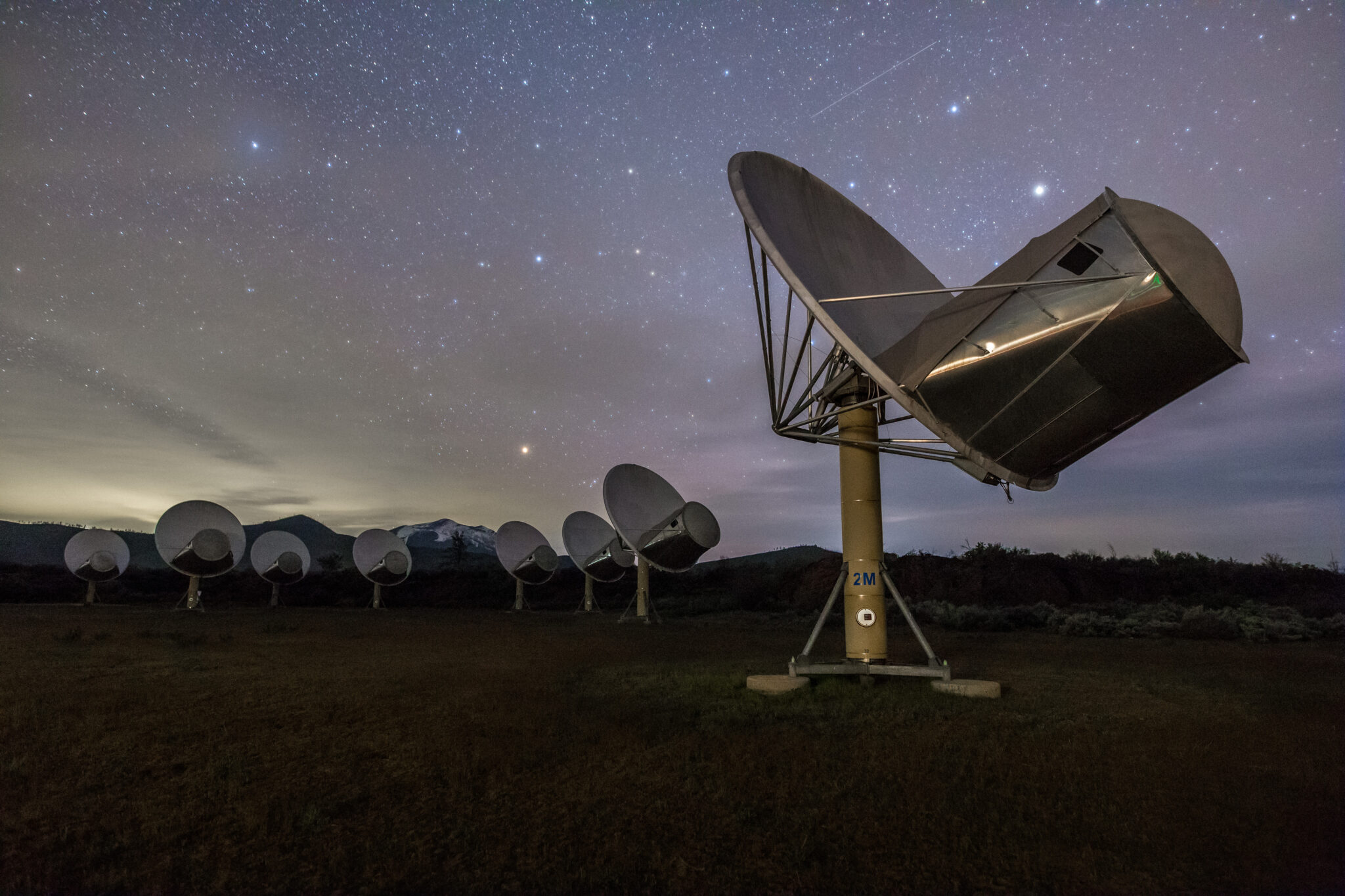
NVIDIA says AI agents now steer the SETI Allen Telescope Array, calibrating it and analyzing up to 2.4 Tbps of live radio data from plain-language requests

Key Takeaways

  • Throughput: up to 2.4 Tbps of radio data on NVIDIA RTX PRO 6000 Blackwell GPUs, with inference running on premises next to the instrument (NVIDIA blog, vendor-reported)
  • Three layers: DAQIRI moves sensor data straight into GPU memory, CyberEther does the signal math with cuFFT and cuBLAS, and Nexus serves as the agent harness for instrument state, compute, and pipelines
  • Capability: one plain-language request can steer the ATA's 42 six-meter dishes, calibrate and focus, fix data errors, and plot results; NVIDIA says this compresses weeks or years of human work into hours
  • Milestone: the first real-time AI detection of a pulsar in the Crab Nebula; no false-positive rates or other metrics were published, and no extraterrestrial signal has been found
  • Next: evaluating open models such as Nemotron for observatories where data locality matters, possibly one day running offline on the far side of the Moon
Read full story

NVIDIA open-sources Nemotron 3.5 Transcribe, a 30B MoE speech model with about 4B active parameters that handles transcription in 40 languages, speaker attribution and translation, and tops open models on the Open ASR English leaderboard

NVIDIA AI announced Nemotron 3.5 Transcribe on Oct 28, with weights on Hugging Face and ModelScope. It is an offline, instruction-driven speech model whose single checkpoint covers transcription in 40 languages, translation between 31 languages and English, speaker attribution in 13 languages, and audio question answering, on recordings up to an hour long with up to eight labeled speakers. NVIDIA says it ranks first among open-weight models on the Hugging Face Open ASR English leaderboard at 5.33% average WER, and Artificial Analysis measured a 2.8% AA-WER, tied for first among open models with Voxtral Small, which uses 24B active parameters. The weights, the Granary v2 training data and fine-tuning recipes are all released.

NVIDIA open-sources Nemotron 3.5 Transcribe, a 30B MoE speech model with about 4B active parameters that handles transcription in 40 languages, speaker attribution and translation, and tops open models on the Open ASR English leaderboard

Key Takeaways

  • Architecture: a speech encoder paired with a Mamba-2/Transformer hybrid MoE language model, about 30B total parameters (34B in the model card counting the audio encoder) and about 4B active per token (4.3B in the model card), shipped in BF16, FP8 and NVFP4
  • Capabilities: transcription in 40 languages, translation between 31 languages and English, speaker attribution in 13 languages, audio Q&A (trained in English only) and word-level timestamps, on recordings up to 1 hour with up to 8 speakers
  • Official and third-party figures: first among open models on the Open ASR English leaderboard (5.33% average WER), 4.62% mean WER across 7 languages and 10.98% on long-form; Artificial Analysis AA-WER 2.8% and 1.8% on its AA-AgentTalk voice-agent set (next-best open model 2.3%)
  • Artificial Analysis measured DeepInfra's hosted endpoint at a 75x speed factor, transcribing a minute of audio in under a second, priced at $2.00 per 1,000 minutes
  • Licensed under OpenMDW-1.1 for commercial use; Granary v2 data and NeMo Speech fine-tuning tools are released too, and in NVIDIA's medical case study fine-tuning cut WER a further 45.8% relative to the best prompt
Read full story
Linked Models & Agents:
⚡ Nemotron 3.5 Transcribe 30B-A4B⚡ Voxtral Small🌐 NVIDIA🌐 Hugging Face🌐 Artificial Analysis

Cadence launches Maestro, a domain-specialized AI model portfolio for agentic chip and system design built in part on NVIDIA Nemotron, claiming up to 30% better results and 5x token efficiency

EDA leader Cadence announced the Maestro AI Model Portfolio on October 26: domain post-trained LLMs, trained decision models and self-improving agent skills that power its AuraStack, ChipStack, InnoStack and ViraStack AI Super Agents as they drive Cadence EDA and SDA tools. Cadence solvers score outputs against engineering constraints to close a reinforcement learning loop. Initial results per Cadence show up to 30% higher quality and up to 5x token efficiency versus a general-purpose foundation model. NVIDIA contributes Nemotron and OpenShell, and the stack runs on Cadence cloud, public cloud or on-premises. The first models reach select early access customers in Q4 2026.

Key Takeaways

  • Maestro is a portfolio, not one model: domain post-trained LLMs, decision models and self-improving agent skills, mixed with frontier and open-weight models per task
  • Deterministic solvers and EDA tools score outputs against engineering objectives and constraints, feeding a verified reinforcement learning loop
  • Per Cadence: up to 30% higher quality of results and up to 5x token efficiency versus a general-purpose foundation model; no third-party evaluation yet
  • NVIDIA supplies Nemotron models and the OpenShell sandbox reference architecture; customers can post-train on their own designs and run on-premises
  • First models go only to select early access customers in Q4 2026; Socionext expects up to 5x productivity from deploying InnoStack
Read full story

NVIDIA open-sources Nemotron 3.5 Bolt E4B 4GB, a Gemma 4 E4B-based small model for local assistants, characters and robots with tool use

On 2026-10-23 (15:41 UTC) the official @NVIDIAAI account announced Nemotron 3.5 Bolt E4B 4GB, a small open model for local assistants, interactive characters and robots that can hold a conversation and use tools. The official Hugging Face model card says it is post-trained from Gemma-4-E4B-it, has 8B total parameters (4B effective), ships in Q4_K_M quantization, supports up to 64K input and 64K output tokens, and has a switchable thinking mode, plus a DFlash speculative-decoding drafter and a BF16 version. Weights, data and recipes are open under the OpenMDW-1.1 license, with commercial use allowed. On the model card the 4GB build scores 55.60 on MultiChallenge (Gemma4 E4B-it at the same quantization 39.36, Qwen3.5 4B 52.23), but trails Qwen3.5 4B on Tau2-Bench (52.32) and BFCL-v3 (67.31).

NVIDIA open-sources Nemotron 3.5 Bolt E4B 4GB, a Gemma 4 E4B-based small model for local assistants, characters and robots with tool use

Key Takeaways

  • NVIDIA officially released Nemotron 3.5 Bolt E4B 4GB for local assistants, interactive characters and robots
  • Post-trained from Gemma-4-E4B-it: 8B total parameters (4B effective), Q4_K_M quantization, 64K context, switchable thinking mode
  • Open weights, data and recipes under the OpenMDW-1.1 license with commercial use allowed, plus a DFlash speculative-decoding drafter
  • Model card results: 55.60 on MultiChallenge leads its size class, but it trails Qwen3.5 4B on Tau2-Bench and BFCL-v3
Read full story
Linked Models & Agents:
⚡ Nemotron 3.5 Bolt E4B⚡ Gemma 4 E4B🌐 NVIDIA🌐 Google
ADSponsored

NVIDIA Launches Nemotron 3.5 Open Model Family, Cosmos World Models, and 13x Faster BioNeMo RFD4-Proteina

During the GTC Berlin keynote, NVIDIA unleashed a sweeping array of open-weights domain-specific foundation models. The release highlights include the multimodal Nemotron 3.5 Super VL, the lightweight Nemotron 3.5 Bolt series, and the end-to-end Nemotron Retriever suite for embedding, reranking, and document OCR. For physical AI, NVIDIA debuted the Cosmos world models and Alpamayo 2 Edge autonomous driving models. In life sciences, NVIDIA and the Baker Lab released BioNeMo RFD4-Proteina, which establishes state-of-the-art accuracy across more than 10 protein design benchmarks while synthesizing 200-amino-acid binders roughly 13x faster than RFdiffusion3.

NVIDIA Launches Nemotron 3.5 Open Model Family, Cosmos World Models, and 13x Faster BioNeMo RFD4-Proteina

Key Takeaways

  • NVIDIA released an extensive open-weights portfolio at GTC Berlin: Nemotron 3.5 Super VL, Bolt 4GB edge variants, and Cosmos world models
  • Unveils the full Nemotron Retriever suite for embedding, reranking, and multimodal document parsing, boosting enterprise RAG fidelity
  • Co-developed BioNeMo RFD4-Proteina with the Baker Lab, leading on over 10 structural protein design benchmarks
  • Synthesizes 200-amino-acid de novo proteins 13x faster than RFdiffusion3, dramatically shortening computational drug discovery timelines
Read full story
Linked Models & Agents:
⚡ Nemotron 3.5 Super VL⚡ Nemotron 3.5 Bolt⚡ BioNeMo RFD4-Proteina⚡ Cosmos🌐 NVIDIA🌐 Baker Lab

Mistral AI and NVIDIA Forge Industrial Engineering AI Alliance, Previewing 1T Mistral Large 4

At GTC Berlin, Mistral AI and NVIDIA announced a strategic partnership dedicated to advancing AI for industrial engineering, computational physics, and electronic design automation (EDA). The alliance couples Mistral frontier architectures with NVIDIA CUDA-X libraries, Warp physics simulation frameworks, and Omniverse digital twins. Mistral simultaneously revealed architectural specifics for its forthcoming flagship, Mistral Large 4: spanning roughly 1 trillion total parameters with 49 billion active parameters (MoE), trained on 3,800 Grace Blackwell GPUs, with open weights slated for official release at the end of October 2026.

Mistral AI and NVIDIA Forge Industrial Engineering AI Alliance, Previewing 1T Mistral Large 4

Key Takeaways

  • Mistral AI and NVIDIA launched a strategic alliance applying frontier foundation models to CAE, physics AI, and EDA semiconductor design
  • Integrates NVIDIA Warp, CUDA-X simulation libraries, and Omniverse to establish open physics datasets and industrial agent benchmarks
  • Disclosed architectural parameters for Mistral Large 4: ~1T total parameters with 49B active sparse MoE, trained on 3,800 Grace Blackwell GPUs
  • Weights for Mistral Large 4 are scheduled for open-source release at the end of October 2026, joining the Nemotron Coalition
Read full story
N
NVIDIA (Hugging Face model card)@AICoder·
👀175
🔥88

NVIDIA quietly releases Dory1.0-4B, a looped model with adjustable inference depth (61.8 SWE-bench Verified, vendor-reported)

NVIDIA published Nemotron-Labs Dory1.0-4B on Hugging Face on Oct 16: a 20-layer shared block runs 1, 2 or 4 times at inference so one checkpoint serves several compute budgets. NVIDIA reports 61.8 on SWE-bench Verified at 4 loops, close to Qwen3.5-9B. BF16/MXFP8/NVFP4/GGUF under OpenMDW-1.1.

NVIDIA quietly releases Dory1.0-4B, a looped model with adjustable inference depth (61.8 SWE-bench Verified, vendor-reported)

Key Takeaways

  • Architecture: 8 input + 20 shared recurrent + 8 output layers; loop count 1/2/4 chosen at inference, 2 recommended
  • Vendor-reported SWE-bench Verified: 50.3 / 59.5 / 61.8 at 1/2/4 loops vs 61 for Qwen3.5-9B
  • Terminal-Bench 2.1 at 4 loops is 22.2, well below Qwen3.6-35B-A3B at 43
  • NVFP4 is ~2.17–2.44x faster than BF16 on DGX Spark; last-loop KV caching holds cache at one-loop size
  • vLLM (PR #60149) and llama.cpp (PR #30306) support not yet in releases; build from the PRs
Read full story
Linked Models & Agents:
⚡ Dory1.0-4B⚡ Nemotron🌐 NVIDIA

NVIDIA open-sources Nemotron 3.5 Super VL (120B-A12B multimodal agent model, 1M context) and the 24GB 2-bit local Bolt 74B-A9B

On 2026-10-15 NVIDIA released Nemotron 3.5 Super VL, an open multimodal agent model with 120B total / 12B active parameters: a Mamba-2–Transformer hybrid MoE with a C-RADIO vision encoder, text/image/document/video input, up to 1M context, and built-in MTP plus LiLiCorr speculative decoding. Weights, datasets and recipes ship under OpenMDW-1.1 on Hugging Face, OpenRouter, ModelScope and NIM. Alongside it, NVIDIA published Bolt 74B-A9B 24GB, a natively 2-bit (QAT) local agent model for RTX/DGX Spark; the 4GB Bolt E4B follows on Oct 23.

NVIDIA open-sources Nemotron 3.5 Super VL (120B-A12B multimodal agent model, 1M context) and the 24GB 2-bit local Bolt 74B-A9B

Key Takeaways

  • Scale: Super VL is 120B total / 12B active with up to 1M context; BF16 reference serving needs 4×H100 or 2×GB200, with an NVFP4 build for smaller footprints (model card)
  • Coding (vendor-reported): SWE-bench Verified 71.10, Terminal-Bench 2.1 66.70, LiveCodeBench v6 88.22; in the same table Qwen3.5-122B-A10B scores 71.9 / 48.70 / 76.7 and GLM-5.3-Flash 79.10 / 82.70 / 80.6
  • Agent evals: Hermes Bench 63.44% (Nemotron 3 Ultra 56.33%), LangChain Evals 87.05% (Ultra 84.3%); NVIDIA claims up to 5x single-GPU throughput vs open peers and 600+ TPS on Baseten (tech blog)
  • Bolt 74B-A9B 24GB: native 2-bit (IQ2 + QAT), 256K context; Terminal-Bench 2.1 50.98 and BrowseComp 66.75 vs 44.38 / 48.74 for Qwen3.6-35B-A3B; PinchBench 87.82 is slightly below Qwen3.6's 88.07 (Bolt card)
  • Serving: LiLiCorr speculative decoding gives up to 2.3x faster generation on DGX Spark; the Dynamo recipe serves 8x more users with 85% lower TTFT on 16×B200 at 50 tok/s/user
Read full story
Linked Models & Agents:
⚡ nemotron-3.5-super-vl⚡ nemotron-3.5-bolt-74b-a9b⚡ nemotron-3.5-bolt-e4b⚡ Nemotron 3 Ultra🤖 hermes-agent🤖 opencode🤖 OpenHands (All-Hands AI)🤖 Cline (VS Code Agent)🌐 Nvidia (NIM)

Hugging Face Transformers 5.18.0: Nemotron 3 streaming diarization; NemotronH Omni; HyperCLOVAX Vision V2; GTE

Hugging Face shipped transformers v5.18.0 on 2026-09-30 (PyPI 5.18.0): NVIDIA Nemotron 3 Diarization (streaming/offline, up to 8 speakers, 80 ms–30.4 s buffers), NemotronH Omni (joint text/image/video/audio), NAVER HyperCLOVAX Vision V2 (built-in <think> CoT), and GTE bidirectional encoders (RoPE + gated MLP; gte / snowflake-arctic-embed family). Official model_doc pages are live.

Hugging Face Transformers 5.18.0: Nemotron 3 streaming diarization; NemotronH Omni; HyperCLOVAX Vision V2; GTE

Key Takeaways

  • Release v5.18.0 at 2026-09-30T16:46:27Z; PyPI ~2026-09-30T16:45:57Z
  • Nemotron 3 Diarization: streaming+offline, ≤8 speakers, 80 ms–30.4 s buffers, 10 ms frame multiples (#49056)
  • NemotronH Omni: NemotronH + RADIO + optional Parakeet for joint text/image/video/audio (#46509)
  • HyperCLOVAX Vision V2 (NAVER) + GTE encoders (RoPE/gated MLP; gte / snowflake-arctic-embed family)
  • pip install -U transformers==5.18.0; docs for diarization/omni/gte linked above
Read full story
Linked Models & Agents:
⚡ Nemotron 3 Diarization⚡ Nemotron H Omni⚡ Hyperclovax Vision V2⚡ gte🌐 huggingface🌐 Nvidia (NIM)🌐 naver

Salesforce launches Koa, its first CRM reasoning model on NVIDIA Nemotron, now in Agentforce pilot

At Dreamforce, Salesforce and NVIDIA announced Koa—Salesforce’s first CRM reasoning model for Agentforce—built by post-training NVIDIA Nemotron 3 Super on a proprietary synthetic corpus modeled on nearly three decades of CRM deployments. Salesforce says Koa matches or exceeds leading models on its CRM benchmark with about 3× fewer CRM-action errors, targets complex multi-step workflows and tool use, and was trained with no customer data. The partners are also bringing Nemotron-based models and accelerated computing into Missionforce for private-cloud and air-gapped government use. Koa is in pilot now.

Key Takeaways

  • Koa is Salesforce’s first CRM reasoning model for Agentforce, post-trained on Nemotron 3 Super
  • CRM benchmark: matches/exceeds leading models with ~3× fewer CRM-action errors; no customer data used
  • Nemotron + accelerated compute also headed to Missionforce; Koa is in pilot
Read full story
Linked Models & Agents:
ADSponsored

vLLM 0.29.0: Model Runner V2 default, Mamba prefix cache, speculative-decoding stats

vLLM shipped v0.29.0 with Model Runner V2 as the default runner for all models (594 commits, 277 contributors). Highlights include another Kimi-K3 optimization pass, DeepSeek-V4 shared experts fused into MegaMoE, Mamba prefix caching that keeps internal prefill checkpoints (about 9–25% better TTFT), per-request speculative-decoding acceptance stats over the API, a sharded_rdt P2P backend for RL weight sync, and new model support such as Hy4-preview, Qwen3.8-Flash-Next, GraniteSWA, and NemotronH Omni Reasoning V3.

Key Takeaways

  • Model Runner V2 is now the default for all models.
  • Mamba prefix caching improves TTFT ~9–25%; speculative decoding exposes acceptance stats via API.
  • DeepSeek-V4 MegaMoE fusion, RL sharded_rdt P2P sync, and several new model backends.
Read full story
Linked Models & Agents:

NVIDIA fine-tuned Nemotron clears IOI 2026 gold, scoring 535.4/600 above the top human

NVIDIA AI reports a fine-tuned Nemotron cleared the IOI 2026 gold-medal threshold, scoring 535.4/600 as graded by the IOI team—above the top human participant. The team competed unofficially in Uzbekistan with no internet access and the same time/submission limits on the same platform as humans; technical report: arXiv:2609.02849.

Key Takeaways

  • Fine-tuned Nemotron hit IOI 2026 gold at 535.4/600 under official grading.
  • Beat the top human under no-internet and identical time/submission constraints.
  • A competitive-programming SOTA signal; report arXiv:2609.02849.
Read full story
Linked Models & Agents:

Together cuts Dedicated Inference on H100s to $3.99/hr for September

Together AI is cutting Dedicated Inference on H100s from $5.49/hr to $3.99/hr for September, with the lower rate applied automatically to new and existing deployments. Supported options include Gemma 4, Qwen3/3.5, gpt-oss, Llama, Nemotron 3.5 Lightning, or a bring-your-own LoRA. For teams that pin coding agents or fine-tunes to dedicated GPUs, the change is a straight cut in 24/7 serving cost without a migration.

Key Takeaways

  • H100 Dedicated Inference drops from $5.49/hr to $3.99/hr in September, auto-applied to all deployments.
  • Catalog includes Gemma 4, Qwen3/3.5, gpt-oss, Llama, Nemotron 3.5 Lightning, and BYO LoRA.
  • Existing dedicated endpoints get the cut with no migration.
Read full story

NVIDIA Unveils Nemotron 3.5 Lightning and NeMo Switchyard for High-Speed Enterprise Agent Routing

NVIDIA announced Nemotron 3.5 Lightning alongside NeMo Switchyard, delivering optimized model dispatching and sub-millisecond routing for enterprise coding and structured data pipelines.

Key Takeaways

  • Nemotron 3.5 Lightning delivers ultra-fast instruction following and code generation for enterprise workloads;
  • NeMo Switchyard performs sub-millisecond dynamic routing between compact and frontier models based on task complexity;
  • Fully compatible with NVIDIA NIM microservices for air-gapped enterprise security compliance.
Read full story
Linked Models & Agents:
⚡ Nvidia Nemotron 3.5