Zyphra released ZONOS3-Mini, an open-source text-to-speech model, on November 9, with weights on Hugging Face under Apache 2.0. It is a sparse MoE with 800 million total and about 100 million active parameters per token, trained on 112 H100s in 2.5 days. By Zyphra's numbers, time to first audio is under 570 ms in the browser on a Pixel 9 and under 150 ms on an M3 MacBook Air, and it ranks first among open models on the capability index of its new ZTTS2-Eval benchmark (35 languages of read speech plus 20 in-the-wild), ahead of Fish S2 Pro and MOSS TTS v1.5. It supports voice cloning, age, accent and gender steering, and word-level delivery control, with WebGPU, SGLang, vLLM, GGML and MLX runtimes.
Zoom
Key Takeaways
Scale: 800M total, about 100M active parameters (64 experts, top-2 routing), versus 8B for the previous ZONOS2; open weights under Apache 2.0
Speed (Zyphra figures): under 570 ms time to first audio in a Pixel 9 browser and under 150 ms on an M3 MacBook Air; 80 ms median at 8 concurrent requests and peak 457 seconds of audio per second on one H100
The new ZAC-1 codec runs at 15 Hz versus 86 Hz for DAC and cuts word error rate about 10x under similar data; one generation can produce up to 10 minutes of 44.1 kHz audio
Evaluation: ZTTS2-Eval covers 35 languages of read speech plus 20 in-the-wild; on its 420-item capability index ZONOS3-Mini ranks first among open models, followed by Fish S2 Pro and MOSS TTS v1.5 (Zyphra's own benchmark, not yet independently reproduced)
Get started: try it in the browser via WebGPU with no install, or run sgl-omni serve --model-path Zyphra/ZONOS3-Mini for an OpenAI-compatible /v1/audio/speech endpoint
At NVIDIA AI Day Seoul, NVIDIA released Dynamo-optimized deployment recipes for four leading Korean open models: SK Telecom's A.X K2, LG AI Research's K-EXAONE 2.0 (750B-A37B), Upstage's Solar Open 2 (250B) and Motif Technologies' Motif-3. The recipes target B200 GPUs with NVFP4 weights, FP8 KV cache and a vLLM backend, and ship aggregated and disaggregated (prefill/decode split) Kubernetes manifests plus benchmark jobs. NVIDIA claims up to 2x inference performance out of the box, without naming the baseline. Per the Dynamo docs, Motif-3 on two B200s reaches about 294 output tok/s per GPU, and K-EXAONE 2.0 on four B200s hits a 291 ms median time to first token. The recipes are part of NVIDIA's AI for All collaboration with Korea's Ministry of Science and ICT.
Zoom
Key Takeaways
Covers four Korean open models: SK Telecom A.X K2, LG K-EXAONE 2.0 (750B-A37B), Upstage Solar Open 2 (250B) and Motif-3; recipes live under recipes/ in the ai-dynamo/dynamo GitHub repo
Per NVIDIA: up to 2x inference performance out of the box on B200, though NVIDIA does not name the baseline
Dynamo docs results (chat trace, SLA of at least 50 tok/s per user and TTFT p50 under 5 s): Motif-3 on 2x B200 at 293.96 tok/s per GPU with 388 ms TTFT; Solar Open 2 with two replicas at 216.88 tok/s per GPU with 308 ms TTFT
K-EXAONE 2.0 aggregated on 4x B200: 87 tok/s per GPU, 51.4 tok/s per user, 291 ms TTFT; A.X K2 on 8x B200 with EAGLE3: 76.49 tok/s per GPU, 0.525 s TTFT, plus a 32x H200 option
Caveats: Motif-3 and A.X K2 numbers use synthetic speculative-decoding acceptance lengths (about 2.1) and do not reflect real acceptance or output quality; Solar Open 2 defaults to high reasoning effort with a median GPQA output near 6,400 tokens, so set max_tokens generously
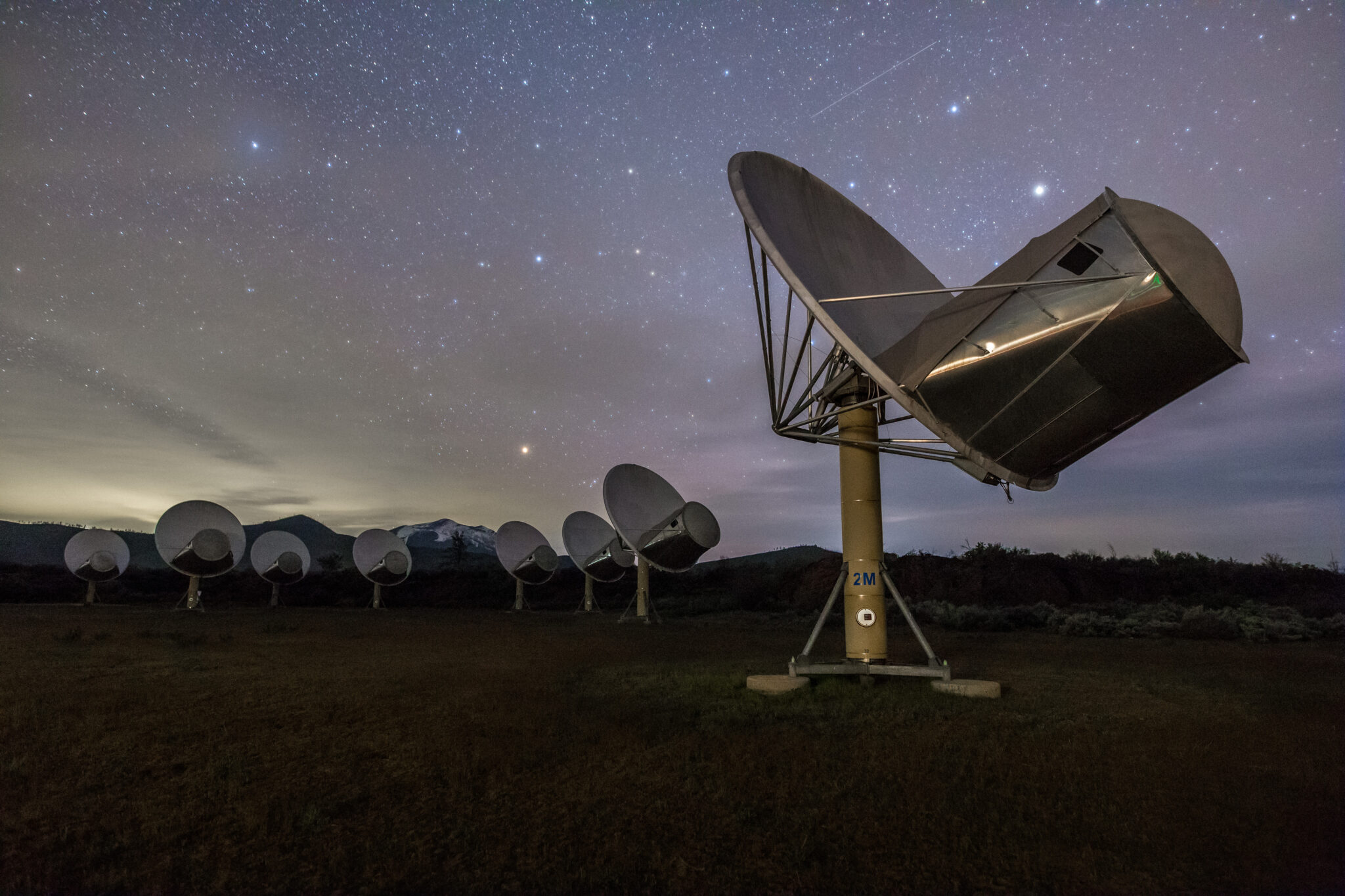
An Oct 30 NVIDIA blog post says Breakthrough Listen and the SETI Institute have brought agents into daily SETI work at the Allen Telescope Array (ATA, 42 dishes of 6 m each) in Northern California: from a single natural-language request, agents can steer the antennas, calibrate and focus, fix data errors, and run AI models on the live stream. Holoscan's DAQIRI library pulls sensor data straight into GPU memory, the SETI Institute's CyberEther handles signal processing, and the web-based orchestrator Nexus acts as the agent harness, handling up to 2.4 Tbps on premises on RTX PRO 6000 Blackwell GPUs. The pipeline has made the first real-time AI detection of a pulsar in the Crab Nebula, and the team is evaluating open models such as Nemotron. The @NVIDIAAI Halloween post on Oct 31 drew about 274 likes.
Zoom
Key Takeaways
Throughput: up to 2.4 Tbps of radio data on NVIDIA RTX PRO 6000 Blackwell GPUs, with inference running on premises next to the instrument (NVIDIA blog, vendor-reported)
Three layers: DAQIRI moves sensor data straight into GPU memory, CyberEther does the signal math with cuFFT and cuBLAS, and Nexus serves as the agent harness for instrument state, compute, and pipelines
Capability: one plain-language request can steer the ATA's 42 six-meter dishes, calibrate and focus, fix data errors, and plot results; NVIDIA says this compresses weeks or years of human work into hours
Milestone: the first real-time AI detection of a pulsar in the Crab Nebula; no false-positive rates or other metrics were published, and no extraterrestrial signal has been found
Next: evaluating open models such as Nemotron for observatories where data locality matters, possibly one day running offline on the far side of the Moon
On Oct 29 Mistral released an improved Mistral Large 4 (Le Chonk) with open weights on Hugging Face (plus an NVFP4 quantized checkpoint), served on its API as mistral-large-4. After about three more weeks of reinforcement learning since the early-October preview, Mistral reports 19.7% on FrontierCode 2.0, Terminal-Bench 4.0 up from 28% to 41%, and new low/medium/high reasoning modes. The license is a modified MIT that allows commercial use, but running a model-as-a-service business needs a separate commercial license.
Zoom
Key Takeaways
Specs: about 1T total parameters with 49B active per token (about 52B including embeddings and output layers), 128 routed experts with 4 active plus 1 shared expert, 1M context, text and image input
Per Mistral: 19.7% on Cognition's FrontierCode 2.0, ahead of DeepSeek V4.1 Flash at 19.3% and GLM-5.3 at 17.8%, first among open models
48% on the Artificial Analysis Coding Agent Index, roughly tied with GLM-5.3 while using 47% fewer tokens per task on average; Terminal-Bench 4.0 rose from 28% in preview to 41%
51% on the Artificial Analysis Cyber Index, and a 96.6% average refusal rate on malicious cyber requests, which Mistral says is the highest among open models
Trained from scratch on 3,800 NVIDIA Grace Blackwell GPUs in Mistral's own European datacenters; in Surge Code blind pairwise tests it ranked behind only Claude Opus 5.5
NVIDIA AI announced Nemotron 3.5 Transcribe on Oct 28, with weights on Hugging Face and ModelScope. It is an offline, instruction-driven speech model whose single checkpoint covers transcription in 40 languages, translation between 31 languages and English, speaker attribution in 13 languages, and audio question answering, on recordings up to an hour long with up to eight labeled speakers. NVIDIA says it ranks first among open-weight models on the Hugging Face Open ASR English leaderboard at 5.33% average WER, and Artificial Analysis measured a 2.8% AA-WER, tied for first among open models with Voxtral Small, which uses 24B active parameters. The weights, the Granary v2 training data and fine-tuning recipes are all released.
Zoom
Key Takeaways
Architecture: a speech encoder paired with a Mamba-2/Transformer hybrid MoE language model, about 30B total parameters (34B in the model card counting the audio encoder) and about 4B active per token (4.3B in the model card), shipped in BF16, FP8 and NVFP4
Capabilities: transcription in 40 languages, translation between 31 languages and English, speaker attribution in 13 languages, audio Q&A (trained in English only) and word-level timestamps, on recordings up to 1 hour with up to 8 speakers
Official and third-party figures: first among open models on the Open ASR English leaderboard (5.33% average WER), 4.62% mean WER across 7 languages and 10.98% on long-form; Artificial Analysis AA-WER 2.8% and 1.8% on its AA-AgentTalk voice-agent set (next-best open model 2.3%)
Artificial Analysis measured DeepInfra's hosted endpoint at a 75x speed factor, transcribing a minute of audio in under a second, priced at $2.00 per 1,000 minutes
Licensed under OpenMDW-1.1 for commercial use; Granary v2 data and NeMo Speech fine-tuning tools are released too, and in NVIDIA's medical case study fine-tuning cut WER a further 45.8% relative to the best prompt
On 2026-10-23 (15:41 UTC) the official @NVIDIAAI account announced Nemotron 3.5 Bolt E4B 4GB, a small open model for local assistants, interactive characters and robots that can hold a conversation and use tools. The official Hugging Face model card says it is post-trained from Gemma-4-E4B-it, has 8B total parameters (4B effective), ships in Q4_K_M quantization, supports up to 64K input and 64K output tokens, and has a switchable thinking mode, plus a DFlash speculative-decoding drafter and a BF16 version. Weights, data and recipes are open under the OpenMDW-1.1 license, with commercial use allowed. On the model card the 4GB build scores 55.60 on MultiChallenge (Gemma4 E4B-it at the same quantization 39.36, Qwen3.5 4B 52.23), but trails Qwen3.5 4B on Tau2-Bench (52.32) and BFCL-v3 (67.31).
Zoom
Key Takeaways
NVIDIA officially released Nemotron 3.5 Bolt E4B 4GB for local assistants, interactive characters and robots
Post-trained from Gemma-4-E4B-it: 8B total parameters (4B effective), Q4_K_M quantization, 64K context, switchable thinking mode
Open weights, data and recipes under the OpenMDW-1.1 license with commercial use allowed, plus a DFlash speculative-decoding drafter
Model card results: 55.60 on MultiChallenge leads its size class, but it trails Qwen3.5 4B on Tau2-Bench and BFCL-v3
During the GTC Berlin keynote, NVIDIA unleashed a sweeping array of open-weights domain-specific foundation models. The release highlights include the multimodal Nemotron 3.5 Super VL, the lightweight Nemotron 3.5 Bolt series, and the end-to-end Nemotron Retriever suite for embedding, reranking, and document OCR. For physical AI, NVIDIA debuted the Cosmos world models and Alpamayo 2 Edge autonomous driving models. In life sciences, NVIDIA and the Baker Lab released BioNeMo RFD4-Proteina, which establishes state-of-the-art accuracy across more than 10 protein design benchmarks while synthesizing 200-amino-acid binders roughly 13x faster than RFdiffusion3.
Zoom
Key Takeaways
NVIDIA released an extensive open-weights portfolio at GTC Berlin: Nemotron 3.5 Super VL, Bolt 4GB edge variants, and Cosmos world models
Unveils the full Nemotron Retriever suite for embedding, reranking, and multimodal document parsing, boosting enterprise RAG fidelity
Co-developed BioNeMo RFD4-Proteina with the Baker Lab, leading on over 10 structural protein design benchmarks
Synthesizes 200-amino-acid de novo proteins 13x faster than RFdiffusion3, dramatically shortening computational drug discovery timelines
Researchers from Amazon Web Services (AWS) and UIUC unveiled Lean4AgenticRL (arXiv:2610.22448). Tackling the limitations of conventional agentic reinforcement learning relying on sparse, binary outcome rewards, the framework grounds multi-level process rewards within a formal Lean4 verification schema. Utilizing workflow-stage-normalized GRPO, the resulting LAR-27B model reaches 77.3% on TerminalBench-2.1, outperforming base models by 9.89% and surpassing comparable open models by 5.07%.
Zoom
Key Takeaways
AWS and UIUC introduced Lean4AgenticRL (arXiv:2610.22448), the first framework grounding multi-level process rewards in Lean4 formal proofs
Overcomes sparse outcome reward bottlenecks using workflow-stage-normalized GRPO to stabilize multi-turn credit assignment
LAR-27B hits 77.3% on TerminalBench-2.1, outperforming base models by 9.89% and outscoring comparable baselines by 5.07%
Ablations show verifiable process rewards accelerate RL convergence by over 42%, establishing a rigorous paradigm for terminal coding agents
MiniMax officially announced M3.1 Flash, its next-generation lightweight frontier model (previously dominating leaderboards as the secret model Space Bunny across 200T+ tokens). Featuring a native 1M context window, flat-rate API pricing of $0.15 / $0.60 per 1M input/output tokens ($0.015 cache reads), and 3x faster inference at 1/3 the cost of M3. It surged +106 points to 1588 on LMSYS Code Arena: WebDev (#12 among open models), with full weights set for open release on October 23.
Zoom
Key Takeaways
MiniMax officially launched M3.1 Flash, unveiling that it was the mystery model Space Bunny evaluated across 200T+ tokens
Features native 1M context with flat-rate API pricing of $0.15/$0.60 per 1M tokens ($0.015 cache reads), offering 3x speed at 1/3 cost of M3
Debuts on LMSYS Code Arena: WebDev at 1588 Elo (+106 pts over M3), ranking #12 among open models with major leaps in Gaming (+179) and Reference Design (+155)
Artificial Analysis benchmark confirms Intelligence Index of 42 and HLE of 48% at half the token consumption of rivals; weights release on Oct 23
Arena announced a major update to Code Arena: WebDev: DeepSeek-V4.1-Flash-20261017 (Max) clinched the #1 position among open models with 1670 points, surpassing Kimi K3 (Max) at a 10x lower cost. Ranking #12 overall, it outperforms Claude Opus 5 (High) and narrows the gap with closed-source frontier GPT-6 Sol (Max) to roughly 10 points, resetting the Pareto efficiency curve at $0.30 input / $1.20 output per million tokens.
Zoom
Key Takeaways
DeepSeek-V4.1-Flash-20261017 (Max) captured the #1 open model position in Arena Code Arena: WebDev with 1670 points, surpassing Kimi K3 (Max)
Ranks #12 overall on the leaderboard, defeating Claude Opus 5 (High) and trailing closed-source champion GPT-6 Sol (Max) by only ~10 points
Resets the Pareto efficiency frontier at $0.30 input / $1.20 output per million tokens, cutting operational costs by ~10x against rival models
Gains +52 points over its previous 20260910 checkpoint in just over a month
Alibaba Taobao & Tmall Group detailed CommerceGen-Studio (arXiv:2610.20603, 52 HF upvotes), a production multi-agent generation system serving millions of images daily within seconds. Its 6B SKU-DiT trained via Reinforce-Distill-Reinforce (RDR) scores 9.43 (single-image) and 9.45 (multi-image) on CommerceGen-Bench, outperforming 20B open models and closed-source Nano Banana Pro. Meanwhile, Microsoft Research introduced Mine, Sample, Render (MSR, arXiv:2610.21185) for training-free test-time diversity alignment.
Zoom
Key Takeaways
Alibaba's CommerceGen-Studio (arXiv:2610.20603) serves millions of commercial product images per day in production with a latency of a few seconds per image
Its 6B SKU-DiT trained with Reinforce-Distill-Reinforce (RDR) scores 9.43 (single-image) and 9.45 (multi-image) on CommerceGen-Bench, beating 20B open models and closed-source Nano Banana Pro (9.39 / 9.33)
Combining SKU-DiT with the self-evolving PERL-Agent loop and Layout Thinker Optimization pushes scores to 9.62 (single-image) and 9.48 (multi-image)
Microsoft Research's Mine, Sample, Render (MSR, arXiv:2610.21185) externalizes test-time diversity via corpus-mined attribute sampling across webpage UI design, agent-generated 3D assets, user simulation, and text-to-image
Three new studies tackle verification, evaluation, and RL alignment for rule-governed generative world models: OmniVerifier-C1 (arXiv:2610.22355, 32 upvotes) uses Decoupled RL to train a decomposed graded visual verifier that reaches 0.684 on ViVerBench and boosts FLUX.1-dev GenEval from 0.68 to 0.79 while enabling Maze and Sudoku world modeling; Meituan's WorldCast benchmark (arXiv:2610.20731, 30 upvotes) evaluates 12 models across 320 multi-step world state prediction cases, finding GPT-Image-2.5 System at 72.8 vs. 42.8 for Nano Banana Pro and 20.1 for the top open model; and NUS's Routing Policy Optimization (RPO, arXiv:2610.22282, 23 upvotes) turns attention routing into an internal exploration action to train video/image diffusion RL 3.1x–4.2x faster than Flow-GRPO and DanceGRPO.
Zoom
Key Takeaways
OmniVerifier-C1 uses Decoupled RL (DAPO) to jointly optimize sub-question binary judgments and global continuous scoring, reaching 0.684 on ViVerBench and boosting FLUX.1-dev GenEval from 0.68 to 0.79
Meituan's 320-case WorldCast benchmark reveals a massive gap in multi-step visual state prediction: GPT-Image-2.5 System scores 72.8 vs. 42.8 for Nano Banana Pro and 20.1 for the best open-source model
NUS's Routing Policy Optimization (RPO) uses internal attention routing exploration to align Wan2.2-TI2V-5B in just 24.1 GPU-hours—3.1x faster than Flow-GRPO and 4.2x faster than DanceGRPO
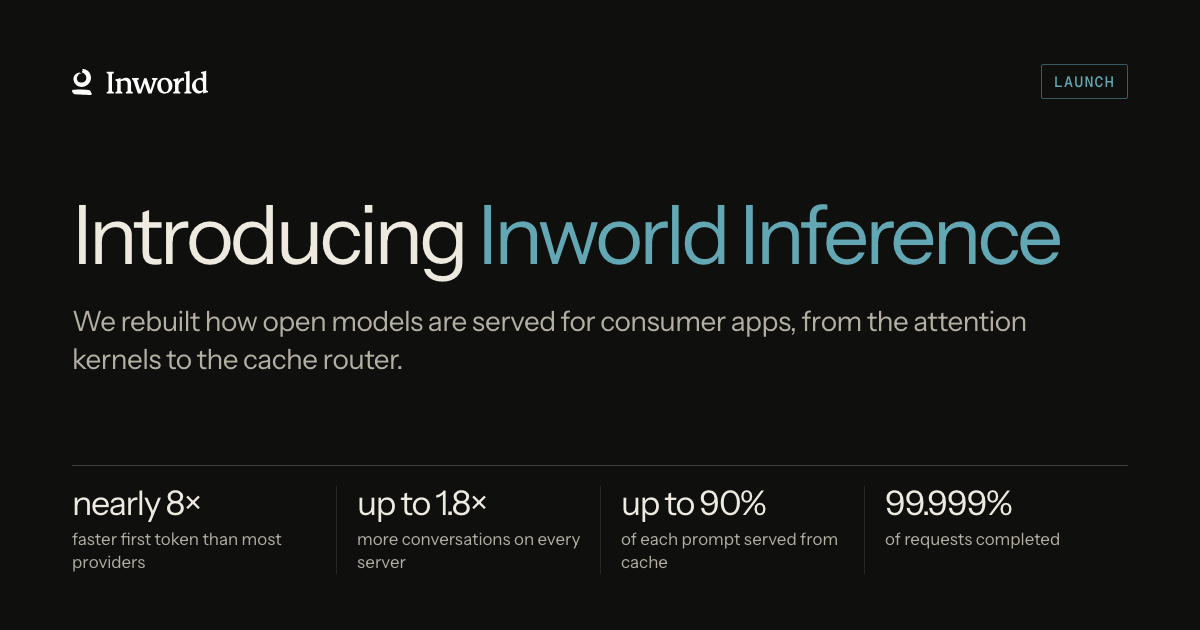
On 2026-10-14 Inworld AI opened Inworld Inference to every developer, positioning it as an inference service for consumer apps (companions, tutors, voice, interactive fiction). Instead of listing thousands of models it builds a per-model serving stack for open models such as Gemma 4, GLM 5.3 Flash, DeepSeek and MiMo: draft-and-verify (speculative) decoding, a rewritten split-KV verify attention kernel, KV-aware routing and eval-gated low precision. Vendor-reported: Gemma 4 26B p95 first token of 0.31 s, 7.8x faster than the median OpenRouter provider; up to 90% of prompts from cache; 99.999% success over 20M+ GLM 5.3 Flash requests in 30 days. The API is OpenAI-compatible with Flex/Default/Priority/Fast tiers per request.
Zoom
Key Takeaways
Gemma 4 26B first token: p50 0.17 s / p95 0.31 s, 3.6x / 7.8x faster than the median OpenRouter provider (blog, vendor-reported snapshot, not a matched workload)
Pricing: Gemma 4 26B at $0.07 input, $0.035 cached, $0.34 output per 1M tokens, nearly 40% below the median no-training provider
Rewritten verify attention: 3.4–7.5x faster per layer, attention share of a decode step 27.5%→16.5%, p50 TTFT 154→117 ms at equal eval scores
KV-aware routing: GLM 5.3 Flash cache hits 25%→47%, DeepSeek V4.1 Flash 11%→33%; cached MiMo 2.6 Pro input costs 99% less
Reliability: 98 failures across 20M+ GLM 5.3 Flash requests in 30 days (~4.8 per million); per-request service_tier of Flex/Default/Priority/Fast
Expanding text embedding models to multimodal domains typically triggers catastrophic forgetting in text retrieval, with existing omni-modal embedders ballooning past multi-billion parameters to compensate. MBZUAI researchers introduce Omni-Embed-Mini, a compact 0.9B architecture mapping text, speech, audio, image, video, and rich documents into a single shared cosine space. Crucially, text-side weights remain bit-identical to the base model, guaranteeing zero regression on text retrieval (49.57 nDCG@10 on MTEB-v2 BEIR-8). Powered by dense cascaded caption distillation, Matryoshka SigLIP loss, and online hybrid hard-negative mining, Omni-Embed-Mini is 2.7x to 9.5x smaller than competing open models, while its 2.3B variant surpasses proprietary gemini-embedding-2 on cross-modality averages.
Zoom
Key Takeaways
Unifies text, speech, audio, image, video, and rich documents into a single shared space at only 0.9B parameters
Guarantees zero text forgetting via bit-identical frozen text weights (49.57 nDCG@10 on MTEB-v2 BEIR-8)
2.3B model variant outperforms proprietary Google gemini-embedding-2 on cross-modality retrieval averages
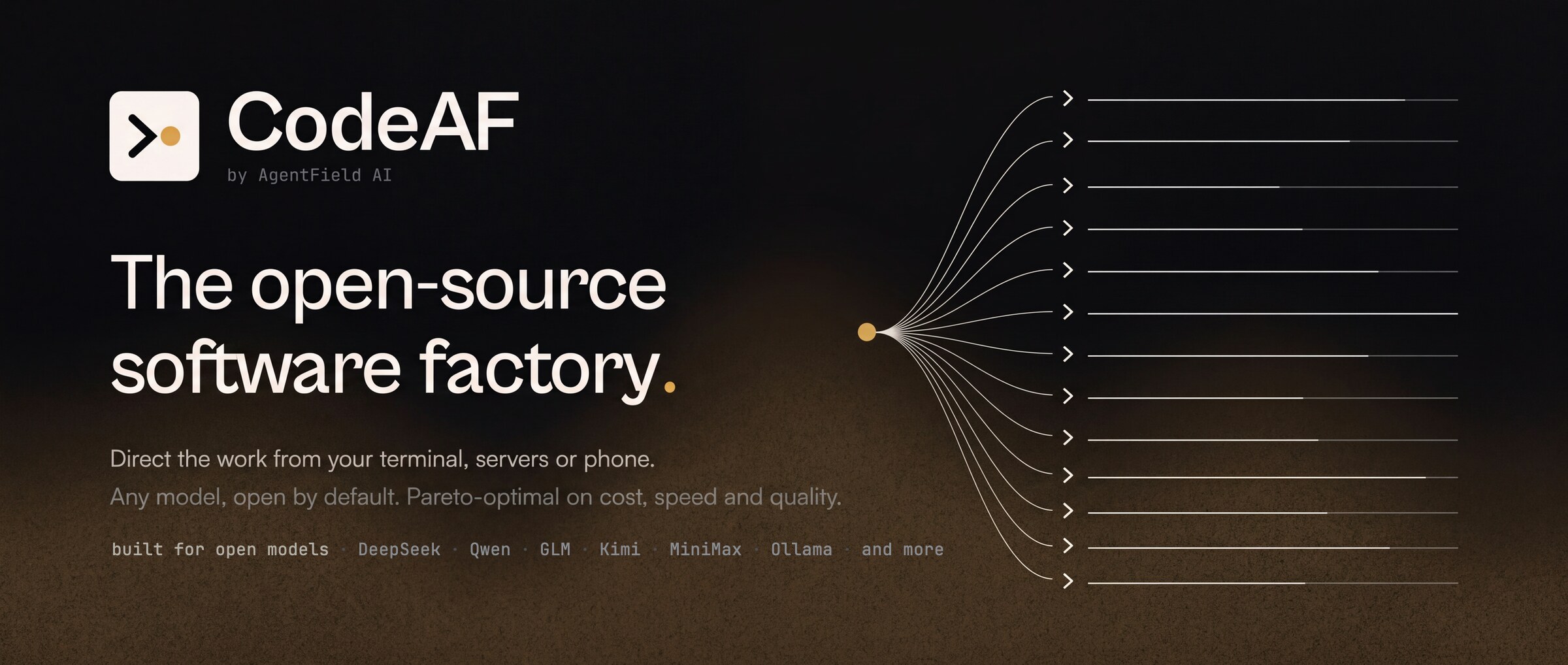
CodeAF is an Apache-2.0 Go binary that runs open-weight models as a local software factory with task fan-out and Pareto crewing. v0.6.0 shipped 2026-10-01; ★259 now. Vendor DeepSWE doc: /senior-dev solved 62/113 (54.9%) on DeepSeek V4 Flash vs nine other harnesses—with stated one-seed and sampling caveats.
Zoom
Key Takeaways
Agent-Field/CodeAF Apache-2.0; ★259 / 34 forks; install via agentfield.ai/get/codeaf
v0.6.0 published 2026-10-01T18:59:00Z; README still says early preview
Vendor DeepSWE same-model table: senior-dev 62/113 (54.9%) at ~22¢/task vs nine harnesses—one seed; sampling-contract caveat documented
Later same 113 tasks: 88/113 (77.9%) on DeepSeek V4.1 Flash; 78/113 (69.0%) on Kimi K3 (senior-dev only)
Built-in providers include OpenRouter, DeepSeek, GLM, Kimi, MiniMax, Qwen, Codex, Ollama; default worker/planner/checker crew