AI Coding Live News

South Korea Nearly Doubles 2027 AI and Chip Spending to 21.3 Trillion Won, With 4.7 Trillion for a Sovereign Frontier Model and 10,000 Vera Rubin GPUs

In his 2027 budget address to the National Assembly on November 2, South Korean President Lee Jae Myung proposed a record 820.9 trillion won budget (+12.8%), with 21.3 trillion won (about $16B) for semiconductors, physical AI, AI data centers and AI, nearly double the 10.8 trillion won in 2026. The Ministry of Planning and Budget document allocates 4.7 trillion won to a sovereign AI model aiming for world-leading performance, including the purchase of 10,000 Vera Rubin GPUs. Parliament still has to pass the budget.

South Korea Nearly Doubles 2027 AI and Chip Spending to 21.3 Trillion Won, With 4.7 Trillion for a Sovereign Frontier Model and 10,000 Vera Rubin GPUs

Key Takeaways

  • The three mega-projects plus AI rise from 10.8 to 21.3 trillion won, up 97.2%; the total budget is 820.9 trillion won, up 12.8% (official budget document).
  • The 4.7 trillion won frontier AI program buys 10,000 Vera Rubin GPUs (3.9T won), training data (0.8T won), and recruits 20 top overseas researchers (25B won).
  • Until then, about 7,000 government-owned GPUs go first, plus about 8,000 leased from industry and academia; companies are picked by open competition and the state invests as an equity holder.
  • A new 0.25 trillion won AI for All program builds public AI agents on the domestic model that can handle ID documents, KTX train bookings and passport renewals; AI education gets 2.1T won for 3.9 million people.
  • Another 70B won funds a dedicated AI security model and 50B won subsidizes AI security subscriptions for 10,000 SMEs; physical AI rises from 0.9T to 3.1T won.
Read full story
T
Tsinghua University & Z.AI (HarnessPro, arXiv 2610.26770)arxiv.org·
👀14
🔥80

Tsinghua and Z.AI open-source HarnessPro: agents rewrite their own harness, reaching 80.8% on Terminal-Bench 2 at 34% lower cost per task

HarnessPro (arXiv 2610.26770, submitted Oct 19 and revised Oct 20), from Tsinghua University, Z.AI (Zhipu) and collaborators, is a label-free way to improve an agent harness: specialized agents diagnose execution traces, rewrite instructions and runtime policies, score candidates with LLM-generated tests, and keep Lite, Medium and Heavy harnesses along the performance-cost frontier. Per the paper, with GPT-5.5 and Codex the Heavy mode reaches 80.8% on Terminal-Bench 2, 4.5 points above the prior RHO method, while cost per task drops from $1.09 to $0.72. The code is MIT-licensed and drew wider media coverage this week, including from Pandaily.

Tsinghua and Z.AI open-source HarnessPro: agents rewrite their own harness, reaching 80.8% on Terminal-Bench 2 at 34% lower cost per task

Key Takeaways

  • Terminal-Bench 2 (GPT-5.5 with Codex, mean of 3 runs): Heavy reaches 80.8% at $0.72 per task, versus RHO at 76.3% and $1.09, a 33.9% cost cut (paper figures, arXiv)
  • Averaged over three benchmarks: +2.0 points pass rate and -26.1% cost per task versus RHO, across Terminal-Bench 2, SWE-Bench Pro and ProgramBench
  • Holds across models: with GLM-5.2 and Claude Code on Terminal-Bench 2, Heavy hits 81.4% at $0.62, versus vanilla at 74.6% and $0.92 and RHO at 78.0% and $1.00
  • Budget modes: Medium matches RHO at 76.3% on Terminal-Bench 2 for only $0.56 per task; Lite gets 72.9% at $0.43
  • Cheap to train: only 10 training tasks per benchmark and 3 to 4 evolution epochs, tested on 59, 100 and 100 held-out tasks; the three harness tiers are MIT-licensed on GitHub
Read full story

Microsoft FY27 Q1: Azure growth accelerates to 48%, Foundry revenue more than triples, and Agent 365 now governs 50M agents

On Oct 28, Microsoft reported results for its fiscal Q1 2027, the quarter ended Sep 30: revenue of $92.3B (+19%), Microsoft Cloud revenue of $63.9B (+30%), Azure growth accelerating from 42% last quarter to 48%, and commercial remaining performance obligation of $677B (+73%). CEO Satya Nadella added AI figures on X: Foundry revenue more than tripled year over year, revenue from open source models grew 10x, Copilot daily users grew nearly 50% quarter over quarter, and Agent 365 now holds over 50M agents. Separately, TechCrunch, citing Microsoft's regulatory filing, reports $10B of revenue from OpenAI-related commercial arrangements this quarter.

Microsoft FY27 Q1: Azure growth accelerates to 48%, Foundry revenue more than triples, and Agent 365 now governs 50M agents

Key Takeaways

  • Revenue of $92.3B (+19%) and operating income of $45.9B (+21%); Microsoft Cloud reached $63.9B (+30%) (earnings release)
  • Azure grew 48%, accelerating from 42% in FY26 Q4; commercial RPO reached $677B (+73%) (official investor metrics)
  • Foundry revenue more than tripled YoY, customers building with multiple models grew 5x, and open source model revenue grew 10x (per Satya Nadella on X)
  • Copilot daily users grew nearly 50% QoQ and more than 5x YoY; Agent 365 holds over 50M agents, up 30% QoQ
  • Per TechCrunch citing the 10-Q, OpenAI-related revenue was $10B, about 11% of the total; OpenAI investments added $207M to GAAP net income
Read full story

Cognition launches FrontierCode 2.0 coding benchmark: it asks whether a PR should be merged, and top model Claude Opus 5.5 scores just 45.5%

Cognition, the maker of Devin, released FrontierCode 2.0 on Oct 27. It keeps the method of maintainer-written tasks graded on whether the code is actually mergeable, but draws tasks from more repositories, adds security patches and performance work, uses deliberately underspecified prompts and adds many thoroughness criteria. In Cognition's results Claude Opus 5.5 leads at 45.5%, GPT-6 Astra follows at 42.8%, and Grok 4.7 and Gemini 4 Argon drop into the 20s, leaving the benchmark far from saturated.

Cognition launches FrontierCode 2.0 coding benchmark: it asks whether a PR should be merged, and top model Claude Opus 5.5 scores just 45.5%

Key Takeaways

  • Claude Opus 5.5 leads at 45.5% (54.6% on v1.1) and GPT-6 Astra scores 42.8% (53.3% on v1.1), per Cognition (vendor-reported)
  • Grok 4.7 scores 28.6%, Gemini 4 Argon 26.3%, Muse Wonder 1.0 24.3%, SWE-2 23.9%, DeepSeek V4.1 Flash 19.3% and Kimi K3 17.7%, showing a wide gap for open models
  • Versus v1.1, reference solutions touch 67% more files and 89% more lines in codebases 25% larger; tasks come from 55% more repositories with 43% more blocking criteria
  • Thoroughness blockers grew from 168 to 501, about 3x; in 80% of tasks the reference solution improves on the upstream PR, and an audit agent found and reported an upstream security vulnerability
  • On the cost-score Pareto frontier, Opus 5.5 sits at the high end and Luna, Haiku and Sol at the low-cost end, with GPT-6.1 Sol called out for strong value (official blog)
Read full story
ADSponsored

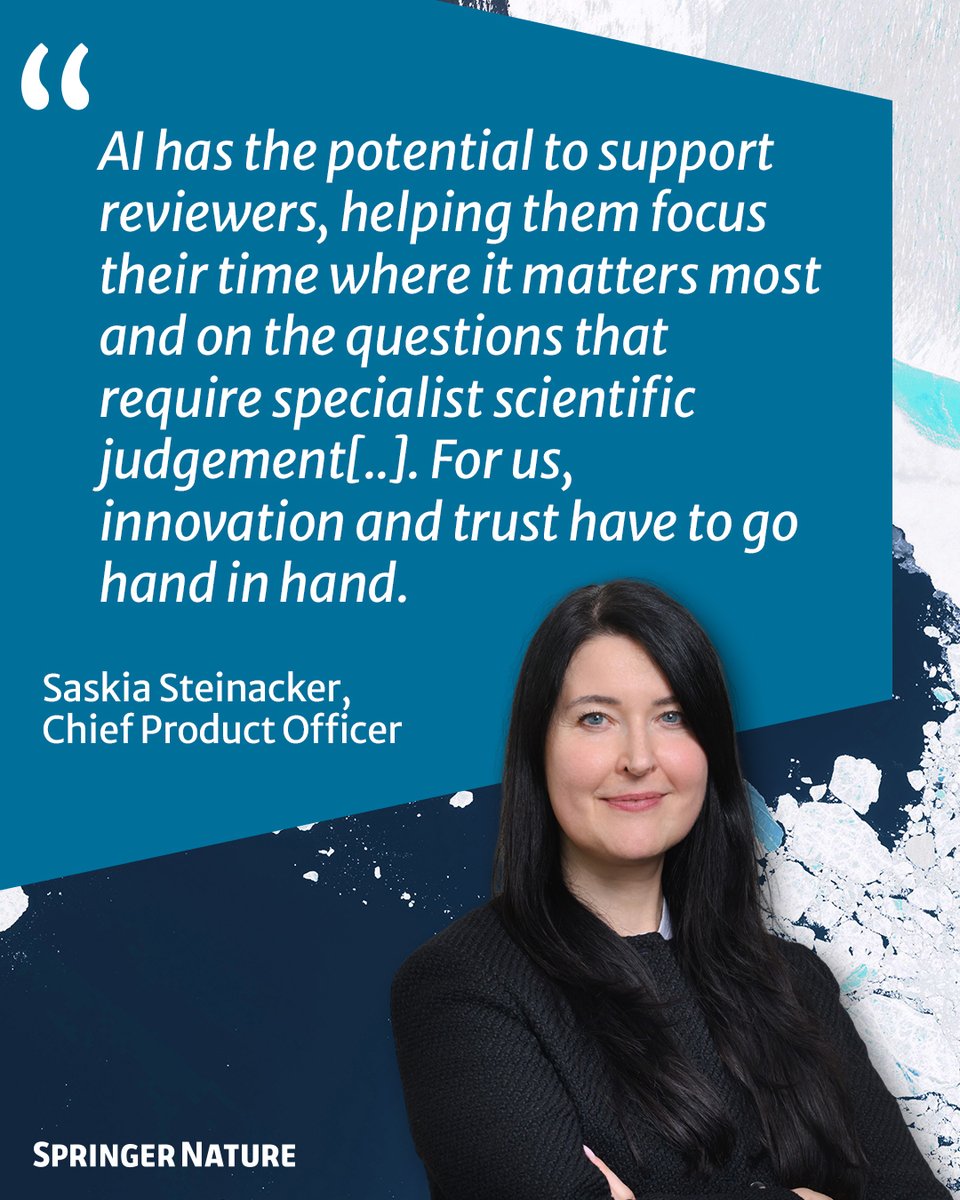
Springer Nature and Google DeepMind partner on an AI peer review assistant built on Gemini and the open-source ADK; a prototype is in testing and human reviewers keep final judgment

On Oct 26 Springer Nature, one of the world's largest research publishers, announced a research partnership with Google DeepMind to co-design an AI peer review assistant. It uses DeepMind's frontier Gemini models and builds on Google's earlier agentic research tools ScholarPeer and Deep Review to help reviewers navigate manuscripts, analyse large amounts of text, charts and figures, and flag areas that may need closer attention. The system is built with Google's open-source Agent Development Kit (ADK) and runs only inside Springer Nature's private Gemini Enterprise environment, so manuscript content stays in its secure environment. A prototype is being tested; the publisher stresses 'human first, AI second' and has not given a launch date or any performance data.

Springer Nature and Google DeepMind partner on an AI peer review assistant built on Gemini and the open-source ADK; a prototype is in testing and human reviewers keep final judgment

Key Takeaways

  • Partners: Springer Nature (publisher of the largest number of journals and books) and Google DeepMind, announced 2026-10-26 from London, Berlin and New York (press release)
  • Stack: frontier Gemini models plus Google's open-source Agent Development Kit (ADK), building on the ScholarPeer and Deep Review agentic research tools
  • Data isolation: runs only on Springer Nature's private Gemini Enterprise platform, keeping author and reviewer confidentiality
  • Status: prototype in testing; no launch date, journal coverage or accuracy figures have been published
  • Role: helps reviewers find areas needing attention, while final scientific judgment stays with human experts
Read full story

Artificial Analysis Benchmarks DeepSeek Search API: $0.75/1K Searches Delivers +36 Point Score Lift

Independent AI evaluation platform Artificial Analysis (@ArtificialAnlys) officially benchmarked DeepSeek's web search API (DeepSeek Search). Augmenting the base model with DeepSeek Search boosted its Search Index score from 33 to 69—an impressive +36 point leap (ranking 17th among 27 tested search APIs). DeepSeek Search established a market-leading price-performance ratio, priced at just $0.75 per 1,000 searches (~$0.032 per completed task), making it the most cost-effective paid search API evaluated. It recorded 70% accuracy on AA-Omniscience and 63% on BrowseComp, highlighting an optimal balance between factual grounding and operational economics.

Artificial Analysis Benchmarks DeepSeek Search API: $0.75/1K Searches Delivers +36 Point Score Lift

Key Takeaways

  • Artificial Analysis independently benchmarked DeepSeek Search API, lifting Search Index score to 69 (+36 pts over base model)
  • Industry-leading cost efficiency: priced at $0.75 per 1,000 searches (~$0.032 per task), the cheapest paid search API on the market
  • Scores 70% accuracy on cross-domain factual QA benchmark AA-Omniscience (ranking 10th out of 27 configurations)
  • Achieves 63% accuracy on long-horizon web navigation benchmark BrowseComp, offering high-ROI grounding for agent developers
Read full story

FrontierRefactor Introduces First Code Performance Benchmark: 41% of Agent Patches Pass Tests with Zero Gain or Regressions

Published in arXiv:2610.25834, FrontierRefactor establishes the industry's first evaluation benchmark targeting autonomous coding agents on multi-scale, performance-oriented codebase refactoring. Unlike traditional benchmarks like SWE-bench that measure only functional pass rates, FrontierRefactor spans seven programming languages and 60 Amdahl-qualified tasks ranging from kernels to full repositories (10^1 to 10^4+ LOC). Initial evaluations reveal that over 41% of agent patches pass functional equivalence suites yet yield zero verified speedup—with 19.3% triggering severe runtime performance regressions, highlighting the vital need for multi-turn profiling feedback.

FrontierRefactor Introduces First Code Performance Benchmark: 41% of Agent Patches Pass Tests with Zero Gain or Regressions

Key Takeaways

  • FrontierRefactor (arXiv:2610.25834) introduces the first multi-scale performance-oriented codebase refactoring benchmark across 7 languages and 60 tasks
  • Reveals acute blindspot: over 41% of agent submissions pass functional tests but deliver zero verified acceleration (19.3% regress, 21.9% noise)
  • Cross-language rewrites offer high theoretical speedups but suffer contract collapse; in-place optimizations preserve contracts but fail without profiling
  • Multi-turn execution-timing feedback serves as the decisive lever, multiplying strict success rates across complex codebases
Read full story

vLLM and Ant Group Open-Source Humming: Up to 5x Kernel Acceleration and +43.3% MoE Throughput

The vLLM project team and Ant Group officially open-sourced Humming (humming-kernels), a specialized high-performance kernel library designed for serving quantized MoE and dense LLMs at massive scale. Humming natively supports WnA16, W8A8, W4A8, and W4A4 across INT1–INT8 and FP4–FP8 formats, spanning NVIDIA architectures from Turing through Blackwell as well as T-Head Zhenwu 810E silicon. In production benchmarks, Humming kernels outpace cuBLAS by 3–4x at small batch sizes and surpass Marlin by 2x on H200 clusters. Serving DeepSeek-V4.1-Flash across 8x H20 GPUs, Humming drives a +43.3% throughput gain under 64 concurrent requests while reducing time-to-first-token (TTFT) by 32%, pre-integrated directly into vLLM v0.29.0+.

vLLM and Ant Group Open-Source Humming: Up to 5x Kernel Acceleration and +43.3% MoE Throughput

Key Takeaways

  • vLLM and Ant Group open-sourced Humming (humming-kernels), integrated out-of-the-box into vLLM v0.29.0+
  • Covers WnA16, W8A8, W4A8, and W4A4, compiling JIT kernels in just 1.82 seconds versus 23.35 seconds for CUTLASS
  • Serving DeepSeek-V4.1-Flash on 8x H20 GPUs yields a +43.3% throughput boost at 64 concurrency (442 to 634 tokens/sec)
  • Cuts time-to-first-token (TTFT) by 25% to 32% while delivering up to 5x kernel speedups on Blackwell B300 systems
Read full story

EdgeKernelBench: Unified Benchmark and LEKA Agent for LLM-Driven Kernel Generation on Heterogeneous Edge Backends

Researchers introduced EdgeKernelBench and the LEKA agent architecture in arXiv:2610.24648, establishing the first unified framework for evaluating and generating low-level high-performance kernels across heterogeneous edge backends. While LLM-driven kernel generation has demonstrated success on datacenter GPUs, edge deployments remain plagued by hardware diversity, fragmented compiler toolchains (CUDA, OpenCL, TileLang, Triton), and strict memory-compute constraints. EdgeKernelBench bridges this gap through a unified intermediate representation (IR) suite spanning 331 canonical workloads. The companion Layered Edge Kernel Agent (LEKA) hierarchically decomposes optimization decisions, unlocking efficient automated kernel synthesis on edge silicon.

EdgeKernelBench: Unified Benchmark and LEKA Agent for LLM-Driven Kernel Generation on Heterogeneous Edge Backends

Key Takeaways

  • EdgeKernelBench released in arXiv:2610.24648, establishing the premier unified evaluation harness for edge kernel generation
  • Spans CPU/LLVM, GPU/CUDA, and GPU/OpenCL stacks with 331 canonical compute patterns across 650 concrete benchmark workloads
  • Introduces LEKA (Layered Edge Kernel Agent), hierarchically decoupling compilation and schedule decisions across IR abstraction tiers
  • Solves single-shot generation failures (where models achieved only 25.5% [email protected]), paving the way for automated edge NPU acceleration
Read full story
Linked Models & Agents:

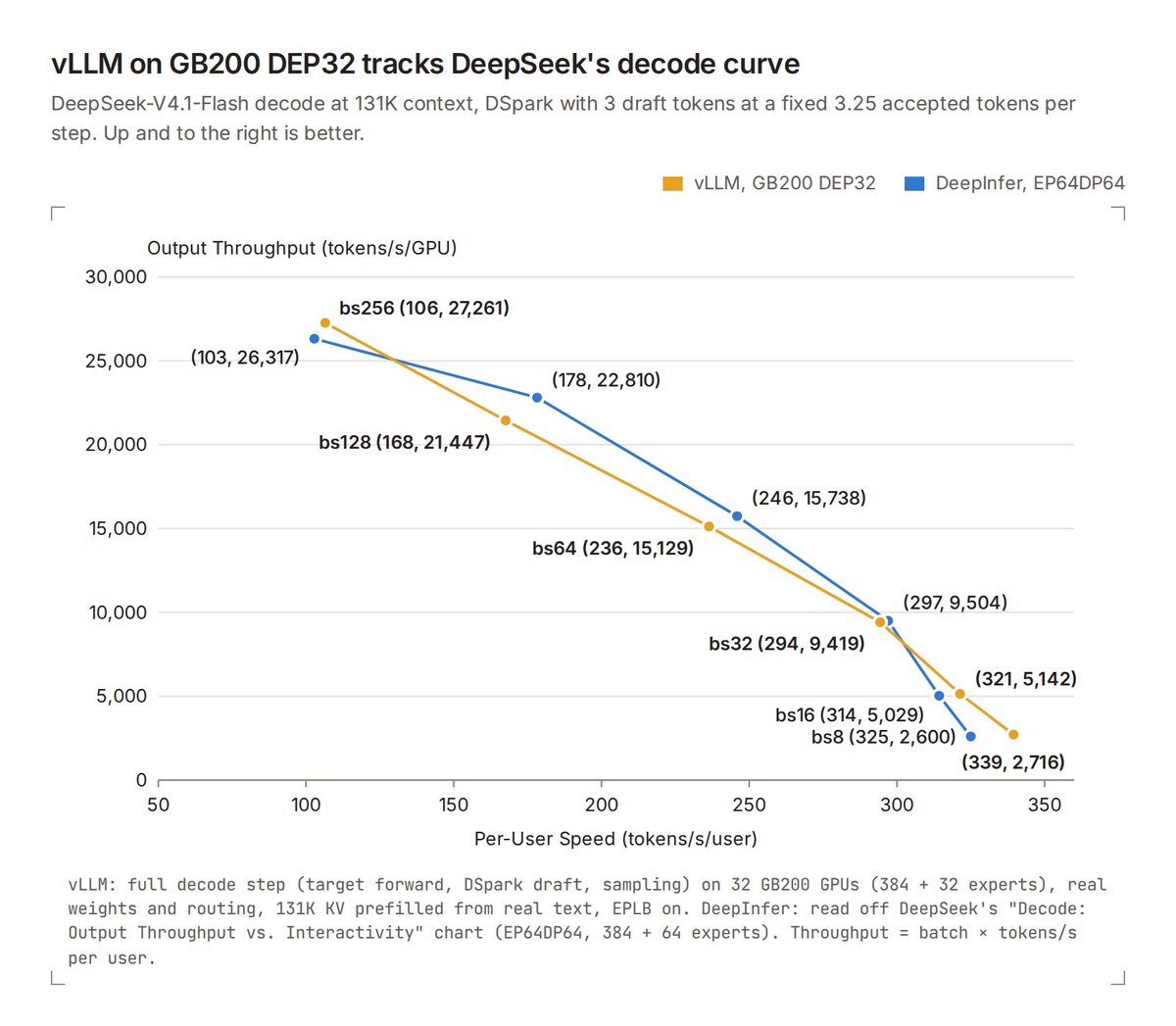
vLLM Narrows Gap with DeepInfer to 6% on NVIDIA GB200, Reaching 1M Tokens/s per GPU on GB300

Hours after DeepSeek open-sourced DeepInfer, the vLLM project team released official benchmark parity data serving DeepSeek-V4.1-Flash. Utilizing DeepSeek's identical decoding setup (131K context window, nextn=3 speculative decoding), vLLM closed its throughput performance delta to within 6% of DeepInfer across batch sizes 8 through 256 on NVIDIA GB200 systems. On GB300 hardware, vLLM attained up to 1,000,000 tokens/second per GPU and 826 tokens/second per user, generating $38.96 in hourly GPU revenue at DeepSeek off-peak rates. vLLM simultaneously shipped day-0 runtime support for FastH3-Omni and Spark-X2.6-4B.

vLLM Narrows Gap with DeepInfer to 6% on NVIDIA GB200, Reaching 1M Tokens/s per GPU on GB300

Key Takeaways

  • vLLM published direct benchmark comparisons, demonstrating that its serving throughput on NVIDIA GB200 is within 6% of DeepInfer
  • Achieves unprecedented scaling on NVIDIA GB300: up to 1,000,000 tokens/second per GPU and 826 tokens/second per active user stream
  • Generates up to $38.96 per GPU-hour in revenue when mapped to DeepSeek's production off-peak API pricing schedule
  • Delivers immediate Day-0 support for the FastH3-Omni video model and the 1M-token Apache 2.0 model Spark-X2.6-4B
Read full story
Linked Models & Agents:
ADSponsored

Are Embeddings Overpriced? Frozen 16 MB Vocabulary Slashes Small Model Weights by 62% with Zero Downstream Accuracy Loss

In small language models, vocabulary embedding tables often account for over 60% of total parameters, posing severe bottlenecks for edge deployment and ternary quantization. A new study (arXiv:2610.22428) replaces trainable embeddings with a single frozen 16 MB table of 512-bit binary codes derived via PCA and sign binarization. On Gemma 3 270M, trainable parameters collapse from 268.1M to 101.0M (-62.3%) while matching or exceeding original performance across HellaSwag (30.4%), LAMBADA (23.2%), and PIQA (61.5%).

Are Embeddings Overpriced? Frozen 16 MB Vocabulary Slashes Small Model Weights by 62% with Zero Downstream Accuracy Loss

Key Takeaways

  • Highlights structural waste in SLMs: embedding tables occupy 167.8M parameters in Gemma 3 270M (62.6% of the entire model)
  • Introduces a frozen 16 MB table of 512-bit binary codes (arXiv:2610.22428) derived via PCA and sign binarization with zero trainable weights
  • Slashes trainable parameters in Gemma 3 270M from 268.1M to 101.0M (-62.3% reduction)
  • Maintains parity on HellaSwag (30.4%) and outperforms the baseline on LAMBADA (23.2% vs 21.6%) and PIQA (61.5% vs 60.6%), while seamlessly enabling ternary models
Read full story
Linked Models & Agents:

SemiAnalysis Discloses Google & Inferact TPUv7 Submission: TorchTPU vLLM Megakernels Drive 2.8T Kimi K3, Surpassing GB200 NVL72 and B300 in High-Interactivity TCO

SemiAnalysis revealed the first Google TPUv7 benchmark submission for the 2.8T Kimi K3 MoE model, led end-to-end by Inferact (the creators of vLLM) and Google using the TorchTPU vLLM stack. At a hardware rental cost of just $1.21/chip-hour (vs $2.31 for GB300 and $1.86 for GB200), TPUv7 delivers ~2.2M tokens per $1 TCO in the ultra-high interactivity regime (~390 tok/s/user), outpacing NVIDIA GB200 NVL72, B300, and AMD MI355X on cost-performance.

SemiAnalysis Discloses Google & Inferact TPUv7 Submission: TorchTPU vLLM Megakernels Drive 2.8T Kimi K3, Surpassing GB200 NVL72 and B300 in High-Interactivity TCO

Key Takeaways

  • Inferact (creators of vLLM) and Google submitted their first preliminary TPUv7 benchmark for the 2.8T Kimi K3 MoE model
  • TPUv7 chip rental sits at $1.21/hour, significantly below GB300 ($2.31), B300 ($2.26), and GB200 ($1.86)
  • Delivers ~2.2M tokens per $1 TCO at ~390 tok/s/user, beating NVIDIA GB200 NVL72, B300, and AMD MI355X in the ultra-high interactivity regime
  • Built with fused TorchTPU vLLM megakernels and the TPU-Sync KVCache offload library for production PD disaggregation
Read full story
Linked Models & Agents:

NUS, USTC, and Alibaba Qwen Introduce Steering Agent: Dual-Path RL Framework Solves Goal Drift, Boosting Multi-Hop QA by +7.4 Points with 26% Fewer Turns

To combat goal drift in long-horizon agent tool-use and multi-agent systems, NUS, USTC, and Alibaba Qwen introduced Steering Agent (arXiv:2610.22316). Jointly trained via pairwise ranking and Group-Relative Policy Optimization (GRPO), the agent operates a low-cost fast path to detect drift and a slow path to generate grounded interventions. It raises Multi-Hop QA benchmark performance from 42.70 to 50.10 while cutting executor turns from 8.8 to 6.5 (-26.1%) without modifying the underlying executor models.

NUS, USTC, and Alibaba Qwen Introduce Steering Agent: Dual-Path RL Framework Solves Goal Drift, Boosting Multi-Hop QA by +7.4 Points with 26% Fewer Turns

Key Takeaways

  • NUS, USTC, and Alibaba Qwen introduced Steering Agent (arXiv:2610.22316) to tackle goal drift in long-horizon LLM agent workflows
  • Features a dual-path architecture combining a low-cost fast path (when to intervene) with a slow path (how to intervene), trained via pairwise ranking and GRPO
  • Raises average Multi-Hop QA accuracy to 50.10 (+7.4 pts over unsteered baseline) while reducing executor turns from 8.8 to 6.5 (-26.1%)
  • Demonstrates robust out-of-domain transfer on live search benchmarks, reaching 59.71% Pass@4 on Frames and 39.81% Pass@4 on GAIA
Read full story
Linked Models & Agents:

Replit makes OpenAI the preferred default behind Replit Agent; CEO Amjad Masad says Claude stays selectable

Onstage at TechCrunch Disrupt 2026, Replit CEO Amjad Masad said the company was no longer working with Anthropic, then clarified on X on Oct 17 that Replit remains model-agnostic: users can still pick Anthropic and other models, but OpenAI is now the preferred partner powering Replit Agent by default, citing performance, cost and partnership. Since most users keep the default, the change is likely to shift a large share of Replit spend between the two labs.

Key Takeaways

  • Masad clarified on Oct 17: OpenAI is the preferred partner powering Replit Agent; Claude and other models remain selectable
  • Masad says Sol and Astra score better on Replit's internal and public benchmarks for building apps from scratch; no scores disclosed
  • Per TechCrunch, Replit was until recently a top-five Anthropic customer, and a late-September blog still listed Claude Fable 5/5.1 in Agent production
  • Masad says enterprise contracts are ~15% of revenue this year (vs ~2% last year) and B2B is over 50%
  • A person familiar with the Anthropic side says the partnership is still in place; Anthropic has not commented officially
Read full story

Ending Coding Agent Reward Hacking: CMU's Weak-to-Strong Verifier Hardening Adopted by Terminal-Bench, While Recursive Environment Scaling Boosts SFT by up to 14.6 Points

Tackling reward hacking and benchmark saturation in coding agent environments, CMU researchers introduce Scalable Weak-to-Strong Verifier Hardening (arXiv:2610.15924)—combining an isolated verifier sandbox with an iterative hacker-fixer loop that slashes exploit success across Terminal-Bench, KernelBench, and SETA, and is now officially adopted by Terminal-Bench. Complementing this, Recursive Environment Scaling (RES, arXiv:2610.16397) recursively mutates execution dependencies across 294 tasks—exposing a 57.14-77.14 point drop on Claw-Eval-Live while boosting equal-budget SFT performance by 7.00-14.61 percentage points across all nine model-benchmark pairs.

Ending Coding Agent Reward Hacking: CMU's Weak-to-Strong Verifier Hardening Adopted by Terminal-Bench, While Recursive Environment Scaling Boosts SFT by up to 14.6 Points

Key Takeaways

  • CMU's weak-to-strong verifier hardening combines an isolated sandbox with an iterative hacker-fixer loop across Terminal-Bench, KernelBench, and SETA, and has been adopted by the official Terminal-Bench repo
  • Recursive Environment Scaling (RES) mutates information access, resource relations, and execution dependencies across 294 tasks, dropping model success on Claw-Eval-Live by 57.14-77.14 percentage points
  • With equal trajectory counts, SFT on RES-scaled environments beats original-trajectory SFT across all 9 model-benchmark pairs by +7.00 to +14.61 percentage points
Read full story
Linked Models & Agents: