AI Coding Live News

Microsoft Open-Sources Mage-VL-Cowork, a 4B Computer-Use Agent That Chooses Between Clicking the GUI and Running Bash, Scoring 66.0% on OSWorld-Verified

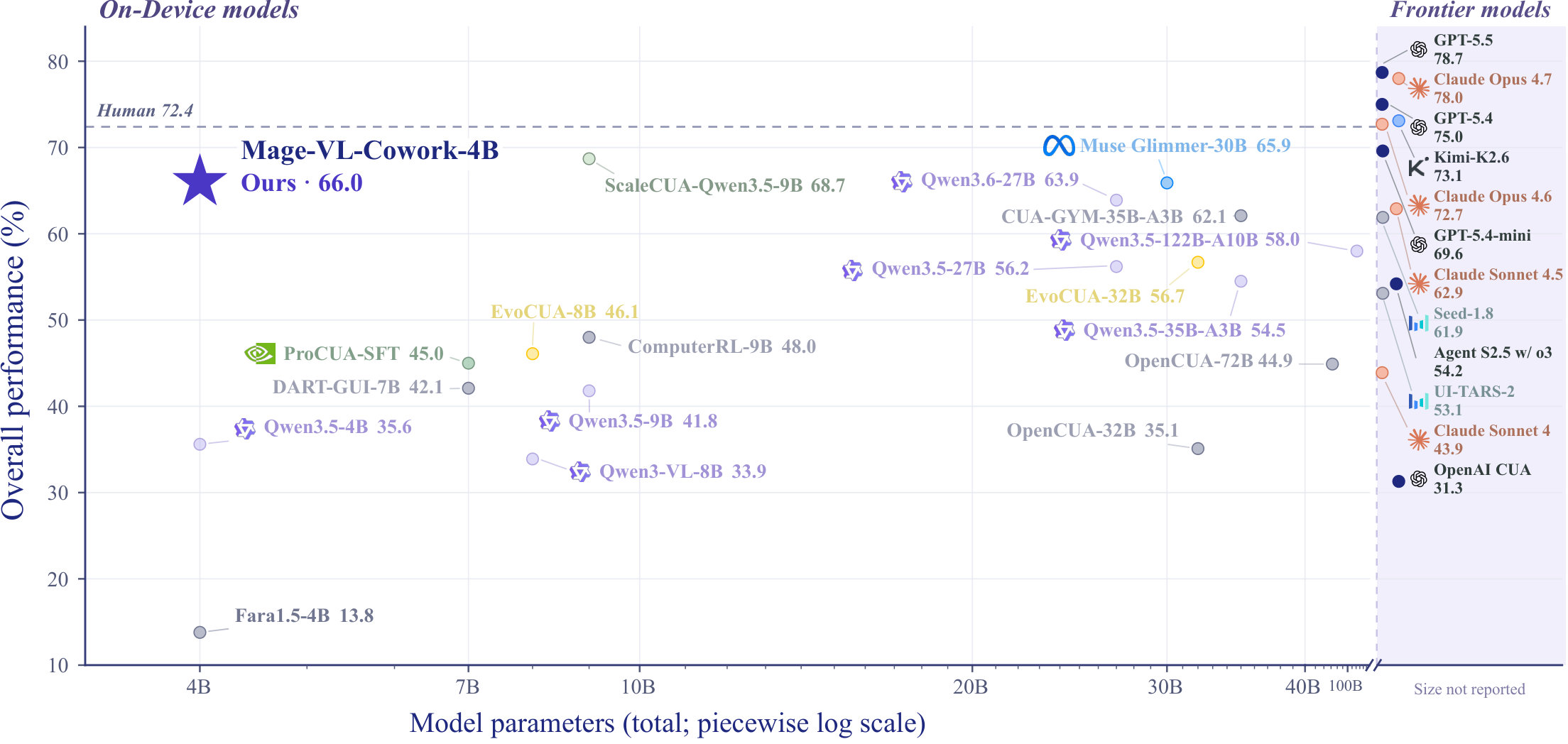
On October 30, Microsoft's Mage team released Mage-VL-Cowork on Hugging Face under Apache-2.0: a 4B multimodal computer-use agent in which a single model decides at every step whether to act through screenshots and GUI clicks (computer_use) or through bash and Python in a terminal, with no external orchestrator. Microsoft reports a two-run average of 66.0% on OSWorld-Verified (361 tasks, 50-step budget), above Qwen3.6-27B at 63.9% but below the 9B SCALECUA-Qwen3.5-9B at 68.7%.
Microsoft Open-Sources Mage-VL-Cowork, a 4B Computer-Use Agent That Chooses Between Clicking the GUI and Running Bash, Scoring 66.0% on OSWorld-Verified

Key Takeaways

  • 4B parameters, built on Mage-VL (Mage-ViT vision encoder plus Qwen3-4B-Instruct-2507); about 9.48 GB of bf16 weights under Apache-2.0.
  • On OSWorld-Verified, two independent runs scored 65.33% and 66.75% for a 66.0% average; 87.5% on operating-system tasks and 62.7% on multi-app workflows.
  • In Microsoft's side-by-side, a LibreOffice Calc chart task took 39 seconds (6 steps) via Python in the terminal, versus 9:56 (39 steps) for GUI-only Qwen3.6-27B.
  • Online RL adds 10.16 points over hybrid SFT while cutting mean model calls by 13.0% and output tokens by 25.4%.
  • Training data came from Mage-CUA-Forge, which synthesized about 294K desktop and web tasks across 6,915 skills and cut per-task generation cost from $0.906 to $0.158.
Read full story
Linked Models & Agents:
⚡ Mage-VL-Cowork⚡ Mage-VL⚡ Qwen3-4B⚡ Qwen3.6-27B🌐 Microsoft

X Discussion: Vercel CEO Guillermo Rauch Says "Own Your Intelligence," Urging Local Models to Keep Spreading and Developers to Own Their Agent Harness and Data

Vercel CEO Guillermo Rauch posted on X on November 1: "Own your intelligence. Anyone that opposes this has something to sell you (perhaps your own intelligence back to you.)" He argued that local models need to keep proliferating; since the biggest models may be out of reach locally for now, the best option is to keep your options open: own your harness, data, connections and runtime, meaning your agents, and embrace open source. Within about 12 hours the post drew about 2,500 likes, 128K views and over 100 quote posts, with debate centered on how to balance local and cloud AI.

Key Takeaways

  • This is Rauch's personal opinion post, not an official Vercel announcement or product release.
  • The original post (2026-11-01 21:08 UTC) had about 2,533 likes, 255 reposts, 266 replies, 107 quotes, 128K views and 581 bookmarks at fetch time.
  • Core claim: local models should keep spreading; until the biggest models can run locally, keep your options open by owning your harness, data, connections, runtime and agents, and embrace open source.
  • Mark (@marksuman), co-founder and CEO of Maple AI, replied in a quote post that it will be hybrid: cloud will always be more powerful, so local-first AI should be paired with private cloud.
  • Engineer Shantanu Goel (@shantanugoel) quoted it saying "Guillermo says the truth that most others won't!", drawing about 37 likes.
Read full story
Linked Models & Agents:

X discussion: open-source AI builder Jun Song says he turned down an anonymous black hat group offering huge money to post-train open-weight models on exploit data

At 02:20 UTC on Nov 1, open-source AI builder Jun Song (@jun_song, who builds Supergemma) posted on X that an anonymous black hat group offered him an "astronomical" sum to post-train open-weight models with reinforcement learning on the exploit data it holds. He said the volume was so large he would have believed it was an undercover FBI dataset, that he turned it down, and that what scares him is that someone else will eventually take the deal. As of 17:10 SGT the post had about 2,029 likes, 222K views and 771 bookmarks, and it has been rewritten as a parody template. This is a personal account; the offer, the data volume and the group cannot be verified, so it is treated here as a discussion.

Key Takeaways

  • Reach: the original post had about 2,029 likes, 127 reposts, 101 replies, 771 bookmarks and 222.2K views as of Nov 1, 17:10 SGT
  • Claim: an anonymous black hat group offered an "astronomical" sum to post-train open-weight models on exploit data; he says he declined, and neither the amount nor the data volume is public or verifiable
  • Comparison: he says a white-hat project of his built on GLM-5.3 used under 1% of that volume and already beat frontier models "by a huge margin"; this is self-reported with no public benchmark
  • Reaction: accounts such as msuiche and Samuel Cardillo reused the opening lines as a parody template, so the thread splits between taking it seriously and joking about it
  • Issue: open-weight models cannot be recalled once released and their safeguards can be trained away, so a request like this makes the open-weights versus misuse debate concrete
Read full story
Linked Models & Agents:
g
guregodevo (Memdoor author)github.com·
👀13
🔥81

Memdoor reproduces GVS5H: a team of five Qwen3.8-27B agents averages 9.8/10 on the first 10 LiveCodeBench Hard problems, against 8.0 for a single Fable 5 call

On Oct 31 the open-source coding agent Memdoor (GitHub guregodevo/memdoor, Apache 2.0) published its team-solve workflow: using the GVS5H paper authors' exact prompts and loop, five Qwen3.8-27B instances act as planner, two ideators, solver and manager, talk only through files on disk, and a script that runs the tests decides success. Over five passes on the first 10 LiveCodeBench Hard problems from the GVS5H list it averaged 9.8/10, against 9.6 for the authors' own harness and 8.0 for a single Fable 5 call; 49 of 50 runs solved the problem for $35.79 in total, and every request and reply is public. The Hacker News post has about 200 points. This is a community reproduction on only 10 problems, and the author notes that training-data contamination cannot be ruled out.

Key Takeaways

  • Score: a mean of 9.8/10 over five passes (10, 10, 10, 10, 9), against 9.6 for the GVS5H authors' own harness and 8.0 for a single Fable 5 call (team-solve README, project-reported)
  • Cost: 49 of 50 runs solved, $35.79 and 15.3M output tokens in total; a median run took about 40 minutes of model time and $0.39, the longest 4 hours
  • Method: five roles (planner, two ideators, solver, manager) plus a repair worker each start from a fresh context, talk only through files on disk, and a shell script that runs the tests decides success instead of a model
  • Limits: only 10 problems rather than the paper's 100; the contests date from March and April 2025 and may be in training data; Fable 5's column comes from the GVS5H authors' result files and was not rerun in this harness
  • Reach: the HN post has about 200 points as of Nov 1, 16:10 SGT; the original GVS5H paper is arXiv 2608.26480, which reached #1 on HN on Oct 25
Read full story
ADSponsored

SenseTime open-sources SenseNova-Loop-9B-Preview, a 9B looped Transformer with about 14.6B inference parameters for long-context and agentic work

On Oct 30, SenseTime released SenseNova-Loop-9B-Preview (Apache 2.0) on its official X account and Hugging Face. It runs layers 4 to 27 of a 32-layer decoder twice with the same weights, so each forward pass executes 56 layer computations while storing about 9B parameters, about 14.6B at inference, and it uses two-stream mHC (manifold-constrained hyper-connections) to manage the residual streams. It takes text and images, with training sequences up to 262,144 tokens. SenseTime charts show it beating Qwen3.5 and Qwen3.6 peers on BIRD-Dev, WorkBuddy Bench, and other agent and data tasks, while it still trails on Terminal Bench 2.1; the technical report is not out yet. The official launch post drew about 910 likes.

SenseTime open-sources SenseNova-Loop-9B-Preview, a 9B looped Transformer with about 14.6B inference parameters for long-context and agentic work

Key Takeaways

  • Structure: 32 distinct decoder layers, with layers 4 to 27 looped twice on shared weights for 56 layer computations per forward pass; about 9B stored and about 14.6B inference parameters (model card)
  • Vendor-reported scores: BIRD-Dev 71.38 (Qwen3.5-27B 69.84), WorkBuddy Bench 66.89 (Qwen3.6-35B-A3B 61.98), AutomationBench 13.72 (Qwen3.5-27B 10.17)
  • Weak spots from the same vendor chart: Terminal Bench 2.1 at 40.45, below Qwen3.6-27B at 47.19; tau3-Banking at 18.56, slightly below Qwen3.5-27B at 19.59
  • Training context up to 262,144 tokens; hybrid attention uses three linear-attention layers plus one full-attention layer per four-layer group; MTP speedup is available, DSpark and DFlash2 are still training
  • Apache 2.0, requires trust_remote_code=True; official examples cover Transformers 5.18.0, a 4-GPU LightLLM setup, and an SGLang PR, and the technical report is still to come
Read full story
Linked Models & Agents:
⚡ SenseNova-Loop-9B-Preview⚡ Qwen3.5-27B⚡ Qwen3.6-35B-A3B🌐 SenseTime

Benji Taylor, head of design at X and SpaceXSI, open-sources Stageshow, an agent skill for realistic faux product UI and animated demos

On Oct 31, Benji Taylor, head of design at X and SpaceXSI, released Stageshow on X: an open-source skill (MIT license) for coding agents that helps them produce faux product UI that looks real, including stills, cursor demo animations, and bento grids, delivered as ordinary React components. It installs with one command, and he says it works with Grok Build, Claude Code, Codex, Gemini, and others. The launch post drew about 4,500 likes and 6,500 bookmarks. He notes it rarely nails a demo in one shot and most still take a few rounds of feedback.

Benji Taylor, head of design at X and SpaceXSI, open-sources Stageshow, an agent skill for realistic faux product UI and animated demos

Key Takeaways

  • Install: npx skills add benjitaylor/skills --skill stageshow; the author says it works with Grok Build, Claude Code, Codex, Gemini, and other agents (author's post)
  • Contents: a seven-step workflow in SKILL.md, reference rule docs, dozens of gold examples, a React kit, and self-check scripts such as film.mjs (GitHub)
  • License: the stageshow folder is MIT licensed; the repo was created Oct 26 and had about 61 stars at writing time
  • Reach: the launch post had about 4,521 likes, 6,561 bookmarks, and 213k views as of Nov 1, 08:00 SGT
  • Quality claims are the author's own: the same prompts did better with the skill, but no quantitative evaluation was published
Read full story

DeepSeek Harness team open-sources dsh-superagent, a proactive coding agent prototype for a single GitHub repo, alongside its Super-agent architecture article

On Oct 31, deepseek-ai open-sourced dsh-superagent-prototype on GitHub under the MIT license: a proactive coding agent that runs as a DeepSeek Harness bundle, lives on one GitHub repository and can optionally listen to Feishu. When an allowed person asks for work, it opens a work item, works in its own session and directory, and answers in the original conversation, for example with a pull request. The README states it is a research prototype, not an official DeepSeek product. The companion article, Exploring Super-agent Design, proposes a two-layer Router-Worker architecture; the team test, as reproduced by media, reports a p95 completion time of 15.7 minutes versus 29.5 minutes for a single-session setup.

Key Takeaways

  • Open source: deepseek-ai/dsh-superagent-prototype went public on Oct 31 under MIT, written in TypeScript, with about 1,800 stars at the time of writing
  • Scope: each deployment serves 1 GitHub repository, with optional Feishu; it acts only when an allowed person addresses it or a team-written rule allows it
  • Delivery: by default it only allows auto-merge for an approved pull request opened for a ticket with fewer than 200 changed lines, and never enables auto-merge as the agent account
  • Team test (as reproduced by media, vendor-reported): in a simulation with about 300 messages and 20 requests, p50 / p95 completion was 12.4 / 15.7 minutes versus 20.4 / 29.5 for a single session with a subagent tool
  • Risk: worker sessions run commands without approval as the operator's OS user, and the README asks users to review and adapt the code first
Read full story

OpenCode team ships Hex 3.0 stable: local voice dictation for Mac, Windows and Linux, built for talking to coding agents

Anomaly, the company behind open-source coding agent OpenCode, shipped Hex 3.0 stable: hold a shortcut, speak, and the text is pasted at your cursor. Recognition runs on-device, local model memory drops from about 900 MB to about 160 MB, and it adds vocabulary hints, a hex CLI and optional OpenCode rewriting.

OpenCode team ships Hex 3.0 stable: local voice dictation for Mac, Windows and Linux, built for talking to coding agents

Key Takeaways

  • Hex v3.0.0 was released on GitHub at 00:38 UTC on Oct 31; it is MIT-licensed, written in Rust, and the repo has about 1,557 stars (release notes)
  • Vendor figures: local model memory drops from about 900 MB to about 160 MB; since 2.3.0 it streams, so a 2-minute dictation finishes about 0.1 s after release on an RTX 5070 Ti
  • Runs on macOS 15+ (Apple silicon), Windows x64/ARM64 and Linux x64/ARM64, with new .deb and .rpm packages on Linux
  • 3.0 does not auto-update from 2.3.1 and starts fresh, so settings, History and models must be set up again; Voice Action and spoken commands are removed
  • The @opencode launch post drew about 2,400 likes, 1,600 bookmarks and 100k+ views (post)
Read full story
Linked Models & Agents:
⚡ Parakeet⚡ Whisper🤖 OpenCode🤖 Hex🌐 Anomaly

YC Labs pits AI agent swarms in Minecraft and Mindustry: GPT swarms win 12 of 16 head-to-head games against Claude, while a 50-agent colony slides into bureaucracy

YC Labs, a research project at Y Combinator, and multi-agent environment startup Olam Labs published "Agents in Games" on Oct 29. Fifty GPT-6.1 Sol agents told to "build a thriving civilization" in survival Minecraft spent three hours huddled in shelters rationing food, sending about 5,900 messages and inventing ration ledgers, permits and job titles. In nine Bed Wars games, 10 GPT-6.1 Sol agents beat 10 Claude Opus 5.5 agents 6–3; in seven 50-vs-50 Mindustry matches lasting about 9.5 hours, GPT won 6–1. The leader was almost always whichever agent was listed first in the directory, and stuck GPT agents fetched the game's public source code on their own. The Minecraft harness is open source. These are one lab's experimental observations, not a standardized benchmark.

YC Labs pits AI agent swarms in Minecraft and Mindustry: GPT swarms win 12 of 16 head-to-head games against Claude, while a 50-agent colony slides into bureaucracy

Key Takeaways

  • Head-to-head: GPT-6.1 Sol won Bed Wars 6–3 over nine games and Mindustry 6–1 over seven, 12 of 16 overall (see the YC Labs report)
  • Civ50: 50 GPT agents sent about 5,900 messages in three hours; 22 of 34 deaths came on the first night, after which the colony turned cautious
  • No election: 46 of the other 49 agents first messaged Ada, first on the roster, who received 616 DMs and became leader
  • Communication: in one Bed Wars game GPT players sent 1,147 DMs versus Claude's 82; GPT drifted into compressed shorthand while Claude voted with "+1"
  • Open source: the long-running Minecraft agent harness is public at yc-software/minecraft-agent-harness
Read full story
T
Tsinghua University & Z.AI (HarnessPro, arXiv 2610.26770)arxiv.org·
👀9
🔥80

Tsinghua and Z.AI open-source HarnessPro: agents rewrite their own harness, reaching 80.8% on Terminal-Bench 2 at 34% lower cost per task

HarnessPro (arXiv 2610.26770, submitted Oct 19 and revised Oct 20), from Tsinghua University, Z.AI (Zhipu) and collaborators, is a label-free way to improve an agent harness: specialized agents diagnose execution traces, rewrite instructions and runtime policies, score candidates with LLM-generated tests, and keep Lite, Medium and Heavy harnesses along the performance-cost frontier. Per the paper, with GPT-5.5 and Codex the Heavy mode reaches 80.8% on Terminal-Bench 2, 4.5 points above the prior RHO method, while cost per task drops from $1.09 to $0.72. The code is MIT-licensed and drew wider media coverage this week, including from Pandaily.

Tsinghua and Z.AI open-source HarnessPro: agents rewrite their own harness, reaching 80.8% on Terminal-Bench 2 at 34% lower cost per task

Key Takeaways

  • Terminal-Bench 2 (GPT-5.5 with Codex, mean of 3 runs): Heavy reaches 80.8% at $0.72 per task, versus RHO at 76.3% and $1.09, a 33.9% cost cut (paper figures, arXiv)
  • Averaged over three benchmarks: +2.0 points pass rate and -26.1% cost per task versus RHO, across Terminal-Bench 2, SWE-Bench Pro and ProgramBench
  • Holds across models: with GLM-5.2 and Claude Code on Terminal-Bench 2, Heavy hits 81.4% at $0.62, versus vanilla at 74.6% and $0.92 and RHO at 78.0% and $1.00
  • Budget modes: Medium matches RHO at 76.3% on Terminal-Bench 2 for only $0.56 per task; Lite gets 72.9% at $0.43
  • Cheap to train: only 10 training tasks per benchmark and 3 to 4 evolution epochs, tested on 59, 100 and 100 held-out tasks; the three harness tiers are MIT-licensed on GitHub
Read full story
ADSponsored

X discussion: Turing Award winner Richard Sutton shares the "intelligence explosion" passage he wrote at 17 in 1975

Richard Sutton, a founder of reinforcement learning and co-winner of the 2024 Turing Award, posted on X at 23:42 UTC on October 30 that he is sanguine about the technological singularity partly because he has seen it coming for over 50 years. He quoted a passage he wrote in 1975 at 17: once man creates an intelligence greater than his own, that intelligence should be able to create a still greater one, and intelligence could shoot up within years. The post drew more than 2,300 likes and about 167,000 views, and was widely shared in English and Chinese threads debating what role humans keep. This is a summary of an X discussion, not a verified conclusion.

Key Takeaways

  • Original post: Richard Sutton himself, 23:42 UTC on October 30, quoting a passage he wrote in 1975 at age 17 and calling it one reason he is sanguine about the singularity
  • Key ideas in the passage: understand the brain first; once that breakthrough comes, progress accelerates exponentially; a smarter-than-human intelligence builds an even smarter one; humans are either left behind or become that intelligence
  • Engagement (X API, read around 19:07 SGT on Oct 31): 2,376 likes, 232 reposts, 45 quotes, 97 replies, 882 bookmarks and about 167,000 views
  • Debate points: how early this anticipates todays recursive self-improvement framing; Chinese-language reposts focus on what human intelligence still means; others argue for using AI to learn faster
  • Sutton co-founded reinforcement learning and temporal-difference learning, and his 2019 essay The Bitter Lesson argues that general methods that scale with compute win in the long run
Read full story

Microsoft Research and UC Berkeley open-source TokenEconomizer, a plugin that cuts Claude Code and Codex costs by 18.4–30.9% on SWE-Bench without changing the agent

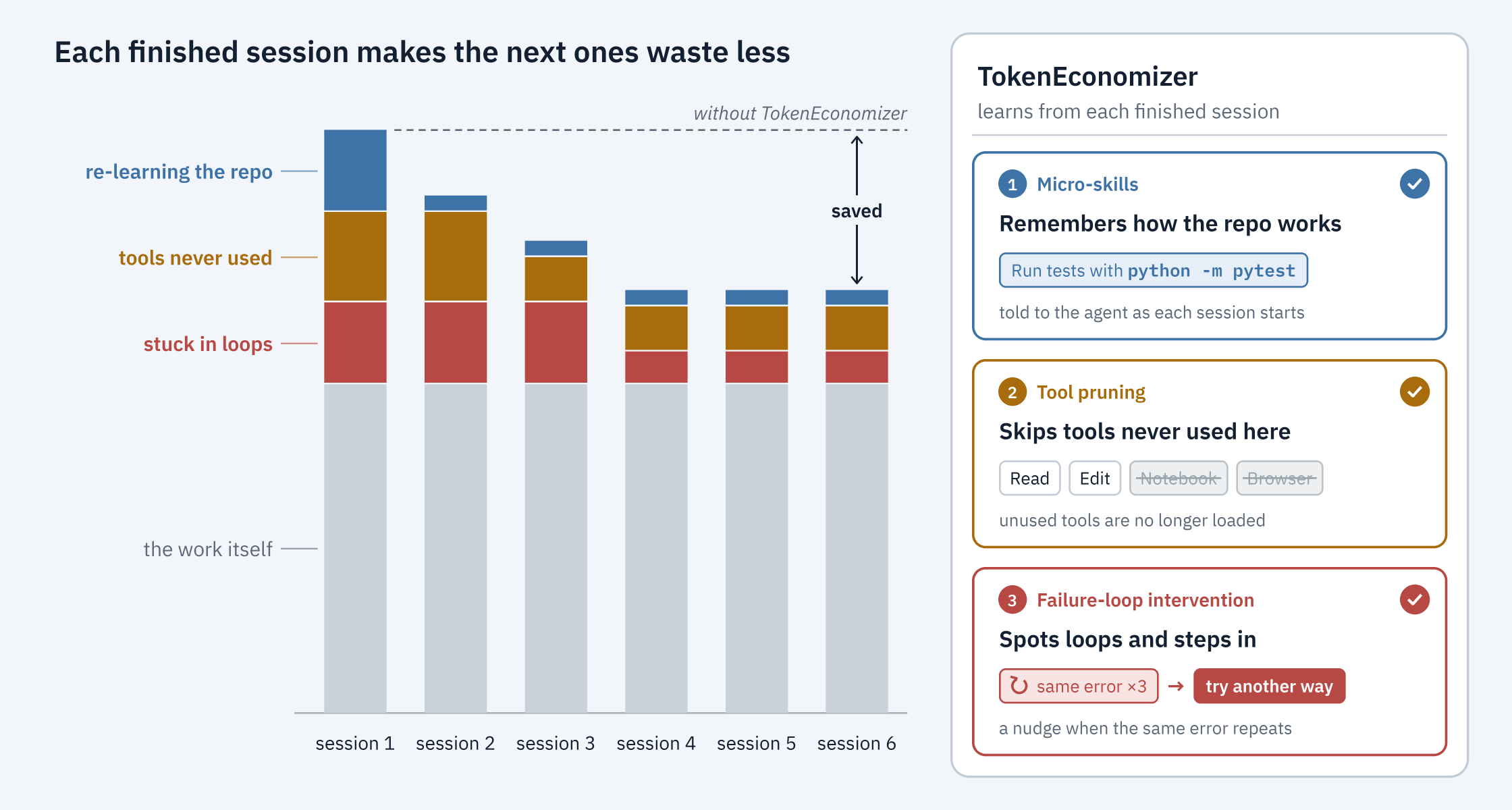
Microsoft Research, Microsoft Security and UC Berkeley open-sourced TokenEconomizer on GitHub (Apache 2.0, v0.1.0 released October 26), a plugin for Claude Code, Codex, GitHub Copilot CLI and Pi, with experimental opencode support. It learns from earlier sessions in the same repository: micro-skills remember repo facts, tool pruning drops tool definitions that go unused, and a loop guard nudges an agent that is stuck. The paper reports 18.4–30.9% lower mean cost across five agent and model combinations on 277 SWE-Bench tasks (paper figures).

Microsoft Research and UC Berkeley open-source TokenEconomizer, a plugin that cuts Claude Code and Codex costs by 18.4–30.9% on SWE-Bench without changing the agent

Key Takeaways

  • Cost: on 277 SWE-Bench tasks across 6 repositories and 5 agent and model combinations, mean cost fell 18.4–30.9%, and all 30 repository-by-combination cells got cheaper (paper figures, including the plugin's own model calls)
  • Success rate: Pass@1 rose in 4 of 5 combinations, e.g. Copilot CLI with Sonnet 5 cost 18.4% less with Pass@1 +2.6, while Claude Code with Opus 4.8 cost 30.9% less with Pass@1 -1.0
  • Three mechanisms: micro-skills (repo facts stated only after three sessions confirm them), tool pruning (by default a tool unused over 10 prompts across 2 sessions is left out), and a failure-loop guard (one redirect when a judge is at least 0.7 confident, never stopping a turn itself)
  • Generalization: 16–21% lower cost on Web-Bench and 6–20% lower on two security-auditing benchmarks where every task is a new repository
  • Deployment: Apache 2.0, Python 3.10+, no API key of its own, and learned experience stays local in ~/.tokeneconomizer
Read full story

Vercel Labs launches agent-desktop: computer use for any coding agent via OS accessibility trees, not pixels, on macOS, Windows and Linux

On October 31, Chris Tate of Vercel Labs, creator of agent-browser, announced agent-desktop on X as "agent-browser, for your whole computer". It is an Apache-2.0 Rust CLI and C library that reads a desktop app's OS accessibility tree and returns every actionable element as a JSON ref; the agent clicks or types on a ref and snapshots again to verify, with no pixel matching, headless by default. Version 1.0.0 shipped on October 27 and added Linux support; the current npm release is 1.0.2.

Vercel Labs launches agent-desktop: computer use for any coding agent via OS accessibility trees, not pixels, on macOS, Windows and Linux

Key Takeaways

  • Install: npm install -g agent-desktop, one package with native x64/ARM64 binaries; 1.0.0 (Oct 27) added Linux (glibc 2.35+, via AT-SPI), and the latest npm release is 1.0.2 (Oct 30)
  • Loop: snapshot prints a JSON tree with refs, click @<snapshot_id>:eN acts, then snapshot again to verify; a changed UI returns STALE_REF, and errors say whether a retry is safe
  • Scope: the README lists 60 command names, 56 of them operational, spanning windows, keyboard and mouse, notifications, clipboard, waits and session traces
  • Headless by default: ref actions go through accessibility APIs without moving the pointer or stealing focus, with --headed for physical input; Chris Tate says multiple agents can use the computer in parallel, each with its own cursor
  • Benchmarks: no official success-rate or speed numbers; it is a tool with no model inside, and web pages stay with agent-browser
Read full story

X discussion: Sam Altman calls DRAM sitting in personal PCs "quite terrible", and local-inference fans push back

On the Cheeky Pint podcast with Stripe co-founder John Collison, published October 29, Sam Altman discussed the memory shortage. He said many people assume open-source models and local inference solve the compute crunch, but from a global allocation perspective it is "quite terrible" for everyone to have scarce DRAM sitting in their own computer and being used about 5% of the time, and that a supply-constrained world wants maximum utilization in the cloud. A pubity post quoting him drew more than 26,000 likes and over 8 million views, and many users pushed back that PC memory is not only for AI and that local models matter for privacy and offline use. This is a summary of an X discussion, not a verified conclusion.

X discussion: Sam Altman calls DRAM sitting in personal PCs "quite terrible", and local-inference fans push back

Key Takeaways

  • Source: Sam Altman on the Cheeky Pint podcast, published October 29, with an official transcript that includes "being used 5% of the time"
  • Altman's argument: with DRAM supply tight, memory in personal computers sits mostly idle, while cloud data centers can serve many users continuously, so utilization should be maximized there
  • Engagement (X API, read Oct 31 13:06 SGT): the pubity post had 26,124 likes, 8,557 quotes, 5,210 replies and about 8.06 million views
  • Main pushback: PC memory also runs the OS, browsers and games; local models keep data on the device; some note the view matches OpenAI's cloud business model
  • Altman did not explain the 5% figure, and coverage suggests treating it as a rough estimate, not a measurement
Read full story
Linked Models & Agents:

CrowdStrike: China-nexus VAPOR PANDA used the ARTEX multi-agent framework, mainly on DeepSeek, against 200+ organizations in 11 days

CrowdStrike reported on Oct 29 that the China-nexus espionage group VAPOR PANDA, starting Oct 17, ran the open-source agentic intrusion framework ARTEX with DeepSeek plus a second, unconfirmed commercial LLM, hitting more than 200 organizations in at least 14 countries from a single controller over 11 days. Post-exploitation was confirmed at nine organizations, where the BLOODALCHEMY backdoor was deployed. Planning agents used about 1.4 billion input tokens in a single intrusion, and recovered transcripts show a human operator steering the agents in Chinese at key decision points.

Key Takeaways

  • Over 11 days from Oct 17, one ARTEX controller targeted 200+ organizations in at least 14 countries, including several foreign ministries, 19 US pharma, semiconductor, defense, nuclear and finance organizations, and telecoms in the US, Belgium and the Philippines (CrowdStrike report)
  • Post-exploitation was confirmed at 9 organizations, which received the BLOODALCHEMY backdoor; at least 12 more saw password spraying and credential scanning
  • DeepSeek was the main model, plus a subscription commercial LLM CrowdStrike could not confirm; planning agents used about 1.4 billion input tokens in one intrusion
  • Recovered transcripts show an operator issuing Chinese instructions tagged as human instructions, including an order to find Windows hosts without the Falcon sensor
  • CrowdStrike says this is separate from the Storm-0940 ARTEX activity reported by Microsoft, and judges China-nexus groups will highly likely keep adopting such agent frameworks over the next 12 months
Read full story
Linked Models & Agents: