On November 10, Google DeepMind and Artificial Analysis launched MKA (Multimodal Knowledge Agent), a benchmark that tests whether agents can read visually dense files such as architectural drawings, engineering schematics, and clinical scans and deliver slide decks, spreadsheets, reports, and marked-up images. Its 200 private tasks span 10 industries and 83 occupations, with about 70 expert rubric checks per task. Artificial Analysis tested 21 models at launch: Claude Fable 5.2 (max) leads with a Climb WSR of 57%, followed by Gemini 4 Carbon (high) at 54% and Claude Opus 5.5 (max) at 53%. Fable averages $31.97 per task versus $6.29 for Carbon. Ten public tasks are on Hugging Face.
Zoom
Key Takeaways
Scale: 200 private tasks across 10 industries and 83 occupations, each equal to 3–8 hours of work for a seasoned professional, graded on about 70 yes/no checks weighted 75% factual accuracy and 25% visual design (Google blog)
Leaderboard (Climb WSR): Claude Fable 5.2 (max) 57%, Gemini 4 Carbon (high) 54%, Claude Opus 5.5 (max) 53%, out of 21 models tested (AA leaderboard)
Cost: Fable 5.2 averages $31.97 per task, more than 5x Carbon ($6.29) and about 29x GPT-6.1 Sol ($1.11); the cheapest is GPT-6 Luna (Max) at $0.18
No single winner: Fable 5.2 leads 5 verticals, Opus 5.5 leads Education and Construction, Gemini 4 Argon leads Science, and Carbon leads Healthcare; Word document and text file outputs are hardest, with no model above 52%
Method: every model runs in the open-source Stirrup agent harness (up to 250 turns) and is graded by a non-Google model, GPT-6 Luna, as an agentic judge that agreed with domain experts 96% of the time; 10 public tasks are on Hugging Face under Apache-2.0
On November 10, Anthropic added two new artifact types to Claude: Claude Whiteboards, a board teams can edit together, and Claude Sheets, a shared spreadsheet with tabs, formulas, and drop-downs, both in beta on all paid plans. Claude Dashboards, which entered beta in October, is renamed Claude Data and is now generally available, adding data stories, certified queries, and live sharing. Interactive connectors can now open full apps such as Adobe, Atlassian, Box, and Notion beside the conversation or in full screen, where you or Claude can make changes directly. The features are rolling out gradually starting today.
Zoom
Key Takeaways
New artifacts: Claude Whiteboards and Claude Sheets are in beta on all paid plans and work on web, desktop, and mobile (official announcement)
Claude Data: the former Claude Dashboards (beta since October) is renamed and now GA, with certified queries and live sharing still in beta; on Enterprise it turns on by default on November 19, while Team plans get all three on by default
Interactive connectors: the first tools include Asana, Canva, Carta, Dropbox, monday.com, Smartsheet, Vercel, and Webflow, and open as full apps beside the chat or in full screen; Figma, Harvey, and Shopify are building integrations (connectors post)
Developers: interactive connectors run on the open MCP Apps extension, which now supports app tools and embedded sites in a developer public preview; Claude Marketplace lists 9,000+ connectors and plugins
Vendor examples: Anthropic's legal team cut marketing reviews from 3 days to 24 hours with a Claude-built review tool, and customer Advantage Solutions cut FP&A report assembly from about 10 hours to under 30 minutes (vendor figures)
On November 10, NVIDIA released Alpamayo 2 Edge, an open autonomous-driving model. It is a 2B-parameter vision-language-action (VLA) reasoning model built to run in real time inside the vehicle, targeting NVIDIA DRIVE AGX Thor. It produces Chain-of-Causation reasoning only when needed and outputs trajectories directly in routine driving to save compute. After TensorRT and DFlash2 optimization, pixel-to-trajectory latency is 160 to 190 ms. NVIDIA also open-sourced AlpaJudge, a reasoning evaluation model, on Hugging Face.
Zoom
Key Takeaways
Model: a 2B-parameter reasoning VLA built on the Nemotron-based reasoning backbone of Cosmos 3 Edge plus a diffusion action expert, offline-distilled with reasoning labels from Alpamayo 2 Super (NVIDIA Technical Blog)
Closed-loop RL: post-training with closed-loop reinforcement learning in AlpaGym improves closed-loop driving by 48.9% over the best checkpoint without it (company figure)
Comparison: NVIDIA says it achieves about 40x the distance between at-fault incidents of the 4B-parameter Qwen-Drive-1.0 in AlpaSim closed-loop evaluation, with half the parameters
Latency: after FP8 calibration and TensorRT acceleration from the Developer Hub recipe, pixel-to-trajectory latency on DRIVE AGX Thor is 160-190 ms; partner Embedl says it reached 10 Hz in under 48 hours
Open release: weights are on Hugging Face under the OpenMDW-1.1 license, and the AlpaJudge reasoning grader comes in reference-based and reference-free variants that need about 5GB of GPU memory to load
On November 10, Google DeepMind released Gemini Robotics 2.5, which it calls its most capable vision-language-action (VLA) model so far. Across more than 200 evaluated tasks, DeepMind reports a 30% to 100% higher success rate than earlier baselines depending on the task type, with tasks finished 20% to 30% faster. In a proof of concept with Apptronik and Mercedes-Benz, the Apollo 2 humanoid sorted parts on car production lines in Hungary and Germany with a 96% success rate. The model is rolling out only to robotics partners for now, so developers cannot call it directly yet.
Zoom
Key Takeaways
Task breadth: evaluated on 200+ tasks (tying a bow, serving food with tongs, pipetting), with a 30%–100% higher success rate than earlier baselines and 20%–30% faster completion (company figures, official blog)
Factory test: Apptronik's Apollo 2 kitted parts at Mercedes-Benz plants in Kecskemet, Hungary, and Sindelfingen, Germany, with a 96% success rate (a proof of concept, not a production rollout)
Safety: inference-time safety guidance raised safe task completion by 33% around obstacles and 43% near people; the new open-source ASIMOV-Jailbreak benchmark shows 99.5% jailbreak resistance for Gemini 4 Argon versus 82% for the earlier Gemini Robotics ER 2 baseline
Faster training: Gemini 4 Argon builds digital twins and thousands of simulated practice runs from a single camera view and analyzes failure videos, which DeepMind says sped up months of training work
Availability: rolling out to robotics partners only, with no public API yet; it runs on Apollo 2 (five-finger, 22-degree-of-freedom SharpaWave hand) and the two-arm Franka Duo platform
On November 10, Google Cloud CEO Thomas Kurian announced Gemini for healthcare, available in preview in the U.S. starting today. It extends the universal Gemini agent introduced at Gemini at Work in October to health systems and health plans, and is built from four parts: healthcare skills, system connectors, a partner ecosystem, and one governed platform. It can assemble a patient history across care settings, prepare charts before visits, build prior-authorization packets against payer policy and draft appeals, and help payers check requests against medical policy and explain out-of-pocket costs. Google says the platform is built to support HIPAA compliance and that clinical data is never used to train its foundation models.
Zoom
Key Takeaways
Status: U.S. preview, available today, joining the existing solutions for legal, financial services, and government services (official blog)
Connectors: Google lists 27, spanning EHRs, eligibility and claims, terminology and coding, coverage rules, clinical guidelines, productivity, and security; Epic and Oracle Health EHR access is read-only, with no write-back to the chart
Pain point: Google says clinicians spend nearly 28 hours a week manually reconciling fragmented information (company figure)
MCP: InterSystems provides a FHIR MCP Server, and Keragon connects 400+ healthcare apps through a single MCP integration
Ecosystem: 16 systems integrators, including Accenture, Deloitte, KPMG, PwC, and TCS, help with deployment; model choice lets routine admin steps go to low-cost models
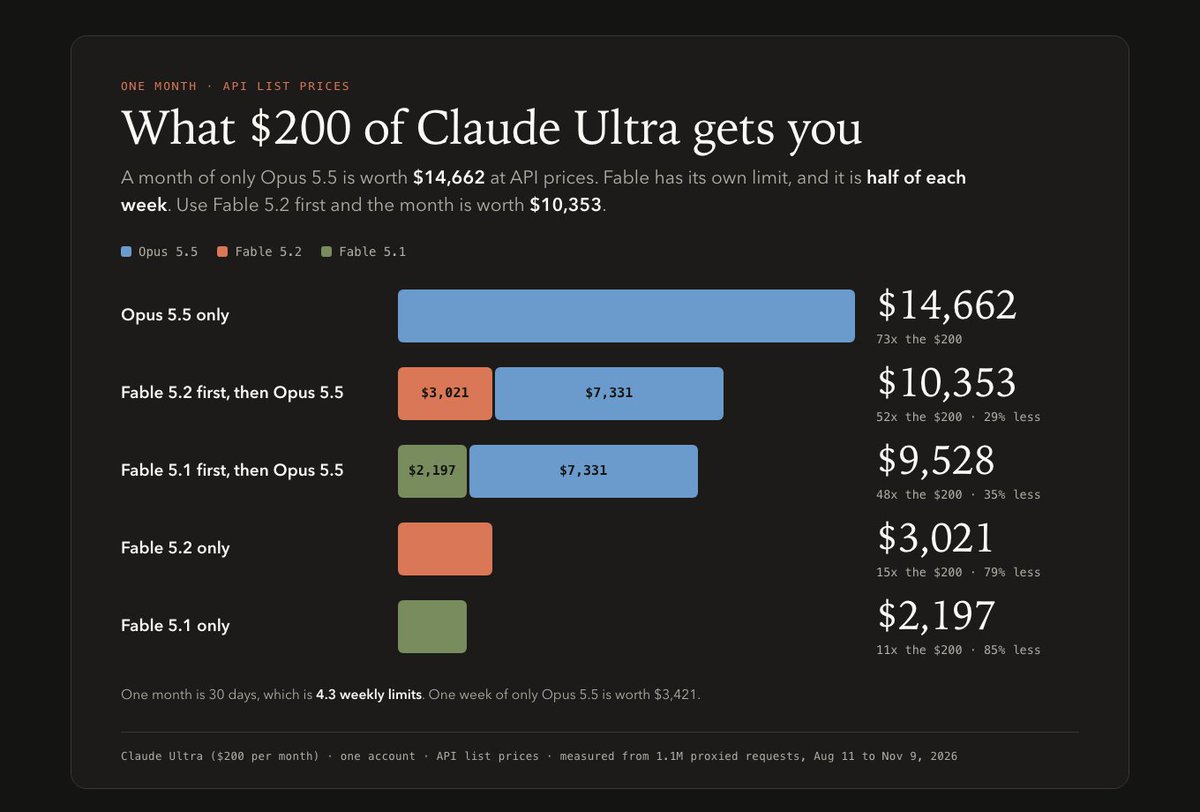
On November 10, T3 Code CEO Theo posted that, based on more than 1.1 million real requests sent through his Ultra subscription, the $200 Claude Ultra plan covers about $15,000 of Opus 5.5 at API prices per month, versus about $3,000 of Fable 5.2. The post drew more than 3,900 likes and 1,000 bookmarks. He also noted Fable more often finishes a task in one prompt, so the gap shrinks when measured as work done per week. These are personal figures, not official data; what Anthropic confirms is the $8/$40 Fable 5.2 price and the launch-week Fable usage rules.
Zoom
Key Takeaways
Theo's estimate (personal figures): the $200 Ultra plan covers about $15,000 of Opus 5.5 at API prices per month versus about $3,000 of Fable 5.2, roughly a 5x gap, based on 1.1M+ real requests from his Ultra subscription
Measured as work done per week: Opus alone gives about 1,200 turns and 230 threads; using up Fable first and then switching to Opus gives about 900 turns and slightly more threads. He says Fable more often finishes in one prompt, but much of his usage this week was benchmarking
Official pricing: Fable 5.2 is $8 / $40 per million tokens, 20% below Fable 5.1 at $10 / $50; Opus 5.5 is $4 / $20 (Anthropic launch post)
Official launch offers: Pro plans and standard Team seats get Fable for one week, up to 50% of weekly usage limits, plus 1 Fable limit reset; Max, Ultra, and premium seats get 1-3 resets depending on tenure (Help Center)
The post drew 3,900+ likes, 1,084 bookmarks, and about 287K views; in replies Theo called API prices "insanely inflated," which is why subscriptions look so generous
Wharton professor Ethan Mollick shared an experiment on X on November 9: from a one-paragraph description, Claude built a site that flies endlessly through 3D worlds linked by portals. Twenty hours in there were 204 worlds; the open-source repo now holds 471 worlds and about 1.4 million lines of JavaScript. On his blog he says the agent teams later built their own review bureaucracy, with a rule book that grew to 204 sections, slowing output from hundreds of worlds a day to about a dozen. The post drew 1,262 likes and 158 replies in about 10 hours.
Zoom
Key Takeaways
From one paragraph to 204 live worlds in 20 hours; the README lists 471 worlds and about 1.4 million lines of JavaScript as of November 9 (GitHub)
Claude's own estimate is about 25,000 agent runs, most doing a single task such as judging an image; by day 10 there was 1 lead agent and 28 parallel teams (One Useful Thing)
The agents built their own review system: a new version had to win a blind vote on 12 test screenshots, and the rule book grew from 84 to 204 sections and 87,500 words in 12 days, so launching a world took about a day
After an outside "consultant" team of agents reviewed the process, output recovered to 30+ worlds a day (per Mollick's blog)
The post drew 1,262 likes, 108 reposts, 158 replies and about 62K views in about 10 hours; replies focused on agents inventing middle management and on token cost
On November 9, Anthropic's developer blog claude.dev published a selection guide by Addy Osmani, "Which Claude model should you build with?"; the ClaudeDevs post drew about 9,200 likes and 12,000 bookmarks. The core advice: start most coding and knowledge work on Opus 5.5 at medium effort (the Claude Code default); drop to Sonnet 5.5 for well-scoped bug fixes and spec-driven work; use Haiku 5.5 for classification, routing, extraction, and log-reading subagents; and move up to Fable 5.2 for major refactors, migrations, and deep research. Before switching models, tune effort and give the model a way to verify its own work. The guide also lists prices, default effort levels, and compatibility differences that can trigger 400 errors when migrating.
Zoom
Key Takeaways
Prices (vendor figures, per million input/output tokens): Haiku 5.5 $0.10/$0.50 ($0.50/$2.50 above 100K), Sonnet 5.5 $2/$10, Opus 5.5 $4/$20, Fable 5.2 $8/$40; all four have a 1M context window and 128K max output
Anthropic's own FrontierCode 2.0 runs: Fable 5.2 at high scores 45.3% vs Opus 5.5 at max 45.5% for roughly half the cost per task, so test Fable before pushing Opus past high
On a SWE-bench Pro subset, running Opus 5.5 at low and re-running failures at high passed about 97% at about $0.17 per task, versus 95.3% at $0.29 with everything at high
An Opus 5.5 lead over up to 25 parallel Sonnet 5.5 workers searching about 22 million tokens of code cost about a third less than Opus alone, with a similar score
Migration traps: Fable 5.2 enables preserved thinking on all API accounts, so editing earlier context returns a 400; tool_choice any/tool also returns 400 on Sonnet 5.5, Opus 5.5, and Fable 5.2
Independent evaluator Artificial Analysis published two new results on November 10. On AA-3D, which tests how well a model acting as an agent builds interactive three.js web scenes, Claude Fable 5.2 (Max) scores 1271 Elo, 67 points ahead of second-place Claude Sonnet 5.5 (1204); its 95% confidence interval of 1246 to 1297 does not overlap any other model, so the lead is outside the margin of error. It is 132 points above Fable 5.1 (1139) and ahead of the top OpenAI and Google entries, GPT-6 Astra (1168) and Gemini 4 Argon (1147). On VIALS-AA, a life-science image reasoning benchmark, Fable 5.2 scores 67%, ahead of previous leader Gemini 4 Carbon (64%) and GPT-6 Astra (63%). AA also found opposite strategies: Fable averages about 37 tool calls per task, Astra about 8.
Zoom
Key Takeaways
AA-3D: Fable 5.2 (Max) 1271 Elo vs Sonnet 5.5 1204 and Opus 5.5 1202; its 95% CI of 1246-1297 overlaps no other model
Generational gain: 132 points above Fable 5.1 (1139); the top OpenAI entry GPT-6 Astra scores 1168, the top Google entry Gemini 4 Argon 1147
AA-3D setup: each model works as an agent in an offline sandbox for up to 3 hours / 250 turns with Blender, Rapier physics, Python and a headless browser; human panelists vote on blind pairs after at least 30 seconds per scene
Opposite tool strategies: Fable makes about 37 tool calls per task and 1.60 per turn (highest on the board); Astra makes about 8, the fewest AA has measured
Seattle startup Nuance Labs released Nuplex 1.0 (Nuance Full-duplex) on November 9, a full-duplex audiovisual foundation model that listens and speaks at the same time, along with Emma, the first AI persona built on it. Emma nods, smiles and uses gaze to signal turn-taking while the user is still speaking instead of waiting for them to finish. On 1,785 questions drawn from recordings of real conversations, the company says Nuplex reply timing overlaps the original human speaker 89% of the time, versus 35% for the next closest system. Emma can be tried in a browser with no sign-up, and the Nuplex Beta API is open, though deliberately restricted: no cloning of real people, watermarked video, English only, adults only, and no healthcare or under-18 use for now.
Zoom
Key Takeaways
Company figures: on 1,785 real-conversation questions, Nuplex reply timing overlaps the human speaker 89% of the time vs 35% for the next closest system; compared systems include PersonaPlex, Moshi, GPT-Live and Gemini Live
18 months of research; Emma's face and voice are licensed from a real actress who helped capture how she actually listens, reacts and speaks, rather than an averaged face
The Nuplex Beta API lets developers brief a persona with their own prompt and hand longer tasks to their tools in the background mid-call; during the beta the language model is served by Nuance
Limits: no uploading faces or voices and no cloning real people, API video carries a visible watermark; English only, 18+ only, and no healthcare or under-18 use yet
Availability: the US (except Colorado, Connecticut, Illinois and Texas), the EU, the UK, and Canada (except Quebec)
Robbyant, the embodied AI company under Ant Group, open-sourced LingBot-Touch on November 9 under Apache 2.0. It uses JEPA-style latent prediction and a shared Haptic Transformer to turn piezoresistive, magnetic, and visuotactile sensor signals into one set of tactile tokens. Per the official technical report, adding the frozen 5.46M-parameter Tiny encoder raised average success of Diffusion Policy, pi0.5, LingBot-VLA, and T-Rex by 13.9 to 24.8 points across 26 real dual-arm dexterous-hand tasks, while feeding raw tactile signals gave at most about half that gain. Tiny and Small weights are on Hugging Face.
Zoom
Key Takeaways
Pretraining corpus: 4,983 hours, 464K episodes, about 1.33B frames from tactile gloves and teleoperated robot hands, covering piezoresistive, magnetic, and visuotactile sensing
Vendor figures on 26 real-robot tasks: LingBot-VLA 48.3% to 73.1%, pi0.5 48.1% to 69.9%, T-Rex 45.4% to 68.6%, Diffusion Policy 21.6% to 35.6%
The Tiny encoder has only 5.46M parameters, adding under 0.2% to the policies it augments; Small has 21.76M, both are 12-layer Transformers
In 12 simulated dexterous RL tasks, success reaches 69% vs 46% with task-specific CNN features and 21% without touch
Caveat: it transfers to sensor models unseen in pretraining, but a new taxel layout still needs geometry calibration first
Robot foundation model company Skild AI open-sourced Steel on November 9, an internal physics solver built with NVIDIA and released under Apache 2.0. It is a GPU rigid-body dynamics solver contributed to the open-source Newton physics engine for robot training in Isaac Lab. Per the official blog, Steel averages 3.8x PhysX and about 1.3x MuJoCo Warp throughput (geometric mean) across 20 single-task benchmarks; on batches mixing 20 different robot tasks it reaches 13x PhysX peak throughput, and at a matched batch it uses about 11 GiB of GPU memory versus 29 GiB. A WebGPU port also lets you try it in a browser.
Zoom
Key Takeaways
Vendor figures: on a mixed 20-task batch Steel hits 3.90M env-steps/s at 245,760 environments vs PhysX peak of 300K, about 13x
At a matched 61,440 environments Steel runs 3.61M steps/s, 12x PhysX, using about 11 GiB vs 29 GiB of GPU memory (about 62% less)
Faster than PhysX on 19 of 20 single-task benchmarks, 3.8x geometric mean; about 1.3x MuJoCo Warp; 6.7x PhysX on the 23-joint Kuka-Allegro lift task
Apache 2.0, available in Newton as newton.solvers.SolverSteel; a WebGPU port runs 24 interactive scenes in the browser
Caveat: all numbers are simulation-only throughput on one RTX PRO 6000 Blackwell GPU, not end-to-end policy training speed
Zyphra released ZONOS3-Mini, an open-source text-to-speech model, on November 9, with weights on Hugging Face under Apache 2.0. It is a sparse MoE with 800 million total and about 100 million active parameters per token, trained on 112 H100s in 2.5 days. By Zyphra's numbers, time to first audio is under 570 ms in the browser on a Pixel 9 and under 150 ms on an M3 MacBook Air, and it ranks first among open models on the capability index of its new ZTTS2-Eval benchmark (35 languages of read speech plus 20 in-the-wild), ahead of Fish S2 Pro and MOSS TTS v1.5. It supports voice cloning, age, accent and gender steering, and word-level delivery control, with WebGPU, SGLang, vLLM, GGML and MLX runtimes.
Zoom
Key Takeaways
Scale: 800M total, about 100M active parameters (64 experts, top-2 routing), versus 8B for the previous ZONOS2; open weights under Apache 2.0
Speed (Zyphra figures): under 570 ms time to first audio in a Pixel 9 browser and under 150 ms on an M3 MacBook Air; 80 ms median at 8 concurrent requests and peak 457 seconds of audio per second on one H100
The new ZAC-1 codec runs at 15 Hz versus 86 Hz for DAC and cuts word error rate about 10x under similar data; one generation can produce up to 10 minutes of 44.1 kHz audio
Evaluation: ZTTS2-Eval covers 35 languages of read speech plus 20 in-the-wild; on its 420-item capability index ZONOS3-Mini ranks first among open models, followed by Fish S2 Pro and MOSS TTS v1.5 (Zyphra's own benchmark, not yet independently reproduced)
Get started: try it in the browser via WebGPU with no install, or run sgl-omni serve --model-path Zyphra/ZONOS3-Mini for an OpenAI-compatible /v1/audio/speech endpoint
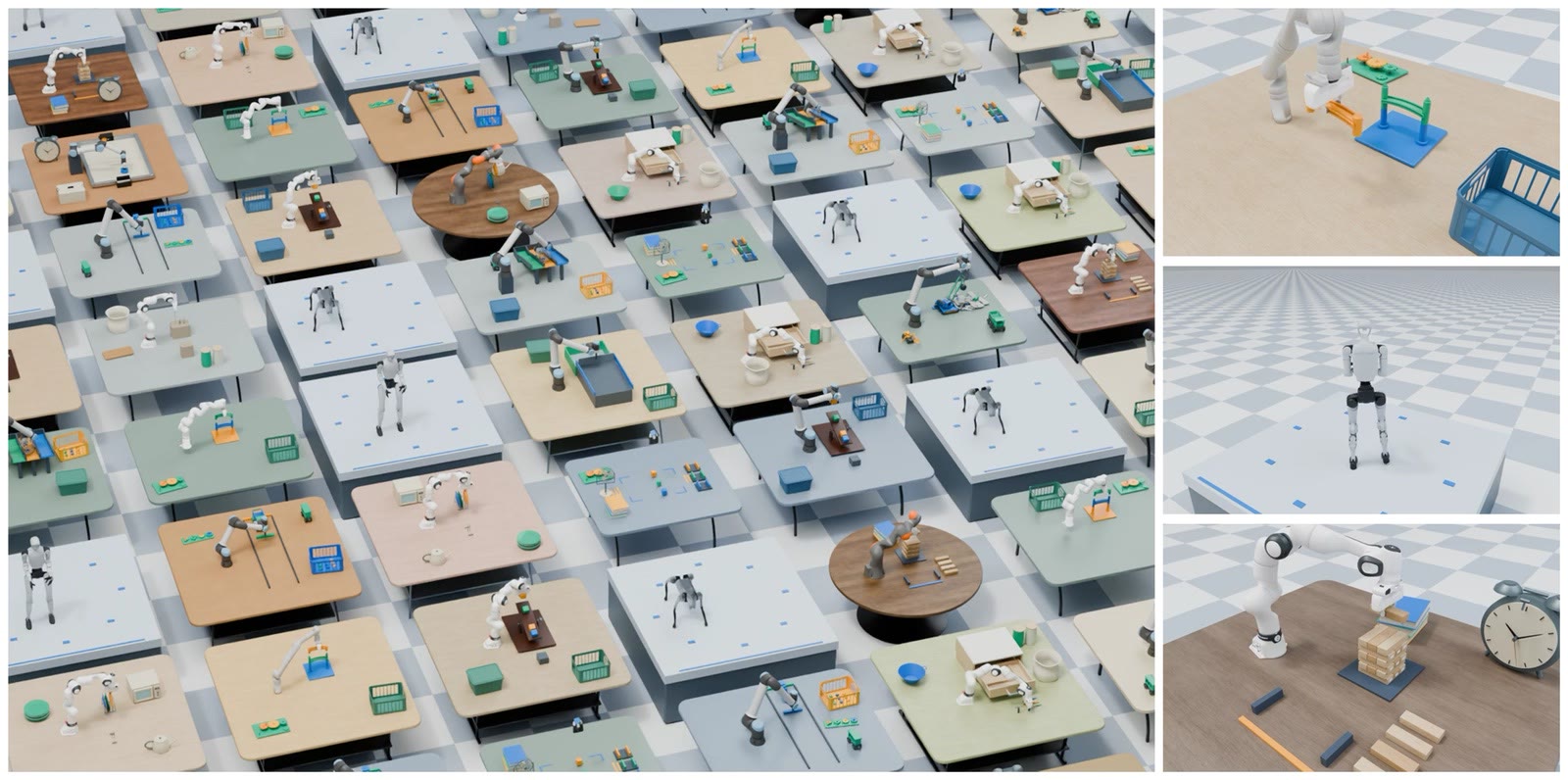
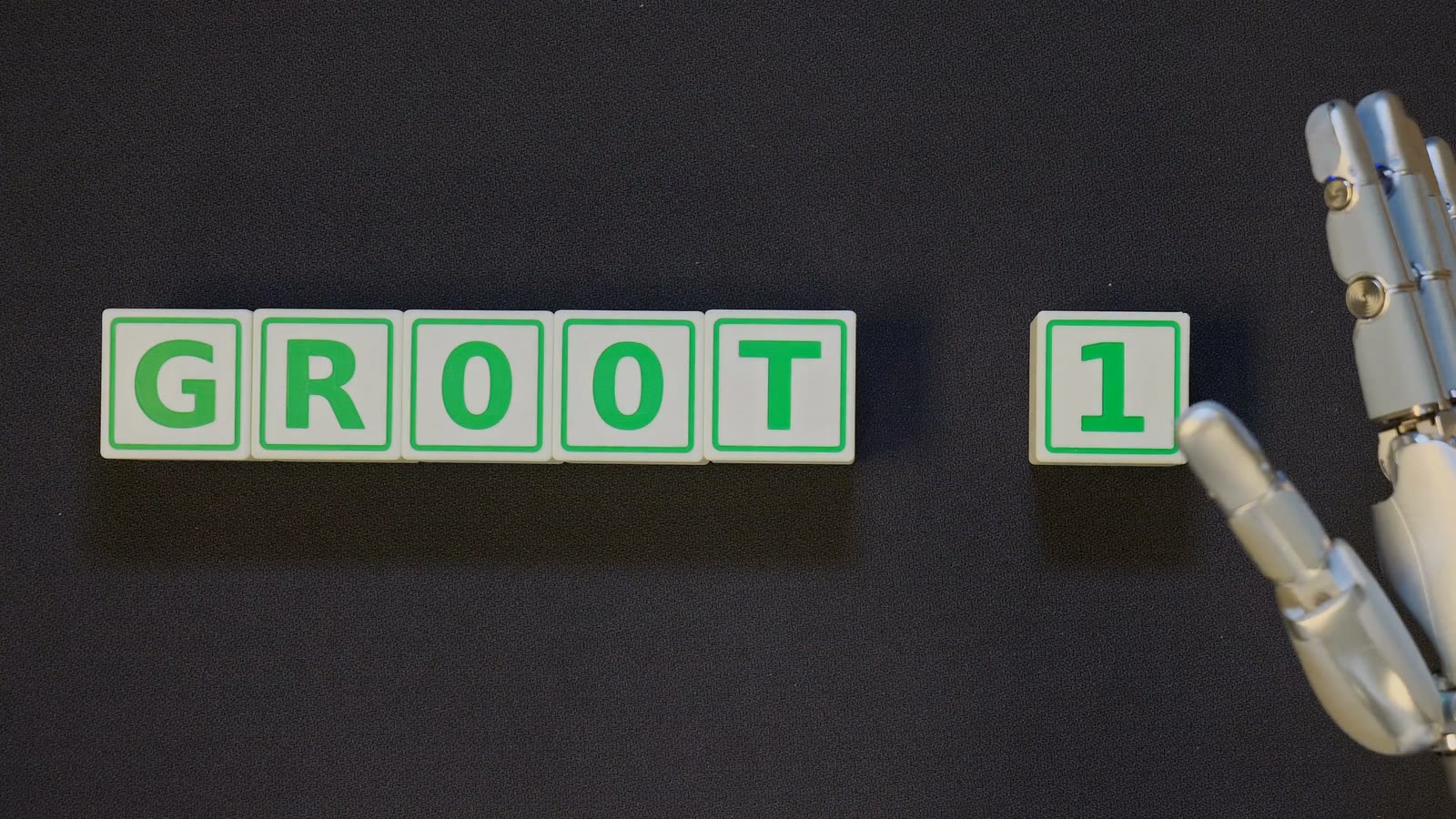
NVIDIA Robotics announced GR00T 2 at CoRL 2026, and NVIDIA GEAR lab lead Yuke Zhu posted the technical details. GR00T 2 is a new generation of world action model (WAM) built on Cosmos: one diffusion transformer denoises future video and an action chunk together, and one model drives parallel grippers, dexterous hands and humanoids. Pretraining mixes 402,730 hours of egocentric human video, 10,184 hours of handheld UMI gripper demos and 23,500 hours of robot teleoperation. By NVIDIA's numbers, it reaches 40% zero-shot success on 50 tasks the target robot never practiced, rising to 95% with five demos per task (under 3 minutes of robot data) and a 30-minute LoRA fine-tune on one RTX 5090. Reasoning models can call GR00T 2 as a tool through the WAM API. Code arrives in December; 100,000 hours of the human video data are already on Hugging Face.
Zoom
Key Takeaways
Architecture: one diffusion transformer predicts future video and action chunks together; small per-robot heads let one model cover grippers, dexterous hands and humanoids
Data: 402,730 h of egocentric human video + 10,184 h of UMI demos (2,897 tasks) + 23,500 h of teleoperation; going from 0% to 100% of the human video lifts real-robot task progress from 50% to 70% (NVIDIA figures)
Adaptation: 40% zero-shot on 50 unseen tasks, 71% with 1 demo, 95% with 5 demos, about a 30-minute LoRA fine-tune on one RTX 5090
Agents: a reasoning model calling GR00T 2 via the WAM API completes 97+ of 100 back-to-back assemblies for each of three toys; marking grasp points on the camera view lifts instruction following from 40% to 92%
GR00T 2 Turbo is a 2B-parameter variant running at 124 ms per prediction on the Unitree G1's Jetson Thor; code ships in December, and 100k hours of human video are already on Hugging Face
OpenAI introduced Control Room on its official account and blog: a central system across its research infrastructure that connects every research inference workload, including agentic sampling for training and evaluation and data processing. It works with OpenAIs misalignment monitoring systems and halts a jobs model output within 35 seconds of a decision to intervene. The kill switch lives in the inference engine layer rather than in research code: engines check a job_id with Control Room before serving each request, and if Control Room goes down or is tampered with, all inference requests are denied (fail-closed). Fail-closed already covers all frontier model research workloads and will reach the remaining research workloads over the next few days. This is a safety infrastructure announcement, not a new model or public API.
Zoom
Key Takeaways
Scope: a central track-and-stop system for every research inference workload at OpenAI, including RL training, evals, high-volume sampling and data processing
Speed: at most 35 seconds from a stop instruction to no further progress; the lag comes from an inference-authorization cache, and OpenAI says it is working to bring it to zero
Mechanism: each job requests a job_id tied to an approved safety case, and inference engines check that ID with Control Room before every request
Fail-closed: if Control Room goes down, is disabled or is tampered with, all inference requests are denied; this covers all frontier model research workloads now and the rest over the next few days
Monitoring link: every frontier RL job runs with a monitor model that can order a stop; OpenAI says its recent DNS-related incident was caught by a monitor