

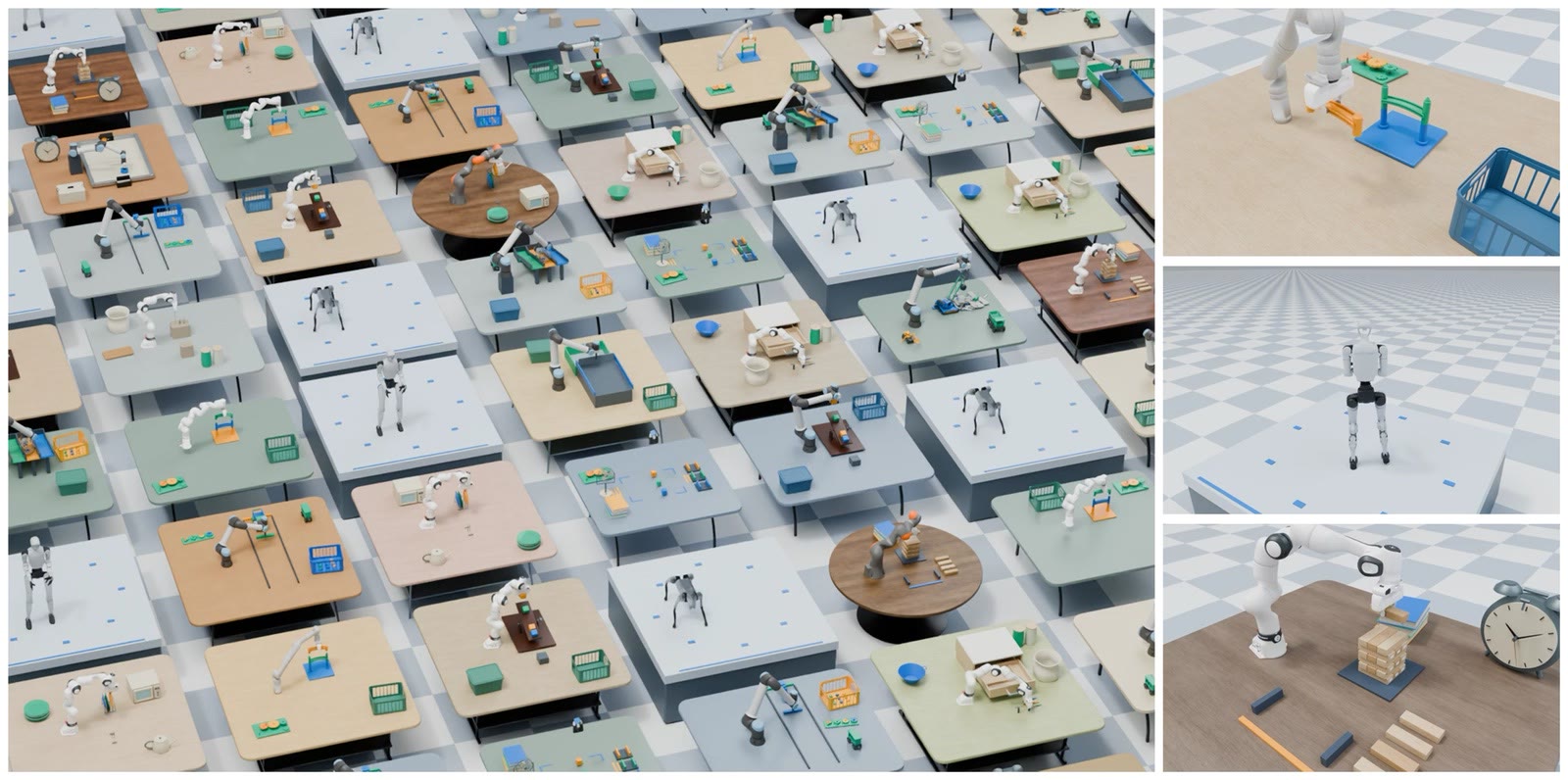
Robot foundation model company Skild AI open-sourced Steel on November 9, an internal physics solver built with NVIDIA and released under Apache 2.0. It is a GPU rigid-body dynamics solver contributed to the open-source Newton physics engine for robot training in Isaac Lab. Per the official blog, Steel averages 3.8x PhysX and about 1.3x MuJoCo Warp throughput (geometric mean) across 20 single-task benchmarks; on batches mixing 20 different robot tasks it reaches 13x PhysX peak throughput, and at a matched batch it uses about 11 GiB of GPU memory versus 29 GiB. A WebGPU port also lets you try it in a browser.
Key Takeaways
- ✓Vendor figures: on a mixed 20-task batch Steel hits 3.90M env-steps/s at 245,760 environments vs PhysX peak of 300K, about 13x
- ✓At a matched 61,440 environments Steel runs 3.61M steps/s, 12x PhysX, using about 11 GiB vs 29 GiB of GPU memory (about 62% less)
- ✓Faster than PhysX on 19 of 20 single-task benchmarks, 3.8x geometric mean; about 1.3x MuJoCo Warp; 6.7x PhysX on the 23-joint Kuka-Allegro lift task
- ✓Apache 2.0, available in Newton as newton.solvers.SolverSteel; a WebGPU port runs 24 interactive scenes in the browser
- ✓Caveat: all numbers are simulation-only throughput on one RTX PRO 6000 Blackwell GPU, not end-to-end policy training speed
Key Decision Metrics at a Glance
Turn your technical choice into a development budget
Compare 40 dev plans & simulate token costs vs $20/mo subscriptions
Project Links & Resources
Direct AccessIn-Depth Technical Analysis
Background and Pain Point
GPU-parallel simulation has driven big gains in locomotion because thousands of copies of the same robot and task can train at once. Manipulation is different: it needs huge numbers of diverse, contact-rich scenes, and robots differ widely in joint and contact counts. Skild AI argues that now that agents can write those tasks at scale, the bottleneck is simulating them together. Many engines are most efficient on homogeneous batches and waste compute and memory on padding and dense matrices when batches are heterogeneous.
Architecture and Mechanism
Steel (Scalable Throughput-optimized Engine for Embodied Learning) is a rigid-body solver inside the Newton physics engine. It organizes dynamics and constraints per environment, groups articulations with similar joint counts, and routes contact-solving work by each environment's current load. Under the hood it combines reduced-coordinate articulation dynamics with projected Gauss-Seidel constraint solving and reuses each articulation's mass-matrix factorization without building a dense pairwise constraint matrix. It shares Newton's model and collision stack, couples with VBD cloth/cable and MPM sand solvers, and offers experimental differentiable simulation.
Benchmarks
All vendor figures, simulation-only, one RTX PRO 6000 Blackwell GPU: on mixed batches of 5/10/15/20 task types Steel reaches 9.2x to 13.0x PhysX peak throughput; at 20 types it hits 3.90M steps/s vs 300K for PhysX. At a matched 61,440 environments it is 12x faster and uses about 11 GiB vs 29 GiB. Across 20 single-task benchmarks it averages 3.8x PhysX (MuJoCo Warp: 2.9x) and leads on 19. The comparison uses Isaac Sim 6.1; Skild notes PhysX on 6.0 ran these mixtures up to about 2.7x faster. No third-party reproduction yet.
Getting Started
Code is at GitHub skild-ai/steel (Apache 2.0) and in Newton as newton.solvers.SolverSteel, aimed at Isaac Lab training. The single-task results used reuse_kinematics=True, which is opt-in in Newton 1.8. To try it first, open the WebGPU demo in the blog and drag objects or tune solver settings in the browser. Teams doing manipulation RL that need many robot types in one batch benefit most.
Benchmark side-by-side against alternatives, or calculate monthly token cost vs subscription break-even.
Discussion & Comments
0Sign in to join the discussion
Connect with AI developers to exchange benchmark insights.