AI Coding Live News

Artificial Analysis: Claude Fable 5.2 Takes #1 on the AA-3D Interactive 3D Benchmark at 1271 Elo, 67 Points Clear, and Leads the VIALS-AA Scientific Image Reasoning Benchmark at 67%

Independent evaluator Artificial Analysis published two new results on November 10. On AA-3D, which tests how well a model acting as an agent builds interactive three.js web scenes, Claude Fable 5.2 (Max) scores 1271 Elo, 67 points ahead of second-place Claude Sonnet 5.5 (1204); its 95% confidence interval of 1246 to 1297 does not overlap any other model, so the lead is outside the margin of error. It is 132 points above Fable 5.1 (1139) and ahead of the top OpenAI and Google entries, GPT-6 Astra (1168) and Gemini 4 Argon (1147). On VIALS-AA, a life-science image reasoning benchmark, Fable 5.2 scores 67%, ahead of previous leader Gemini 4 Carbon (64%) and GPT-6 Astra (63%). AA also found opposite strategies: Fable averages about 37 tool calls per task, Astra about 8.

Artificial Analysis: Claude Fable 5.2 Takes #1 on the AA-3D Interactive 3D Benchmark at 1271 Elo, 67 Points Clear, and Leads the VIALS-AA Scientific Image Reasoning Benchmark at 67%

Key Takeaways

  • AA-3D: Fable 5.2 (Max) 1271 Elo vs Sonnet 5.5 1204 and Opus 5.5 1202; its 95% CI of 1246-1297 overlaps no other model
  • Generational gain: 132 points above Fable 5.1 (1139); the top OpenAI entry GPT-6 Astra scores 1168, the top Google entry Gemini 4 Argon 1147
  • AA-3D setup: each model works as an agent in an offline sandbox for up to 3 hours / 250 turns with Blender, Rapier physics, Python and a headless browser; human panelists vote on blind pairs after at least 30 seconds per scene
  • VIALS-AA: Fable 5.2 67%, Gemini 4 Carbon 64%, GPT-6 Astra 63%
  • Opposite tool strategies: Fable makes about 37 tool calls per task and 1.60 per turn (highest on the board); Astra makes about 8, the fewest AA has measured
Read full story

Nuance Labs, Founded by Ex-Apple Researchers, Launches Nuplex 1.0 Full-Duplex Audiovisual Model and Emma Persona: Reacts With Her Face While You Talk, Matches Human Reply Timing 89% of the Time per the Company, Beta API Opens

Seattle startup Nuance Labs released Nuplex 1.0 (Nuance Full-duplex) on November 9, a full-duplex audiovisual foundation model that listens and speaks at the same time, along with Emma, the first AI persona built on it. Emma nods, smiles and uses gaze to signal turn-taking while the user is still speaking instead of waiting for them to finish. On 1,785 questions drawn from recordings of real conversations, the company says Nuplex reply timing overlaps the original human speaker 89% of the time, versus 35% for the next closest system. Emma can be tried in a browser with no sign-up, and the Nuplex Beta API is open, though deliberately restricted: no cloning of real people, watermarked video, English only, adults only, and no healthcare or under-18 use for now.

Nuance Labs, Founded by Ex-Apple Researchers, Launches Nuplex 1.0 Full-Duplex Audiovisual Model and Emma Persona: Reacts With Her Face While You Talk, Matches Human Reply Timing 89% of the Time per the Company, Beta API Opens

Key Takeaways

  • Company figures: on 1,785 real-conversation questions, Nuplex reply timing overlaps the human speaker 89% of the time vs 35% for the next closest system; compared systems include PersonaPlex, Moshi, GPT-Live and Gemini Live
  • 18 months of research; Emma's face and voice are licensed from a real actress who helped capture how she actually listens, reacts and speaks, rather than an averaged face
  • The Nuplex Beta API lets developers brief a persona with their own prompt and hand longer tasks to their tools in the background mid-call; during the beta the language model is served by Nuance
  • Limits: no uploading faces or voices and no cloning real people, API video carries a visible watermark; English only, 18+ only, and no healthcare or under-18 use yet
  • Availability: the US (except Colorado, Connecticut, Illinois and Texas), the EU, the UK, and Canada (except Quebec)
Read full story
Linked Models & Agents:

Google AI Studio Adds Google Maps Platform: Describe a Maps App in One Prompt, Get a One-Click Maps Demo Key With No Credit Card and 100 Free Calls per API per Day

Google announced on November 9 that developers can now build apps with Google Maps Platform directly inside Google AI Studio. Describe an idea, such as an interactive 3D tour of New York landmarks, and when AI Studio detects maps intent it shows a "Set up Google Maps Platform" card that provisions a Maps Demo Key in one click, stores it in the app's secrets and loads a live interactive map in the preview. The Demo Key needs no credit card or billing account and allows 100 calls per API per day; linking a Google Cloud billing account unlocks production quotas. New users get most APIs, including Maps, Places, Routes, Weather, Air Quality and Aerial View, while existing Google Cloud users prototyping for free get a common subset.

Google AI Studio Adds Google Maps Platform: Describe a Maps App in One Prompt, Get a One-Click Maps Demo Key With No Credit Card and 100 Free Calls per API per Day

Key Takeaways

  • Free tier: the Maps Demo Key allows 100 calls per API per day, resetting every 24 hours, with no credit card or Google Cloud billing account
  • New users get all Maps Platform APIs except Route Optimization, Solar and Nav Connect, including Maps JavaScript, Places, Routes, Geocoding, Weather, Air Quality, Pollen, Aerial View and Maps Experience agent tools
  • Existing Google Cloud users prototyping for free get a common subset (Places without user content such as photos and reviews), or can connect a billed project for 100% of APIs and standard quotas
  • The key is injected into app secrets as GOOGLE_MAPS_PLATFORM_KEY; linking billing to the project later keeps the same key working
  • Google also published a Codelab that builds a maps app in AI Studio Build mode and deploys it to Cloud Run
Read full story
Linked Models & Agents:

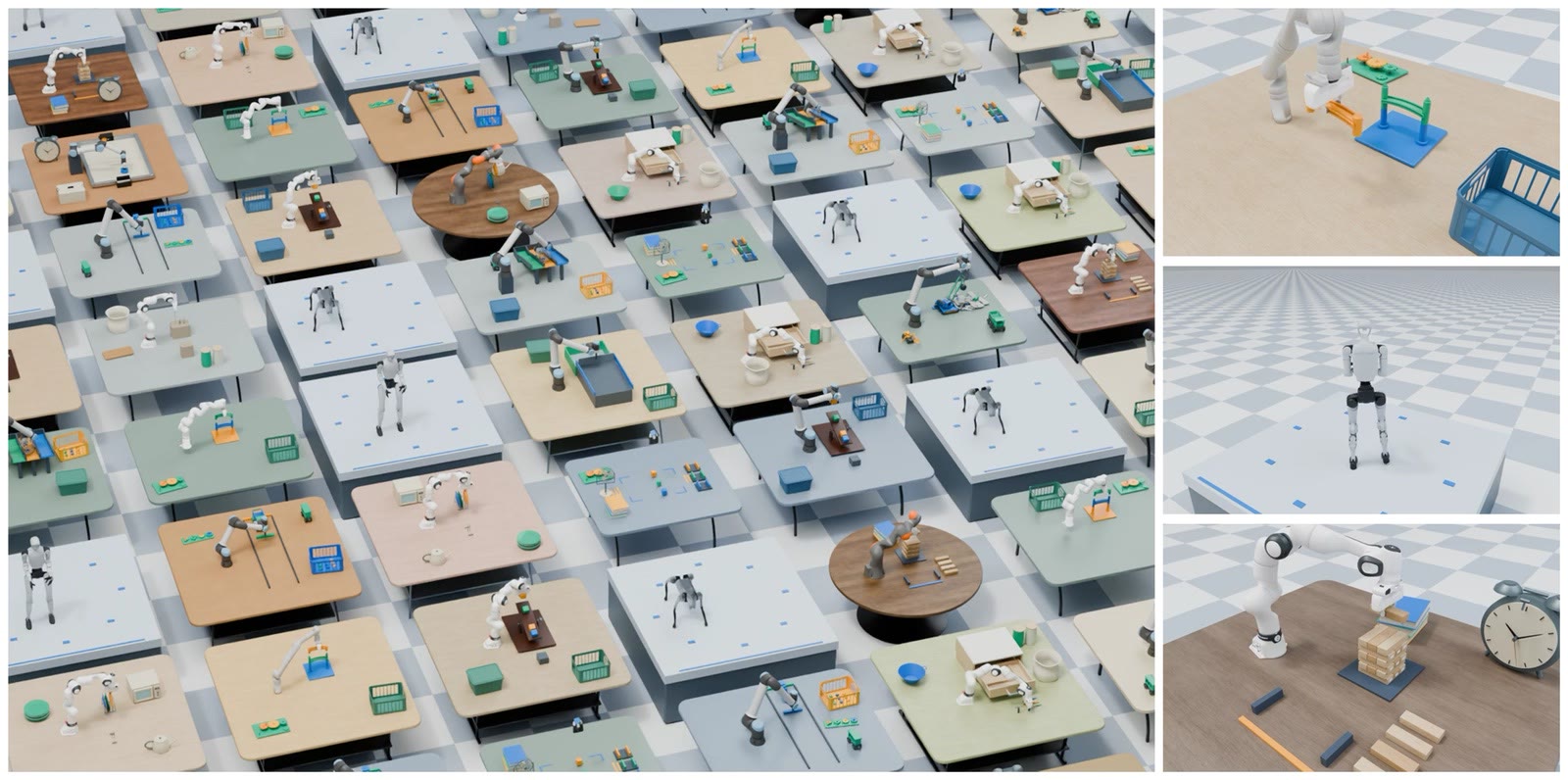
Skild AI and NVIDIA Open-Source Steel, a Robot Physics Solver for Newton That Hits 13x PhysX Peak Throughput on Mixed 20-Task Batches With About 62% Less GPU Memory

Robot foundation model company Skild AI open-sourced Steel on November 9, an internal physics solver built with NVIDIA and released under Apache 2.0. It is a GPU rigid-body dynamics solver contributed to the open-source Newton physics engine for robot training in Isaac Lab. Per the official blog, Steel averages 3.8x PhysX and about 1.3x MuJoCo Warp throughput (geometric mean) across 20 single-task benchmarks; on batches mixing 20 different robot tasks it reaches 13x PhysX peak throughput, and at a matched batch it uses about 11 GiB of GPU memory versus 29 GiB. A WebGPU port also lets you try it in a browser.

Skild AI and NVIDIA Open-Source Steel, a Robot Physics Solver for Newton That Hits 13x PhysX Peak Throughput on Mixed 20-Task Batches With About 62% Less GPU Memory

Key Takeaways

  • Vendor figures: on a mixed 20-task batch Steel hits 3.90M env-steps/s at 245,760 environments vs PhysX peak of 300K, about 13x
  • At a matched 61,440 environments Steel runs 3.61M steps/s, 12x PhysX, using about 11 GiB vs 29 GiB of GPU memory (about 62% less)
  • Faster than PhysX on 19 of 20 single-task benchmarks, 3.8x geometric mean; about 1.3x MuJoCo Warp; 6.7x PhysX on the 23-joint Kuka-Allegro lift task
  • Apache 2.0, available in Newton as newton.solvers.SolverSteel; a WebGPU port runs 24 interactive scenes in the browser
  • Caveat: all numbers are simulation-only throughput on one RTX PRO 6000 Blackwell GPU, not end-to-end policy training speed
Read full story
Linked Models & Agents:
ADSponsored

X Discussion: OpenAI President Greg Brockman Says "Integrating With OpenAI Can Drive a Lot of Business," Citing OpenTable's 190,000 Seated Diners via ChatGPT in September

Greg Brockman, OpenAI's president and co-founder, quoted a post by Juozas Kaziukenas on X with one line: "integrating with OpenAI can drive a lot of business." The quoted post says OpenTable's native integration with OpenAI drove 190,000 people to restaurants in September alone, calling it possibly one of the biggest agentic commerce success stories. The figure comes from Booking Holdings' Q3 earnings call on November 3, where CFO Ewout Steenbergen disclosed it. On the same call, however, Booking stressed that AI-driven traffic is "still very small in aggregate" and that LLM referrals are "significantly less than 1%" of Booking.com room nights. The debate is whether agentic commerce is real incremental demand or an early signal from a small base.

X Discussion: OpenAI President Greg Brockman Says "Integrating With OpenAI Can Drive a Lot of Business," Citing OpenTable's 190,000 Seated Diners via ChatGPT in September

Key Takeaways

  • Number: Booking Holdings' CFO said on the Q3 earnings call that OpenTable's native OpenAI integration produced 190,000 seated covers in September (counted per diner, not per reservation)
  • Framing: Booking's CEO called it one of OpenTable's fastest-growing channels, but "from a small base"
  • Big picture: on the same call, LLM referrals were "significantly less than 1%" of Booking.com room nights, and AI traffic overall is "still very small"
  • Context: according to Hospitality.today, restaurant booking in ChatGPT went live on August 10 on all plans, making September the first full month; the outlet estimates 190,000 is roughly 0.1% of OpenTable's monthly diners based on its stated 1.9 billion a year
  • Opinion: Brockman uses the case to pitch the business value of integrating with OpenAI, while the quoted author admits the number was high enough to "triple check"; treat it as discussion, not a settled conclusion
Read full story

ByteDance Seed Launches Seedream 5.5: Stable Editing Across 100 Rounds With Pixel-Level Preservation, Native RGBA Transparent Assets, and a 0.4% Severe Text Corruption Rate (Vendor Figures)

On November 9, ByteDance Seed released Seedream 5.5, its next-generation image creation model. Three main upgrades: multi-turn editing that preserves unedited regions at the pixel level and removes color shifts, supporting up to 100 rounds of edits on the same image; native RGBA output with full and partial transparency, so no separate background removal is needed; and more photo-like lighting, materials and skin textures with more accurate dense small text. In expert evaluations on the MagicArena platform, ByteDance reports higher usability and quality scores than Seedream 5.0 Pro across all six production use cases, with usability more than doubling in film/TV and office work; a 0.4% severe and 1.7% minor text corruption rate; and leading text structure and text-to-image realism versus GPT Image 2.5 Sunburst and Nano Banana 2.1. All figures are vendor-reported; no third-party leaderboard results are public yet. The Chinese blog says it is rolling out on Jimeng, Doubao, Doubao Work and Volcano Engine Ark; the English blog says it is coming to Dreamina, CapCut and BytePlus. A Pro version is planned.

ByteDance Seed Launches Seedream 5.5: Stable Editing Across 100 Rounds With Pixel-Level Preservation, Native RGBA Transparent Assets, and a 0.4% Severe Text Corruption Rate (Vendor Figures)

Key Takeaways

  • Editing: up to 100 rounds of successive edits on one image, with pixel-level preservation of unedited regions and no color shift
  • Assets: native RGBA output with full and partial transparency, ready for layout and compositing without background removal
  • Text: vendor-reported 0.4% severe and 1.7% minor text corruption rate across Chinese, English and dense small text
  • Versus previous version: higher usability in all six use cases, more than 2x Seedream 5.0 Pro usability in film/TV and office work; +55.62% GSB for image-to-image realism
  • Availability: Jimeng, Doubao, Doubao Work and Volcano Engine Ark (Chinese blog); Dreamina, CapCut and BytePlus (English blog); API pricing not published in the official blog; a Pro version will follow
Read full story
Linked Models & Agents:
⚡ Seedream 5.5⚡ Seedream 5.0 Pro⚡ GPT Image 2.5 Sunburst⚡ Nano Banana 2.1🌐 ByteDance (字节跳动)🌐 OpenAI🌐 Google DeepMind

Alibaba Taobao MNN Team Open-Sources 300M-Parameter On-Device Model MNN-Pocket-0.3B: 173 MB INT4 Build, Up to 466 tok/s Decode on iPad Pro M5, Apache 2.0

On 2026-11-04 Alibaba Taobao's MNN inference-engine team released MNN-Pocket-0.3B on GitHub (alibaba/MNN) and Hugging Face (taobao-mnn): a roughly 300M-parameter Chinese-English instruction model co-designed with the MNN stack for smartphone apps, under Apache 2.0. The official model card says the INT4 (W4A16) QAT build is only 173 MB, supports 32K context, decodes at up to 466 tok/s on iPad Pro M5 (Metal) and about 350 tok/s in tests on iPhone 18 Pro, and averages 50.00 across 11 zh/en benchmarks, ahead of larger ~500M baselines such as Qwen3-0.6B at 44.28 (all vendor figures). The family also ships Base, SFT, GGUF, an on-device MNN package and a Dec decision model that answers in one forward pass. Since 11-08 the third-party iOS app Local LLM has added it and the community has published a LiteRT conversion. The team explicitly does not recommend it for advanced math or long code generation.

Alibaba Taobao MNN Team Open-Sources 300M-Parameter On-Device Model MNN-Pocket-0.3B: 173 MB INT4 Build, Up to 466 tok/s Decode on iPad Pro M5, Apache 2.0

Key Takeaways

  • Specs (official model card): about 300M parameters, 28 layers, hidden size 896, GQA with 14 heads and 2 KV heads, 65,536-token vocabulary, 32K context in deployment, Chinese and English
  • Size and speed (vendor figures): INT4 (W4A16) QAT build is 173 MB; at 512-token context, iPad Pro M5 Metal does 8,721 tok/s prefill and 466 tok/s decode, Snapdragon 8 Gen 5 CPU decodes 251 tok/s; the GitHub README cites about 350 tok/s decode on iPhone 18 Pro
  • Scores (vendor figures): 50.00 average over 11 zh/en benchmarks, 49.59 for INT4, a 0.41-point drop; IFEval 73.20, GSM8K 54.36, HumanEval 53.66, average above Qwen3-0.6B (44.28) and MiniCPM4-0.5B (46.81)
  • Full family: Base, SFT, instruct, GGUF (llama.cpp), an on-device MNN package and a Dec decision model that answers in one forward pass; Apache 2.0 allows commercial use
  • Positioning: the team targets on-device assistants, data extraction and lightweight agent pipelines, not advanced math or long code generation
Read full story
Linked Models & Agents:
⚡ MNN-Pocket-0.3B⚡ Qwen3-0.6B⚡ MiniCPM4-0.5B🌐 alibaba🌐 taobao-mnn

Tencent Open-Sources DSpine, a Parallel Draft Model for Qwen3.8-27B: Vendor Figures Show About 3.19x Throughput on SWE-bench Pro Replay, Ahead of DFlash2 Across the Board

Tencent published tencent/Qwen3.8-27B-DSpine-b16 on Hugging Face at 14:20 UTC on 2026-11-07: a five-layer speculative-decoding draft model of about 2B parameters with block size 16 and an 8,192-token sliding window, under Apache 2.0, with code at GitHub Tencent/DSpine and the paper at arXiv 2609.36173. The model card (vendor figures) shows that with SGLang 0.5.22, BF16 and concurrency 8, output throughput on a SWE-bench Pro replay at xhigh reasoning rose from about 248 to about 791 tokens/s (about 3.19x), versus 2.87x for the official DFlash2; acceptance length beat DFlash2 in all 10 agent settings. Note that DSpine drafts 16 tokens per block while DFlash2 drafts 8, so the setups are not identical, and no third-party reproduction exists yet.

Tencent Open-Sources DSpine, a Parallel Draft Model for Qwen3.8-27B: Vendor Figures Show About 3.19x Throughput on SWE-bench Pro Replay, Ahead of DFlash2 Across the Board

Key Takeaways

  • Release: Tencent uploaded tencent/Qwen3.8-27B-DSpine-b16 at 14:20 UTC on 2026-11-07; about 2.03B parameters (about 4GB in BF16), five layers, block size 16, 8,192-token sliding window, Apache 2.0
  • Throughput (vendor figures): SWE-bench Pro replay at xhigh reasoning went from about 248 to about 791 tokens/s, about 3.19x; DFlash2 reached 2.87x
  • Best speedup (vendor figures): about 3.84x on WorkBuddy Office at low reasoning (DFlash2: 3.17x)
  • Acceptance length (vendor figures): 4.77 vs 4.00 for DFlash2 on SWE-bench Pro at xhigh; 7.20 vs 5.69 on GSM8K with greedy decoding
  • Caveat: DSpine drafts 16 tokens per block and DFlash2 drafts 8, so conditions are not identical; only model-card numbers exist so far, with no third-party reproduction
Read full story

X Discussion: "Is Opus 5.5 Nerfed?" A User Says Gemini Found a Nov 3 Shift Across 1,400 Claude Code Sessions; Theo Thinks the Reasoning Summarizer Changed Instead

Starting 2026-11-07, many developers on X complained that Claude Opus 5.5 felt "nerfed" in Claude Code: ignoring instructions, repeating mistakes and spawning sub-agents for small jobs. User Shane Melaugh (@shanemelaugh) posted that he had Gemini 4 Argon analyze 1,400 of his Claude Code sessions and found that around November 3 the model name stayed the same but its reasoning style took a sharp turn; at capture the post had about 966 likes, 134 replies and 112k impressions. T3 CEO Theo (@theo) later said that after digging in, Anthropic appears to be rolling out a change to the reasoning summarizer per account, and that he saw no sign of degraded capability. Anthropic had not commented publicly at the time of writing. This is a community debate, not a confirmed downgrade or an official announcement.

X Discussion: "Is Opus 5.5 Nerfed?" A User Says Gemini Found a Nov 3 Shift Across 1,400 Claude Code Sessions; Theo Thinks the Reasoning Summarizer Changed Instead

Key Takeaways

  • Original post: Shane Melaugh (@shanemelaugh) at 2026-11-07 22:15 UTC, "is Opus 5.5 nerfed?"; about 966 likes, 134 replies, 57 reposts, 315 bookmarks and ~113k impressions at capture
  • His claim: Gemini 4 Argon analyzed 1,400 Claude Code sessions and saw a sharp reasoning-style shift around November 3 with an unchanged model name; single-user data judged by another model, raw data not published
  • Counterpoint: Theo (@theo, T3 CEO) said at 2026-11-08 01:18 UTC that Anthropic appears to be rolling out a reasoning summarizer change per account and he saw no capability drop (~367 likes); his earlier jab at a Codex send-button bug drew ~1,270 likes
  • Context: Claude extended thinking returns summarized thinking blocks; Claude Code 2.1.318 shipped on November 3 (UTC) with sub-agent effort changes, and Anthropic has not linked it to the complaints
  • Framing: an X debate; neither a downgrade nor its absence is confirmed, and Anthropic had not commented publicly at the time of writing
Read full story

Kimi K3.1 Pro Highspeed Lands on Amazon Bedrock: $4/$20 Global Pricing Matches Moonshot, Flex Tier Halves It

On 2026-11-06 AWS announced Moonshot AI's Kimi K3.1 Pro (Highspeed) on Amazon Bedrock, available in every Bedrock Region via cross-Region inference and aimed at coding and document-processing agents. The official model card lists Global CRIS pricing of $4 input, $20 output and $0.20 cache read per million tokens, matching Moonshot's own Highspeed price; US and India geo routing costs 10% more, Priority is billed at 1.75x and Flex at 0.5x.

Key Takeaways

  • Pricing (official AWS model card): Global CRIS $4 input / $20 output / $0.20 cache read / $5 cache write per million tokens
  • US and India geo routing is $4.40 / $22, 10% above Global
  • Priority is billed at 1.75x and Flex at 0.5x, so Flex is about $2 / $10, the same as Moonshot's standard (non-Highspeed) API price
  • Model ID moonshotai.kimi-k3.1, 1M context, with explicit prompt caching, tool calling, structured outputs and Guardrails
  • This is the second Moonshot flagship in the AWS managed catalog, after Kimi K3 joined Bedrock in September
Read full story
ADSponsored

Google ReproBridge: Packaging One Successful Reproduction for the Next Coding Agent Lifts ML Experiment Reproduction from 76.4% to 92.6%

Google and the University of Waterloo posted ReproBridge on arXiv (2611.08452, 2026-11-05). It turns the code fixes, environment setup, launchers and guide an agent discovers while reproducing a paper into a standardized artifact. ReproBridge-Bench covers 36 papers, 387 experiments and 1,029 tasks. Author-reported: across Sonnet 4.6, Sonnet 5, Opus 5 and Gemini 3.8 Flash, mean success rises from 76.4% to 92.6% and API spend drops 19.7% on average.

Google ReproBridge: Packaging One Successful Reproduction for the Next Coding Agent Lifts ML Experiment Reproduction from 76.4% to 92.6%

Key Takeaways

  • Benchmark: 36 papers, 387 experiments, 1,029 tasks, each anchored by 5 human-verified reference scores
  • Author-reported: mean reproduction success 76.4% → 92.6% across 4 models; API spend down 19.7% on average
  • Cross-model spread narrows from 21.6 to 3.9 points; all four models exceed 90%
  • Gains range from 5.5pp (Opus 5) to 23.2pp (Gemini 3.8 Flash); removing code or environment hurts most in ablations
  • 24-hour wall-clock limit per paper on 8×H100; Codex serves as the primary Auditor
Read full story

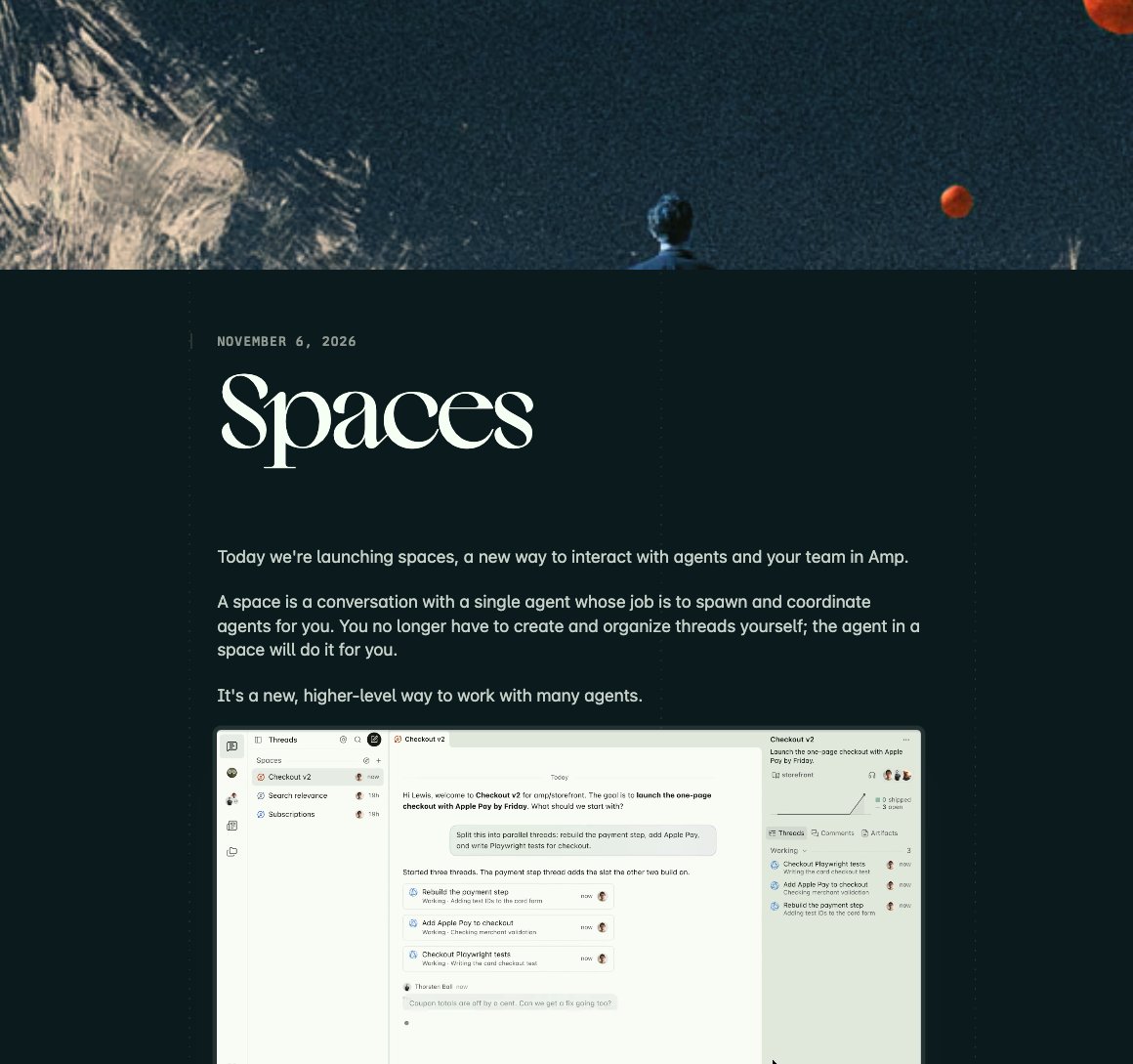
Amp Launches Spaces: One Orchestrator Agent Spawns Parallel Threads While Teams Collaborate in One Room

On 2026-11-06 Amp (ampcode.com) launched Spaces: a Space is a conversation with one orchestrator agent that understands a goal, decomposes work, and creates/coordinates parallel threads so users need not manage threads by hand. Official examples include co-building a feature, running a service-accounts launch, and a security review split across 16 areas. Start from the Spaces sidebar with + (title + project); teammates comment in the same chat, and Amp reads comments only when @-mentioned.

Amp Launches Spaces: One Orchestrator Agent Spawns Parallel Threads While Teams Collaborate in One Room

Key Takeaways

  • Official: ampcode.com/news/spaces (2026-11-06); Amp teammate Lewis Metcalf posted; @AmpCode amplified
  • Form: one orchestrator agent decomposes goals, spawns parallel threads, and summarizes; bird's-eye or deep dive
  • Teams: comment inside the same Space; Amp reads comments only when @-mentioned
  • Examples: Spaces was built inside a Spaces v1 room; service-accounts launch ops; security review across 16 areas
  • Start: Spaces sidebar → + → set title and project → describe the goal
Read full story
Linked Models & Agents:

Klavis Ships Multi-step SWE: 69 Tasks / 574 Dependent Steps; Vendor Opus 5.5 Solves 18.5% of Full Tasks, 56.8% of Steps

On 2026-11-04 Klavis AI released Multi-step SWE (arXiv 2611.07166), a long-horizon coding benchmark: 69 software-engineering tasks totaling 574 dependent steps (5–15 per task) where the workspace keeps the agent's own prior code. Across nine frontier model–harness pairs (vendor/paper figures): strongest Claude Opus 5.5 / Claude Code reaches 18.5% whole-task solve rate, 56.8% steps passed, and 31.9% Pass@4; 38 of 69 tasks are unsolved by every model. Tasks, eval code, and trajectories are public.

Klavis Ships Multi-step SWE: 69 Tasks / 574 Dependent Steps; Vendor Opus 5.5 Solves 18.5% of Full Tasks, 56.8% of Steps

Key Takeaways

  • Scale: 69 tasks, 574 steps, 9 languages; each step is a full engineering request (2–4h budget), not a tool call
  • Rules: workspace is not reset to a reference solution; later steps still run after failures, but a full solve needs every step full credit
  • Top (paper/blog): Opus 5.5 / Claude Code 18.5% solve [11.6, 25.7], 56.8% steps passed, 31.9% Pass@4
  • Hardest: version-upgrade family (16 of 20 unsolved by all); ~52% of failed steps still report completion (model-assisted labels)
  • Artifacts: arXiv 2611.07166, github.com/Klavis-AI/Multi-step-SWE, multistepswe.com leaderboard
Read full story

Reflection Publishes 156-Page Beam Technical Report: 23.8T-Token Pretraining, 4-Week Async RL on 10.5K GB300s, NVFP4 Keeps ~99% of Scores

On 2026-11-06 Reflection's official account released the Beam model technical report (a 156-page PDF), detailing how its 501.3B-total / 23.4B-active open-weight MoE was trained: 23.8T pretraining tokens on 6,144 GB300 GPUs in under four weeks, then a fully asynchronous RL run on about 10.5K GB300s for four weeks that produced over 100M rollouts. The report says FP8 and NVFP4 checkpoints keep 99.93% and 98.98% of median benchmark scores, and the 1.93B DFlash 2 drafter speeds single-request decoding 1.96–3.03x (vendor figures).

Reflection Publishes 156-Page Beam Technical Report: 23.8T-Token Pretraining, 4-Week Async RL on 10.5K GB300s, NVFP4 Keeps ~99% of Scores

Key Takeaways

  • Scale: 501.3B total / 23.4B active, 52 layers, 256 experts per layer with 8 active per token, 151,936-token vocabulary
  • Pretraining: 23.8T tokens on 6,144 GB300s in under four weeks, 92.3% goodput late in the run and 21% steady-state MFU
  • RL: about 10.5K GB300s for four weeks, 100M+ rollouts, 110K concurrent rollouts and 12-second weight updates; the report sees no plateau as RL compute grows
  • Serving: FP8 / NVFP4 keep 99.93% / 98.98% of median scores; DFlash 2 speeds single-request decoding 1.96-3.03x
  • Safety: 88.9% refuse/pivot on harmful requests and 81.5% compliance on harmless ones in in-house ISE; Limited in all four systemic-risk categories
Read full story
Linked Models & Agents:

Apiiro: Claude Code's "Don't Ask Again" Saves Approved Commands—Passwords Included—to settings.local.json; 2,539 Secrets Found on Public GitHub

On 2026-11-05 Apiiro researchers Shmulik Cohen and Matan Giladi reported that when a Claude Code user picks "Yes, and don't ask again" on an exact command, the command is saved verbatim—any password or token included—to the project's .claude/settings.local.json. Of 104,185 public GitHub copies of that file, 1,122 hold at least one secret; counting git history, shared settings.json and saved agent transcripts, the total is 2,539 secrets across 1,994 repos. Apiiro did not test whether the credentials work and advises rotating first, then cleaning up.

Key Takeaways

  • Trigger: when "don't ask again" saves an exact command, any password or token in it lands verbatim in .claude/settings.local.json
  • Scale (Apiiro figures): 1,122 of 104,185 public copies (~1.1%) hold secrets, 1,379 distinct; 2,539 secrets across 1,994 repos overall
  • Mix: over a third open a database directly (379 DB passwords), plus 43 SSH logins, 42 GitHub/GitLab/npm tokens and 23 AWS keys
  • Scanner gap: gitleaks flagged 564 and TruffleHog 643; 215 files were missed by both, mostly passwords typed inside commands
  • Fix: rotate every secret the file ever held, then git rm --cached and add it to the repo's own .gitignore; prefer pattern rules like npm test *
Read full story