AI Coding Live News

Microsoft Research and UC Berkeley open-source TokenEconomizer, a plugin that cuts Claude Code and Codex costs by 18.4–30.9% on SWE-Bench without changing the agent

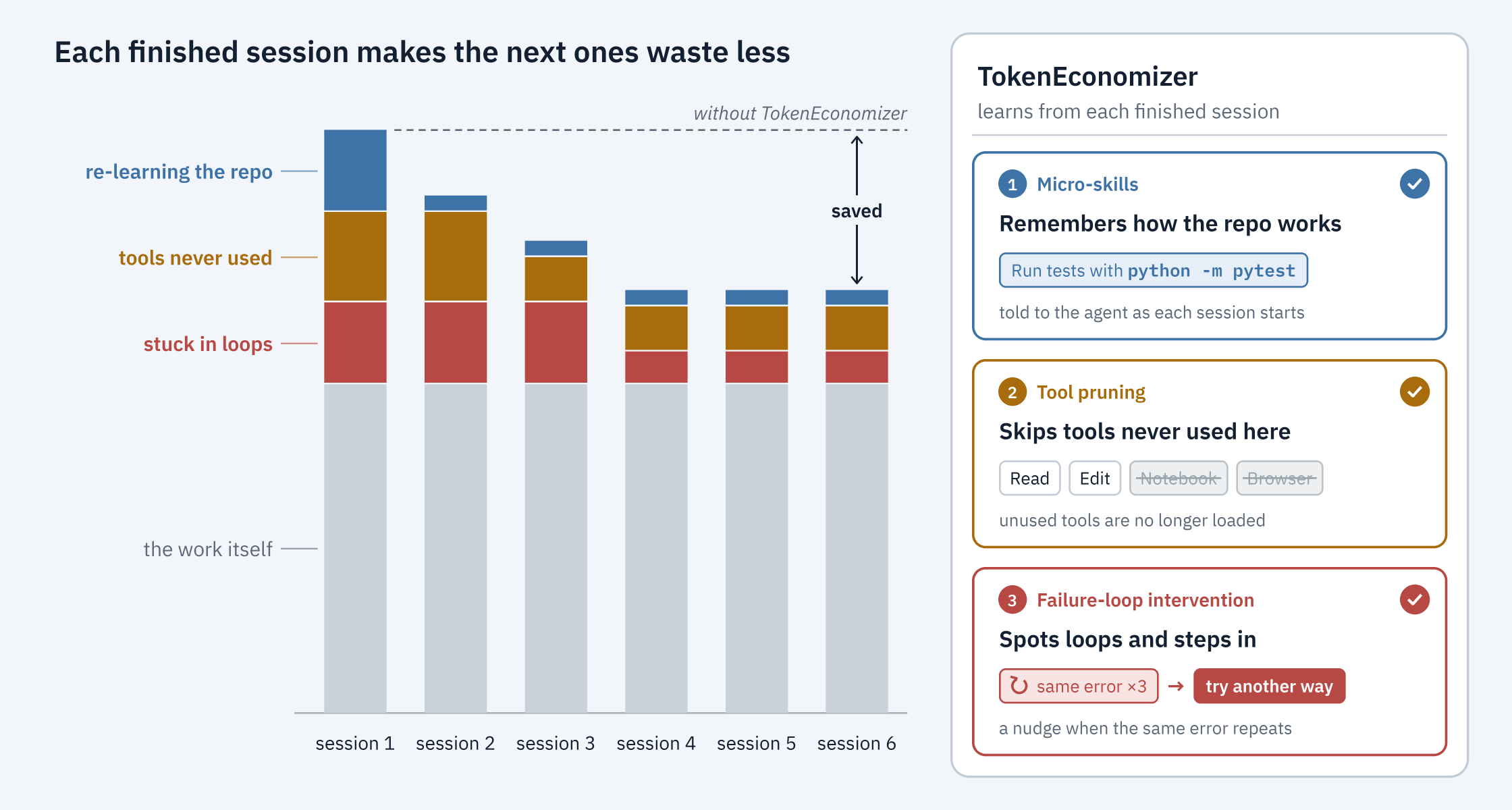
Microsoft Research, Microsoft Security and UC Berkeley open-sourced TokenEconomizer on GitHub (Apache 2.0, v0.1.0 released October 26), a plugin for Claude Code, Codex, GitHub Copilot CLI and Pi, with experimental opencode support. It learns from earlier sessions in the same repository: micro-skills remember repo facts, tool pruning drops tool definitions that go unused, and a loop guard nudges an agent that is stuck. The paper reports 18.4–30.9% lower mean cost across five agent and model combinations on 277 SWE-Bench tasks (paper figures).
Microsoft Research and UC Berkeley open-source TokenEconomizer, a plugin that cuts Claude Code and Codex costs by 18.4–30.9% on SWE-Bench without changing the agent

Key Takeaways

  • Cost: on 277 SWE-Bench tasks across 6 repositories and 5 agent and model combinations, mean cost fell 18.4–30.9%, and all 30 repository-by-combination cells got cheaper (paper figures, including the plugin's own model calls)
  • Success rate: Pass@1 rose in 4 of 5 combinations, e.g. Copilot CLI with Sonnet 5 cost 18.4% less with Pass@1 +2.6, while Claude Code with Opus 4.8 cost 30.9% less with Pass@1 -1.0
  • Three mechanisms: micro-skills (repo facts stated only after three sessions confirm them), tool pruning (by default a tool unused over 10 prompts across 2 sessions is left out), and a failure-loop guard (one redirect when a judge is at least 0.7 confident, never stopping a turn itself)
  • Generalization: 16–21% lower cost on Web-Bench and 6–20% lower on two security-auditing benchmarks where every task is a new repository
  • Deployment: Apache 2.0, Python 3.10+, no API key of its own, and learned experience stays local in ~/.tokeneconomizer
Read full story

DiffuSpace, founded by the HKU Dream team, open-sources Clover-35B-A3B, a diffusion LLM hitting 680 tokens/s on one GPU and 73.6 on SWE-bench Verified

On Oct 28 DiffuSpace, whose members come from the HKU NLP group behind Dream 7B, released its first model, Clover-35B-A3B-Preview: a mixture-of-experts diffusion language model initialized from Qwen3.6-35B-A3B, with 35B total and about 3B active parameters, a 128K context window and block-parallel denoising. Vendor-reported results include 73.6 on SWE-bench Verified, 51.7 on Terminal-Bench 2.1 and 83.8 on GPQA Diamond, with 680 tokens/s on a single GB300 in agent workloads. Weights are Apache 2.0 on Hugging Face, ModelScope and GitHub, with SGLang and llama.cpp support.

DiffuSpace, founded by the HKU Dream team, open-sources Clover-35B-A3B, a diffusion LLM hitting 680 tokens/s on one GPU and 73.6 on SWE-bench Verified

Key Takeaways

  • A 35B-total, roughly 3B-active MoE diffusion model initialized from Qwen3.6-35B-A3B, with 128K context and a thinking mode
  • DiffuSpace says it tops all six agent benchmarks it compared: SWE-bench Verified 73.6, Terminal-Bench 2.1 51.7 and tau3 Overall 65.3, ahead of LLaDA2.2 flash, Mercury 2.5 and Qwen3.6-35B-A3B
  • Speed (vendor-reported): 680 tokens/s on one GB300 at BF16 and batch size 1 in agent workloads, and 515 tokens/s on one H200 versus 365 tokens/s for Qwen with DFlash2
  • An INT4 build runs on a 16GB RTX 5070 Ti at 101.8 tokens/s on MATH-500
  • Weights on Hugging Face are Apache 2.0, about 69GB in BF16, and SGLang is the recommended serving path
Read full story
Linked Models & Agents:
⚡ Clover-35B-A3B-Preview⚡ Qwen3.6-35B-A3B⚡ Dream 7B⚡ LLaDA2.2 flash⚡ Mercury 2.5🌐 DiffuSpace🌐 HKU NLP🌐 Alibaba Qwen🌐 NVIDIA

Shanghai AI Lab ships Atria Dawn full release: 744B MoE GLM-5.2 agentic model, context doubled to 512K, MIT weights

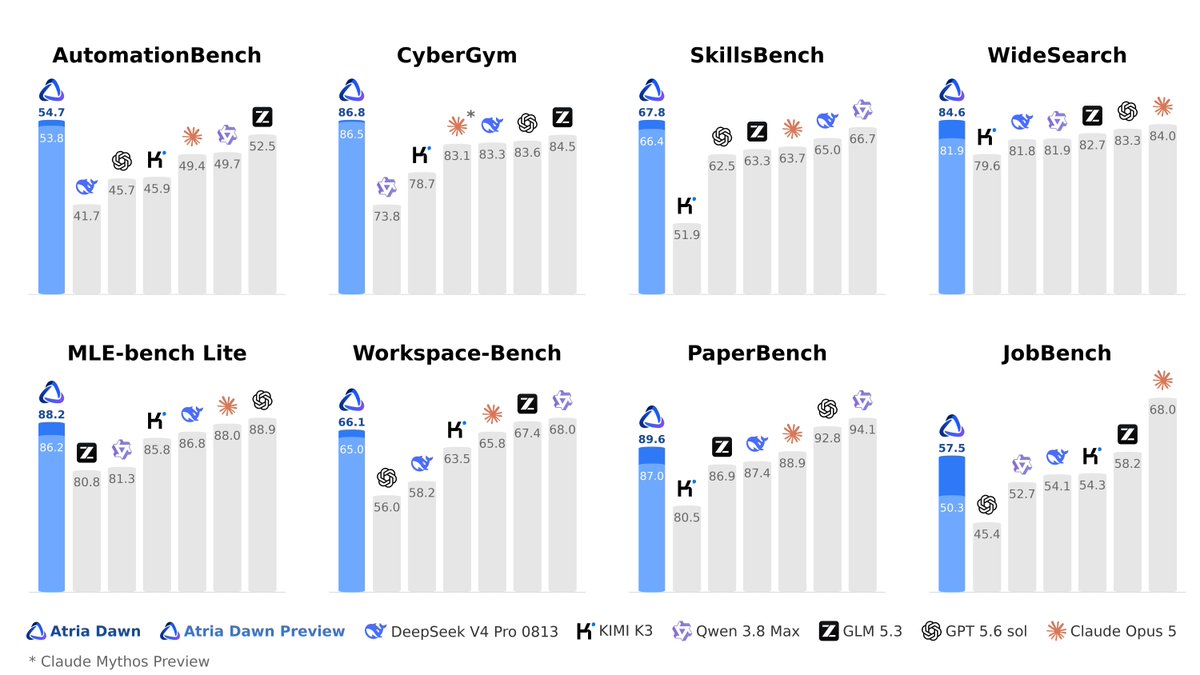
Shanghai AI Laboratory has moved Atria Dawn from Preview to a full release, with open weights (plus an FP8 build) on Hugging Face under internlm/Atria-Dawn and on ModelScope, MIT licensed. Built on the 744B-parameter MoE GLM-5.2, it targets long-horizon research and engineering agent work; context doubles from the Preview's 256K to 512K and input is text only. The vendor table shows it leading the listed models on AutomationBench, CyberGym and SkillsBench, while still trailing Claude Opus 5 on coding tests such as SWE-bench Pro and Terminal-Bench 2.1 (all vendor-reported).

Shanghai AI Lab ships Atria Dawn full release: 744B MoE GLM-5.2 agentic model, context doubled to 512K, MIT weights

Key Takeaways

  • 512K context, double the Preview's 256K; built on the 744B-parameter MoE GLM-5.2, text input only
  • BF16 and FP8 weights on Hugging Face and ModelScope, MIT license
  • Vendor-reported: AutomationBench 54.7, CyberGym 86.8, SkillsBench 67.8, BFCL V4 78.4, each the top score in its table
  • Weak spots from the same table: SWE-bench Pro 61.7 vs 76.5 for Claude Opus 5, Terminal-Bench 2.1 81.0 vs 90.2
  • Local serving needs SGLang v0.5.13.post1+ or vLLM v0.23.0+; an OpenAI-compatible API also plugs into Codex
Read full story
Linked Models & Agents:

Mirendil, founded by ex-Anthropic researchers, unveils Fern: its first from-scratch model with up to 10M tokens of context

On Oct 26 Mirendil unveiled Fern, its first model, pretrained from scratch on its own Mirendil-Base (0.1-0.5T params) with a context window of up to ~10M tokens, about 0.5M lines of code or days of agent traces. Fern 0.1 got only a short round of post-training and targets AI R&D work such as auditing training data, debugging runs from logs and reading agent traces end to end. Vendor-reported: 73.4% on SWE-Bench Verified and 100% single-needle RULER retrieval at 10M, while multi-hop QA drops to 45% at 10M. Access is early-access only; no price or weights yet.

Mirendil, founded by ex-Anthropic researchers, unveils Fern: its first from-scratch model with up to 10M tokens of context

Key Takeaways

  • Scale and context (vendor-reported): Mirendil-Base has 0.1-0.5T params; Fern reads up to ~10.2M tokens (about 23 MB or ~0.5M lines of code, roughly Megatron-LM scale), per the official blog
  • Coding scores (run by Mirendil, OpenCode, 1 attempt): SWE-Bench Verified 73.4, SWE-Bench Pro v2-Hard 76.5, SWE Atlas QnA 53.2, DeepSWE v1.1 44.2, Terminal-Bench 4.0 just 6.1; Claude Opus 5.5 in the same table scores 98.2/100.0/66.4/74.2/66.4
  • RULER long context (vendor-reported): single-needle retrieval is 100% from 32K to 10M; multi-hop HotpotQA falls from 65% at 32K to 45% at 10M, with only 20 samples per 10M cell
  • Cost (vendor-reported): one researcher plus agents built Mirendil-Base in 3.5 months for under $10M of compute, with agents writing over 99% of the code, per the pretraining write-up
  • Availability: Fern is the smallest of three models; Base-Large (0.5-2T) and Base-XL (2-10T) are still pretraining; access is via early-access requests only, with no price or weights announced
Read full story
Linked Models & Agents:
⚡ Fern 0.1⚡ Mirendil-Base🌐 Mirendil
ADSponsored

BOSS Zhipin's Nanbeige lab open-sources Nanbeige4.3-33B, a 33B dense agent model with 512K context under Apache 2.0, reporting 80.9 on Terminal-Bench 2.1 vs 73.0 for Qwen3.8-27B

At 12:11 UTC on 2026-10-25, the Nanbeige LLM Lab of BOSS Zhipin (Kanzhun Limited) announced Nanbeige4.3-33B from its account @nanbeige (post), with the model and its Base version released as open weights on Hugging Face under Apache 2.0 (model card). It is a 33B dense model on a Llama-style architecture with a 512K context window, positioned as the teacher model of the Nanbeige4.3 series that will be distilled into smaller models such as Nanbeige4.3-3B. The official model card compares it with Qwen3.8-27B, Muse-Glimmer-30B and Gemma4-31B using the same harness at highest thinking effort: 80.9 on Terminal-Bench 2.1 (Qwen3.8-27B 73.0) and 65.5 on DeepSWE (42.5), but 60.3 on SWE-Bench Pro, slightly below Qwen's 61.7, and 84.8 on GDPval vs 86.4. All figures are self-reported and not yet independently reproduced.

Key Takeaways

  • Official sources: @nanbeige post on X and the Hugging Face model card; the post had about 616 likes, 79 reposts and 38K views when we pulled it
  • Specs: 33B dense, Llama-style architecture, 512K context, Apache 2.0, with a Base checkpoint released too
  • Self-reported coding scores: Terminal-Bench 2.1 80.9, Terminal-Bench 4.0 23.8, DeepSWE 65.5, SWE-Bench Pro 60.3 (Qwen3.8-27B: 73.0, 6.3, 42.5, 61.7)
  • Self-reported cowork scores: Automation Bench 54.2, JobBench 44.8, GDPval 84.8 (Qwen3.8-27B: 38.3, 34.5, 86.4)
  • Deployment: Transformers, SGLang and vLLM, with official examples using 4-way tensor parallelism; Nanbeige4.3-3B distillation is next
Read full story
Linked Models & Agents:
⚡ Nanbeige4.3-33B⚡ Qwen3.8-27B⚡ Gemma4-31B⚡ Muse-Glimmer-30B🌐 Nanbeige🌐 BOSS Zhipin🌐 Kanzhun

FrontierRefactor Introduces First Code Performance Benchmark: 41% of Agent Patches Pass Tests with Zero Gain or Regressions

Published in arXiv:2610.25834, FrontierRefactor establishes the industry's first evaluation benchmark targeting autonomous coding agents on multi-scale, performance-oriented codebase refactoring. Unlike traditional benchmarks like SWE-bench that measure only functional pass rates, FrontierRefactor spans seven programming languages and 60 Amdahl-qualified tasks ranging from kernels to full repositories (10^1 to 10^4+ LOC). Initial evaluations reveal that over 41% of agent patches pass functional equivalence suites yet yield zero verified speedup—with 19.3% triggering severe runtime performance regressions, highlighting the vital need for multi-turn profiling feedback.

FrontierRefactor Introduces First Code Performance Benchmark: 41% of Agent Patches Pass Tests with Zero Gain or Regressions

Key Takeaways

  • FrontierRefactor (arXiv:2610.25834) introduces the first multi-scale performance-oriented codebase refactoring benchmark across 7 languages and 60 tasks
  • Reveals acute blindspot: over 41% of agent submissions pass functional tests but deliver zero verified acceleration (19.3% regress, 21.9% noise)
  • Cross-language rewrites offer high theoretical speedups but suffer contract collapse; in-place optimizations preserve contracts but fail without profiling
  • Multi-turn execution-timing feedback serves as the decisive lever, multiplying strict success rates across complex codebases
Read full story

Ollama Natively Supports Recursive Flint 40B: 2.5B Active MoE Coding Agent Delivering 125+ tok/s on MacBook Pro

Recursive, founded by Richard Socher, has officially open-sourced Flint (RecursiveSI/flint), a 39.8B Mixture-of-Experts (MoE) coding agent model under Apache 2.0 with day-zero Ollama support (ollama run flint). Activating just 2.5B parameters per token across 47 MoE layers with a 262K context window, Flint hits 125+ tokens/sec on an M4 Pro MacBook Pro. It sets new benchmarks for sub-50B local models, scoring 74.2% on SWE-bench Verified and 89.7% on SWE-bench Pro v2.

Ollama Natively Supports Recursive Flint 40B: 2.5B Active MoE Coding Agent Delivering 125+ tok/s on MacBook Pro

Key Takeaways

  • Flint employs a 49-layer architecture (2 dense + 47 MoE layers) with 39.8B total and 2.5B active parameters per token
  • Native 262,144-token (256K) context window supports end-to-end repository indexing and cross-file debugging
  • Blazing local inference speed: 125+ tokens/sec on M4 Pro MacBook Pro and 150+ tokens/sec on RTX Spark
  • Scores 74.2% on SWE-bench Verified, 89.7% on SWE-bench Pro v2, and 80.3% on LiveCodeBench v6 with instant 'ollama run flint' execution
Read full story
Linked Models & Agents:

Recursive releases its first model, Flint: a 40B-total, 2.5B-active open-weights local coding model under Apache 2.0, running at 125+ tok/s on a MacBook

On Oct 21, Recursive, the startup founded by Richard Socher, released its first model, Flint: a 39.8B-total MoE coding model with about 2.5B active parameters per token, with weights on Hugging Face under Apache 2.0. Recursive says it leads sub-50B MoE models on SWE-Bench Pro v2, Terminal-Bench 2.1 and SWE-Bench Verified, runs at 125+ tok/s on an M4 Pro MacBook Pro, and was built from scratch in under four months with its automated research system, the Eureka Machine, contributing to nearly every part of the stack.

Recursive releases its first model, Flint: a 40B-total, 2.5B-active open-weights local coding model under Apache 2.0, running at 125+ tok/s on a MacBook

Key Takeaways

  • Scale: 39.8B total, ~2.5B active incl. output head; 256 routed experts pick 6 plus 1 shared expert; Apache 2.0 (model card)
  • Benchmarks (vendor-reported): Terminal-Bench 2.1 54.9%, SWE-bench Verified 74.2%; the card lists SWE-bench Pro v2 at 89.7%
  • Speed (vendor-reported): 125+ tok/s on M4 Pro MacBook Pro, 150+ tok/s on 64GB RTX Spark at short contexts, up to 2x comparable models
  • Context: 262,144 tokens in the model card config; the blog says up to 512K, best within 256K
  • Ecosystem: day-one llama.cpp, Ollama, LM Studio, vLLM, SGLang, plus the open-source rec local engine; free to try on OpenCode and Pi
Read full story

Ornith-1.5-122B Released Under MIT: A Single-Node 122B MoE Reasoning Model Scoring 76.9 on SWE-bench Pro

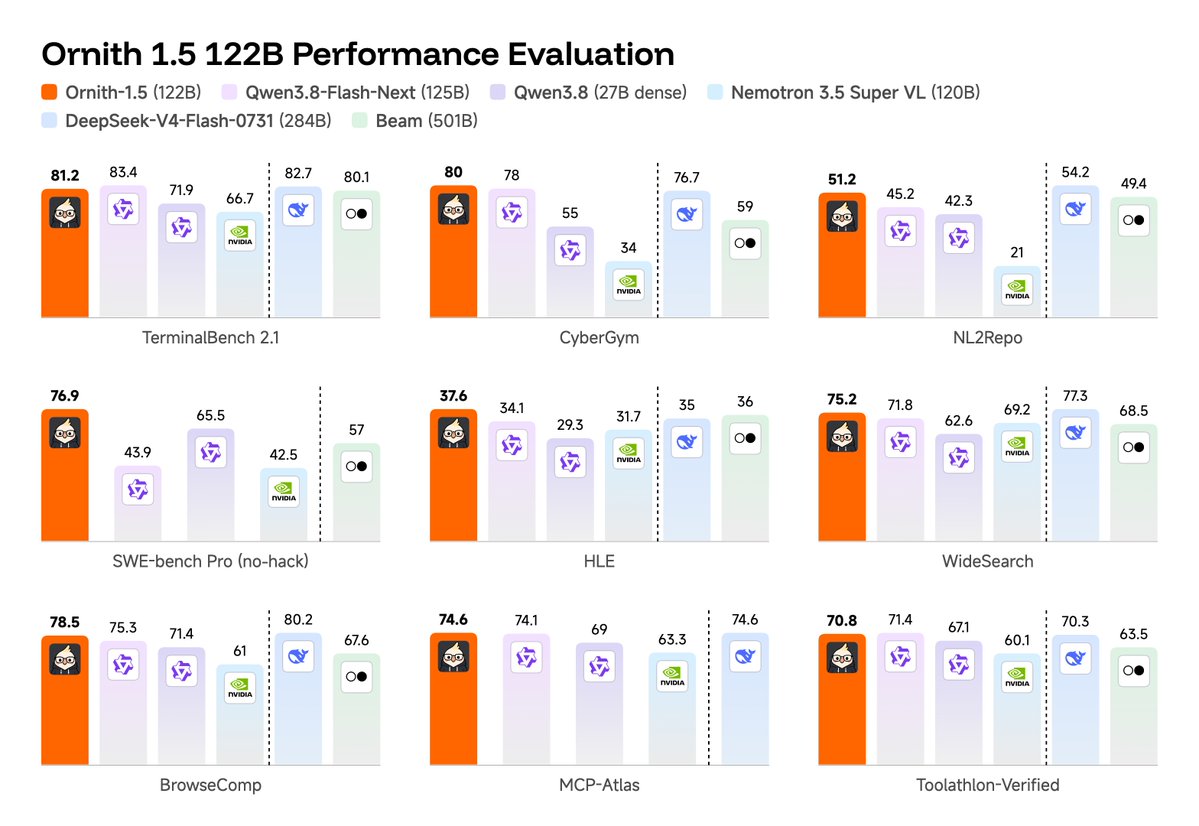
The Ornith AI team officially released Ornith-1.5-122B under the permissive MIT license, a 122-billion parameter mixture-of-experts (MoE) reasoning model optimized to execute on a single GPU node (such as a single DGX). The model is immediately available across vLLM (0.19.1+), SGLang (0.5.9+), Hugging Face, and Ollama (ornith-1.5:122b) with native FP8, GGUF, and MLX quantization. Across independent agentic evaluations in the OpenHands harness, Ornith-1.5-122B registered 84.5 on SWE-bench Verified, 76.9 on SWE-bench Pro (surpassing Qwen3.8-Flash-Next's 43.9 by 33 points), 81.2 on TerminalBench 2.1, and 74.6 on MCP-Atlas.

Ornith-1.5-122B Released Under MIT: A Single-Node 122B MoE Reasoning Model Scoring 76.9 on SWE-bench Pro

Key Takeaways

  • Ornith-1.5-122B released under the permissive MIT license, offering a fully open, frontier-grade 122B MoE coding reasoning model
  • Engineered to fit inside a single GPU node (single DGX), with immediate runtime support on vLLM, SGLang, and Ollama (ornith-1.5:122b)
  • Achieves 76.9 on SWE-bench Pro, drastically outperforming the comparable open-weight baseline Qwen3.8-Flash-Next (43.9)
  • Delivers balanced agentic performance with 81.2 on TerminalBench 2.1, 80.0 on CyberGym, and 74.6 on MCP-Atlas
Read full story
Linked Models & Agents:
⚡ Ornith-1.5-122B⚡ Qwen3.8-Flash-Next🤖 OpenHands🌐 Ornith

Meta Releases Muse Glimmer 30B: An Apache 2.0 On-Device Agentic Model Running on a Single Consumer GPU

Meta AI published the technical report for Muse Glimmer 30B (arXiv:2610.24628), an open-source 30-billion parameter causal language model with an integrated perception encoder designed for on-device autonomous agents. Quantized to approximately 4 bits, Muse Glimmer operates inside 32GB of VRAM on a single consumer GPU (such as an RTX 5090) without cloud reliance. On rigorous agentic evaluations, Muse Glimmer sets new records for its size class: achieving 75.5 on MCPAtlas (surpassing Gemma4-31B at 54.2 and Qwen3.6-27B at 62.5) and 51.2 on SWE-Bench Pro, released fully under the Apache 2.0 license.

Meta Releases Muse Glimmer 30B: An Apache 2.0 On-Device Agentic Model Running on a Single Consumer GPU

Key Takeaways

  • Meta released the technical report for Muse Glimmer 30B (arXiv:2610.24628), open-sourcing the agentic foundation model under Apache 2.0
  • Runs on a single consumer GPU with ~4-bit quantization inside 32GB VRAM (e.g. RTX 5090), enabling 100% offline edge autonomy
  • Scores 75.5 on MCPAtlas tool use benchmark, outperforming Gemma4-31B (54.2) and Qwen3.6-27B (62.5) by wide margins
  • Achieves 51.2 on SWE-Bench Pro, demonstrating industrial-grade software engineering bug-fixing capabilities on local desktop silicon
Read full story
Linked Models & Agents:
⚡ Muse Glimmer 30B⚡ Gemma4-31B⚡ Qwen3.6-27B🌐 Meta
ADSponsored

Empirical Benchmark Unmasks Sub-Agent Concurrency: SWE-bench Success Drops 24% as Token Costs Surge up to 3.3x

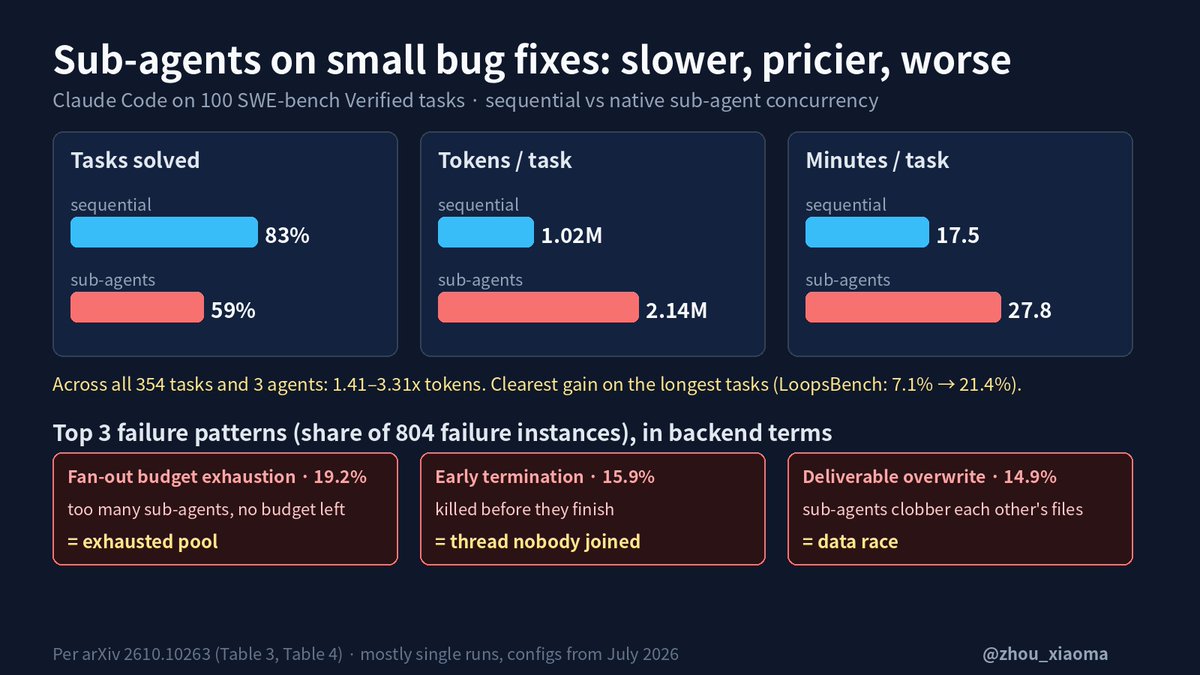
A comprehensive empirical study evaluated native sub-agent concurrency across 2,124 runs on Claude Code, Codex, and Kimi Code (354 tasks, ~$20.8K API cost). On 100 standard SWE-bench Verified tasks, enabling sub-agents caused Claude Code's solve rate to collapse from 83% to 59% (with latency increasing from 17.5 to 27.8 minutes) and Kimi Code from 77% to 59%, while token consumption inflated by 1.41x to 3.31x. The study revealed severe failure modes including budget-exhausting fan-outs, orphaned child processes, and concurrent delivery race conditions.

Empirical Benchmark Unmasks Sub-Agent Concurrency: SWE-bench Success Drops 24% as Token Costs Surge up to 3.3x

Key Takeaways

  • A $20,800 empirical study across 2,124 runs revealed the real costs of native sub-agent concurrency in Claude Code, Codex, and Kimi Code
  • On SWE-bench Verified, sub-agent concurrency dropped Claude Code's solve rate from 83% to 59% and Kimi Code from 77% to 59%
  • Token consumption inflated by 1.41x-3.31x while execution times lengthened, caused by thread race conditions and budget exhaustion
  • Delivered gains only on massive multi-file projects (LoopsBench: 7.1% to 21.4%); authors recommend sequential execution as the default
Read full story
Linked Models & Agents:

Inception Unveils Mercury 3: Diffusion-Based LLM Breaks 1,000+ Tok/s with 1M Context Window

Inception co-founder Stefano Ermon officially unveiled Mercury 3, the company's next-generation diffusion-based large language model. Delivering an astonishing 1,068 tokens per second inference speed on NVIDIA GPUs, Mercury 3 scales to 40x the size of Mercury 1 with a native 1M context window. Benchmarked on IFBench, GPQA Diamond, and SWE-Bench Atlas, it matches frontier closed baselines with standard API pricing of $0.20 / $0.70 per 1M input/output tokens (with 50% promotional pricing of $0.10 / $0.35).

Inception Unveils Mercury 3: Diffusion-Based LLM Breaks 1,000+ Tok/s with 1M Context Window

Key Takeaways

  • Inception co-founder Stefano Ermon officially launched Mercury 3, a diffusion LLM generating 1,068 tokens per second on NVIDIA GPUs
  • Scales model size by 40x over Mercury 1 with a native 1M context window; priced at $0.20 / $0.70 per 1M tokens ($0.10/$0.35 promotional)
  • Triples baseline intelligence on IFBench, GPQA Diamond, and SWE-Bench Atlas, with live availability via OpenRouter
  • Bypasses autoregressive sequential bottlenecks via parallel diffusion denoising, accelerating multi-step agent workflows
Read full story
Linked Models & Agents:

Inception launches Mercury 3 diffusion LLM: 1,068 tokens/s and 1M context, beating GPT-6 Luna and Haiku 5.5 on several benchmarks per the vendor

On October 19 Inception released Mercury 3, which it calls the most capable diffusion LLM (dLLM) to date. Per the vendor, it is more than 40x the size of Mercury 1, outputs 1,068 tokens/s, expands context from 260K (Mercury 2.5) to 1M tokens, and beats GPT-6 Luna and Claude Haiku 5.5 (both medium) on GPQA Diamond, IFBench, SWE-Bench Atlas and more. List price is $0.20/M input and $0.70/M output, 50% off at launch. It is live on the Inception API, OpenRouter, Baseten and Vercel AI Gateway with an OpenAI-compatible API. All scores are vendor-reported and not yet independently reproduced.

Inception launches Mercury 3 diffusion LLM: 1,068 tokens/s and 1M context, beating GPT-6 Luna and Haiku 5.5 on several benchmarks per the vendor

Key Takeaways

  • Speed: 1,068 tokens/s output; the vendor table lists GPT-6 Luna at ~130 and Haiku 5.5 at ~240 (vendor figures).
  • Scores: GPQA Diamond 89.23, IFBench 76.84, SWE-Bench Atlas 51.08, all above Luna and Haiku 5.5; but DeepSWE v1 at 46.31 trails Haiku 5.5 (51.62), and MRCR v2 also trails Haiku.
  • Scale and context: more than 40x the parameters of Mercury 1, with a 1M-token window (260K on Mercury 2.5).
  • Price: $0.20/M in and $0.70/M out list, 50% off at launch ($0.10/$0.35), cached input 90% off; new API keys get 100M free tokens.
  • Access: Inception API, OpenRouter, Baseten and Vercel AI Gateway, OpenAI-compatible as a drop-in replacement.
Read full story
N
NVIDIA (Hugging Face model card)@AICoder·
👀168
🔥88

NVIDIA quietly releases Dory1.0-4B, a looped model with adjustable inference depth (61.8 SWE-bench Verified, vendor-reported)

NVIDIA published Nemotron-Labs Dory1.0-4B on Hugging Face on Oct 16: a 20-layer shared block runs 1, 2 or 4 times at inference so one checkpoint serves several compute budgets. NVIDIA reports 61.8 on SWE-bench Verified at 4 loops, close to Qwen3.5-9B. BF16/MXFP8/NVFP4/GGUF under OpenMDW-1.1.

NVIDIA quietly releases Dory1.0-4B, a looped model with adjustable inference depth (61.8 SWE-bench Verified, vendor-reported)

Key Takeaways

  • Architecture: 8 input + 20 shared recurrent + 8 output layers; loop count 1/2/4 chosen at inference, 2 recommended
  • Vendor-reported SWE-bench Verified: 50.3 / 59.5 / 61.8 at 1/2/4 loops vs 61 for Qwen3.5-9B
  • Terminal-Bench 2.1 at 4 loops is 22.2, well below Qwen3.6-35B-A3B at 43
  • NVFP4 is ~2.17–2.44x faster than BF16 on DGX Spark; last-loop KV caching holds cache at one-loop size
  • vLLM (PR #60149) and llama.cpp (PR #30306) support not yet in releases; build from the PRs
Read full story
Linked Models & Agents:
⚡ Dory1.0-4B⚡ Nemotron🌐 NVIDIA

Liquid AI open-sources LFM2.5-24B-A2B: a 24B-total, ~2B-active reasoning MoE built for on-device agents and tool use

On Oct 13 Liquid AI released LFM2.5-24B-A2B, the largest and final LFM2.5 model: 24B total parameters, ~2.45B active per token, 131K context, and always-on reasoning. By Liquid's own numbers it leads or matches Qwen3.6-35B-A3B on 5 of 8 tool-use/agent benchmarks (AutomationBench 27.69 vs 8.72) while trailing on SWE-Bench Verified, GPQA and other knowledge/coding tests. Open weights are on Hugging Face with GGUF, MLX, FP8 and ONNX builds; API pricing is $0.10 / $1.00 per million tokens and it is also on OpenRouter.

Liquid AI open-sources LFM2.5-24B-A2B: a 24B-total, ~2B-active reasoning MoE built for on-device agents and tool use

Key Takeaways

  • Specs (model card): 24.0B total / 2.45B active, 40 layers (30 gated short-conv + 10 GQA), 64 experts top-4, 131,072 context, 128K vocab
  • Agent benchmarks (vendor-reported, vs Qwen3.6-35B-A3B): AutomationBench 27.69 vs 8.72, LiveClaw 48.09 vs 38.19, ToolSandbox 80.71 vs 75.02, BFCLv4 65.01 vs 65.00
  • Disclosed weaknesses: SWE-Bench Verified (OpenCode) 51.00 vs 66.20, GPQA Diamond 74.42 vs 83.69, WebArena Verified 26.75 vs 37.62
  • Speed: 184 tok/s decode on Apple M5 Max, 114 tok/s on Ryzen AI Max+ 395, 21K+ output tok/s on one B300 with SGLang
  • Training: pretraining scaled 17T to 33T tokens; agentic RL inside OpenClaw, Hermes Agent, Pi and OpenCode; API $0.10 in / $1.00 out per M tokens
Read full story
Linked Models & Agents:
⚡ LFM2.5-24B-A2B⚡ LFM2.5-24B-A2B-Base⚡ LFM2-24B-A2B⚡ Qwen3.6-35B-A3B⚡ Gemma-4-26B-A4B-it🤖 Hermes Agent🤖 OpenClaw🤖 OpenCode🤖 Pi🌐 Liquid AI🌐 Hugging Face🌐 OpenRouter