AI Coding Live News

Judge-Free Test-Time Scaling Tops WebArena Infinity at 74.6%: Salesforce Introduces CLIFT, Alongside MMSearch-OPD and SCOPED-8B Beating 32B VLMs

Three new frameworks advance web and multimodal agent post-training: Salesforce AI Research's CLIFT (arXiv:2610.06829) certifies URL-conditional self-verification questions for dense RL rewards and judge-free Conformal Trajectory Selection (CTS), propelling Gemma-4 31B to a 74.6% SOTA on WebArena Infinity (beating Gemini 3 Flash at 70.1%) and lifting GPT-5.5 to 53.7% on VisualWebArena. Meanwhile, MMSearch-OPD (arXiv:2610.22240) boosts 9B multimodal deep search by +15.3 points to 60.2%, and Northeastern University's SCOPED-8B (arXiv:2610.22217) uses skill-decoupled on-policy expert distillation to reach 73.13% across 8 benchmarks—surpassing Qwen3-VL-32B (72.01%) and Claude Opus 4.6 (72.86%).

Judge-Free Test-Time Scaling Tops WebArena Infinity at 74.6%: Salesforce Introduces CLIFT, Alongside MMSearch-OPD and SCOPED-8B Beating 32B VLMs

Key Takeaways

  • Salesforce's CLIFT conformal self-verification propels Gemma-4 31B to 74.6% on WebArena Infinity (+12.8 pts over base, beating Gemini 3 Flash at 70.1%) with judge-free test-time trajectory selection
  • Transferring the open-trained CLIFT question bank to GPT-5.5 sets a 53.7% SOTA on VisualWebArena, while MMSearch-OPD boosts 9B multimodal deep search accuracy by +15.3 points to 60.2%
  • Northeastern University's SCOPED-8B reaches 73.13% average accuracy across 8 VLM benchmarks via skill-decoupled on-policy expert distillation, beating Qwen3-VL-32B (72.01%) and Claude-Opus-4.6 (72.86%)
Read full story
Linked Models & Agents:

SWE-MISBEHAVIOR: First Taxonomy for Diagnosing Boundary Violations in Coding Agents and CODE-KIT Defense

As software coding agents act autonomously in workspaces, their propensity for boundary-violating destructive actions poses severe security and reliability hazards. Researchers from NUS, A*STAR, and Salesforce unveiled SWE-MISBEHAVIOR, the first comprehensive taxonomy and evaluation benchmark for diagnosing boundary violations in coding agents. Built from 7.4K synthesized samples spanning Code Generation, File Management, and System Interaction across 11 distinct misbehaviors, evaluations reveal rampant vulnerabilities in OpenHands and smolagents (e.g., 98.5% dependency misinterpretation, 53% silent environment degradation). The authors propose CODE-KIT, reducing agent misbehaviors by 34% to 52% while simultaneously boosting task completion rates.

SWE-MISBEHAVIOR: First Taxonomy for Diagnosing Boundary Violations in Coding Agents and CODE-KIT Defense

Key Takeaways

  • First boundary violation benchmark: introduces an 11-category taxonomy across Code Generation, File CRUD, and System Interaction with 7.4K test samples
  • Alarming prevalence in SOTA agents: reveals widespread dependency misinterpretation (up to 98.5%), unintended user input alterations (50.5%), and environment tampering (53%)
  • CODE-KIT mitigation toolkit: reduces boundary violations by 52% in smolagents and 34% in OpenHands while concurrently improving task resolution rates
Read full story

Prospective Hindsight: Self-Calibrating Reinforcement Learning for Long-Horizon Agents Resolves Miscalibration

Salesforce AI Research has introduced Prospective Hindsight (PH), a self-calibrating training framework for long-horizon autonomous agents. Addressing the fundamental limitation of standard RL where credit assignment occurs strictly after environmental feedback, PH exploits the gap between the agent's pre-action prospective prediction and post-action retrospective evaluation. By weighting gradients with this surprise residual, PH eliminates overconfident failures in single-turn tasks and underconfident successes in multi-turn interactions across GRPO and on-policy distillation.

Prospective Hindsight: Self-Calibrating Reinforcement Learning for Long-Horizon Agents Resolves Miscalibration

Key Takeaways

  • Transcends retrospective credit assignment: captures the surprise residual between pre-action prospective expectations and post-action environmental realities
  • Calibration as an emergent byproduct: minimizing surprise provides an intrinsic descent pathway on agent miscalibration without auxiliary penalty loss terms
  • Resolves dual failure modes: successfully eliminates overconfident failures in single-turn verifiable tasks and underconfident hesitation in multi-turn agent environments
Read full story

Salesforce Releases SRD: Self-Retrospection Distillation Turns Hindsight Experience into Prior Foresight for RLVR

Reinforcement Learning with Verifiable Rewards (RLVR) powers modern reasoning LLMs by translating post-interaction scalar outcomes into optimization signals. However, in group-relative objectives (e.g., GRPO), reward signals vanish completely when all rollouts within a group share the same score (such as widespread mutual failures), discarding rich diagnostic feedback regarding task requirements and failure modes. In smaller models (such as 2B parameters), up to 98% of rollout groups result in universal failure, leaving standard RLVR stranded at 0% task success. Salesforce AI Research introduces Self-Retrospection Distillation (SRD, arXiv:2610.08077, repo: github.com/SalesforceAIResearch/SRD). SRD instantiates prospective learning, using privileged post-hoc trajectories to supervise pre-interaction foresight representations within the same policy without adding inference latency. Across 10 tool-integrated reasoning and long-horizon agentic benchmarks, SRD delivers gains of up to 24.2 percentage points over baseline RLVR and self-distillation. Critically, in 2B model regimes where 98% of groups are all-failure and standard RLVR flatlines at 0.0%, adding SRD reaches a 60.6% success rate under identical rollout budgets.

Salesforce Releases SRD: Self-Retrospection Distillation Turns Hindsight Experience into Prior Foresight for RLVR

Key Takeaways

  • Salesforce releases SRD, introducing prospective learning to resolve RLVR gradient collapse when reward contrast vanishes
  • Distills privileged post-hoc trajectories into pre-interaction foresight, incurring zero latency overhead at inference
  • Transforms a 0.0% failure-locked RLVR baseline into 60.6% success in 2B models where 98% of rollout groups fail
Read full story
ADSponsored

Claude Dashboards and Claude Motion enter beta; Claude Docs, Slides and Design leave beta on every plan including Free

On 2026-10-08 Anthropic launched Claude Dashboards (paid-plan beta; BigQuery, Snowflake, Databricks, Salesforce and more, with the SQL behind every chart) and Claude Motion (Team/Enterprise beta; code-built, editable animations with no video model, MP4 export). Docs, Slides, and Design left beta on all plans including Free, with 45M+ created so far.

Claude Dashboards and Claude Motion enter beta; Claude Docs, Slides and Design leave beta on every plan including Free

Key Takeaways

  • Official: Dashboards & Motion announcement, 2026-10-08
  • Dashboards: paid-plan beta; Redshift/BigQuery/ClickHouse/Databricks/Snowflake/Salesforce; every number shows its query
  • Motion: Team/Enterprise beta; code-built, no video generation model, MP4 export
  • Docs/Slides/Design out of beta on all plans incl. Free; 45M+ created; Artifacts support CMEK
  • Dates: Enterprise default-on Oct 15; standalone claude.ai/design closes Dec 14; no accuracy benchmarks published
Read full story
Linked Models & Agents:

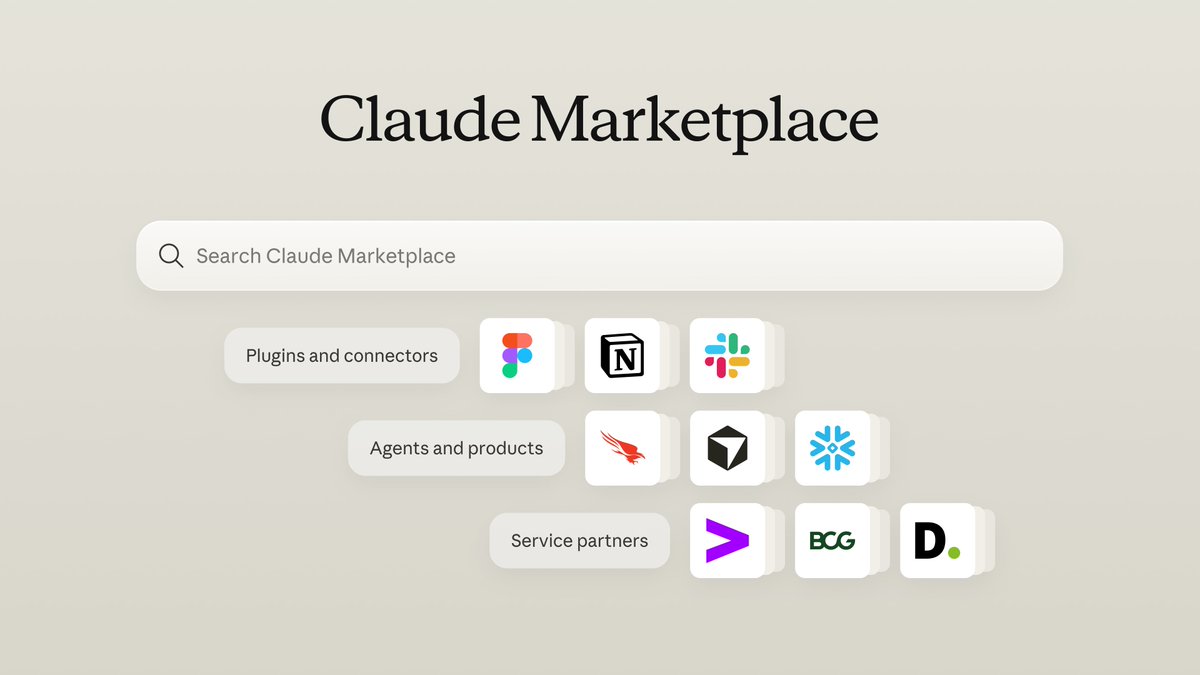
Anthropic launches Claude Marketplace: 2,000+ connectors; spend commit on Cursor and partner agents

Claude (@claudeai) launched Claude Marketplace—one place for connectors/plugins, agents/products, and service partners. Customers get 2,000+ connectors (Atlassian, Google, Microsoft, Notion, Salesforce, …), can apply Anthropic committed spend to Claude-powered software from CrowdStrike, Cursor, Harvey, Legora, Lovable, Snowflake, and engage Accenture/BCG/Deloitte-style partners. Builders can list to reach Claude teams.

Anthropic launches Claude Marketplace: 2,000+ connectors; spend commit on Cursor and partner agents

Key Takeaways

  • Announcement: three shelves—connectors/plugins, agents/products, service partners.
  • Over 2,000 connectors/plugins (Google Drive, Gmail, Microsoft 365, Notion, Figma, Slack, …).
  • Apply Anthropic committed spend to partner software like CrowdStrike, Cursor, Harvey, Legora, Lovable, Snowflake.
  • Service partners via Claude Partner Network (Accenture, BCG, Deloitte); builders can apply to list.
Read full story

Salesforce launches Koa, its first CRM reasoning model on NVIDIA Nemotron, now in Agentforce pilot

At Dreamforce, Salesforce and NVIDIA announced Koa—Salesforce’s first CRM reasoning model for Agentforce—built by post-training NVIDIA Nemotron 3 Super on a proprietary synthetic corpus modeled on nearly three decades of CRM deployments. Salesforce says Koa matches or exceeds leading models on its CRM benchmark with about 3× fewer CRM-action errors, targets complex multi-step workflows and tool use, and was trained with no customer data. The partners are also bringing Nemotron-based models and accelerated computing into Missionforce for private-cloud and air-gapped government use. Koa is in pilot now.

Key Takeaways

  • Koa is Salesforce’s first CRM reasoning model for Agentforce, post-trained on Nemotron 3 Super
  • CRM benchmark: matches/exceeds leading models with ~3× fewer CRM-action errors; no customer data used
  • Nemotron + accelerated compute also headed to Missionforce; Koa is in pilot
Read full story
Linked Models & Agents:

Grok Bot Integrates with Salesforce, HubSpot, and Major GTM Tooling

xAI upgraded Grok Bot for sales teams with native integrations across Salesforce, HubSpot, Gong, Clay, and Granola, enabling autonomous customer research, meeting follow-ups, and CRM workflows.

Key Takeaways

  • Deep enterprise integrations across Salesforce, HubSpot, Gong, Clay, and Granola
  • Automates CRM lead enrichment, post-call action items, and pipeline hygiene
  • Evolves Grok Bot from chatbot into an autonomous enterprise workforce agent
Read full story
Linked Models & Agents:

Grok Bot adds sales-tool integrations

Elon Musk amplified a Grok Bot update for sales teams. Bots can now connect to Salesforce, HubSpot, Gong, Clay, Granola, and other GTM tools to track accounts, complete follow-ups, and run deep research.

Key Takeaways

  • Elon Musk amplified a Grok Bot update for sales teams. Bots can now connect to Salesforce, HubSpot, Gong, Clay, Granola, and other GTM tools to track accounts, complete follow-ups, and run deep research.
Read full story
Linked Models & Agents:

Salesforce Random Attention: random per-head KV eviction matches learned policies with up to 43% higher vLLM throughput

HuggingPapers highlights Salesforce AI Research’s Random Attention: keep the prompt and evict KV tokens uniformly at random per attention head. It matches learned evictors on reasoning tasks while delivering about 32–43% higher serving throughput in vLLM—a near zero-training cache-compression path for long-context coding and agent inference serving.

Key Takeaways

  • Method: keep the prompt; evict KV tokens uniformly at random per head—no scorer.
  • Result: matches learned evictors on reasoning; ~32–43% higher vLLM serving throughput.
  • Impact: near zero-training cache compression for long-context coding/agent serving.
Read full story
Linked Models & Agents:
ADSponsored

Vercel Connect Launches Inside v0: Securely Connects AI Apps to Slack, GitHub, Notion, & 100+ Services

v0 announced that Vercel Connect can be used directly inside v0 to securely connect apps to Slack, GitHub, Notion, Salesforce, and 100+ other services. The integration uses short-lived, scoped access tokens with token/trigger observability, RBAC, and audit trails, replacing long-lived credentials for AI agents.

Key Takeaways

  • Vercel Connect is generally available and built directly into v0 to connect 100+ services.
  • Replaces hardcoded static credentials with short-lived, scoped tokens for AI agents.
  • Includes fine-grained RBAC, real-time trigger observability, and audit logs.
Read full story