AI Coding Live News

Microsoft Open-Sources Mage-VL-Cowork, a 4B Computer-Use Agent That Chooses Between Clicking the GUI and Running Bash, Scoring 66.0% on OSWorld-Verified

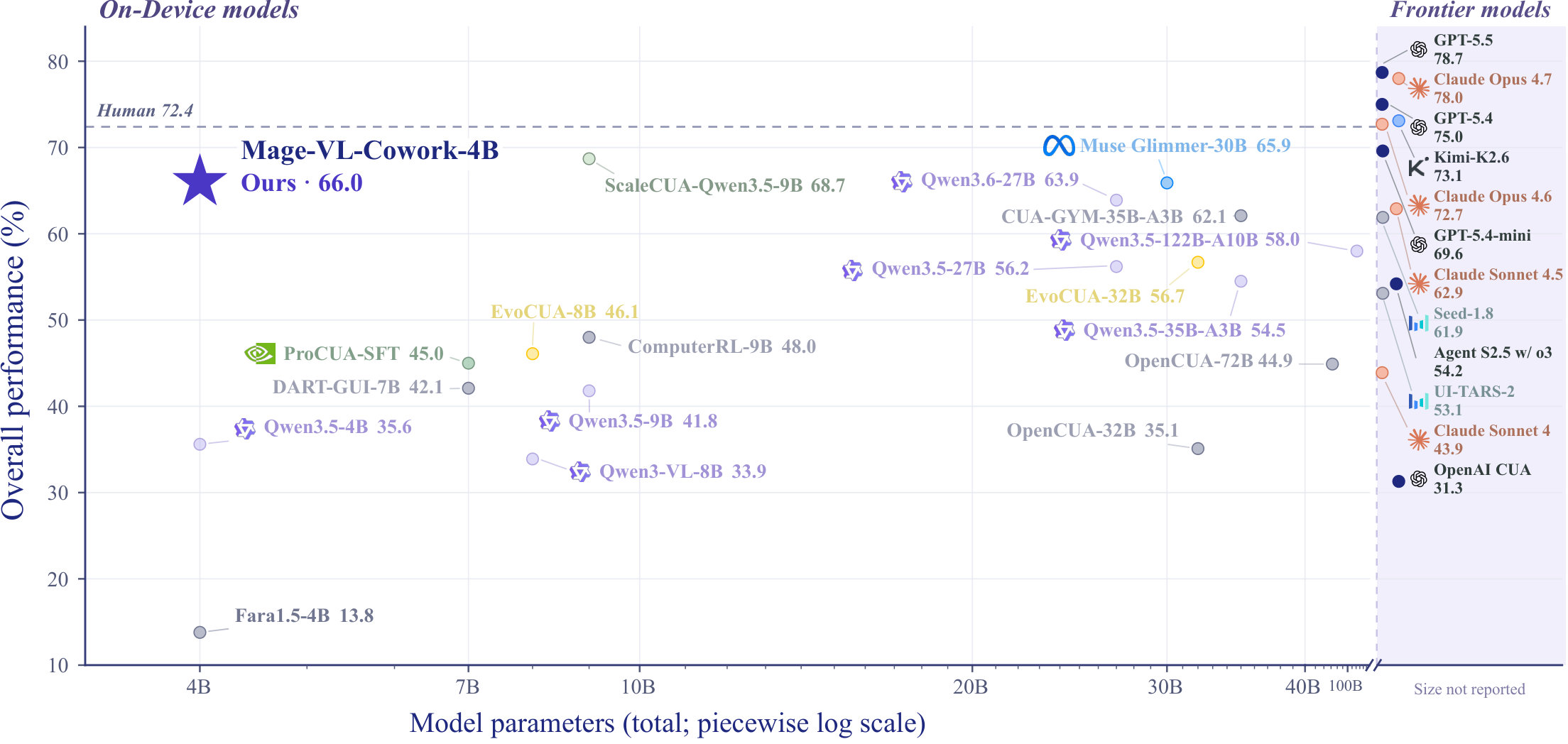
On October 30, Microsoft's Mage team released Mage-VL-Cowork on Hugging Face under Apache-2.0: a 4B multimodal computer-use agent in which a single model decides at every step whether to act through screenshots and GUI clicks (computer_use) or through bash and Python in a terminal, with no external orchestrator. Microsoft reports a two-run average of 66.0% on OSWorld-Verified (361 tasks, 50-step budget), above Qwen3.6-27B at 63.9% but below the 9B SCALECUA-Qwen3.5-9B at 68.7%.
Microsoft Open-Sources Mage-VL-Cowork, a 4B Computer-Use Agent That Chooses Between Clicking the GUI and Running Bash, Scoring 66.0% on OSWorld-Verified

Key Takeaways

  • 4B parameters, built on Mage-VL (Mage-ViT vision encoder plus Qwen3-4B-Instruct-2507); about 9.48 GB of bf16 weights under Apache-2.0.
  • On OSWorld-Verified, two independent runs scored 65.33% and 66.75% for a 66.0% average; 87.5% on operating-system tasks and 62.7% on multi-app workflows.
  • In Microsoft's side-by-side, a LibreOffice Calc chart task took 39 seconds (6 steps) via Python in the terminal, versus 9:56 (39 steps) for GUI-only Qwen3.6-27B.
  • Online RL adds 10.16 points over hybrid SFT while cutting mean model calls by 13.0% and output tokens by 25.4%.
  • Training data came from Mage-CUA-Forge, which synthesized about 294K desktop and web tasks across 6,915 skills and cut per-task generation cost from $0.906 to $0.158.
Read full story
Linked Models & Agents:
⚡ Mage-VL-Cowork⚡ Mage-VL⚡ Qwen3-4B⚡ Qwen3.6-27B🌐 Microsoft

Meituan ships LongCat-2.5, a 1.6T-parameter (about 48B active) native multimodal agentic model, with API pricing of $0.30/$1.20 per 1M tokens

On Nov 2 Meituan's LongCat team listed LongCat-2.5 in its API platform change log as the full release of September 25's LongCat-2.5-Preview. The official technical blog says it has 1.6 trillion total parameters with about 48 billion activated per token, builds on LongCat-2.0 with stronger native visual understanding and agentic coding, and was trained and served with W4A4 inference on domestic AI accelerators. Vendor-reported scores include 88.4 on Terminal Bench v2.1, 38.5 on Terminal Bench v4.0, 91.9 on BrowseComp and 83.1 on MCP Atlas. The API speaks both OpenAI and Anthropic formats with a 1M-token context and up to 128K output tokens, at a limited-time price of $0.30 per 1M uncached input tokens, $0.006 cached input and $1.20 output.

Meituan ships LongCat-2.5, a 1.6T-parameter (about 48B active) native multimodal agentic model, with API pricing of $0.30/$1.20 per 1M tokens

Key Takeaways

  • Scale: a 1.6-trillion-parameter MoE with about 48B active per token, a 1M-token context and up to 128K output tokens (official blog, API docs)
  • Code agents (vendor-reported): Terminal Bench v2.1 88.4 (Claude Opus 5 89.1, GPT-5.6-Sol 88.8), Terminal Bench v4.0 38.5 (GPT-5.6-Sol 37.3, Claude Opus 5 53.9), DeepSWE v1.1 64.6
  • General agents (vendor-reported): BrowseComp 91.9, MCP Atlas 83.1, AutomationBench v1.0.6 51.8, HLE with tools 63.1; AutomationBench jumps from 15.8 on LongCat-2.0
  • Pricing: limited-time $0.30 per 1M uncached input tokens, $0.006 cached input and $1.20 output (pricing page)
  • Engineering: W4A4 inference raises prefill throughput 43.3% and decode throughput 42.77% over a W8A8 baseline; FSDP gives 86% higher per-device throughput than DDP in long-sequence SFT
Read full story

SenseTime open-sources SenseNova-Loop-9B-Preview, a 9B looped Transformer with about 14.6B inference parameters for long-context and agentic work

On Oct 30, SenseTime released SenseNova-Loop-9B-Preview (Apache 2.0) on its official X account and Hugging Face. It runs layers 4 to 27 of a 32-layer decoder twice with the same weights, so each forward pass executes 56 layer computations while storing about 9B parameters, about 14.6B at inference, and it uses two-stream mHC (manifold-constrained hyper-connections) to manage the residual streams. It takes text and images, with training sequences up to 262,144 tokens. SenseTime charts show it beating Qwen3.5 and Qwen3.6 peers on BIRD-Dev, WorkBuddy Bench, and other agent and data tasks, while it still trails on Terminal Bench 2.1; the technical report is not out yet. The official launch post drew about 910 likes.

SenseTime open-sources SenseNova-Loop-9B-Preview, a 9B looped Transformer with about 14.6B inference parameters for long-context and agentic work

Key Takeaways

  • Structure: 32 distinct decoder layers, with layers 4 to 27 looped twice on shared weights for 56 layer computations per forward pass; about 9B stored and about 14.6B inference parameters (model card)
  • Vendor-reported scores: BIRD-Dev 71.38 (Qwen3.5-27B 69.84), WorkBuddy Bench 66.89 (Qwen3.6-35B-A3B 61.98), AutomationBench 13.72 (Qwen3.5-27B 10.17)
  • Weak spots from the same vendor chart: Terminal Bench 2.1 at 40.45, below Qwen3.6-27B at 47.19; tau3-Banking at 18.56, slightly below Qwen3.5-27B at 19.59
  • Training context up to 262,144 tokens; hybrid attention uses three linear-attention layers plus one full-attention layer per four-layer group; MTP speedup is available, DSpark and DFlash2 are still training
  • Apache 2.0, requires trust_remote_code=True; official examples cover Transformers 5.18.0, a 4-GPU LightLLM setup, and an SGLang PR, and the technical report is still to come
Read full story
Linked Models & Agents:
⚡ SenseNova-Loop-9B-Preview⚡ Qwen3.5-27B⚡ Qwen3.6-35B-A3B🌐 SenseTime
T
Tsinghua University & Z.AI (HarnessPro, arXiv 2610.26770)arxiv.org·
👀11
🔥80

Tsinghua and Z.AI open-source HarnessPro: agents rewrite their own harness, reaching 80.8% on Terminal-Bench 2 at 34% lower cost per task

HarnessPro (arXiv 2610.26770, submitted Oct 19 and revised Oct 20), from Tsinghua University, Z.AI (Zhipu) and collaborators, is a label-free way to improve an agent harness: specialized agents diagnose execution traces, rewrite instructions and runtime policies, score candidates with LLM-generated tests, and keep Lite, Medium and Heavy harnesses along the performance-cost frontier. Per the paper, with GPT-5.5 and Codex the Heavy mode reaches 80.8% on Terminal-Bench 2, 4.5 points above the prior RHO method, while cost per task drops from $1.09 to $0.72. The code is MIT-licensed and drew wider media coverage this week, including from Pandaily.

Tsinghua and Z.AI open-source HarnessPro: agents rewrite their own harness, reaching 80.8% on Terminal-Bench 2 at 34% lower cost per task

Key Takeaways

  • Terminal-Bench 2 (GPT-5.5 with Codex, mean of 3 runs): Heavy reaches 80.8% at $0.72 per task, versus RHO at 76.3% and $1.09, a 33.9% cost cut (paper figures, arXiv)
  • Averaged over three benchmarks: +2.0 points pass rate and -26.1% cost per task versus RHO, across Terminal-Bench 2, SWE-Bench Pro and ProgramBench
  • Holds across models: with GLM-5.2 and Claude Code on Terminal-Bench 2, Heavy hits 81.4% at $0.62, versus vanilla at 74.6% and $0.92 and RHO at 78.0% and $1.00
  • Budget modes: Medium matches RHO at 76.3% on Terminal-Bench 2 for only $0.56 per task; Lite gets 72.9% at $0.43
  • Cheap to train: only 10 training tasks per benchmark and 3 to 4 evolution epochs, tested on 59, 100 and 100 held-out tasks; the three harness tiers are MIT-licensed on GitHub
Read full story
ADSponsored

LM Studio Bionic 1.1.10 adds the oMLX engine, bringing RAM-plus-SSD KV caching and MLX speculative decoding to local models on Macs

LM Studio posted on X at 15:32 UTC on Oct 29 that users can now download a new oMLX engine inside LM Studio and run it with MLX models they already have. The official changelog lists it in Bionic 1.1.10, alongside speculative decoding for MLX models and an in-app terminal. oMLX is an open-source Apple Silicon inference server maintained by developer jundot (Apache 2.0, about 23,000 GitHub stars) built around continuous batching and a two-tier RAM and SSD KV cache. LM Studio has not published speed comparisons for the engine.

LM Studio Bionic 1.1.10 adds the oMLX engine, bringing RAM-plus-SSD KV caching and MLX speculative decoding to local models on Macs

Key Takeaways

  • LM Studio says the oMLX engine can now be downloaded inside the app and used with existing MLX models; the post has about 540 likes (post)
  • The Bionic 1.1.10 changelog (Oct 29) also lists speculative decoding for MLX models, a public in-app terminal and llama.cpp 2.66.0 extension packs (changelog)
  • oMLX is Apache 2.0 open source with about 23,000 GitHub stars and needs macOS 15+ on Apple Silicon M1 to M5 (GitHub)
  • Its core is a two-tier KV cache: hot blocks stay in RAM, overflow is written to SSD as safetensors, and matching prefixes are restored from disk even after a restart
  • LM Studio has published no speed comparison with its existing MLX engine; one user reported that restart-to-update failed after launch and LM Studio is investigating
Read full story

Factory launches Droid 1.0: programmatic tool calling by default, hundreds of tool calls per model request, leads native harnesses on its own Terminal-Bench 4 runs

AI coding agent company Factory announced Droid 1.0 on X and its blog at 22:31 UTC on Oct 29, calling it the largest update yet to its agent harness. The key change makes programmatic tool calling (PTC) the default: the model writes a JavaScript program that runs up to hundreds of tool calls in a sandbox in one model request. In Factorys own Terminal-Bench 4 runs, Droid scored 57.6% with GPT-6.1 Sol ($0.79 per passed task) and 65.2% with Claude Opus 5.5 ($4.73), ahead of Codex, Claude Code, Cursor, OpenCode and Devin on the same models.

Factory launches Droid 1.0: programmatic tool calling by default, hundreds of tool calls per model request, leads native harnesses on its own Terminal-Bench 4 runs

Key Takeaways

  • Programmatic tool calling is now the default: the model writes JavaScript that runs in a sandbox with no file, network or system access of its own, making up to hundreds of tool calls per request, with independent calls run concurrently
  • Factory example: moving and verifying 151 Linear issues took 312 tool calls; direct calls needed about 36 requests and 3.1M input tokens, a Script needed 2 requests and 61K tokens
  • Terminal-Bench 4 (Factory runs, Oct 23-28, three trials per task): with GPT-6.1 Sol, Droid 57.6% vs Codex 54.0%, OpenCode 51.0%, Devin 45.0%; with Opus 5.5, Droid 65.2% vs Cursor and OpenCode 62.1%, Devin 59.6%, Claude Code 57.6%
  • The first request shrank from 20,887 to 13,055 tokens (-37%) and up-front tool definitions went from 11 to 2; newly loaded MCP tools are appended to keep the prompt cache intact, and a typical production request reads 98% of input from cache
  • Available now as a macOS and Windows desktop app, a terminal UI and the Droid SDK (@factory/droid-sdk); the benchmarks are vendor-run with no third-party reproduction yet
Read full story

Mistral releases the open weights of Mistral Large 4 "Le Chonk": a 1T-total, ~52B-active multimodal MoE that Mistral says leads open models on FrontierCode 2.0

On Oct 29 Mistral released an improved Mistral Large 4 (Le Chonk) with open weights on Hugging Face (plus an NVFP4 quantized checkpoint), served on its API as mistral-large-4. After about three more weeks of reinforcement learning since the early-October preview, Mistral reports 19.7% on FrontierCode 2.0, Terminal-Bench 4.0 up from 28% to 41%, and new low/medium/high reasoning modes. The license is a modified MIT that allows commercial use, but running a model-as-a-service business needs a separate commercial license.

Mistral releases the open weights of Mistral Large 4 "Le Chonk": a 1T-total, ~52B-active multimodal MoE that Mistral says leads open models on FrontierCode 2.0

Key Takeaways

  • Specs: about 1T total parameters with 49B active per token (about 52B including embeddings and output layers), 128 routed experts with 4 active plus 1 shared expert, 1M context, text and image input
  • Per Mistral: 19.7% on Cognition's FrontierCode 2.0, ahead of DeepSeek V4.1 Flash at 19.3% and GLM-5.3 at 17.8%, first among open models
  • 48% on the Artificial Analysis Coding Agent Index, roughly tied with GLM-5.3 while using 47% fewer tokens per task on average; Terminal-Bench 4.0 rose from 28% in preview to 41%
  • 51% on the Artificial Analysis Cyber Index, and a 96.6% average refusal rate on malicious cyber requests, which Mistral says is the highest among open models
  • Trained from scratch on 3,800 NVIDIA Grace Blackwell GPUs in Mistral's own European datacenters; in Surge Code blind pairwise tests it ranked behind only Claude Opus 5.5
Read full story
Linked Models & Agents:

Artificial Analysis launches Intelligence Index v5: 60% private test sets, Claude Opus 5.5 leads at 58 and the open-weights gap widens to 12 points

On Oct 28 independent evaluator Artificial Analysis released Intelligence Index v5, its biggest revision since v4 in January: it adds Cognition's FrontierCode 2.0 and Terminal-Bench-Science, swaps Humanity's Last Exam for HLE-Diamond, and now draws 60% of its weight from private or held-out test sets. Claude Opus 5.5 (max) leads at 58, ahead of GPT-6 Astra at 57 and GPT-6.1 Sol at 55; the top open-weights model, Kimi K3.1 Pro (weights not yet released), scores 46, widening the gap from 3 points in v4.3 to 12. It also launched Progress Index v1 for comparing models across years.

Artificial Analysis launches Intelligence Index v5: 60% private test sets, Claude Opus 5.5 leads at 58 and the open-weights gap widens to 12 points

Key Takeaways

  • Overall (vendor-reported by Artificial Analysis): Claude Opus 5.5 (max) 58, GPT-6 Astra (max) 57, GPT-6.1 Sol (max) 55; Anthropic and OpenAI hold the top five, with Gemini 4 Argon (high) next at 50
  • The open-weights gap grows from 3 to 12 points: Kimi K3.1 Pro scores 46, while released-weight leaders DeepSeek V4.1 Flash 1017 and GLM-5.3 (max) score 32, below Claude Haiku 5.5 (max) at 36
  • Cost per task varies more than 13x: among the top 10, GPT-6.1 Terra (max) is cheapest at $0.96 and Claude Fable 5.1 (max) priciest at $13.04; GPT-6.1 Sol trails Opus 5.5 by 4 points at about one eighth the cost ($1.27 vs $10.04)
  • Four categories at 25% each: Knowledge Work, Coding (FrontierCode 2.0 15%, Terminal-Bench 4.0 10%), Science and General; GDPval-AA v2.1, SciCode and AA-LCR were removed
  • Tasks are heavier: median output tokens per task rose from 35k to 59k, and effort matters more, with Opus 5.5 scoring 35 at low effort vs 58 at max for 10x the cost
Read full story

DiffuSpace, founded by the HKU Dream team, open-sources Clover-35B-A3B, a diffusion LLM hitting 680 tokens/s on one GPU and 73.6 on SWE-bench Verified

On Oct 28 DiffuSpace, whose members come from the HKU NLP group behind Dream 7B, released its first model, Clover-35B-A3B-Preview: a mixture-of-experts diffusion language model initialized from Qwen3.6-35B-A3B, with 35B total and about 3B active parameters, a 128K context window and block-parallel denoising. Vendor-reported results include 73.6 on SWE-bench Verified, 51.7 on Terminal-Bench 2.1 and 83.8 on GPQA Diamond, with 680 tokens/s on a single GB300 in agent workloads. Weights are Apache 2.0 on Hugging Face, ModelScope and GitHub, with SGLang and llama.cpp support.

DiffuSpace, founded by the HKU Dream team, open-sources Clover-35B-A3B, a diffusion LLM hitting 680 tokens/s on one GPU and 73.6 on SWE-bench Verified

Key Takeaways

  • A 35B-total, roughly 3B-active MoE diffusion model initialized from Qwen3.6-35B-A3B, with 128K context and a thinking mode
  • DiffuSpace says it tops all six agent benchmarks it compared: SWE-bench Verified 73.6, Terminal-Bench 2.1 51.7 and tau3 Overall 65.3, ahead of LLaDA2.2 flash, Mercury 2.5 and Qwen3.6-35B-A3B
  • Speed (vendor-reported): 680 tokens/s on one GB300 at BF16 and batch size 1 in agent workloads, and 515 tokens/s on one H200 versus 365 tokens/s for Qwen with DFlash2
  • An INT4 build runs on a 16GB RTX 5070 Ti at 101.8 tokens/s on MATH-500
  • Weights on Hugging Face are Apache 2.0, about 69GB in BF16, and SGLang is the recommended serving path
Read full story
Linked Models & Agents:
⚡ Clover-35B-A3B-Preview⚡ Qwen3.6-35B-A3B⚡ Dream 7B⚡ LLaDA2.2 flash⚡ Mercury 2.5🌐 DiffuSpace🌐 HKU NLP🌐 Alibaba Qwen🌐 NVIDIA

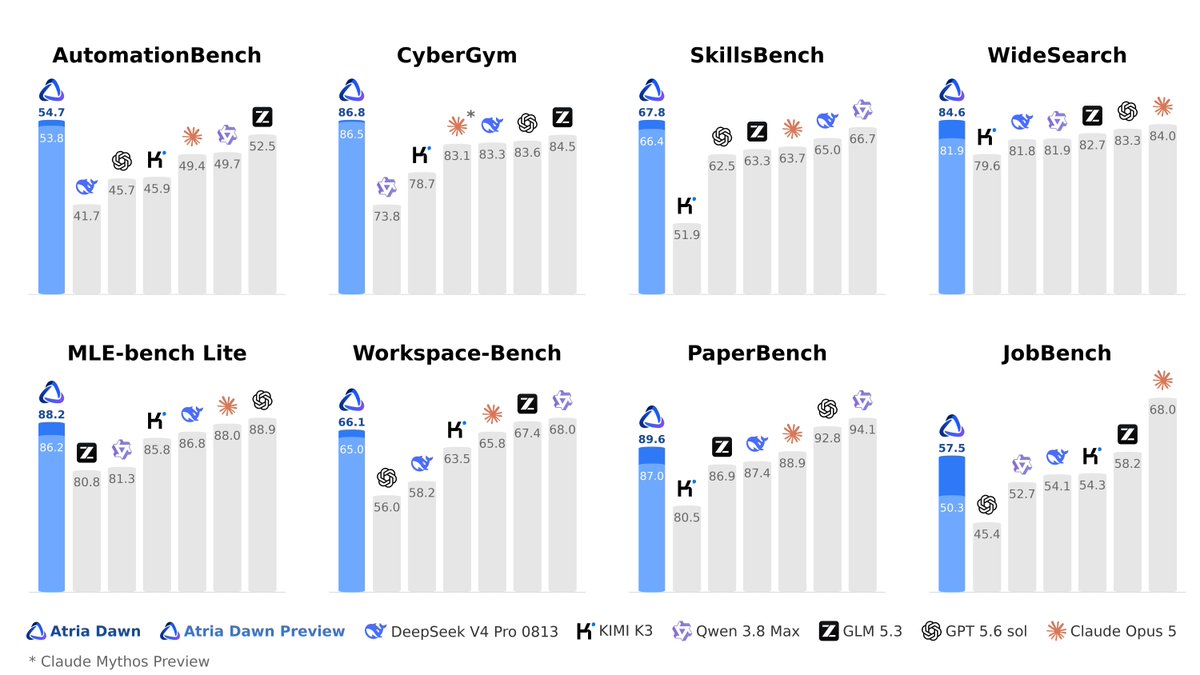
Shanghai AI Lab ships Atria Dawn full release: 744B MoE GLM-5.2 agentic model, context doubled to 512K, MIT weights

Shanghai AI Laboratory has moved Atria Dawn from Preview to a full release, with open weights (plus an FP8 build) on Hugging Face under internlm/Atria-Dawn and on ModelScope, MIT licensed. Built on the 744B-parameter MoE GLM-5.2, it targets long-horizon research and engineering agent work; context doubles from the Preview's 256K to 512K and input is text only. The vendor table shows it leading the listed models on AutomationBench, CyberGym and SkillsBench, while still trailing Claude Opus 5 on coding tests such as SWE-bench Pro and Terminal-Bench 2.1 (all vendor-reported).

Shanghai AI Lab ships Atria Dawn full release: 744B MoE GLM-5.2 agentic model, context doubled to 512K, MIT weights

Key Takeaways

  • 512K context, double the Preview's 256K; built on the 744B-parameter MoE GLM-5.2, text input only
  • BF16 and FP8 weights on Hugging Face and ModelScope, MIT license
  • Vendor-reported: AutomationBench 54.7, CyberGym 86.8, SkillsBench 67.8, BFCL V4 78.4, each the top score in its table
  • Weak spots from the same table: SWE-bench Pro 61.7 vs 76.5 for Claude Opus 5, Terminal-Bench 2.1 81.0 vs 90.2
  • Local serving needs SGLang v0.5.13.post1+ or vLLM v0.23.0+; an OpenAI-compatible API also plugs into Codex
Read full story
Linked Models & Agents:
ADSponsored

OpenAI launches GPT-6.1 Terra: fast, low-cost computer use at $1/$5 per million tokens, half the price of GPT-5.6 Terra and GPT-6.1 Sol

On Oct 26 OpenAI released GPT-6.1 Terra, an efficient model for visual reasoning, precise computer use and natural writing. It is rolling out today to Plus, Pro, Enterprise and Edu users in ChatGPT Work and Codex, and in the API as gpt-6.1-terra. Standard API pricing is $1 input, $0.05 cached input and $5 output per million tokens, which OpenAI says is 50% lower than GPT-5.6 Terra and GPT-6.1 Sol, with a 1,050,000-token context window. By OpenAI's figures it scores 15 points higher than GPT-5.6 Terra on Agents' Last Exam at medium effort for about a third of the cost, and solves 50.3% of Terminal-Bench 4.0 at max effort.

OpenAI launches GPT-6.1 Terra: fast, low-cost computer use at $1/$5 per million tokens, half the price of GPT-5.6 Terra and GPT-6.1 Sol

Key Takeaways

  • Pricing (official docs): $1 input, $0.05 cached input, $1.25 for 30-minute cache writes and $5 output per million tokens; requests over 272K input tokens are billed at 2x input and 1.5x output; Batch/Flex are half price and Fast mode is 2x
  • Specs: 1,050,000-token context, 922,000 max input and 128,000 max output tokens, Jun 1 2026 knowledge cutoff; reasoning.effort from none to max, and tool calling requires the Responses API
  • Computer use (OpenAI figures): on Agents' Last Exam at medium effort it beats GPT-5.6 Terra by 15 points at about one-third the cost, and matches GPT-6 Astra at one-tenth the price per token; it finishes tasks over 3x faster than GPT-6 Astra and GPT-6.1 Sol
  • Coding and factuality (OpenAI figures): 50.3% on Terminal-Bench 4.0 at max effort, more than double GPT-5.6 Terra's published 21.5%; error rate on an internal error-inducing prompt set fell from 53.6% to 16.7% at low effort
  • Safety: OpenAI says it meets the Critical cybersecurity threshold under its Preparedness Framework and keeps the safeguards built for GPT-6 Astra
Read full story

BOSS Zhipin's Nanbeige lab open-sources Nanbeige4.3-33B, a 33B dense agent model with 512K context under Apache 2.0, reporting 80.9 on Terminal-Bench 2.1 vs 73.0 for Qwen3.8-27B

At 12:11 UTC on 2026-10-25, the Nanbeige LLM Lab of BOSS Zhipin (Kanzhun Limited) announced Nanbeige4.3-33B from its account @nanbeige (post), with the model and its Base version released as open weights on Hugging Face under Apache 2.0 (model card). It is a 33B dense model on a Llama-style architecture with a 512K context window, positioned as the teacher model of the Nanbeige4.3 series that will be distilled into smaller models such as Nanbeige4.3-3B. The official model card compares it with Qwen3.8-27B, Muse-Glimmer-30B and Gemma4-31B using the same harness at highest thinking effort: 80.9 on Terminal-Bench 2.1 (Qwen3.8-27B 73.0) and 65.5 on DeepSWE (42.5), but 60.3 on SWE-Bench Pro, slightly below Qwen's 61.7, and 84.8 on GDPval vs 86.4. All figures are self-reported and not yet independently reproduced.

Key Takeaways

  • Official sources: @nanbeige post on X and the Hugging Face model card; the post had about 616 likes, 79 reposts and 38K views when we pulled it
  • Specs: 33B dense, Llama-style architecture, 512K context, Apache 2.0, with a Base checkpoint released too
  • Self-reported coding scores: Terminal-Bench 2.1 80.9, Terminal-Bench 4.0 23.8, DeepSWE 65.5, SWE-Bench Pro 60.3 (Qwen3.8-27B: 73.0, 6.3, 42.5, 61.7)
  • Self-reported cowork scores: Automation Bench 54.2, JobBench 44.8, GDPval 84.8 (Qwen3.8-27B: 38.3, 34.5, 86.4)
  • Deployment: Transformers, SGLang and vLLM, with official examples using 4-way tensor parallelism; Nanbeige4.3-3B distillation is next
Read full story
Linked Models & Agents:
⚡ Nanbeige4.3-33B⚡ Qwen3.8-27B⚡ Gemma4-31B⚡ Muse-Glimmer-30B🌐 Nanbeige🌐 BOSS Zhipin🌐 Kanzhun

Moonshot launches Kimi K3.1 Pro: 2.8T-total / 104B-active open-weight MoE with 1M context, 65.7% on Terminal-Bench 4.0, API at $2/$10, weights by Nov 4

On 2026-10-23 (17:15 UTC) the official @Kimi_Moonshot account launched Kimi K3.1 Pro, alongside K3.1 Pro Highspeed (2-3x faster). Both are live on Kimi.ai, Kimi Work, Kimi Code and the Kimi API, and full weights are promised by 2026-11-04. The official tech blog describes it as a post-trained version of K3 with much larger multi-domain joint RL: a 2.8T-total / 104B-active MoE, 1M-token context, multimodal. Vendor-reported scores: 65.7% on Terminal-Bench 4.0 (GPT-6 Astra 58.2%, Claude Opus 5.5 66.4%) and 92.7% on BenchCAD with tools. The Kimi API pricing page lists kimi-k3.1-pro at $2 input, $10 output and $0.20 cached input per million tokens, down from K3 at $3/$15.

Moonshot launches Kimi K3.1 Pro: 2.8T-total / 104B-active open-weight MoE with 1M context, 65.7% on Terminal-Bench 4.0, API at $2/$10, weights by Nov 4

Key Takeaways

  • 2.8T-total / 104B-active MoE, 1M-token context, multimodal; full weights promised by 2026-11-04 (official blog)
  • Vendor-reported: 65.7% on Terminal-Bench 4.0, ahead of GPT-6 Astra (58.2%) and just behind Claude Opus 5.5 (66.4%); 61.2% on the internal Kimi Code Bench 3.0 Long-horizon (K3: 55.95%)
  • API pricing: kimi-k3.1-pro at $2 input / $10 output / $0.20 cached input per million tokens; Highspeed at $4 / $20 (pricing page)
  • On the internal Kimi Hallu Bench Hard stress test, claim-level hallucination fell from 23.4% (K3) to 8.3%; Moonshot notes this is not a daily-use error rate
  • Cyber-related data was removed from mid-training and RL for the open-weight release: xdev-bench-hard pass@3 drops from 90.5% (unmitigated checkpoint) to 81.0%
Read full story
Linked Models & Agents:

Kimi teaser video shows the model name Kimi K3.1: Kimi Code terminal reads "K3.1 thinking: high" while generating a Three.js 3D scene

On 2026-10-23 (01:41 UTC) the official Kimi account @Kimi_Moonshot posted a 24-second, retro-CRT-style video with no caption text. The Kimi Code terminal at the start of the clip reads "Model: Kimi K3.1" and "Version: 2.2.0", the status bar shows "Kimi K3.1 thinking: high", and a notice says "Kimi Code Desktop is here". The user then types "Build a complex procedural 3D scene in Three.js." and the model calls the Write tool to create ./scene.js. This is the first time the Kimi K3.1 name has appeared in official material. The post has no caption and no release date, benchmark, price or parameter details, so this is a teaser and not a confirmed release.

Kimi teaser video shows the model name Kimi K3.1: Kimi Code terminal reads "K3.1 thinking: high" while generating a Three.js 3D scene

Key Takeaways

  • In the official teaser the Kimi Code terminal shows "Model: Kimi K3.1" and the status bar reads "Kimi K3.1 thinking: high", the first official appearance of the K3.1 name
  • The clip also shows Kimi Code version 2.2.0 and the notice "Kimi Code Desktop is here", with install via the /desktop command or kimi.com/code
  • The demo task is "Build a complex procedural 3D scene in Three.js." and the model uses the Write tool to create ./scene.js, in a clip of about 24 seconds
  • The post has no caption; release date, benchmarks, price and parameters are not officially announced, so treat this as a teaser and not a release. As of the evening of 10-23 SGT the post had about 1.63M views and 17.6K likes (public X counts)
Read full story

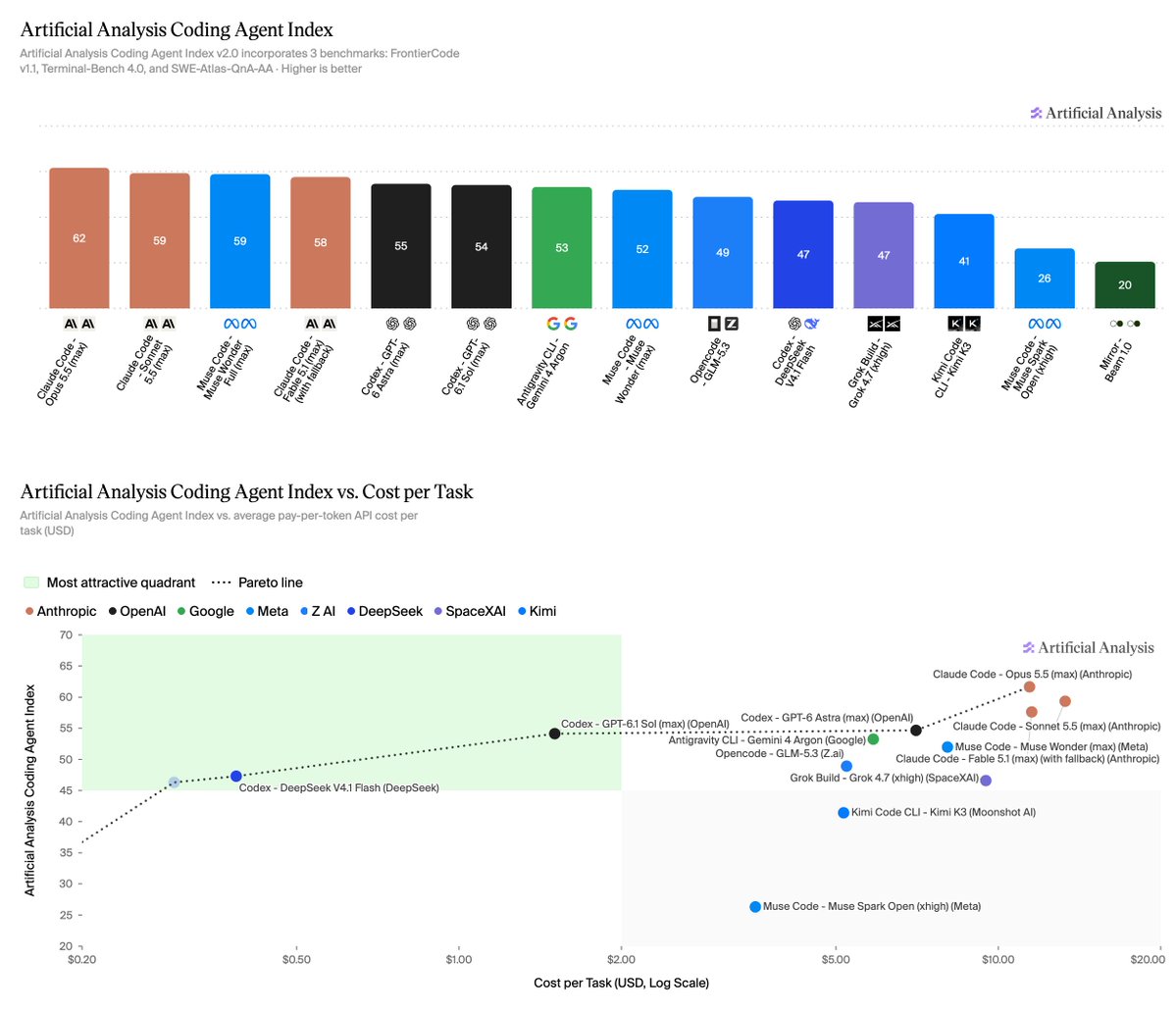
Artificial Analysis launches Coding Agent Index v2.0: FrontierCode from Cognition replaces DeepSWE, and Claude Code with Opus 5.5 leads at 61.7

On 2026-10-23 Artificial Analysis launched Coding Agent Index v2.0, which scores model-plus-harness combinations across 290 tasks with three equally weighted benchmarks: FrontierCode v1.1 from Cognition (100 tasks on real open-source repos, graded on whether a maintainer would merge the change) replaces DeepSWE v1.1, SWE-Atlas-QnA becomes the stricter SWE-Atlas-QnA-AA, and Terminal-Bench 4.0 is unchanged. Claude Code with Claude Opus 5.5 (max) leads at 61.7, ahead of Sonnet 5.5 at 59.3 and Muse Wonder Full at 58.9. Scores fall across the board: the 21 configurations measured on both versions drop from a mean of 54.8 to 47.4.

Artificial Analysis launches Coding Agent Index v2.0: FrontierCode from Cognition replaces DeepSWE, and Claude Code with Opus 5.5 leads at 61.7

Key Takeaways

  • Top of the index: Claude Code with Claude Opus 5.5 (max) 61.7, Claude Sonnet 5.5 (max) 59.3, Muse Code with Muse Wonder Full (max) 58.9, Claude Fable 5.1 (max with fallback) 57.6 (Artificial Analysis figures)
  • On FrontierCode v1.1, Opus 5.5 scores 56.0%, ahead of Codex with DeepSeek V4.1 Flash at 52.6%; 15 of 24 configurations sit between 43% and 49%
  • Version shift: 21 configurations average 54.8 on v1.5 and 47.4 on v2.0, with 20 of 21 moving down; the same set averages 45.1% on FrontierCode versus 65.6% on DeepSWE
  • Four points on the cost frontier: DeepSeek V4.1 Flash 47.3 at $0.39 per task, GPT-6.1 Sol 54.1 at $1.50, GPT-6 Astra 54.7 at $7.04, Opus 5.5 61.7 at $11.42 (pay-per-token API costs, not subscriptions)
  • SWE-Atlas-QnA-AA rewords 127 of 1,306 rubric criteria and uses GPT-6 Luna (xhigh) as judge with five votes per criterion; dataset and judge config are on Hugging Face
Read full story