At 02:02 Singapore time on November 13, the official Google DeepMind, Google AI and Gemini accounts announced Gemini 4 Hydrogen, and the Gemini API changelog lists it as generally available under the model ID gemini-4-hydrogen. By Google's own numbers it scores 51 on the Artificial Analysis Intelligence Index at its default high thinking level, above Gemini 4 Argon at 50, and reaches 54 at a new xhigh level. It finishes tasks 2.5x faster than Gemini 3.8 Flash and lifts Terminal-Bench 4.1 from 18.2% to 57%. Pricing is flat across the 1M-token context at $1.50 input and $7.50 output per million tokens, and the model is also on the free tier. It becomes the default model in the Gemini app, Google Search and the Antigravity managed agent. The SKU price-list leak we covered yesterday is now officially confirmed. Cursor then officially said Hydrogen is in the editor, scoring 54.3% on CursorBench 4.0 at default high effort, up from 39.6% for Gemini 3.8 Flash.
Zoom
Key Takeaways
Official figures: 51 on the Artificial Analysis Intelligence Index at default high thinking, above Gemini 4 Argon at 50; the new xhigh level reaches 54
2.5x faster than Gemini 3.8 Flash, Terminal-Bench 4.1 up from 18.2% to 57%, fabricated claims cut by more than 5x
Pricing: $1.50 input and $7.50 output per million tokens, flat across the 1M-token context, and available on the free tier
New Orchestrator in Antigravity switches between Carbon and Hydrogen: near-Carbon success on Terminal-Bench 4.0 with 24% less quota and 19% faster
Partner tests on graph, SQL and data-heavy enterprise work: 2x to 2.8x faster than 3.8 Flash with 12% to 23% fewer tokens
Cursor: official announcement that Hydrogen is in the editor; on CursorBench 4.0 it scores 54.3% at default High (about $5.59 per task), up from 39.6% for Gemini 3.8 Flash; Medium is 46.7% (about $1.76) and Low 27.9% (about $0.28); it is a third-party model and is not included in Cursor plan usage (Cursor docs, CursorBench)
Independent evaluator Artificial Analysis published Tencent Hunyuan Hy4 results on its Cyber Index on November 13. Hy4 scores 58 and ranks third, 1 point ahead of DeepSeek V4.1 Flash 1017 (max) and behind Kimi K3.1 Pro (64) and the trusted-access-only GPT-6 Sol (Daybreak Blue, max) at 69. On CWE-Bench-AA, one of the three component evaluations, Hy4 ranks first with a 76% pass@1, 6 to 7 points ahead of DeepSeek in second. It averages $0.92 and 64k output tokens per task, which puts it on the capability vs. cost Pareto frontier.
Zoom
Key Takeaways
Overall rank: 58 on the Cyber Index, third behind GPT-6 Sol (Daybreak Blue, max, trusted access only) at 69 and Kimi K3.1 Pro at 64; DeepSeek V4.1 Flash 1017 (max) follows at 57
Top single score: 76% pass@1 on CWE-Bench-AA, versus 69% for DeepSeek V4.1 Flash 1017 (max) and 68% for Grok 4.7 (xhigh)
Cost efficiency: $0.92 per task, 2 points above Grok 4.7 (xhigh) at about 1/11 of its cost and 1 point above DeepSeek at about 2x its cost
Leaner output: about 64k output tokens per task, 43% fewer than DeepSeek and 37% fewer than Grok 4.7, but 49% more than Kimi K3.1 Pro
Pricing basis: AA priced Hy4 at $0.834/$2.501 per 1M input/output tokens; OpenRouter currently lists tencent/hy4 at $0.417/$1.25, so real costs may be lower
On November 12 Lightning Labs released pi402, an extension for the Pi coding agent with an embedded Wavelength Lightning wallet. When the agent calls a paid inference API, it pays automatically over L402 or MPP, and the proof of payment doubles as the API key, so there is no sign-up and no credit card. Sellers put Aperture v0.6.0 in front of an existing inference API and price per token with meterd or lightmeter. The whole stack is open source (MIT). Lightning Labs' example rate of 1 msat per input token and 2 msat per output token works out to about $0.80/$1.61 per million tokens at a bitcoin price of about $80,500.
Zoom
Key Takeaways
Quick start: buyers run pi install npm:@lightninglabs/pi-402, then top up with a Lightning invoice via /fund or on-chain via /deposit
Two protocols: Aperture v0.6.0 (released November 5) supports both L402 and MPP, the Machine Payments Protocol from Stripe and Tempo (IETF draft-httpauth-payment-00)
Per-token billing: the example rate of 1 msat per input token and 2 msat per output token is about $0.80/$1.61 per million tokens at a bitcoin price of about $80,500
Budget controls: the extension enforces a per-request ceiling and a daily budget, and a footer shows the wallet balance and each payment live
Fully open source: the pi-402 extension, Aperture and the lightmeter reference server are open source, with pi-402 under MIT; the demo pays for Kimi K3.1 Pro inference
On November 13, DeepSeek said the capabilities behind the DeepSeek App are now available through its API. V4.1-Flash (model name deepseek-flash) supports server-side web search (including image search with citations), deep thinking search, file input for PDF, Office and image files, automatic reading of links in user messages, and input/output safety checks across the Messages, Responses and Chat Completions protocols. OCR, speech-to-text (ASR) and text-to-speech (TTS) also launch as standalone APIs. Tool calls are billed on top of token charges: Search and Fetch cost $0.75 per 1K requests, OCR $0.225 per 1K pages, ASR $0.058 per hour and TTS $0.225 per 10K characters (both at a limited-time 50% discount). DeepSeek also open-sourced an MIT-licensed chat front end that can import DeepSeek chat history. Public-facing apps must enable safety checks.
Zoom
Key Takeaways
All three protocols are supported: Messages (/anthropic/v1/messages), Responses (/responses) and Chat Completions (/chat/completions), all with the deepseek-flash model
Turn features on with the deepseek_web_search and deepseek_read_url tools and the safety_check and title parameters; tool calls and context assembly run server-side
Tool prices (vendor figures, on top of tokens): Search and Fetch $0.75 per 1K requests, OCR $0.225 per 1K pages, ASR $0.058 per hour, TTS $0.225 per 10K characters (ASR and TTS at a limited-time 50% off)
The open-source demo deepseek-ai/chat-demo is TypeScript under MIT, imports DeepSeek chat history and keeps your API key only in the browser
The launch post drew about 117K views and 2,100+ likes in two hours; DeepSeek has published no search-quality or OCR/ASR accuracy benchmarks
On November 12 Replit gave Replit Agent two new abilities. The first is agentic commerce: using what it knows about your business, Agent compares products on merchant sites, fills the cart and prepares checkout, and nothing is charged until you approve the final total in your Link wallet. It is limited to Core and Pro users in the US and to one-time purchases. The second is agentic ads: Agent reads your site or app, drafts ad copy, generates images and recommends a daily budget, then launches a Google Performance Max campaign after your review. It is available to Pro users worldwide. Replit docs say a new Replit-managed ads account needs an average daily budget of at least $15, with ad spend deducted from Replit credits.
Zoom
Key Takeaways
Two new abilities: purchasing paid through Link (from Stripe) and Visa, and Google Ads campaigns, both run from the Replit chat
Purchasing limits: Core and Pro users only, starting in the US, one-time purchases only; the docs also allow fixed-price subscriptions whose initial and renewal totals are identical
Safety design: merchant sites are driven in an isolated Browserbase browser and Agent stops at checkout for approval; shell access and general browsing are disabled during payment, and approval checks are enforced in code, not left to the model
Ads requirements: Pro plan, personal Workspace and auto-reload enabled; only Performance Max is supported, a new account runs 1 campaign at a time, and the average daily budget is at least $15 and is not a hard cap
Replit-reported figures: entrepreneurs connecting Replit-built businesses to Stripe are up 9x since May; one featured user made $170,000 in 30 days at roughly 4x return on ad spend (company case study, not independently verified)
On November 12 (04:04 SGT on November 13) the official ChatGPT account announced an update to dots, its always-on agent: faster replies, less jargon, better follow-through, and support for custom instructions. Users can tell a dot in the thread how to talk and which actions need their go-ahead, such as "Show me a draft before sending any emails", or set this in Customize > Behavior on mobile or the dot menu on web and desktop. OpenAI docs say a dot's instructions are stored separately from ChatGPT's own custom instructions, and four levels of custom rules decide whether specific actions may proceed. OpenAI gave no figures for the speed-up.
Zoom
Key Takeaways
Three experience upgrades: OpenAI says replies are faster, use less jargon and follow through better, but published no speed or success-rate numbers
Custom instructions: set them in the thread or edit them in Customize > Behavior on mobile or the dot menu on web and desktop; they are kept separate from ChatGPT's own custom instructions
4 custom-rule levels: take action without asking, take action when you say so, ask before taking action, or hand off to you, set per action
Official examples: "always talk in lowercase" and "Show me a draft before sending any emails"; the docs note that asking for drafted replies does not grant permission to send them
Availability: OpenAI help docs list Pro users aged 18+ outside the EEA, Switzerland and the UK, plus Business Premium; enterprise workspaces get dots on by default from November 18
On November 12 (01:00 SGT on November 13) Fish Audio launched Fish Agent, a no-code platform for voice agents: describe the assistant you want in text and it is generated, with a company-reported median deploy time of 32 seconds. Agents can rent a phone number or bring their own to make and take calls, use a platform model or your own OpenAI-compatible endpoint, and extend through webhooks, knowledge bases and a REST API. Conversations run on Live 3, the full-duplex model Fish Audio released earlier. The docs label the platform a public beta. Pricing is $0.035 per minute (normally $0.07, discounted until December 31), plus $0.01 per minute for phone calls and $1.20 per month per number, with $5 of free credit for new users.
Zoom
Key Takeaways
No-code generation: describe a voice agent in text to create it, with a company-reported median deploy time of 32 seconds
Phone calls: rent a number or bring your own carrier via BYO SIP to make and take calls; managed numbers are US and Canada local only, with warm and cold transfers to humans
Swappable brain: a platform model by default, or your own OpenAI-compatible chat completions endpoint, while Fish Audio still handles speech recognition, synthesis and interruptions
Pricing: $0.035 per minute (normally $0.07, discounted until December 31, 2026), plus $0.01 per minute for phone calls and $1.20 per month per number; new users get $5 of credit with no card required
Testing and monitoring: single-turn, multi-turn and tool-call tests, versioned publishing and rollback, call recordings, transcripts and automatic post-call analysis; the platform is still in public beta
On November 12, World Labs, the company founded by Fei-Fei Li, opened its Atlas world model to every registered user. When Atlas was announced in September only a few partners could try it, and the Frameboy demo released on November 5 only offered preset scenes. This launch adds four tools: Viewfinder rebuilds scenes from photos or generated images, Chisel generates from a graybox layout, Splats to Mesh converts Gaussian splats into meshes, and Relight changes lighting. World Labs also opened all the API endpoints behind these apps, with Blender integration. The model is closed and hosted only, and no price has been published.
Zoom
Key Takeaways
Who can use it: from November 12 anyone can sign up at atlas.worldlabs.ai; Viewfinder had been a closed beta with a waitlist
Four tools: Viewfinder rebuilds scenes from photos and renders camera paths; Chisel controls scene structure with a graybox; Splats to Mesh turns Gaussian splats into meshes with real geometry; Relight changes lighting on splat scenes
Developer API: all API endpoints behind the apps are open, returning keyframes, video clips and 3D Gaussian splats, with Blender listed as an integration
Target uses: World Labs highlights film and VFX, architecture and design, and robotics simulation
Limits: the model is closed and hosted only, with no open weights; World Labs has not published Atlas pricing, quotas or rate limits
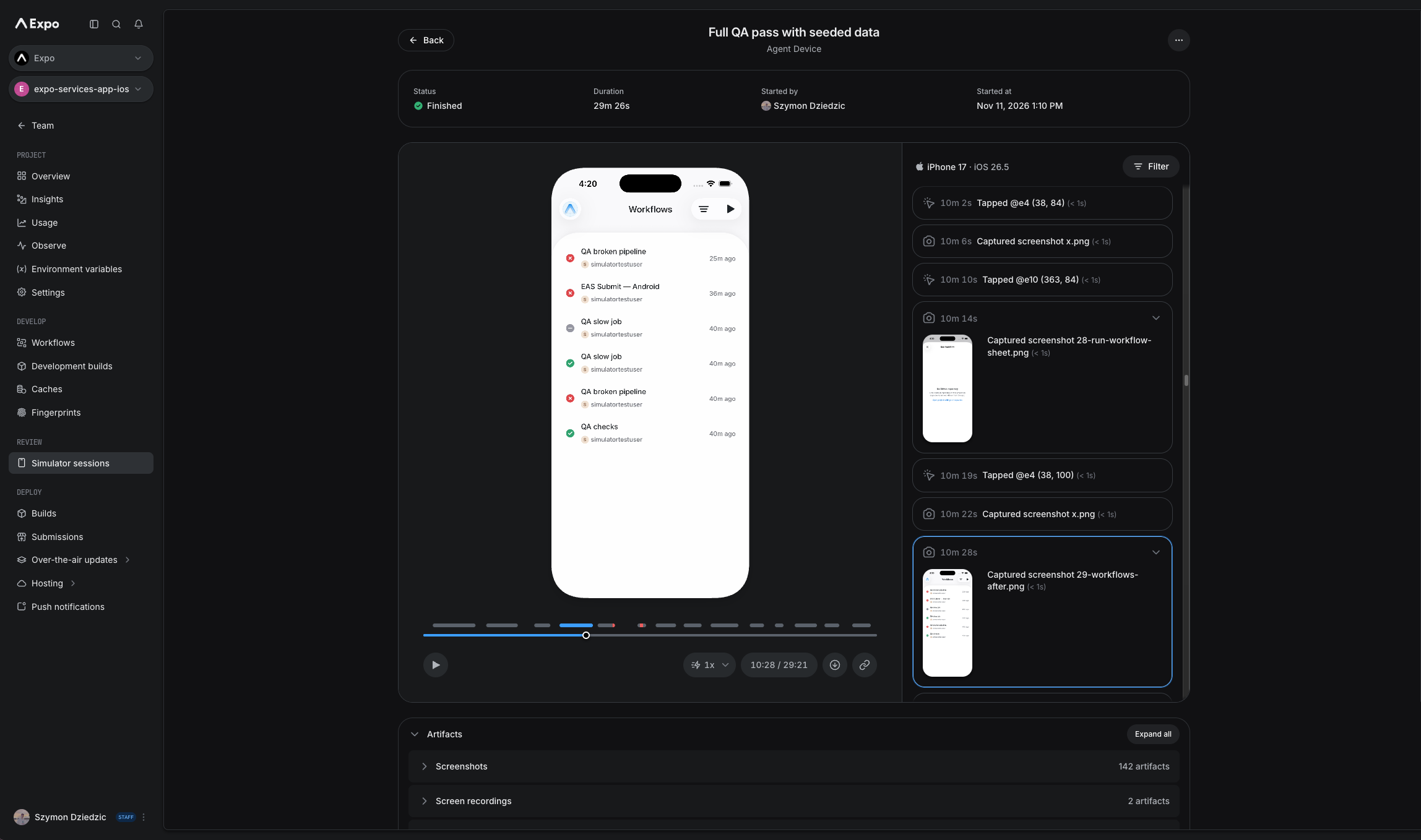
On November 12, mobile framework Expo launched Expo Simulators, available on all paid plans. A coding agent can start a cloud iOS Simulator or Android Emulator with one command, install a build and test it itself; afterward it keeps a full screen recording, screenshots, logs and network traffic that can be attached to a PR for human review. Each session runs on its own VM, no Mac is needed, and the iOS Simulator can be used from Linux or Windows via WSL. Billing is per minute: $0.10 per minute for both iOS and Android, with 60 minutes a month included on Starter and higher plans.
Zoom
Key Takeaways
One command to start: npx eas-cli@latest simulator --platform ios starts a cloud session; sessions can also start from CI, the REST API, Expo Workflows or GitHub Actions
Works with existing agents: any agent that runs CLI commands, such as Claude Code, Codex or Cursor, can use it with the same agent-device, Argent or Appium commands; Expo ships an eas-simulator skill
Proof of work: each session keeps a full screen recording, screenshots, logs, network traffic and CPU and memory data that can be attached to a PR, so reviewers need not pull and build the branch
Isolation and auto-stop: every session gets its own VM and runs at most 2 hours, with optional shorter limits and idle timeouts so forgotten sessions stop billing
Pricing: $0.10 per minute for both iOS and Android; Starter, Production and Enterprise plans include 60 minutes a month until 2027; Expo adds no AI model of its own
On November 12, LMSYS Org, the nonprofit behind the open-source inference engine SGLang, announced the SGLang Consortium in the opening keynote of the first SGLang Summit in San Francisco. Founding members NVIDIA, AMD, Intel, Google, Meta, Cloudflare, Modal and RadixArk will work with the SGLang maintainers on the roadmap, focusing on frontier model support, reasoning and multimodal workloads, distributed inference and hardware optimization. Each member names one technical representative and joins two roadmap meetings a year; SGLang maintainers keep authority over technical decisions and code acceptance, and the project stays open to the whole community.
Zoom
Key Takeaways
Eight founding members: NVIDIA, AMD, Intel, Google, Meta, Cloudflare, Modal and RadixArk (the company founded by SGLang core authors), spanning GPU/CPU vendors, clouds and inference providers
Governance: each member names one technical representative and joins two roadmap meetings a year, with working groups and public progress updates in between; SGLang maintainers keep technical decisions and code acceptance
Four focus areas: frontier model support, reasoning and multimodal workloads, distributed inference, and optimization across hardware platforms
Scale (official figures): SGLang runs on hundreds of thousands of GPUs for users including Meta, Microsoft, Google, Amazon, Thinking Machines Lab, Cloudflare, Reflection and Modal
Context: citing Deloitte, LMSYS says inference will be about two-thirds of all AI compute in 2026, up from about half in 2025; the first summit runs November 12-13 at Fort Mason in San Francisco with 100+ speakers
On November 13, Cognition launched Devin Apps. You describe the tool you need, Devin builds it as a web app in a session and serves it from its own cloud machine, with nothing deployed to a third-party host. Each App has a stable URL (name--id.preview.devinapps.com); everyone who opens it must sign in to Devin, Apps are never public, and they can be shared with people, an organization or a whole enterprise. Apps can use any stack, reuse connected MCPs, integrations and code, and keep data such as SQLite or Postgres on the same machine. The machine sleeps 5 minutes after the last request and wakes when someone opens the App; billing is by awake time, while building and changes bill as normal session work. Every update is a new version tied to a commit, and if a new version fails to start the previous one keeps serving. Apps are rolling out gradually.
Zoom
Key Takeaways
Hosting: Apps run on Devin's own cloud machine with nothing sent to a third-party host, and data and uploads stay on that machine
Stable URL: shaped like name--id.preview.devinapps.com and unchanged by renames or updates; viewers must sign in to Devin and Apps are never public
Billing: the machine sleeps 5 minutes after the last request and bills by awake time, the first load after sleep takes a few seconds, and building and edits bill as normal sessions
Versions: Devin commits before every deploy, the previous version keeps serving if a new one fails to start, and the session can redeploy any older version
Use cases: internal tools, dashboards, staging copies and demos; rollout is gradual and Cognition lists no unit price
On November 12, Cognition upgraded the Devin Teams plan. Everyone on a team can now use the new Devin Desktop without paying for extra seats, and a new Free mode gives every user two concurrent free sessions powered by Cognition's own SWE-2 model; free SWE-2 in Devin Desktop and the CLI becomes a permanent part of the Teams, Pro and Max plans. Admins can connect Okta, Entra ID or any SAML/OIDC provider for SSO, set usage limits per user or group with up to three tiers, and request a standard BAA from settings. Quota seats on Teams are being retired in 30 days, and the seat cap drops from 200 to 100.
Zoom
Key Takeaways
No Desktop seat fees: everyone on the team can use the new Devin Desktop without buying separate Desktop seats
Free SWE-2: Free mode gives each user 2 concurrent free sessions, with more available to buy; free SWE-2 in Desktop and the CLI becomes a permanent part of Teams, Pro and Max. Cognition says SWE-2 performs close to frontier models at a fraction of the cost (no benchmark numbers given)
Admin controls: SSO with Okta, Microsoft Entra ID or any SAML/OIDC provider, with email login optionally disabled; usage limits per user or group with up to 3 tiers, and overage requests either admin-approved or auto-approved up to a cap
Compliance: Teams customers can request a standard BAA (needed for health data) from settings without an enterprise contract
Changes: quota seats are retired in 30 days and the Teams seat cap drops from 200 to 100; the startup program offers up to $65k in credits
On November 12 Perplexity released pplx-decider-v1.3 (built on Qwen3.8-27B, about 26.1B parameters) and the distilled pplx-decider-flash-v1.3 (built on Qwen3.5-4B, about 4.5B). The weights are on Hugging Face under Apache 2.0, and both models are served through the Decisions API and OpenRouter. The new Locate feature extracts verbatim spans by label or instruction and returns character offsets. Perplexity says v1.3 averages 91.6% accuracy across 63 classification tasks, 6.54 points above its production classifiers.
Zoom
Key Takeaways
Two open-weight sizes: v1.3 has about 26.1B parameters (fine-tuned from Qwen3.8-27B) and Flash v1.3 about 4.5B (distilled onto Qwen3.5-4B), both Apache 2.0; running v1.3 locally in BF16 needs about 49 GiB of GPU memory
New Locate feature: extracts verbatim spans by label or instruction with start and end character offsets and a score, covering NER, PII detection and extractive QA, and can share a request with classification and scoring questions
Classification (vendor-reported): 91.6% mean accuracy across 63 classification tasks, 6.54 points above Perplexity's production classifiers; ahead of Jev 1.14 in all 7 domains, by up to 12.9 points in finance
Retrieval and stability: nDCG@10 of 83.99 across 72 retrieval tasks, 1.81 above Qwen3-Reranker-8B; answers changed on only 0.27% of questions under input rewrites, versus 2.69% to 4.84% for Jev 1.14
Where to get it: Hugging Face downloads, the Perplexity Decisions API, and OpenRouter, where both v1.3 models are free until November 19
On November 12, Thinking Machines Lab made the Inkling 2 Small weights downloadable on Hugging Face under the Apache 2.0 license, keeping the promise it made at the November 5 closed launch to open the weights after safety testing. The model is a 594B-total, 17B-active multimodal MoE that takes text and image input with a 1M-token context. The main checkpoint is native NVFP4, the precision it was trained in, and needs at least 500GB of aggregated VRAM (two B300s or four H200s); an MXFP8 checkpoint is also published. SGLang, vLLM and Unsloth ship local recipes, and Cloudflare Workers AI, OpenRouter, Together, Nebius and others went live on day 0 at $0.30 per million input tokens and $1.00 per million output tokens.
Zoom
Key Takeaways
License and repos: Hugging Face thinkingmachines/Inkling-2-Small (main NVFP4 weights) and Inkling-2-Small-MXFP8, Apache 2.0, usable commercially, for fine-tuning and in third-party products
Specs (model card): 48-layer decoder, each token routed to 8 of 384 experts, hybrid local and global attention; 594B total / 17B active; text and image in, text out, up to 1M tokens of context
Hardware: NVFP4 needs at least 500GB aggregated VRAM (2x B300 or 4x H200); MXFP8 needs at least 800GB (4x B300 or 8x H200), and the lab says MXFP8 scores only 1-2 points higher, so it recommends NVFP4
Scores (vendor-reported, model card): AA Index v5.0 30.6, DeepSWE v1.1 72.1%, FrontierCode v2.0 25.4%, BrowseComp 90.2%; DeepSeek-V4.1-Flash still scores higher on AA Index (32.6) and DeepSWE (77.0%)
Day-0 ecosystem: local inference via SGLang, vLLM, TokenSpeed and Unsloth; post-training via Miles, SkyRL and Snowflake Cortex; Cloudflare Workers AI and OpenRouter both charge $0.30 in / $1.00 out per million tokens, and OpenRouter also lists a free variant
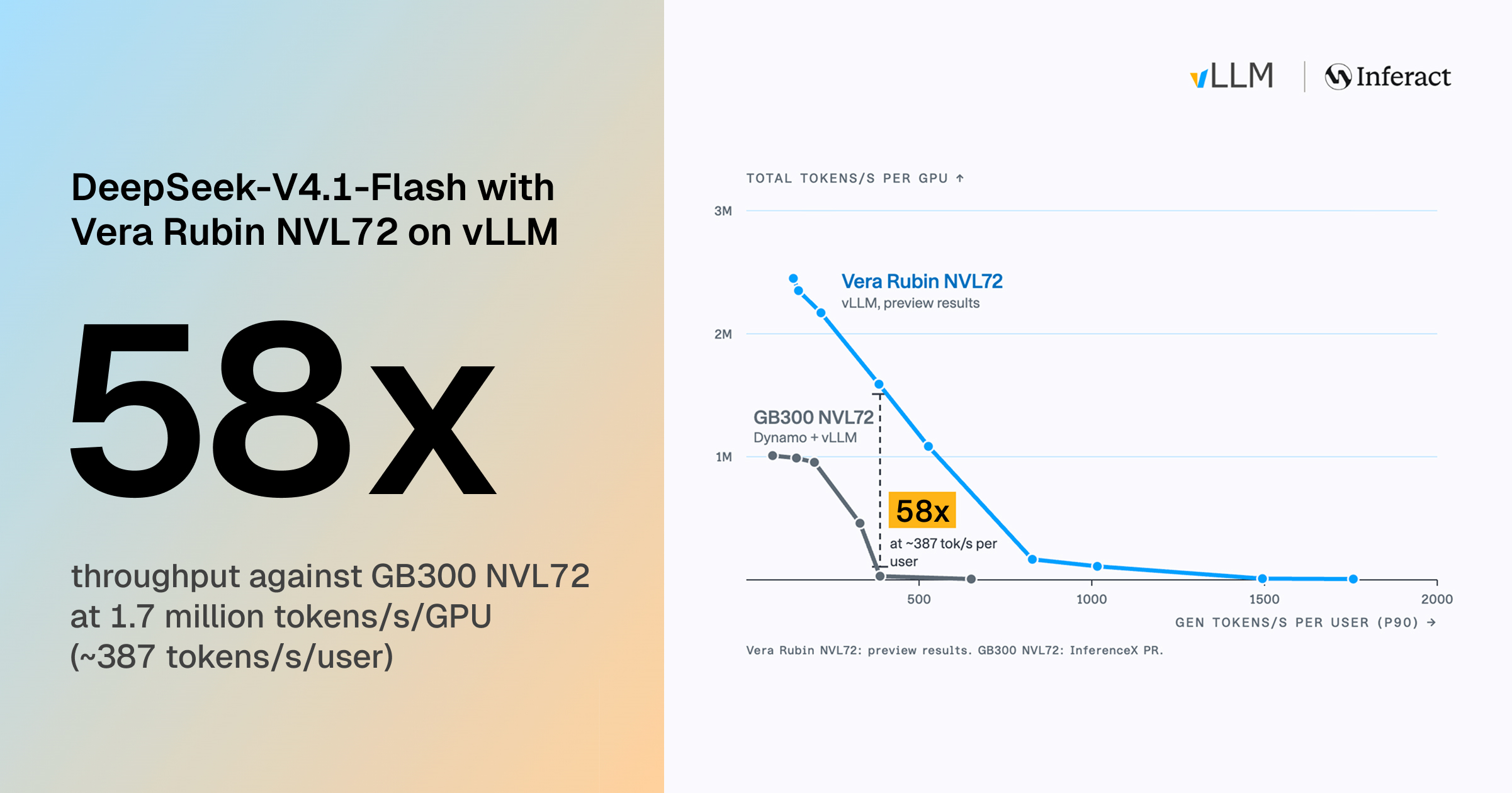
On November 12, vLLM published the third post in its DeepSeek-V4.1-Flash series, led by Inferact. On one Vera Rubin NVL72 rack running the SemiAnalysis AgentX workload, it measured 1.7M total tokens/s per GPU at a P90 of 387 tokens/s per user, 58x GB300 NVL72 at the same interactivity, and 2.52M tokens/s per GPU at peak throughput, 2.7x GB300. The 58x figure applies only at that high-interactivity point, and the Rubin numbers are preview results.
Zoom
Key Takeaways
Keep the two multiples apart (vLLM figures): 1.7M tokens/s per GPU at 387 tokens/s per user is 58x GB300; 2.52M tokens/s per GPU at peak throughput is 2.7x GB300
Single-user latency: a specialized TP8 decode path spanning two compute trays reaches 1,810 tokens/s at P90 with one concurrent session, and P50 rose from 1,117 to 1,844 tokens/s
Rewritten kernels: tuned for Rubin's two memory domains and SM107's new MMA instructions, DEP2 prefill steps are about 28% faster and DEP decode steps about 25% faster
Rack-scale memory pools: the Mooncake KV pool extends from DRAM to spare HBM and Engram tables are sharded across GPU HBM; at concurrency 4,800 requests served rise 68% and TTFT P50 falls from 29.8 s to 4.2 s
Nature of the data: Rubin results are preview numbers, GB300 comparisons come from an InferenceX PR, and some points are interpolated