

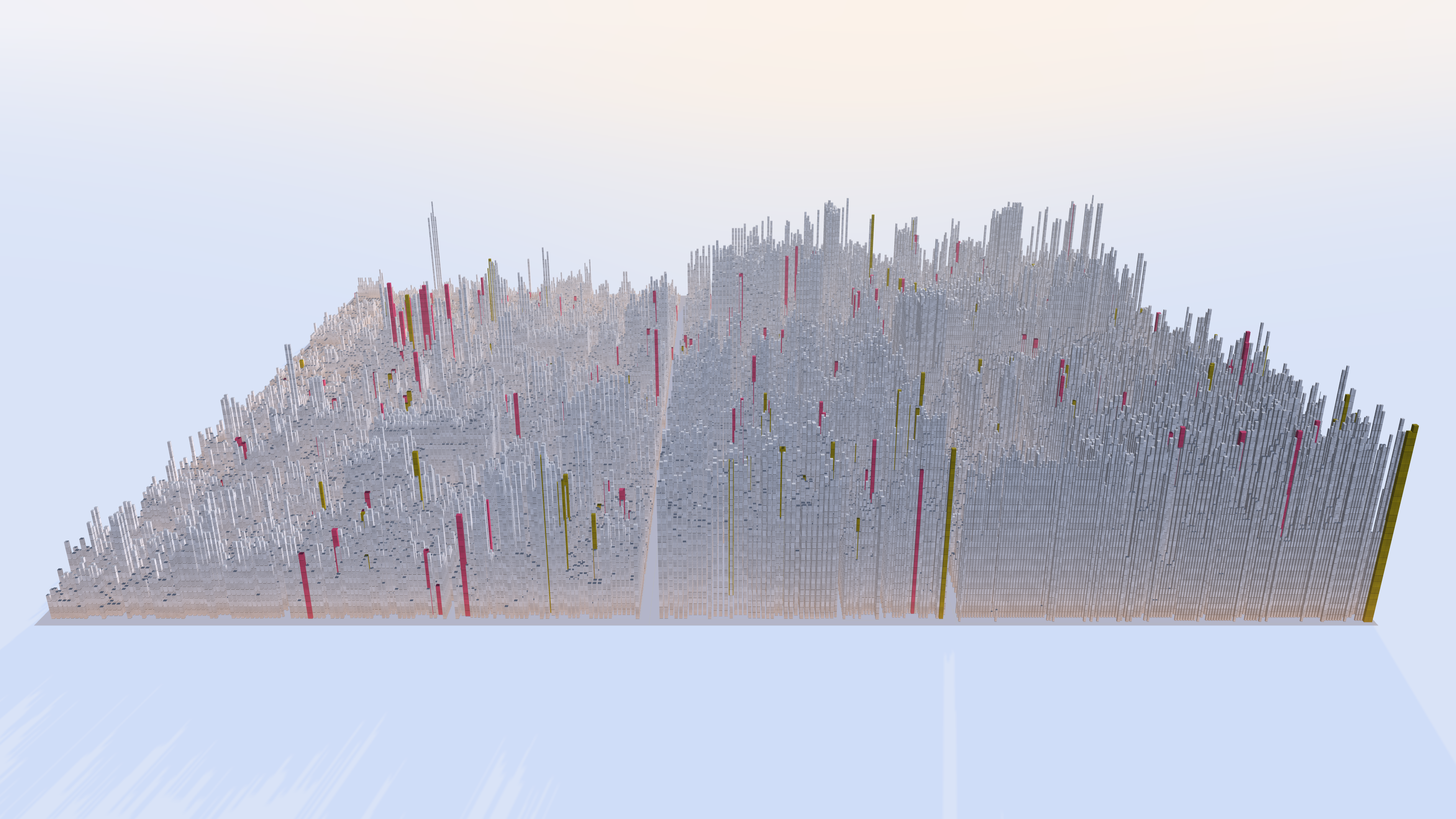
Axiom released a Lean formalization of the entire Stacks Project on November 4 (official X post at 17:13 UTC, with over 2 million views). The roughly 7,500-page open-source algebraic geometry reference, started by Johan de Jong in 2005, becomes about 16 million lines of code, which Axiom calls the largest integrated, reusable formal math library ever built. Hierarchically coordinated AI agent swarms did the work and surfaced dozens of statements in the original that needed local fixes, with counterexamples. The library is open source and browsable side by side with the original text at stacks.axiommath.ai.
Key Takeaways
- ✓Scale: about 7,500 pages of source text and roughly 16 million lines of Lean, which Axiom calls the largest integrated reusable formal math library (vendor claim).
- ✓Method: hierarchical AI agent swarms translate statements, search Mathlib for existing abstractions and build proofs in parallel, with multi-agent auditing and semantic cross-checks against the source to keep statements faithful.
- ✓Findings: the system surfaced dozens of statements needing local refinement, including missing hypotheses and edge cases in positive characteristic, and built explicit counterexamples where claims failed.
- ✓The permanent Stacks tag structure is preserved so every Lean declaration links back to the original text; stacks.axiommath.ai offers side-by-side reading and a dependency graph.
- ✓This follows Axiom's October 27 formalization of the Classification of Finite Simple Groups (CFSG); per de Jong's request, corrections are kept in Axiom's own repository rather than sent upstream.
Key Decision Metrics at a Glance
Turn your technical choice into a development budget
Compare 40 dev plans & simulate token costs vs $20/mo subscriptions
Project Links & Resources
Direct AccessIn-Depth Technical Analysis
Background and the Industry Pain Point
As AI systems generate mathematical arguments faster than humans can check them, formal verification becomes essential. Modern algebraic geometry has been hard to formalize: a single contemporary proof can depend on a long chain of results across commutative algebra, schemes, sheaves, cohomology and algebraic stacks, and Lean lacked that infrastructure. The Stacks Project, started by Columbia mathematician Johan de Jong in 2005, is a roughly 7,500-page open-source reference with permanent four-character tags. Axiom has now formalized all of it, and on X pitched it as a counterexample to the idea that vibecoding at scale is slop.
Architecture Highlights and Mechanism
According to the official blog, Axiom built a hierarchical system of AI agents with specialized roles and strict coordination protocols. Agents work in parallel across the dependency graph to translate statements, search Mathlib for existing abstractions, construct proofs and resolve prerequisites, while keeping definitions, typeclass interfaces and abstractions aligned across chapters so different agents do not produce incompatible definitions of the same object. Faithfulness is enforced by multi-agent auditing, semantic cross-checks against the source, and the requirement that every definition and lemma must work with the downstream theorems that use it.
Benchmarks and Measured Results
This is not a benchmark release. Axiom's figures are about 16 million lines of code from about 7,500 pages; "largest integrated, reusable formal math library ever built" is Axiom's own claim with no third-party evaluation yet. The process surfaced dozens of statements in the original that needed local refinement, with counterexamples, and the agents found alternative routes through the literature to keep main theorems where possible.
Getting Started for Developers
Mathematicians and developers building theorem-proving agents can browse the Lean code side by side with the original text, inspect counterexamples and the full dependency graph at stacks.axiommath.ai, and import definitions and theorems directly into their own formal proofs. The code is open source under Axiom's GitHub organization. Note that de Jong has asked that AI-generated comments and pull requests not be sent to the upstream Stacks Project repository for now, so Axiom keeps its corrections in its own repository.
Benchmark side-by-side against alternatives, or calculate monthly token cost vs subscription break-even.
Discussion & Comments
0Sign in to join the discussion
Connect with AI developers to exchange benchmark insights.