

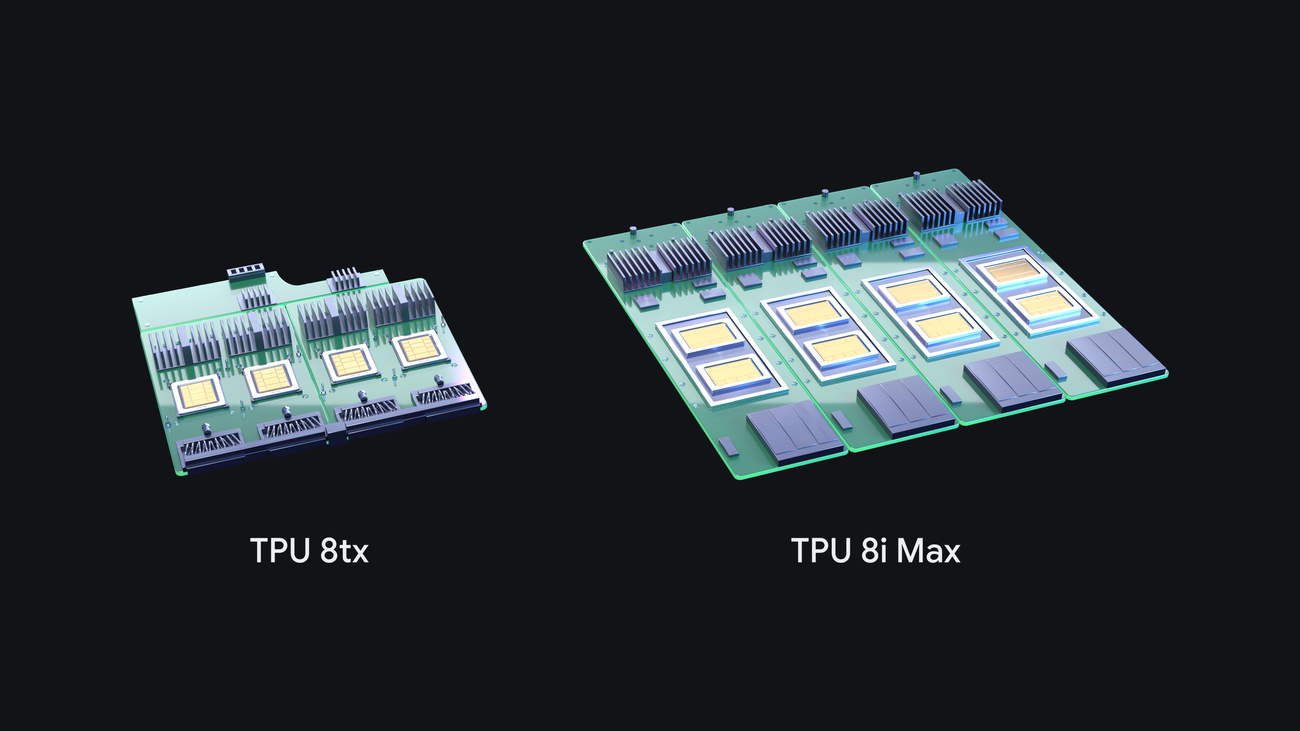
On November 9, the official Google Cloud account and Amin Vahdat, Google SVP for AI and Infrastructure, announced two new eighth-generation TPU systems. TPU 8i Max packages two TPU 8i chips together; Google says it has 2x the compute, SRAM and HBM bandwidth of TPU 8i, and it targets massive context windows and the highest compute density per rack. TPU 8tx uses the same silicon as TPU 8t, pairs it with 5th Gen AMD EPYC hosts, and protects data and model weights in hardware while they are in use; Google says it has up to 2x lower latency than TPU 8t with a near-zero performance penalty. With 8t and 8i from April, this is the first time Google has introduced four TPU systems in one year. On software, Google is open-sourcing TPU Sync, which it says cuts KV transfer latency and time to first token by more than 90%, adding Agent Compute Engine and a preview TPU agent suite that plugs into Claude Code, Cursor and Antigravity, and making Cloud Pathways and GKE dynamic slicing generally available. Google has not published availability dates or pricing.
Key Takeaways
- ✓Lineup: the eighth-generation TPU family now has 4 systems: 8t (training), 8i (low-latency reasoning), 8tx (confidential computing) and 8i Max (massive context); Google says it is the first time it has introduced 4 TPU systems in one year
- ✓TPU 8i Max: two 8i chips in one package; Google says compute, SRAM and HBM bandwidth are all 2x TPU 8i, with 2x the silicon in the same rack footprint
- ✓TPU 8tx: same silicon as 8t with 5th Gen AMD EPYC hosts, protecting data and weights in hardware even while in use; Google says latency is up to 2x lower than 8t with a near-zero performance penalty
- ✓Software: open-source TPU Sync (Google says KV transfer latency and TTFT drop more than 90%); GKE dynamic slicing is GA, with up to 5x faster job startup and up to 4.5x faster fault recovery
- ✓Developers: a preview open-source TPU agent suite plugs into Claude Code, Cursor and Antigravity; TPUs have nearly 100 customers; availability and pricing are not published
Key Decision Metrics at a Glance
Turn your technical choice into a development budget
Compare 40 dev plans & simulate token costs vs $20/mo subscriptions
Project Links & Resources
Direct AccessIn-Depth Technical Analysis
Background and Pain Points
Agent workloads are changing what inference hardware needs. When many agents read an entire codebase or hours of video at once, memory bandwidth becomes the bottleneck, and regulated enterprises and governments also need sensitive data and model weights to stay protected while they are being processed. In April at Cloud Next, Google launched the eighth-generation TPU 8t for training and TPU 8i for inference; it is now adding two more systems in the same generation to address these two problems. Google says TPUs have nearly 100 customers, including frontier labs, trading firms, retailers and universities.
Architecture Highlights
Google stresses that these are new systems, not new chips. The silicon stays the same; packaging, memory, networking and security change, which lets Google deliver in months. TPU 8i Max puts two 8i chips in one package, doubling compute, SRAM and HBM bandwidth together in the same rack footprint. TPU 8tx uses the 8t chip with 5th Gen AMD EPYC CPU hosts and adds confidential computing in hardware, so data and weights stay encrypted and isolated even while processed in memory. It also uses the low-latency Boardfly network built for real-time reasoning, so teams can run private fine-tuning, distillation and reinforcement learning on one system.
Benchmarks
All figures below come from Google; there are no third-party tests yet. 8i Max has 2x the compute, SRAM and HBM bandwidth of 8i. 8tx has up to 2x lower latency than 8t with a near-zero performance penalty. TPU Sync cuts KV transfer latency and time to first token by more than 90%. GKE dynamic slicing makes job startup up to 5x faster and fault recovery up to 4.5x faster. Google says its vLLM plus TorchTPU stack reached leading price-performance on the InferenceX and AgentX benchmarks, but the blog gives no specific scores. Peak compute, availability dates and pricing for the new systems are not published.
Getting Started
For most developers the software news matters more than the new hardware. TorchTPU, open-sourced last month, runs PyTorch and Hugging Face models on TPUs without code rewrites, and vLLM and SGLang have ready TPU backends. The new preview TPU agent suite plugs into Claude Code, Cursor and Antigravity to handle TPU onboarding, find bottlenecks and tune kernels in plain language. Teams already running TPUs on GKE can try Cloud Pathways and dynamic slicing, both now generally available. Teams that need confidential inference should watch for 8tx availability dates and regions before planning a move.
Benchmark side-by-side against alternatives, or calculate monthly token cost vs subscription break-even.
Discussion & Comments
0Sign in to join the discussion
Connect with AI developers to exchange benchmark insights.