
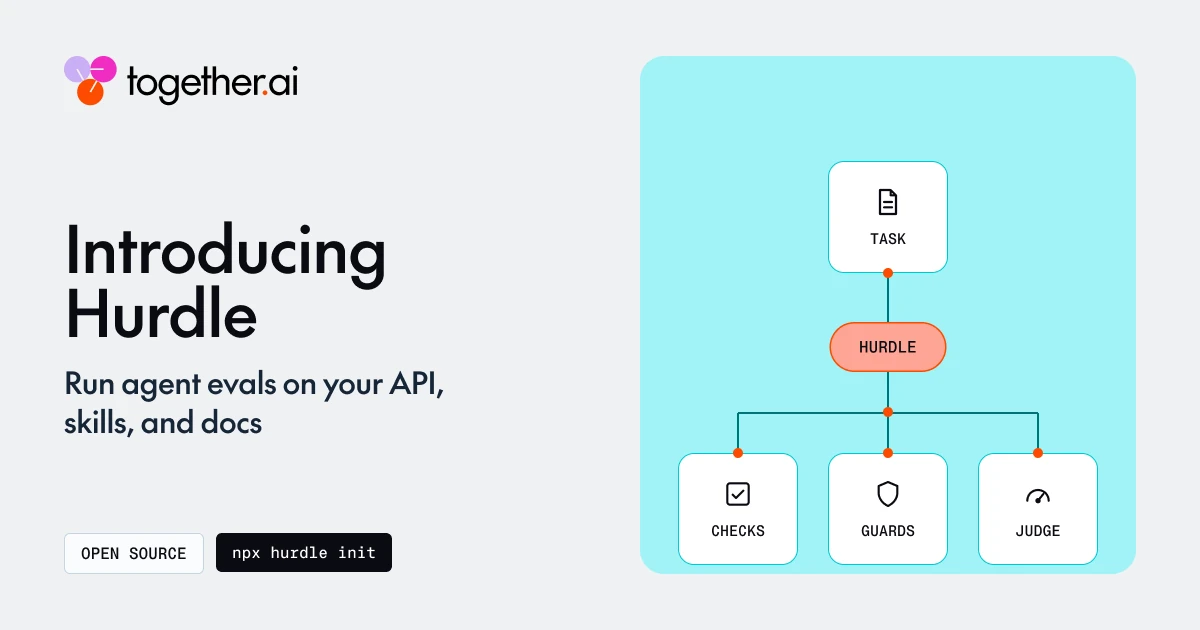
On November 25, Together AI (@togethercompute) open-sourced Hurdle, the agent eval framework it has used internally for about six months. The npm library has Claude Code and Codex work through tasks a developer would actually hand an agent on your platform, records each session and scores it. Scoring can combine code checks (API requests the agent must make, files it must produce), guards (blocking forbidden actions such as creating a paid GPU cluster, counted as a failure) and an LLM judge that reviews the session against a plain-English rubric. Each task can run under different conditions, such as with and without your MCP server or skill, across multiple models and repeated runs, reporting pass rate, duration and cost. Production runs can use isolated Together Sandbox environments.
Key Takeaways
- ✓Purpose: it measures how well coding agents use your API, SDK, docs, MCP servers and skills, not the models themselves
- ✓Three scoring methods can be mixed: code checks, guards that block risky requests and fail the run, and an LLM judge; a hybrid verdict requires both checks and judge to pass
- ✓Controlled comparisons: run the same task with and without an MCP server or skill, across several models, with repeats to get a pass rate
- ✓Two modes: local runs start the claude or codex CLI but cannot see or block API requests; sandboxed runs use Together Sandbox with a local proxy called Guardian that monitors requests
- ✓Getting started: npx hurdle init, then npx hurdle run --view; source is at github.com/togethercomputer/hurdle
Key Decision Metrics at a Glance
Turn your technical choice into a development budget
Compare 40 dev plans & simulate token costs vs $20/mo subscriptions
Project Links & Resources
Direct AccessIn-Depth Technical Analysis
Background
More developers reach APIs and docs through coding agents, yet platforms rarely know how well agents actually use their products, and testing by hand across models, harnesses and conditions is tedious. Together AI's official blog says it spent about six months building Hurdle for this, and it announced on X on November 25 that the tool is now open source.
How it works
A task is simply a prompt a developer would give an agent. Hurdle runs Claude Code or Codex, records the session and scores it: code checks assert required requests and outputs, guards block forbidden requests while the agent works, and an LLM judge reviews the session against a plain-English rubric. Sandboxed runs monitor API traffic through a local proxy called Guardian.
Numbers that matter
Hurdle is an eval tool, not a leaderboard, and no comparative scores were published. The blog's example suite runs 1 task x 2 models x 2 conditions x 15 repeats, or 60 runs.
What it means for developers
Start with npx hurdle init and view pass rate, duration and per-run cost with npx hurdle run --view. In local mode the agent runs as you and can read local files and real API keys, so complex or risky tasks belong in a sandbox. Source is on GitHub.
Benchmark side-by-side against alternatives, or calculate monthly token cost vs subscription break-even.
Discussion & Comments
Sign in to join the discussion
Connect with AI developers to exchange benchmark insights.