AI Coding Live News

Kimi launches 3D Make: K3.1 Pro drives Blender, CAD tools and Unreal, Unity and Godot to build models, scenes and games

Moonshot AI's official Kimi account announced 3D Make at 03:14 UTC on Oct 30, saying Kimi connects to tools such as Blender and CAD software to create models, assemble scenes and develop games, available now on kimi.ai and Kimi Work. The companion 3D guide says K3.1 Pro was specifically trained to drive 3D software through Python scripts, so specialized tools without MCP support can join the workflow, while meshes such as people and animals are handed to diffusion services like Tripo. Plugins that need locally installed software work only in Kimi Work.
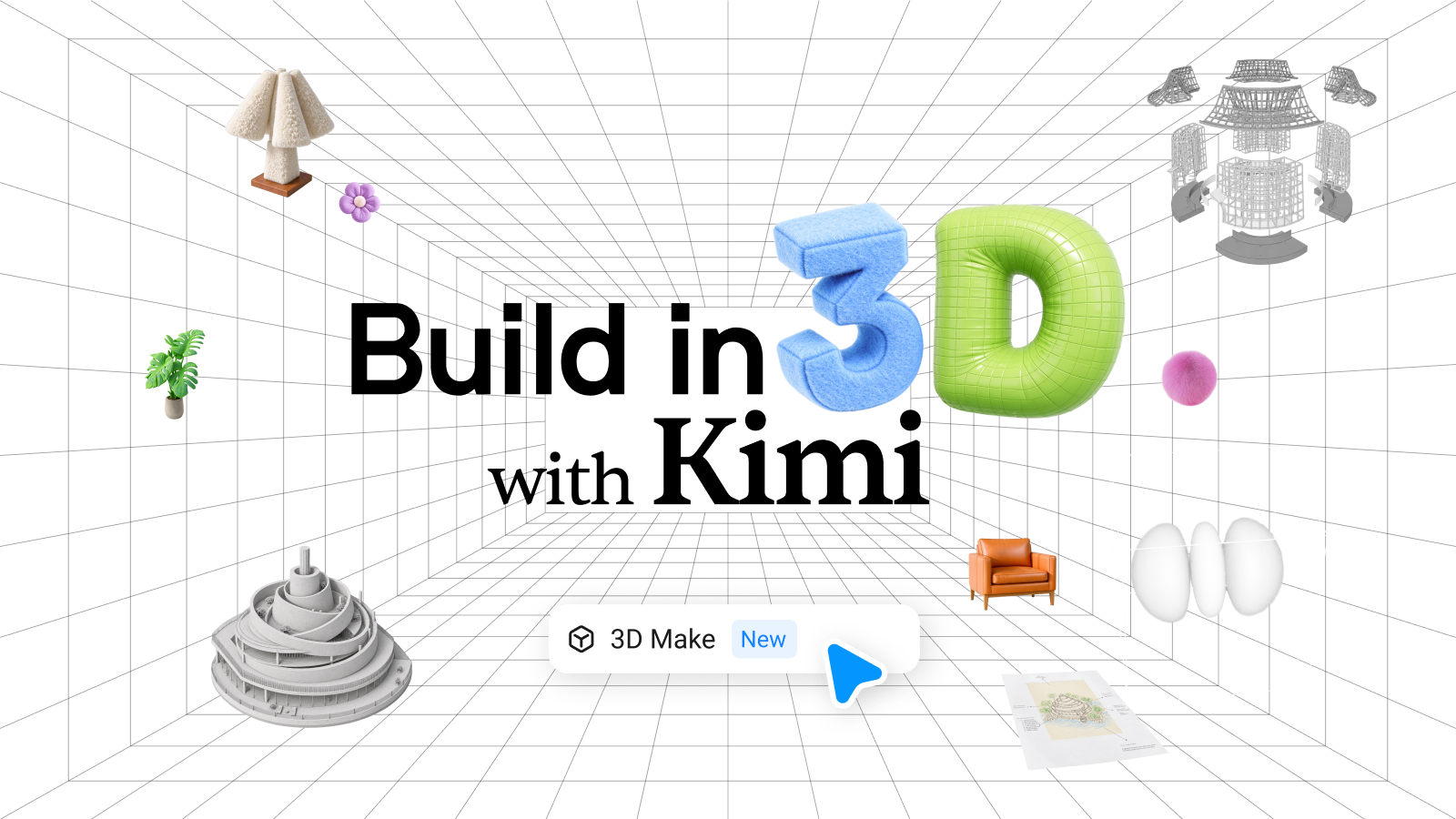
Kimi launches 3D Make: K3.1 Pro drives Blender, CAD tools and Unreal, Unity and Godot to build models, scenes and games

Key Takeaways

  • Availability: 3D Make is live on kimi.ai and Kimi Work; plugins that need locally installed software are Kimi Work only
  • Two modeling routes: parametric models (furniture, mechanical parts, buildings) via Python scripts written by K3.1 Pro, and meshes via services such as Tripo, Meshy and Hyper3D
  • Engines: Kimi says it is adapted to Unreal Engine, Unity and Godot to import models, assemble scenes and build gameplay step by step
  • Showcase: the celestial palace in the K3.1 Pro launch video was built in Unreal Engine 5.8 from source models totaling 36 million triangles, rendered with Nanite and Lumen
  • Benchmarks: no 3D benchmarks were published; the guide admits some tasks need several rounds, and rigging and complex materials remain weak spots
Read full story

Artificial Analysis launches Intelligence Index v5: 60% private test sets, Claude Opus 5.5 leads at 58 and the open-weights gap widens to 12 points

On Oct 28 independent evaluator Artificial Analysis released Intelligence Index v5, its biggest revision since v4 in January: it adds Cognition's FrontierCode 2.0 and Terminal-Bench-Science, swaps Humanity's Last Exam for HLE-Diamond, and now draws 60% of its weight from private or held-out test sets. Claude Opus 5.5 (max) leads at 58, ahead of GPT-6 Astra at 57 and GPT-6.1 Sol at 55; the top open-weights model, Kimi K3.1 Pro (weights not yet released), scores 46, widening the gap from 3 points in v4.3 to 12. It also launched Progress Index v1 for comparing models across years.

Artificial Analysis launches Intelligence Index v5: 60% private test sets, Claude Opus 5.5 leads at 58 and the open-weights gap widens to 12 points

Key Takeaways

  • Overall (vendor-reported by Artificial Analysis): Claude Opus 5.5 (max) 58, GPT-6 Astra (max) 57, GPT-6.1 Sol (max) 55; Anthropic and OpenAI hold the top five, with Gemini 4 Argon (high) next at 50
  • The open-weights gap grows from 3 to 12 points: Kimi K3.1 Pro scores 46, while released-weight leaders DeepSeek V4.1 Flash 1017 and GLM-5.3 (max) score 32, below Claude Haiku 5.5 (max) at 36
  • Cost per task varies more than 13x: among the top 10, GPT-6.1 Terra (max) is cheapest at $0.96 and Claude Fable 5.1 (max) priciest at $13.04; GPT-6.1 Sol trails Opus 5.5 by 4 points at about one eighth the cost ($1.27 vs $10.04)
  • Four categories at 25% each: Knowledge Work, Coding (FrontierCode 2.0 15%, Terminal-Bench 4.0 10%), Science and General; GDPval-AA v2.1, SciCode and AA-LCR were removed
  • Tasks are heavier: median output tokens per task rose from 35k to 59k, and effort matters more, with Opus 5.5 scoring 35 at low effort vs 58 at max for 10x the cost
Read full story

Kimi apologizes for K3.1 Pro plan rate limits and wasted quota, gives every subscriber a one-time 25% monthly quota reset and trims subagent calls and output length

At 20:14 UTC on 2026-10-25, Moonshot AI's official account @Kimi_Moonshot (post) acknowledged rate limits and unnecessary quota consumption on the K3.1 Pro subscription plan, saying "these were our issues, and we should have fixed them sooner." Every subscriber on every plan gets a one-time usage reset that restores 25% of their monthly quota (usage below 25% resets to zero), equal to about one week of usage; usage bars update by end of day PST. Kimi also adjusted the plan's parameters and is cutting unnecessary subagent calls and output length so quota lasts longer.

Key Takeaways

  • Compensation: a one-time 25% monthly quota restore, about 1 week of usage (official post)
  • Users below 25% usage are reset to zero; applies to every subscription plan
  • Timing: usage bars update by end of day PST on Oct 25 (about 15:00 SGT on Oct 26)
  • Fix direction: fewer unnecessary subagent calls, shorter outputs and adjusted plan parameters
  • Context: K3.1 Pro launched Oct 23 with API pricing of $2/$10 per million tokens (vendor figures)
Read full story

Moonshot launches Kimi K3.1 Pro: 2.8T-total / 104B-active open-weight MoE with 1M context, 65.7% on Terminal-Bench 4.0, API at $2/$10, weights by Nov 4

On 2026-10-23 (17:15 UTC) the official @Kimi_Moonshot account launched Kimi K3.1 Pro, alongside K3.1 Pro Highspeed (2-3x faster). Both are live on Kimi.ai, Kimi Work, Kimi Code and the Kimi API, and full weights are promised by 2026-11-04. The official tech blog describes it as a post-trained version of K3 with much larger multi-domain joint RL: a 2.8T-total / 104B-active MoE, 1M-token context, multimodal. Vendor-reported scores: 65.7% on Terminal-Bench 4.0 (GPT-6 Astra 58.2%, Claude Opus 5.5 66.4%) and 92.7% on BenchCAD with tools. The Kimi API pricing page lists kimi-k3.1-pro at $2 input, $10 output and $0.20 cached input per million tokens, down from K3 at $3/$15.

Moonshot launches Kimi K3.1 Pro: 2.8T-total / 104B-active open-weight MoE with 1M context, 65.7% on Terminal-Bench 4.0, API at $2/$10, weights by Nov 4

Key Takeaways

  • 2.8T-total / 104B-active MoE, 1M-token context, multimodal; full weights promised by 2026-11-04 (official blog)
  • Vendor-reported: 65.7% on Terminal-Bench 4.0, ahead of GPT-6 Astra (58.2%) and just behind Claude Opus 5.5 (66.4%); 61.2% on the internal Kimi Code Bench 3.0 Long-horizon (K3: 55.95%)
  • API pricing: kimi-k3.1-pro at $2 input / $10 output / $0.20 cached input per million tokens; Highspeed at $4 / $20 (pricing page)
  • On the internal Kimi Hallu Bench Hard stress test, claim-level hallucination fell from 23.4% (K3) to 8.3%; Moonshot notes this is not a daily-use error rate
  • Cyber-related data was removed from mid-training and RL for the open-weight release: xdev-bench-hard pass@3 drops from 90.5% (unmitigated checkpoint) to 81.0%
Read full story
Linked Models & Agents:
ADSponsored

Kimi teaser video shows the model name Kimi K3.1: Kimi Code terminal reads "K3.1 thinking: high" while generating a Three.js 3D scene

On 2026-10-23 (01:41 UTC) the official Kimi account @Kimi_Moonshot posted a 24-second, retro-CRT-style video with no caption text. The Kimi Code terminal at the start of the clip reads "Model: Kimi K3.1" and "Version: 2.2.0", the status bar shows "Kimi K3.1 thinking: high", and a notice says "Kimi Code Desktop is here". The user then types "Build a complex procedural 3D scene in Three.js." and the model calls the Write tool to create ./scene.js. This is the first time the Kimi K3.1 name has appeared in official material. The post has no caption and no release date, benchmark, price or parameter details, so this is a teaser and not a confirmed release.

Kimi teaser video shows the model name Kimi K3.1: Kimi Code terminal reads "K3.1 thinking: high" while generating a Three.js 3D scene

Key Takeaways

  • In the official teaser the Kimi Code terminal shows "Model: Kimi K3.1" and the status bar reads "Kimi K3.1 thinking: high", the first official appearance of the K3.1 name
  • The clip also shows Kimi Code version 2.2.0 and the notice "Kimi Code Desktop is here", with install via the /desktop command or kimi.com/code
  • The demo task is "Build a complex procedural 3D scene in Three.js." and the model uses the Write tool to create ./scene.js, in a clip of about 24 seconds
  • The post has no caption; release date, benchmarks, price and parameters are not officially announced, so treat this as a teaser and not a release. As of the evening of 10-23 SGT the post had about 1.63M views and 17.6K likes (public X counts)
Read full story

Empirical Benchmark Unmasks Sub-Agent Concurrency: SWE-bench Success Drops 24% as Token Costs Surge up to 3.3x

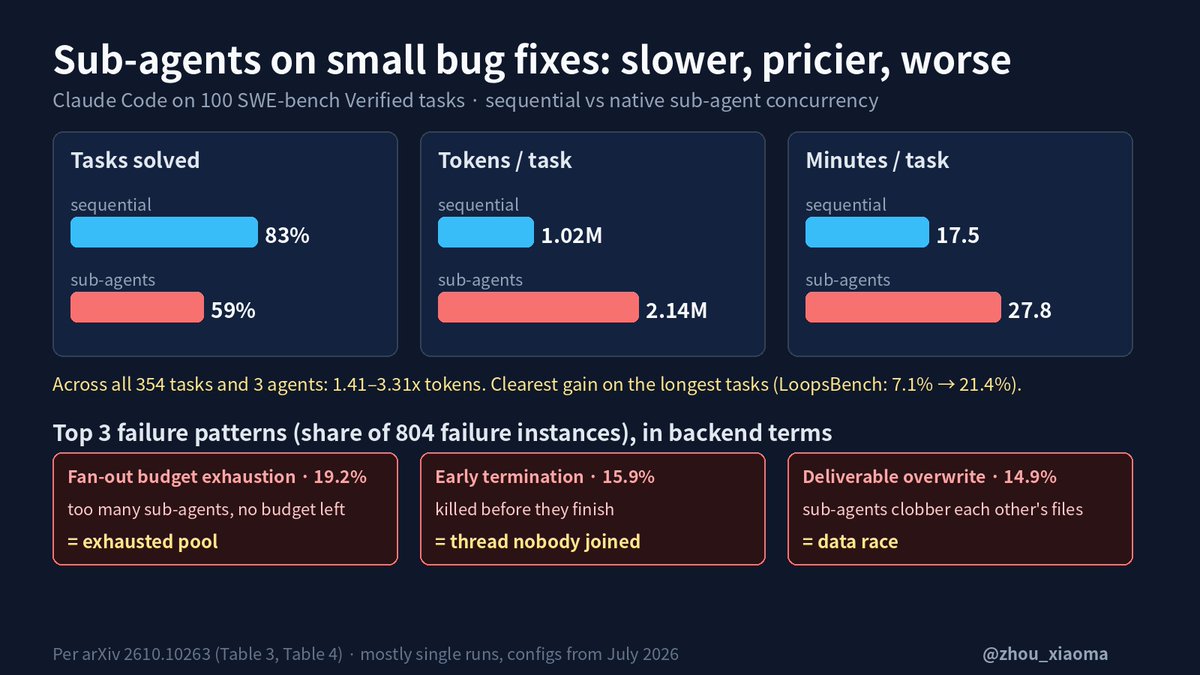
A comprehensive empirical study evaluated native sub-agent concurrency across 2,124 runs on Claude Code, Codex, and Kimi Code (354 tasks, ~$20.8K API cost). On 100 standard SWE-bench Verified tasks, enabling sub-agents caused Claude Code's solve rate to collapse from 83% to 59% (with latency increasing from 17.5 to 27.8 minutes) and Kimi Code from 77% to 59%, while token consumption inflated by 1.41x to 3.31x. The study revealed severe failure modes including budget-exhausting fan-outs, orphaned child processes, and concurrent delivery race conditions.

Empirical Benchmark Unmasks Sub-Agent Concurrency: SWE-bench Success Drops 24% as Token Costs Surge up to 3.3x

Key Takeaways

  • A $20,800 empirical study across 2,124 runs revealed the real costs of native sub-agent concurrency in Claude Code, Codex, and Kimi Code
  • On SWE-bench Verified, sub-agent concurrency dropped Claude Code's solve rate from 83% to 59% and Kimi Code from 77% to 59%
  • Token consumption inflated by 1.41x-3.31x while execution times lengthened, caused by thread race conditions and budget exhaustion
  • Delivered gains only on massive multi-file projects (LoopsBench: 7.1% to 21.4%); authors recommend sequential execution as the default
Read full story
Linked Models & Agents:

SemiAnalysis Discloses Google & Inferact TPUv7 Submission: TorchTPU vLLM Megakernels Drive 2.8T Kimi K3, Surpassing GB200 NVL72 and B300 in High-Interactivity TCO

SemiAnalysis revealed the first Google TPUv7 benchmark submission for the 2.8T Kimi K3 MoE model, led end-to-end by Inferact (the creators of vLLM) and Google using the TorchTPU vLLM stack. At a hardware rental cost of just $1.21/chip-hour (vs $2.31 for GB300 and $1.86 for GB200), TPUv7 delivers ~2.2M tokens per $1 TCO in the ultra-high interactivity regime (~390 tok/s/user), outpacing NVIDIA GB200 NVL72, B300, and AMD MI355X on cost-performance.

SemiAnalysis Discloses Google & Inferact TPUv7 Submission: TorchTPU vLLM Megakernels Drive 2.8T Kimi K3, Surpassing GB200 NVL72 and B300 in High-Interactivity TCO

Key Takeaways

  • Inferact (creators of vLLM) and Google submitted their first preliminary TPUv7 benchmark for the 2.8T Kimi K3 MoE model
  • TPUv7 chip rental sits at $1.21/hour, significantly below GB300 ($2.31), B300 ($2.26), and GB200 ($1.86)
  • Delivers ~2.2M tokens per $1 TCO at ~390 tok/s/user, beating NVIDIA GB200 NVL72, B300, and AMD MI355X in the ultra-high interactivity regime
  • Built with fused TorchTPU vLLM megakernels and the TPU-Sync KVCache offload library for production PD disaggregation
Read full story
Linked Models & Agents:

Arena Code Arena: WebDev Update: DeepSeek-V4.1-Flash Becomes #1 Open Model, Scoring 1670 to Rival GPT-6 Sol and Surpass Claude Opus 5

Arena announced a major update to Code Arena: WebDev: DeepSeek-V4.1-Flash-20261017 (Max) clinched the #1 position among open models with 1670 points, surpassing Kimi K3 (Max) at a 10x lower cost. Ranking #12 overall, it outperforms Claude Opus 5 (High) and narrows the gap with closed-source frontier GPT-6 Sol (Max) to roughly 10 points, resetting the Pareto efficiency curve at $0.30 input / $1.20 output per million tokens.

Arena Code Arena: WebDev Update: DeepSeek-V4.1-Flash Becomes #1 Open Model, Scoring 1670 to Rival GPT-6 Sol and Surpass Claude Opus 5

Key Takeaways

  • DeepSeek-V4.1-Flash-20261017 (Max) captured the #1 open model position in Arena Code Arena: WebDev with 1670 points, surpassing Kimi K3 (Max)
  • Ranks #12 overall on the leaderboard, defeating Claude Opus 5 (High) and trailing closed-source champion GPT-6 Sol (Max) by only ~10 points
  • Resets the Pareto efficiency frontier at $0.30 input / $1.20 output per million tokens, cutting operational costs by ~10x against rival models
  • Gains +52 points over its previous 20260910 checkpoint in just over a month
Read full story
Linked Models & Agents:

USC, UCLA, and CMU Release Grid-Bench for Multi-Step Spatial Reasoning: 8,928 Executable Instances Reveal Severe State Drift Across 64-Step Trajectories

Can LLMs reliably maintain spatial state representations across sequential operations? USC, UCLA, and CMU introduced Grid-Bench (arXiv:2610.22312, GitHub: grid-bench/Grid-Bench), an executable benchmark with 8,928 instances testing 2D/3D/4D grid state transitions across history lengths up to T=64. Evaluations across 6 frontier models show steep degradation: while GPT-5.6 Sol and Claude 5 Sonnet retain strong cell accuracy, open-weight and mid-tier models collapse to near-zero exact world reconstruction over long trajectories.

USC, UCLA, and CMU Release Grid-Bench for Multi-Step Spatial Reasoning: 8,928 Executable Instances Reveal Severe State Drift Across 64-Step Trajectories

Key Takeaways

  • USC, UCLA, and CMU introduced Grid-Bench (arXiv:2610.22312), an executable spatial tracking benchmark across 2D, 3D, and 4D discrete manifolds
  • Evaluates 8,928 instances across 8 spatial transformation rule families and trajectory lengths up to T=64 steps
  • At intermediate length T=16, GPT-5.6 Sol (98.0% cell accuracy) and Claude 5 Sonnet (96.8%) lead while mid-tier models drop sharply
  • At extreme length T=64, exact world recovery drops to 0 for GLM-5 and Kimi K2.5, demonstrating that long-horizon agents must rely on external state engines
Read full story
Linked Models & Agents:

Kimi K3 Hits 842 tok/s on NVIDIA GB300 NVL72: NVIDIA and vLLM Unveil 12,000-Line CuTe DSL Decode Megakernel with 1.8x Higher AgentX Interactivity

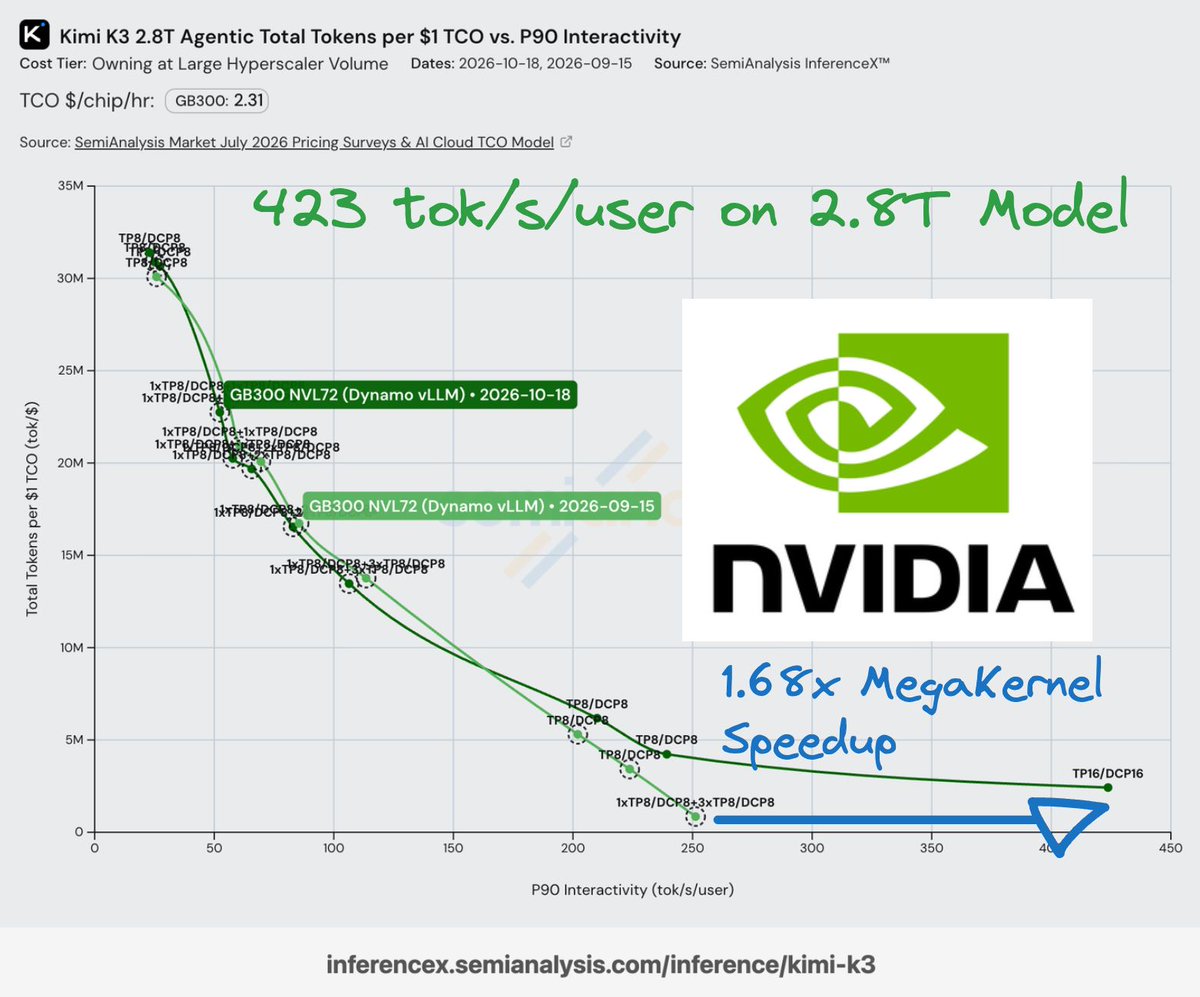
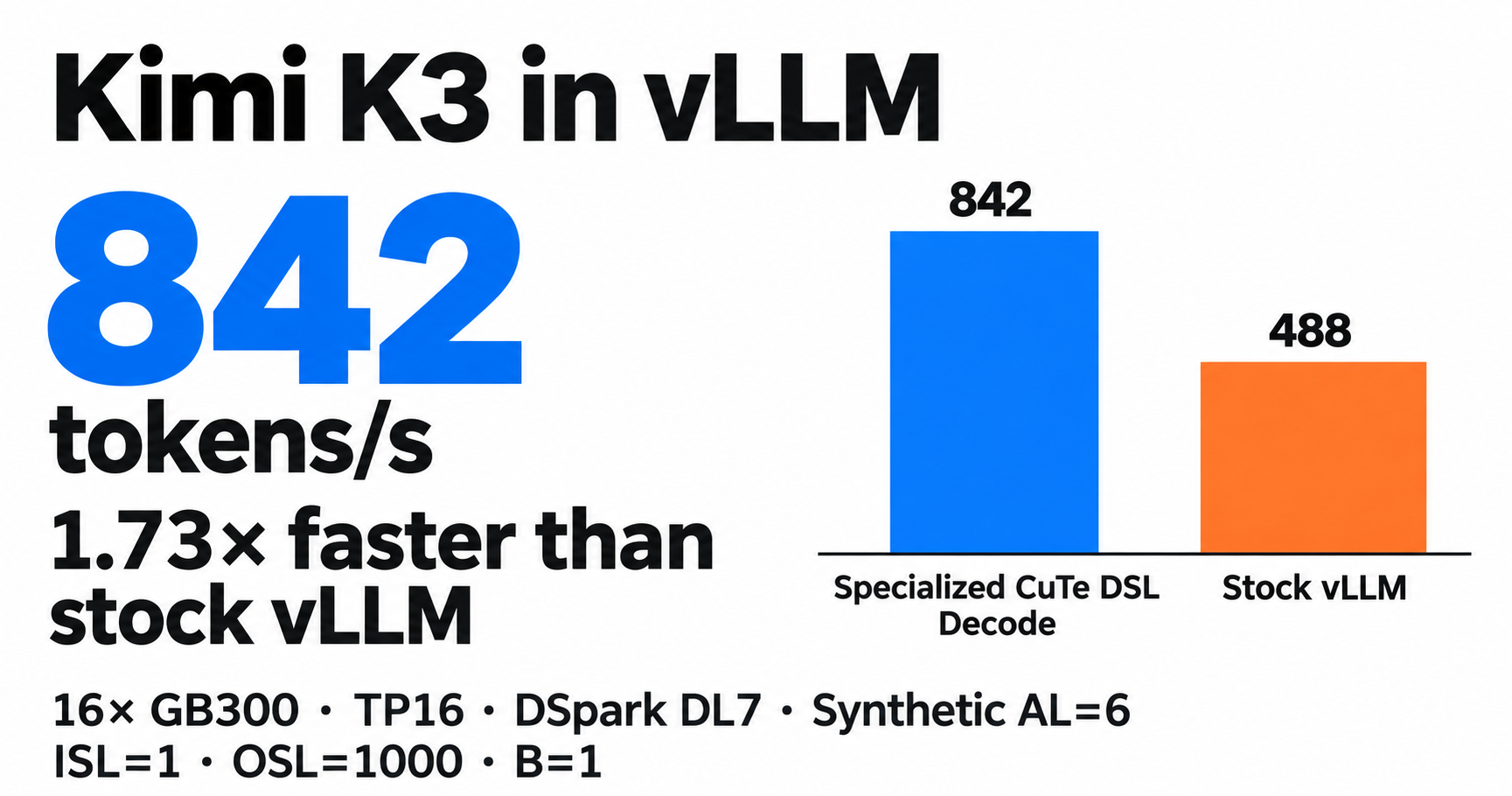
vLLM and NVIDIA unveiled a unified CuTe DSL decode megakernel (~12,000 LoC authored by NVIDIA CentML's Benjamin Chislett) for Moonshot AI's frontier Kimi K3 model on NVIDIA GB300 NVL72. By fusing attention, MoE, and cross-GPU communication, the optimization cuts per-layer latency from 130 µs (23 kernels) to 69 µs (13 kernels), delivering 842 tokens/s at batch=1 with DSpark speculative decoding (1.73x faster than stock vLLM) and up to 1.8x higher P90 per-user interactivity (403.2–423 tok/s/user) on SemiAnalysis AgentX, with DeepSeek-V4.1-Flash (PR #61868) and GLM-5.3 support coming next.

Kimi K3 Hits 842 tok/s on NVIDIA GB300 NVL72: NVIDIA and vLLM Unveil 12,000-Line CuTe DSL Decode Megakernel with 1.8x Higher AgentX Interactivity

Key Takeaways

  • NVIDIA and vLLM introduce a 12,000-line CuTe DSL decode megakernel for the 2.8T-parameter Kimi K3, reducing per-layer execution from 23 kernels (130 µs) to 13 kernels (69 µs)
  • On 16x NVIDIA GB300 NVL72 GPUs, batch-1 decode hits 842 tok/s with DSpark speculative decoding (1.73x faster) and 256.4 tok/s without speculation (1.88x faster)
  • Delivers up to 1.8x higher P90 interactivity (403.2-423 tok/s/user) on SemiAnalysis AgentX, with DeepSeek-V4.1-Flash (vLLM PR #61868) and GLM-5.3 megakernels following next
Read full story
Linked Models & Agents:
ADSponsored

vLLM and NVIDIA ship a specialized Kimi K3 decode path on GB300: 842 tok/s at batch 1, 1.3–1.9x faster without speculation

A vLLM blog post by NVIDIA engineer Benjamin Chislett details an agent-assisted CuTe DSL decode path for Kimi K3 on NVIDIA GB300 that fuses attention, MoE and NVLink communication, cutting per-layer time from 130 µs across 23 kernels to 69 µs across 13. With DSpark speculative decoding on 16 GPUs it reaches 842 tok/s at batch 1, 1.73x stock vLLM; PR #61867 was merged on Oct 16.

vLLM and NVIDIA ship a specialized Kimi K3 decode path on GB300: 842 tok/s at batch 1, 1.3–1.9x faster without speculation

Key Takeaways

  • 842 tok/s at batch 1 on 16 GB300 GPUs with DSpark (7 draft tokens, synthetic AL=6) vs 488 for stock vLLM, 1.73x (vendor figures)
  • Without speculation TP16 gains 1.62–1.92x (3,606 tok/s at batch 64); TP8 gains 1.31–1.58x
  • Per layer: 23 kernels and 130 µs down to 13 kernels and 69 µs
  • AgentX P90 interactivity 403.2 vs 223.7 tok/s/user (1.8x), though the baseline is an earlier 8-GPU run
  • The same fast-track approach now covers DeepSeek-V4.1-Flash (PR #61868, open); early Muse Spark Open results exceed 950 tok/s/user
Read full story

MLExpert: Open 35B MoE Agentic Model Lifts MLE-Bench Lite Medal Rate from 37.9% to 72.7%, Matching Kimi-K3 and GLM-5.3

Advancing autonomous AI-for-AI (AI4AI) engineering, researchers from Shanghai AI Lab (InternScience) release MLExpert (arXiv:2610.22344), a 35B Mixture-of-Experts agentic model for autonomous machine learning engineering. Powered by the Kaggle-MLE Factory, hierarchical agentic SFT, and Windowed Interaction RL (WIRL), MLExpert boosts average medal rates on MLE-Bench Lite from 37.9% to 72.7%—matching frontier giants like Kimi-K3 and GLM-5.3 while generalizing to agent scaffold optimization.

MLExpert: Open 35B MoE Agentic Model Lifts MLE-Bench Lite Medal Rate from 37.9% to 72.7%, Matching Kimi-K3 and GLM-5.3

Key Takeaways

  • 72.7% medal rate on MLE-Bench Lite: boosts base model performance from 37.9% to 72.7%, matching frontier models Kimi-K3 and GLM-5.3 with a 35B MoE backbone
  • Windowed Interaction RL (WIRL): assigns shared outcome rewards to multi-turn windows between successive experiment results with asynchronous policy updates
  • Cross-domain AI4AI generalization: transfers optimization skills directly to NatureBench Lite, agent scaffold optimization, and algorithm engineering
Read full story

vLLM adds NVIDIA Vera Rubin NVL72 support: up to 7.84x per-GPU throughput over GB200 on AgentX with MiniMax M3

On Oct 9 the vLLM team, with Inferact, Red Hat and NVIDIA, shipped early Vera Rubin NVL72 support: CUDA 13.4 nightly images already serve DeepSeek, Kimi, GLM and MiniMax. Vendor-reported results: up to 7.84x per-GPU throughput vs GB200 on SemiAnalysis AgentX (MiniMax M3, matched interactivity) and up to 3.7x vs GB300 NVL72 on the MLPerf Inference v6.1 VLM benchmark (Qwen3-VL-235B-A22B).

vLLM adds NVIDIA Vera Rubin NVL72 support: up to 7.84x per-GPU throughput over GB200 on AgentX with MiniMax M3

Key Takeaways

  • Versus GB200 NVL72: 5x NVFP4 FLOPS, ~2.4x HBM4 bandwidth, 1.7x bidirectional NVLink, 2–4x faster softmax exponentials (vLLM blog)
  • AgentX with MiniMax M3: up to 7.84x per-GPU throughput at matched interactivity, 5.18x under a 150 TPS cap (vendor-reported, early)
  • MLPerf Inference v6.1: Qwen3-VL-235B-A22B on vLLM + Dynamo, up to 3.7x vs GB300 NVL72
  • CUDA 13.4 locality domains split MoE weights for ~1.2x average MoE-layer speedup in small-token decode
  • Image: vllm/vllm-openai:cu134-nightly (CUDA 13.4 + PyTorch 2.15)
Read full story

Microsoft×Hugging Face open ThinkingBox: 507 stateful workflows graded on backend state, not chat endings

On 2026-10-03, Microsoft Copilot Studio and Hugging Face released ThinkingBox plus ThinkingBox-Bench (507 tasks × 20 trials): isolated MCP sessions graded by executable terminal-state/side-effect checks, wired into OpenEnv. Vendor board: Claude Opus 5.5 67.16% pass@1; Kimi-K3 93.89% pass@20 but only 13.41% all-20 — one success ≠ reliability. MIT framework microsoft/thinkingbox; CDLA data microsoft/thinkingbox-data; paper arXiv:2608.19741.

Key Takeaways

  • Sources: HF blog 2026-10-03, OpenEnv docs, microsoft/thinkingbox (MIT), thinkingbox-data (CDLA), arXiv:2608.19741
  • 507 stateful business workflows × 20 isolated MCP trials each
  • Grade terminal DB/side effects; ~67% of failing traces still terminate cleanly after a mutating tool
  • Opus 5.5 67.16% pass@1; Kimi-K3 broadest pass@20 (93.89%) but 13.41% all-20; GPT-5.4 ~$6.80/dependable task
  • Run: OpenEnv + [email protected] → Typesense + MCP proxy → thinkingbox-eval
Read full story
A
AgentField / Santosh Radha@Agent-Field·
👀81
🔥95

AgentField open-sources CodeAF v0.6: one Go binary software factory for open models; vendor DeepSWE 54.9% #1 same-model

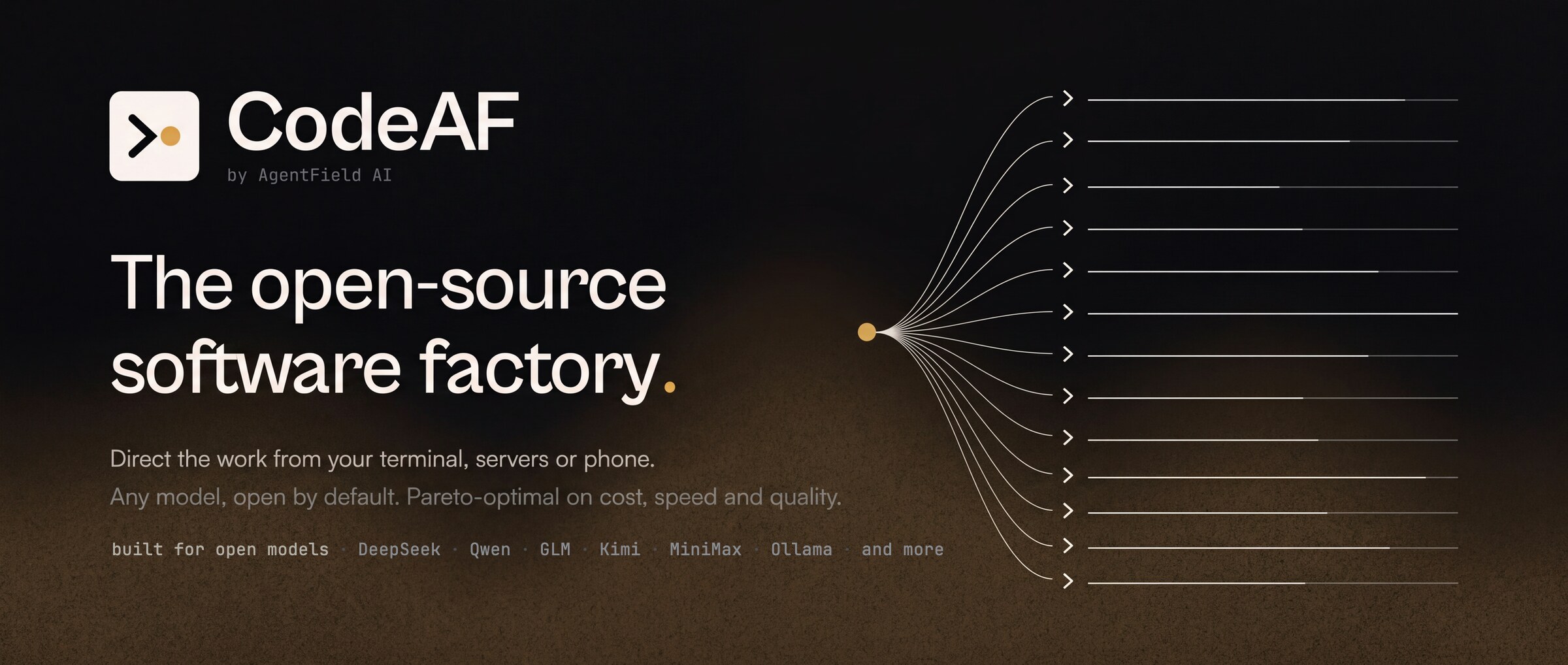
CodeAF is an Apache-2.0 Go binary that runs open-weight models as a local software factory with task fan-out and Pareto crewing. v0.6.0 shipped 2026-10-01; ★259 now. Vendor DeepSWE doc: /senior-dev solved 62/113 (54.9%) on DeepSeek V4 Flash vs nine other harnesses—with stated one-seed and sampling caveats.

AgentField open-sources CodeAF v0.6: one Go binary software factory for open models; vendor DeepSWE 54.9% #1 same-model

Key Takeaways

  • Agent-Field/CodeAF Apache-2.0; ★259 / 34 forks; install via agentfield.ai/get/codeaf
  • v0.6.0 published 2026-10-01T18:59:00Z; README still says early preview
  • Vendor DeepSWE same-model table: senior-dev 62/113 (54.9%) at ~22¢/task vs nine harnesses—one seed; sampling-contract caveat documented
  • Later same 113 tasks: 88/113 (77.9%) on DeepSeek V4.1 Flash; 78/113 (69.0%) on Kimi K3 (senior-dev only)
  • Built-in providers include OpenRouter, DeepSeek, GLM, Kimi, MiniMax, Qwen, Codex, Ollama; default worker/planner/checker crew
Read full story