The official Kimi account @Kimi_Moonshot announced the Kimi K3.1 Pro model weights at 16:00 UTC on November 4; the moonshotai/Kimi-K3.1-Pro repository is public and not gated. The model card describes a natively multimodal MoE with 2.8T total and 104B active parameters and a 1M-token context, shipped as MXFP4 weights from quantization-aware training, about 1.56TB in total; vLLM, SGLang and TokenSpeed are the recommended engines. The license allows free use and modification, but Model-as-a-Service businesses with over $20M in annual revenue need a separate agreement.
Zoom
Key Takeaways
Architecture: 93 layers (1 dense), 69 KDA plus 24 Gated DSA attention layers, 896 experts with 16 selected per token plus 2 shared experts, and a 401M MoonViT-V2 vision encoder.
Compared with K3, the full-attention Gated MLA layers are replaced with Gated DeepSeek Sparse Attention for more efficient long-context modeling.
Vendor-reported scores on the model card: Terminal-Bench 4.0 65.7 (Opus 5.5 66.4), SWE Marathon v1.1 51.7 (Opus 5.5 46.3), HLE-Full with tools 70.0 and BrowseComp 92.1; ProgramBench 31.5 trails Opus 5.5 at 65.0.
License: a Model-as-a-Service business with over $20M revenue in any 12 months needs a separate agreement with Moonshot, and products above 100M monthly users or $20M monthly revenue must prominently display "Kimi K3.1-Pro"; internal use is exempt from both.
Independent evaluator Artificial Analysis announced on X on November 4 that its six Capability Indexes (Finance & Accounting, Strategy & Ops, Legal, Healthcare & Medical, Engineering, Economics) are now v2.0, aligned with Intelligence Index v5.0 evaluations and weighting Non-Hallucination and Agentic Tool Use more heavily. Across the indexes, HLE becomes HLE-Diamond, AA-Omniscience moves to v1.1 and GDPval-AA is removed; Engineering gains a new Science capability. Per Artificial Analysis, Claude Opus 5.5 (max) leads all six, with GPT-6 Astra (max) second in Finance & Accounting, Legal and Engineering. Among open-weights models, Kimi K3.1 Pro (weights not yet released) leads all six at #5 to #8.
Zoom
Key Takeaways
The six indexes map O*NET occupation tasks to representative benchmarks, weighted by how often each capability appears in that occupation (methodology page)
Common changes: HLE becomes HLE-Diamond, AA-Omniscience moves to v1.1, and GDPval-AA is dropped from Agentic Knowledge Work (now AA-Briefcase v1.1)
Non-Hallucination weight rises to 15% in Finance & Accounting and Legal; Agentic Tool Use (AutomationBench-AA) is 35% of Strategy & Ops, its largest component
Engineering adds Science (20%, CritPt v2 Hard Subset plus Terminal-Bench-Science 0.1) and FrontierCode 2.0 under Agentic Coding; Economics swaps AA-LCR for GDP.pdf
Results per Artificial Analysis: Claude Opus 5.5 (max) is #1 in all six; among open weights, Kimi K3.1 Pro leads all six, MiniMax-M3.1-Flash leads Strategy & Ops (#10) and DeepSeek V4.1 Flash 1017 (max) leads Healthcare & Medical (#12)
On Oct 28 independent evaluator Artificial Analysis released Intelligence Index v5, its biggest revision since v4 in January: it adds Cognition's FrontierCode 2.0 and Terminal-Bench-Science, swaps Humanity's Last Exam for HLE-Diamond, and now draws 60% of its weight from private or held-out test sets. Claude Opus 5.5 (max) leads at 58, ahead of GPT-6 Astra at 57 and GPT-6.1 Sol at 55; the top open-weights model, Kimi K3.1 Pro (weights not yet released), scores 46, widening the gap from 3 points in v4.3 to 12. It also launched Progress Index v1 for comparing models across years.
Zoom
Key Takeaways
Overall (vendor-reported by Artificial Analysis): Claude Opus 5.5 (max) 58, GPT-6 Astra (max) 57, GPT-6.1 Sol (max) 55; Anthropic and OpenAI hold the top five, with Gemini 4 Argon (high) next at 50
The open-weights gap grows from 3 to 12 points: Kimi K3.1 Pro scores 46, while released-weight leaders DeepSeek V4.1 Flash 1017 and GLM-5.3 (max) score 32, below Claude Haiku 5.5 (max) at 36
Cost per task varies more than 13x: among the top 10, GPT-6.1 Terra (max) is cheapest at $0.96 and Claude Fable 5.1 (max) priciest at $13.04; GPT-6.1 Sol trails Opus 5.5 by 4 points at about one eighth the cost ($1.27 vs $10.04)
Four categories at 25% each: Knowledge Work, Coding (FrontierCode 2.0 15%, Terminal-Bench 4.0 10%), Science and General; GDPval-AA v2.1, SciCode and AA-LCR were removed
Tasks are heavier: median output tokens per task rose from 35k to 59k, and effort matters more, with Opus 5.5 scoring 35 at low effort vs 58 at max for 10x the cost
On 2026-10-23 (17:15 UTC) the official @Kimi_Moonshot account launched Kimi K3.1 Pro, alongside K3.1 Pro Highspeed (2-3x faster). Both are live on Kimi.ai, Kimi Work, Kimi Code and the Kimi API, and full weights are promised by 2026-11-04. The official tech blog describes it as a post-trained version of K3 with much larger multi-domain joint RL: a 2.8T-total / 104B-active MoE, 1M-token context, multimodal. Vendor-reported scores: 65.7% on Terminal-Bench 4.0 (GPT-6 Astra 58.2%, Claude Opus 5.5 66.4%) and 92.7% on BenchCAD with tools. The Kimi API pricing page lists kimi-k3.1-pro at $2 input, $10 output and $0.20 cached input per million tokens, down from K3 at $3/$15.
Zoom
Key Takeaways
2.8T-total / 104B-active MoE, 1M-token context, multimodal; full weights promised by 2026-11-04 (official blog)
Vendor-reported: 65.7% on Terminal-Bench 4.0, ahead of GPT-6 Astra (58.2%) and just behind Claude Opus 5.5 (66.4%); 61.2% on the internal Kimi Code Bench 3.0 Long-horizon (K3: 55.95%)
API pricing: kimi-k3.1-pro at $2 input / $10 output / $0.20 cached input per million tokens; Highspeed at $4 / $20 (pricing page)
On the internal Kimi Hallu Bench Hard stress test, claim-level hallucination fell from 23.4% (K3) to 8.3%; Moonshot notes this is not a daily-use error rate
Cyber-related data was removed from mid-training and RL for the open-weight release: xdev-bench-hard pass@3 drops from 90.5% (unmitigated checkpoint) to 81.0%
On 2026-10-23 (01:41 UTC) the official Kimi account @Kimi_Moonshot posted a 24-second, retro-CRT-style video with no caption text. The Kimi Code terminal at the start of the clip reads "Model: Kimi K3.1" and "Version: 2.2.0", the status bar shows "Kimi K3.1 thinking: high", and a notice says "Kimi Code Desktop is here". The user then types "Build a complex procedural 3D scene in Three.js." and the model calls the Write tool to create ./scene.js. This is the first time the Kimi K3.1 name has appeared in official material. The post has no caption and no release date, benchmark, price or parameter details, so this is a teaser and not a confirmed release.
Zoom
Key Takeaways
In the official teaser the Kimi Code terminal shows "Model: Kimi K3.1" and the status bar reads "Kimi K3.1 thinking: high", the first official appearance of the K3.1 name
The clip also shows Kimi Code version 2.2.0 and the notice "Kimi Code Desktop is here", with install via the /desktop command or kimi.com/code
The demo task is "Build a complex procedural 3D scene in Three.js." and the model uses the Write tool to create ./scene.js, in a clip of about 24 seconds
The post has no caption; release date, benchmarks, price and parameters are not officially announced, so treat this as a teaser and not a release. As of the evening of 10-23 SGT the post had about 1.63M views and 17.6K likes (public X counts)
SemiAnalysis revealed the first Google TPUv7 benchmark submission for the 2.8T Kimi K3 MoE model, led end-to-end by Inferact (the creators of vLLM) and Google using the TorchTPU vLLM stack. At a hardware rental cost of just $1.21/chip-hour (vs $2.31 for GB300 and $1.86 for GB200), TPUv7 delivers ~2.2M tokens per $1 TCO in the ultra-high interactivity regime (~390 tok/s/user), outpacing NVIDIA GB200 NVL72, B300, and AMD MI355X on cost-performance.
Zoom
Key Takeaways
Inferact (creators of vLLM) and Google submitted their first preliminary TPUv7 benchmark for the 2.8T Kimi K3 MoE model
TPUv7 chip rental sits at $1.21/hour, significantly below GB300 ($2.31), B300 ($2.26), and GB200 ($1.86)
Delivers ~2.2M tokens per $1 TCO at ~390 tok/s/user, beating NVIDIA GB200 NVL72, B300, and AMD MI355X in the ultra-high interactivity regime
Built with fused TorchTPU vLLM megakernels and the TPU-Sync KVCache offload library for production PD disaggregation
Arena announced a major update to Code Arena: WebDev: DeepSeek-V4.1-Flash-20261017 (Max) clinched the #1 position among open models with 1670 points, surpassing Kimi K3 (Max) at a 10x lower cost. Ranking #12 overall, it outperforms Claude Opus 5 (High) and narrows the gap with closed-source frontier GPT-6 Sol (Max) to roughly 10 points, resetting the Pareto efficiency curve at $0.30 input / $1.20 output per million tokens.
Zoom
Key Takeaways
DeepSeek-V4.1-Flash-20261017 (Max) captured the #1 open model position in Arena Code Arena: WebDev with 1670 points, surpassing Kimi K3 (Max)
Ranks #12 overall on the leaderboard, defeating Claude Opus 5 (High) and trailing closed-source champion GPT-6 Sol (Max) by only ~10 points
Resets the Pareto efficiency frontier at $0.30 input / $1.20 output per million tokens, cutting operational costs by ~10x against rival models
Gains +52 points over its previous 20260910 checkpoint in just over a month
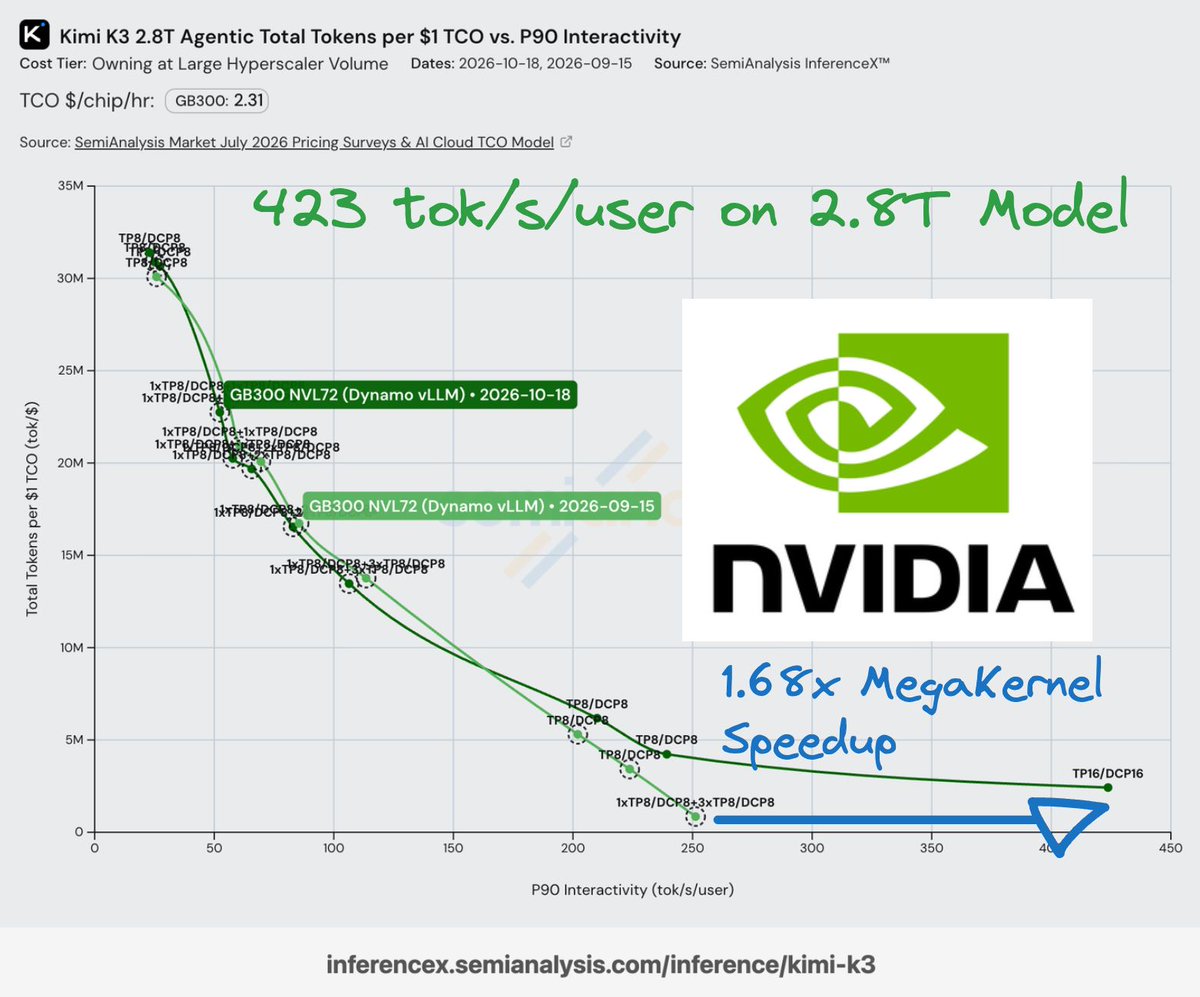
vLLM and NVIDIA unveiled a unified CuTe DSL decode megakernel (~12,000 LoC authored by NVIDIA CentML's Benjamin Chislett) for Moonshot AI's frontier Kimi K3 model on NVIDIA GB300 NVL72. By fusing attention, MoE, and cross-GPU communication, the optimization cuts per-layer latency from 130 µs (23 kernels) to 69 µs (13 kernels), delivering 842 tokens/s at batch=1 with DSpark speculative decoding (1.73x faster than stock vLLM) and up to 1.8x higher P90 per-user interactivity (403.2–423 tok/s/user) on SemiAnalysis AgentX, with DeepSeek-V4.1-Flash (PR #61868) and GLM-5.3 support coming next.
Zoom
Key Takeaways
NVIDIA and vLLM introduce a 12,000-line CuTe DSL decode megakernel for the 2.8T-parameter Kimi K3, reducing per-layer execution from 23 kernels (130 µs) to 13 kernels (69 µs)
On 16x NVIDIA GB300 NVL72 GPUs, batch-1 decode hits 842 tok/s with DSpark speculative decoding (1.73x faster) and 256.4 tok/s without speculation (1.88x faster)
Delivers up to 1.8x higher P90 interactivity (403.2-423 tok/s/user) on SemiAnalysis AgentX, with DeepSeek-V4.1-Flash (vLLM PR #61868) and GLM-5.3 megakernels following next
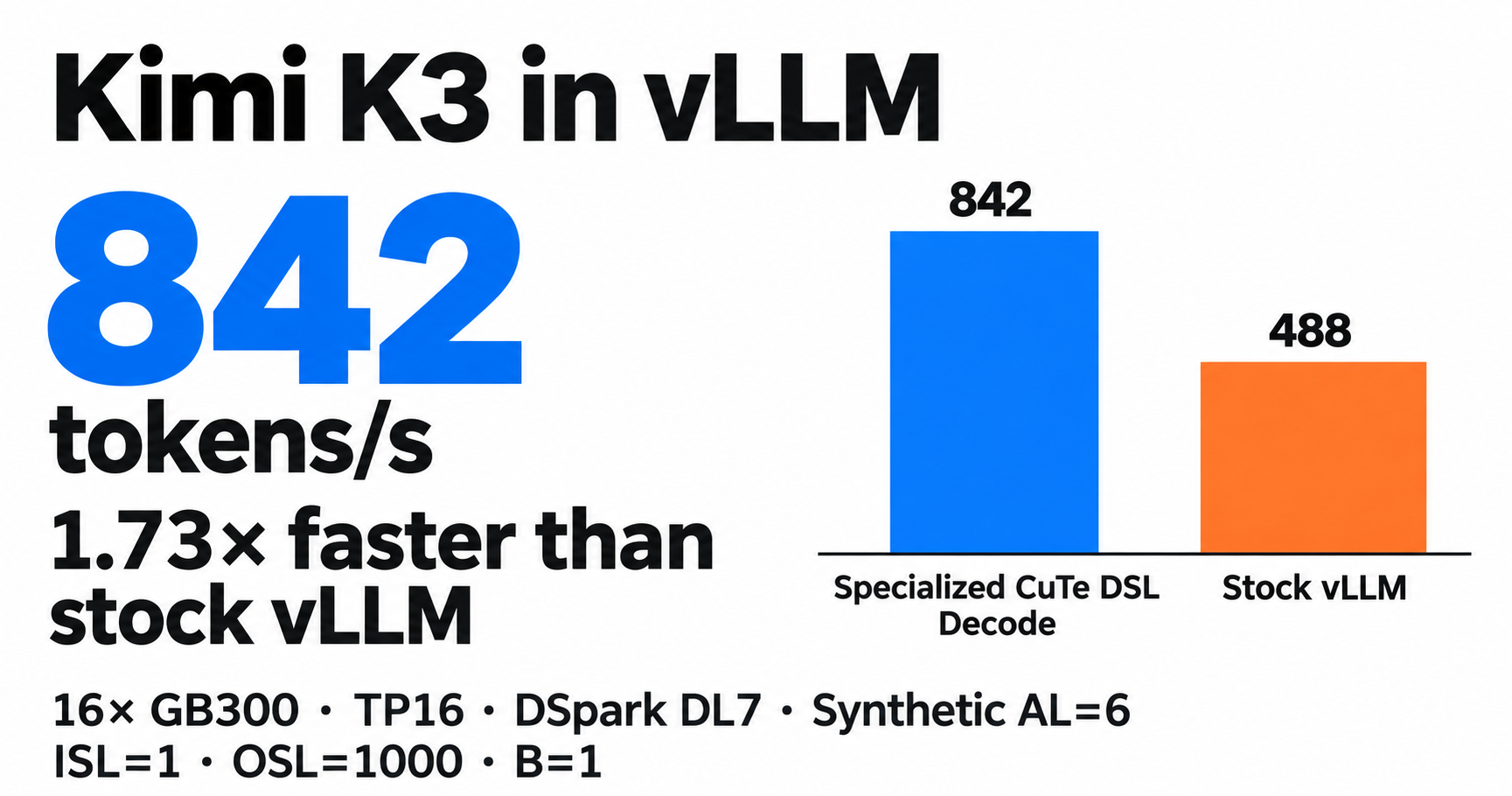
A vLLM blog post by NVIDIA engineer Benjamin Chislett details an agent-assisted CuTe DSL decode path for Kimi K3 on NVIDIA GB300 that fuses attention, MoE and NVLink communication, cutting per-layer time from 130 µs across 23 kernels to 69 µs across 13. With DSpark speculative decoding on 16 GPUs it reaches 842 tok/s at batch 1, 1.73x stock vLLM; PR #61867 was merged on Oct 16.
Zoom
Key Takeaways
842 tok/s at batch 1 on 16 GB300 GPUs with DSpark (7 draft tokens, synthetic AL=6) vs 488 for stock vLLM, 1.73x (vendor figures)
Without speculation TP16 gains 1.62–1.92x (3,606 tok/s at batch 64); TP8 gains 1.31–1.58x
Per layer: 23 kernels and 130 µs down to 13 kernels and 69 µs
AgentX P90 interactivity 403.2 vs 223.7 tok/s/user (1.8x), though the baseline is an earlier 8-GPU run
The same fast-track approach now covers DeepSeek-V4.1-Flash (PR #61868, open); early Muse Spark Open results exceed 950 tok/s/user
On 2026-10-01 DigitalOcean launched Agent Droplets for Managed Agents (public preview): Pro $50/mo (15% off) and Team $200/mo (20% off) bundling Harness Runtime microVMs, DO-hosted open-model inference (Kimi K3, GLM 5.3), session storage, and Action Gateway (16,000+ tools). Works with Claude Code, Codex CLI, OpenCode. Paired with prepaid Inference and Agents Balance.
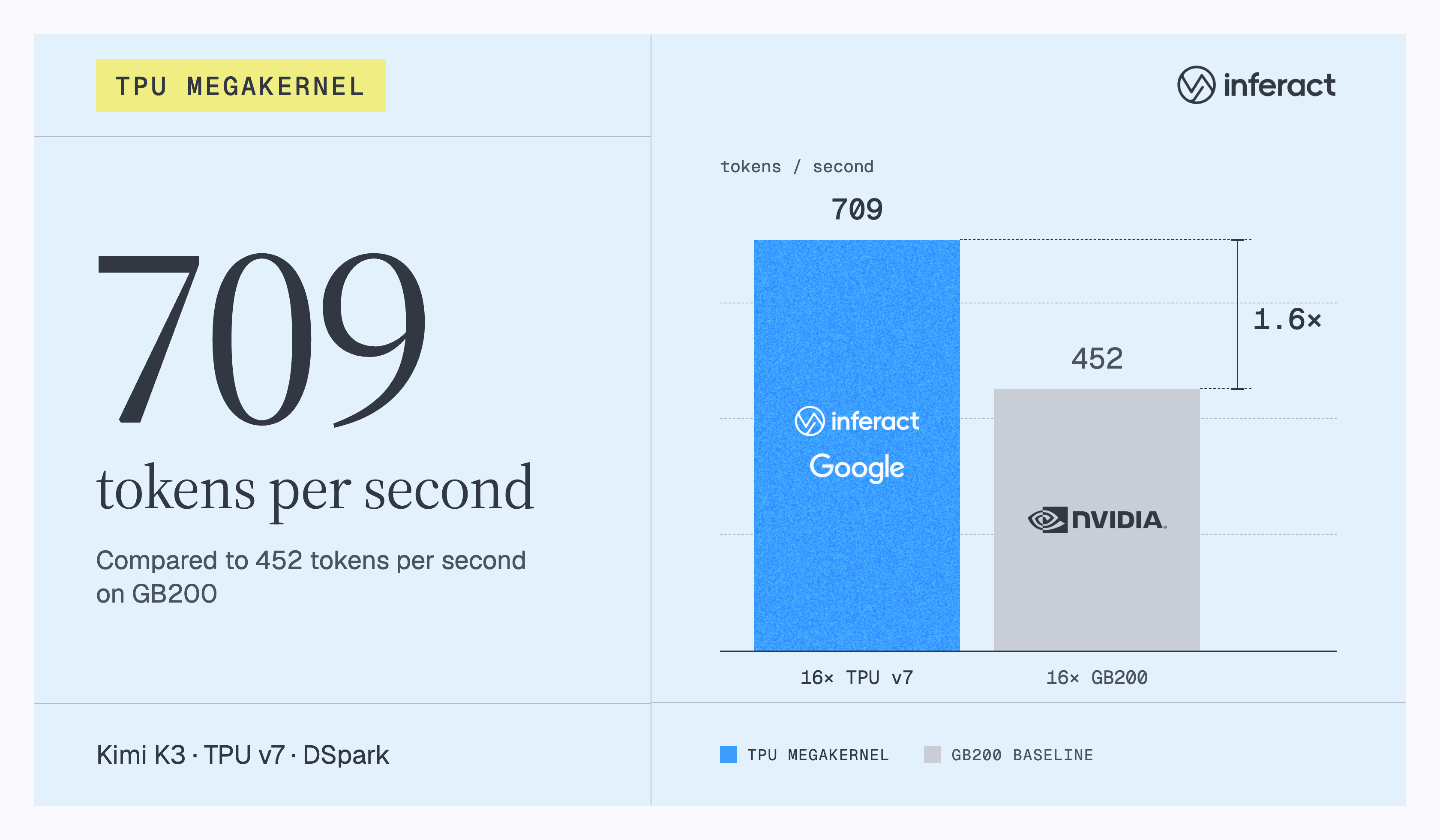
Inferact open-sourced inferact/tpu-megakernels on 2026-09-23: a Pallas megakernel collection for TPU v7. Their blog reports Kimi K3 at 709 tok/s on 16× TPU v7 Ironwood vs 452 tok/s on 16× GB200 under DSpark speculative decoding (acceptance length 6), and roughly 1.4–2× the GB200 baseline at batch sizes 1–8 without speculation. All 92 MoE layers of Kimi K3 run in a single kernel with cross-layer weight prefetch.
Zoom
Key Takeaways
Inferact-reported (not independently reproduced): Kimi K3 + DSpark reaches 709 tok/s on 16× TPU v7 vs 452 tok/s on 16× GB200 (blog)
Without speculation: ~1.4–2× GB200 baseline at batch 1–8; Qwen 3.8 27B: 1,515 vs 695 tok/s on 4× chips with speculation
All 92 MoE layers of Kimi K3 run in one Pallas megakernel with cross-layer weight prefetch into VMEM
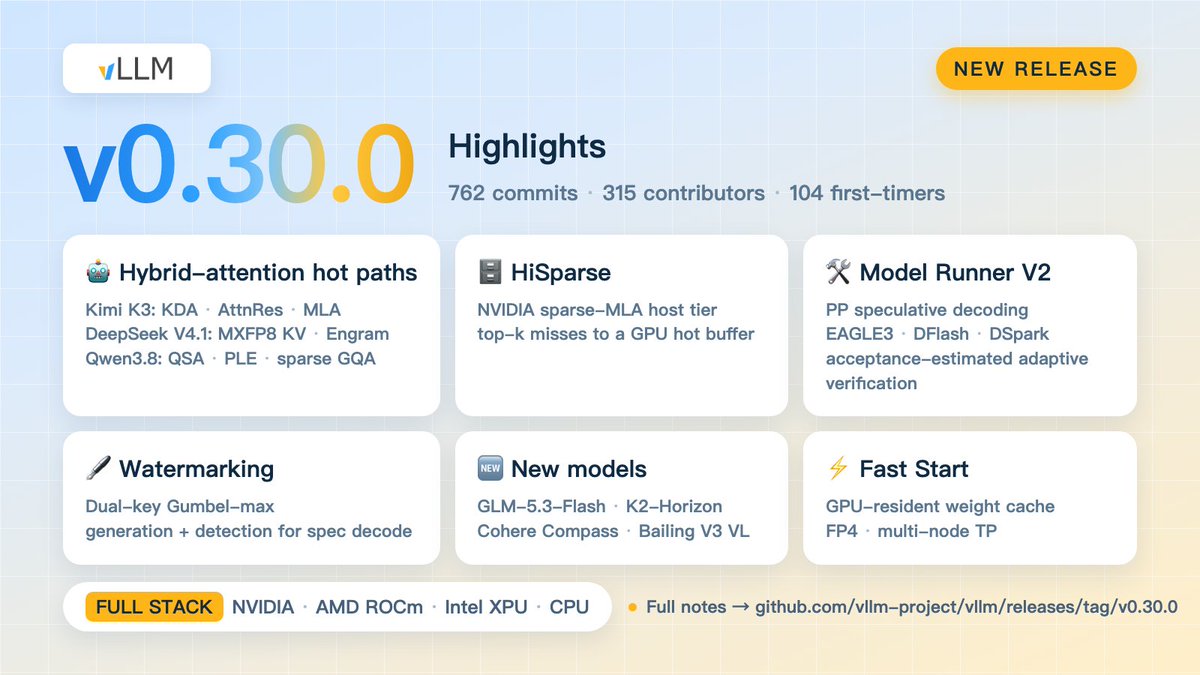
The vLLM project (@vllm_project) released v0.30.0 with 762 commits from 315 contributors. Highlights include hybrid-attention hot paths for Kimi K3 (KDA/AttnRes/MLA), DeepSeek-V4.1-Flash (MXFP8 KV and async Engram), and Qwen3.8-Flash-Next (QSA/PLE, lower sparse-GQA overhead); plus HiSparse host-tier decode, Model Runner V2 EAGLE3 pipeline parallelism with adaptive verification, dual-key Gumbel-max watermarking, Fast Start CUDA IPC weight cache, and new models such as GLM-5.3-Flash, K2-Horizon, Cohere Compass, and Bailing V3 VL.
Zoom
Key Takeaways
Hybrid-attention hot paths cover Kimi K3, DeepSeek-V4.1-Flash, and Qwen3.8-Flash-Next.
Model Runner V2 brings EAGLE3-style drafts to pipeline parallelism with online acceptance estimation.
Fast Start maps post-quantized TP-sharded weights over CUDA IPC for faster restarts.
@ArtificialAnlys evaluated StepFun Step 5 Preview (600B-total / 27B-active MoE): Artificial Analysis Intelligence Index 44, matching Kimi K3 (max) at about $0.72 per Index task (~2.8x cheaper). Pricing is about $1/$2.70 per 1M input/output tokens with $0.05/M cached input; 1M context; open weights planned for October 15. It still lags peers on agentic evals such as GDPval-AA and Terminal-Bench 4.0.
Zoom
Key Takeaways
AA Intelligence Index 44, tied with Kimi K3 (max); ~$0.72/task (~2.8x cheaper).
Pricing ~$1/$2.70 per 1M in/out with $0.05/M cached input; 600B/27B MoE; 1M context.
Open weights planned Oct 15; still trails peers on GDPval-AA and Terminal-Bench 4.0.
@Kimi_Moonshot announced Kimi K3 is now on Amazon Bedrock for coding, document analysis, and extended agent workflows, with Bedrock access, encryption, and auditing controls, plus explicit prompt caching. AWS published a Bedrock model card so teams can call K3 inside the AWS stack.
Zoom
Key Takeaways
Kimi K3 is live on Amazon Bedrock.
Targets coding, document analysis, and extended agent workflows with Bedrock access/encryption/auditing.
Explicit prompt caching supported; start via the AWS Bedrock model card.
Databricks engineer Yuchen Jin says Databricks Unity Gateway is coming to developers on Neon (@neondatabase) and calls it the fastest AI Gateway for Kimi K3, noting Databricks inference is moving quickly. For teams building agents/apps on Neon that need low-latency Moonshot Kimi K3 access, this is a new managed gateway path.
Key Takeaways
Unity Gateway is being brought to Neon developers and called the fastest AI Gateway for Kimi K3.
Targets teams building agents/apps on Neon that need low-latency Kimi K3 inference.
Source: @Yuchenj_UW on 2026-09-19; notes Databricks inference velocity.