
Google Cloud Tech's official account promoted Google's new open-source plugin Elephant-Goldfish Model (EGM) at 23:00 UTC on 2026-11-07 (07:00 SGT on November 8). The "Elephant" holds project context and drafts a design spec; "Goldfish" reviewers are fresh subagents that never saw the earlier conversation and look for unstated assumptions and implementation risks across five stages, and the developer approves the spec before any code is written. The repo sits in the google GitHub org under Apache-2.0, supports Claude Code, Codex, Antigravity and the ChatGPT desktop app, and is at v0.1.1. The README says it is not an officially supported Google product, and no effectiveness benchmark has been published.
Key Takeaways
- ✓The repo google/elephant-goldfish-model is Apache-2.0 licensed; at writing it has about 14,900 GitHub stars and 1,084 forks
- ✓The Google Cloud Tech post had about 1,693 likes, 188 reposts, 1,707 bookmarks and 137,000 views at writing
- ✓egm-review runs five phases: Initial Zoom Out Review, Comprehension Review, Design Critique, Intermediate Zoom Out Review and Implementation Readiness
- ✓Supports Claude Code, Codex CLI, Antigravity and the ChatGPT/Codex desktop app; v0.1.1 (November 6) adds experimental Cursor, OpenCode and GitHub Copilot adapters
- ✓The README states it is not an officially supported Google product; no defect-detection or quality metrics have been published
Key Decision Metrics at a Glance
Heavy Claude Code use: compare subscription limits and API bills
Compare 40 dev plans & simulate token costs vs $20/mo subscriptions
Project Links & Resources
Direct AccessIn-Depth Technical Analysis
Core Background & Industry Pain Points
Coding agents often jump straight into code and bake wrong assumptions into a PR before requirements are clear, and a single session that both writes and reviews a plan tends to agree with itself. Google Cloud Tech's official account promoted Google's new open-source plugin Elephant-Goldfish Model (EGM) at 23:00 UTC on 2026-11-07 (07:00 SGT on November 8). It pushes a spec-first flow: write the spec, let reviewers with no memory attack it, and only then write code. The repo is in the google GitHub org under Apache-2.0, and the README says it is not an officially supported Google product.
Architecture Highlights & Internals
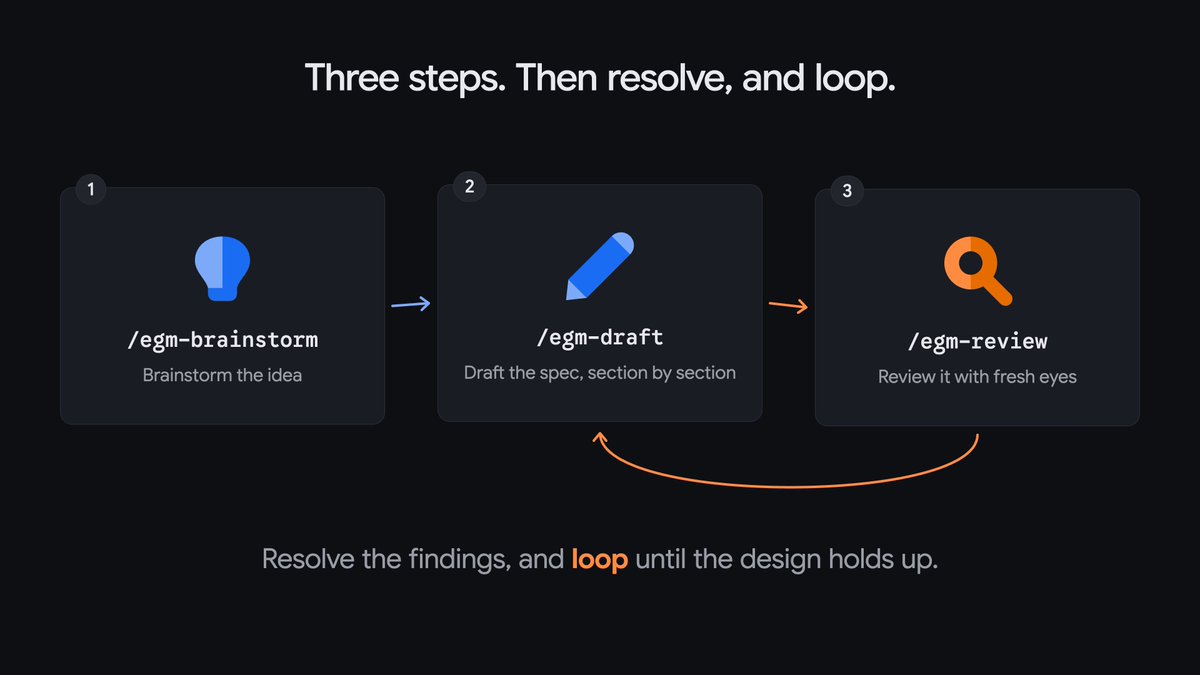
EGM has three roles. The Elephant holds the project, requirements and earlier decisions and drafts the spec. Goldfish reviewers get only the document and the source it references, without the earlier conversation, and look for missing assumptions, unclear requirements and implementation risks. The developer resolves trade-offs and approves the spec. Reviews are run by egm-review in five phases: Initial Zoom Out Review, Comprehension Review, Design Critique, Intermediate Zoom Out Review and Implementation Readiness. Each Goldfish must run in a fresh subagent (invoke_subagent in Antigravity, Agent in Claude Code, spawn_agent in Codex); if the harness cannot create one, EGM stops the review. Bootstrap writes docs for an existing codebase, and drift report compares checked-in docs with current code.
Authoritative Benchmarks & Measured Scores
No defect-detection, rework or other effectiveness benchmark has been published. What can be checked is traction: at writing the repo had about 14,900 stars and 1,084 forks, and the official post had about 1,693 likes, 188 reposts and 1,707 bookmarks. v0.1.1 shipped on November 6 with a TRIZ inventive reviewer and experimental Cursor, OpenCode and GitHub Copilot adapters; its notes say native end-to-end verification of the release ZIPs is still open. The README also warns that a review does not replace tests or human judgment.
Developer Hands-on Guide
Claude Code: claude plugin marketplace add google/elephant-goldfish-model, then claude plugin install egm@egm. Codex CLI: codex plugin marketplace add google/elephant-goldfish-model, then codex plugin add egm@egm. Antigravity CLI: agy plugin install https://github.com/google/elephant-goldfish-model. The ChatGPT and Codex desktop apps can install the published plugin listing. Start a new session, then run /egm:egm-brainstorm (writes concepts_brief.md), /egm:egm-draft (writes design_draft.md) and /egm:egm-review design_draft.md; address the findings and approve the design before asking the agent to implement it.
Benchmark side-by-side against alternatives, or calculate monthly token cost vs subscription break-even.
Discussion & Comments
0Sign in to join the discussion
Connect with AI developers to exchange benchmark insights.